
流动性

Search documents
流动性缺口弱于季节性 10月资金面平稳可期
Shang Hai Zheng Quan Bao· 2025-10-10 18:20
Group 1 - The market is focusing on liquidity and interest rate trends as it enters the fourth quarter, with expectations of a stable liquidity environment despite seasonal disturbances from government bond issuance and tax periods [1][5] - Fiscal spending is progressing steadily, with a projected net financing of approximately 600 billion yuan in October, and government deposits expected to increase by about 500 billion yuan, indicating limited overall impact on market liquidity [1][2] - The liquidity gap for October is estimated at around 2.88 trillion yuan, with the People's Bank of China (PBOC) conducting significant reverse repo operations to alleviate pressure [2][3] Group 2 - Bond market sentiment is becoming more rational, with expectations of a low interest rate environment supporting economic recovery, and a low risk of significant adjustments in the bond market [3][5] - Analysts suggest maintaining a neutral position in the short term, focusing on short-term interest rate strategies and leveraging opportunities while awaiting clearer signals in the latter part of the fourth quarter [3][4] - The PBOC's operations are expected to continue to provide a buffer against liquidity tightening risks, with structural tensions in the market remaining low [3][4]
央行加量续作3个月期买断式逆回购 “补水”流动性稳定市场预期
Xin Jing Bao· 2025-10-09 16:39
Core Viewpoint - The People's Bank of China (PBOC) is actively injecting medium-term liquidity into the banking system through various monetary policy tools, including reverse repos and MLF, to maintain a stable and ample liquidity environment in response to potential tightening pressures in the market [1][2][3]. Group 1: Monetary Policy Actions - On October 9, the PBOC conducted a 1.1 trillion yuan reverse repo operation with a term of 3 months, indicating a proactive approach to liquidity management post the "National Day" holiday [1]. - The PBOC is expected to continue with equal or slightly increased amounts of reverse repos and MLF operations in October, marking the fifth consecutive month of such actions [2]. - The PBOC's monetary policy committee emphasized the need for effective monetary policy adjustments to align with economic growth and inflation expectations, aiming to keep liquidity abundant [2]. Group 2: Market Liquidity Outlook - The liquidity environment is anticipated to experience a "first loose, then tight" seasonal pattern in October, influenced by fiscal spending, holiday cash flow, and large-scale government bond issuances [4]. - Market analysts predict that the PBOC will utilize various tools, including reverse repos and MLF, to maintain short-term and medium-term liquidity balance, while also considering potential long-term liquidity injections through reserve requirement ratio (RRR) cuts [3][4]. - The expectation of a new round of growth-stabilizing policies, including a potential RRR cut, is likely to influence the net medium-term liquidity injection scale, which may decrease from the previously high levels [5][6].
黄金、基金和股票选哪个
Bei Jing Shang Bao· 2025-10-09 16:14
Group 1 - The core viewpoint is that investors face a dilemma between investing in gold, stocks, or mutual funds, each catering to different investment goals and time commitments [1][2]. - Gold prices have surpassed $4000 per ounce, while the Shanghai Composite Index has risen above 3900 points, indicating a simultaneous bull market in both gold and stocks [1]. - For investors with limited time, mutual funds are recommended as they are managed by professional fund managers who can provide stable long-term returns [2][3]. Group 2 - Investors seeking liquidity should consider gold investments due to its large market size and high liquidity, allowing for quick transactions [2]. - For higher expected returns, direct investment in stocks is suggested, with a long-term view being the most beneficial strategy, particularly in blue-chip stocks [2][3]. - Successful stock investment requires a solid understanding of macroeconomics, financial data, and industry trends, making value investing a more suitable approach for average investors [3].
博时宏观观点:流动性和风险偏好支撑有色与成长
Xin Lang Ji Jin· 2025-10-09 11:09
Market Overview - The profit cycle remains weak, but liquidity and risk appetite factors have improved, making the market relatively attractive in the medium term [1] - The Federal Reserve's interest rate cuts are favorable for gold, copper, and growth styles [1] - Global stock indices have risen, with gold surpassing $4000 per ounce, while oil prices remain weak [1] Economic Indicators - In September, the manufacturing PMI marginally increased to 49.8% from 49.4% in August, while the non-manufacturing business activity index slightly decreased to 50% from 50.3% [1] - The production side shows stronger improvement compared to the demand side, indicating a high market risk appetite [1] Market Strategy - In the bond market, interest rates are expected to fluctuate at high levels before the holiday, with intense long-short battles [1] - The central bank is expected to maintain a supportive monetary policy stance, but cautious liquidity measures indicate a focus on preventing capital turnover [1] - The bond market may remain in a volatile pattern due to upcoming events such as the Fourth Plenary Session and US-China negotiations [1] A-Share Market - Despite the National Day consumption not exceeding expectations, the market is still in a window period for the Federal Reserve's interest rate cuts [1] - Anticipation of new domestic demand policies from the Fourth Plenary Session and the Central Economic Work Conference suggests limited downside risk for indices [1] - The technology growth sector is expected to continue outperforming, driven by domestic and international AI industry catalysts [1] Hong Kong Stock Market - Following the Federal Reserve's preemptive interest rate cuts, the Hong Kong stock market typically shows strong resilience [2] Oil Market - Oil demand is expected to remain weak over the next 25 years, with continuous supply release putting downward pressure on oil prices [3] Gold Market - A positive long-term outlook for gold prices is anticipated, with short-term upward pressure from events such as the US government shutdown [4]
经济前瞻指标小幅回升,因子选择略偏向均衡:——量化资产配置月报202510-20251009
Shenwan Hongyuan Securities· 2025-10-09 11:05
Group 1 - The report indicates that the economic leading indicators are showing signs of a slight recovery, with liquidity remaining slightly loose and credit indicators improving [3][12][19] - The economic forecast model suggests that October 2025 is at a turning point, with expectations for a slight upward trend over the next three months before entering a plateau [12][13] - The report highlights that the focus of the market is shifting towards economic indicators, surpassing liquidity concerns, with increased attention on economic and PPI-related factors [26][27] Group 2 - The liquidity environment is characterized by rising interest rates, with long-term rates exceeding the average, while overall liquidity remains slightly loose due to positive monetary supply signals [19][22] - Credit indicators have shown a slight positive trend, although the overall credit volume and structure remain low, indicating a mixed outlook for credit conditions [23][24] - The asset allocation perspective suggests a high allocation to gold due to strong momentum, while equity allocations have been slightly reduced [24][25] Group 3 - The industry selection is leaning towards sectors that are sensitive to economic conditions but less sensitive to liquidity, with a notable increase in defensive and consumer attributes [28][29] - The report identifies specific industries with the highest sensitivity to economic changes, including utilities and coal, while also highlighting sectors like media and consumer electronics for credit sensitivity [28][29] - The overall balance in industry selection reflects a decline in growth attributes, emphasizing a more defensive investment strategy [29]
量化资产配置月报:经济前瞻指标小幅回升,因子选择略偏向均衡-20251009
Shenwan Hongyuan Securities· 2025-10-09 08:43
Group 1 - The report indicates a slight recovery in economic indicators, with liquidity remaining slightly loose and credit indicators showing improvement. The macroeconomic dimensions suggest an overall direction of economic improvement, weak liquidity, and loose credit [3][6][8] - The economic leading indicators are expected to show a slight upward trend over the next three months, indicating a bottoming out in October 2025, with a prolonged period of slight recovery compared to last month [12][13] - The liquidity environment is characterized by rising interest rates, with long-term rates exceeding the moving average, while overall liquidity remains slightly loose due to positive monetary supply signals [19][22] Group 2 - The report emphasizes a high allocation to gold, with a weakening view on bonds and a slight reduction in A-share allocation. The current economic upturn, tight liquidity, and favorable credit conditions support this allocation strategy [24][26] - Market focus has shifted towards economic indicators, surpassing liquidity concerns, with a notable increase in attention to economic and PPI-related factors since September [26][28] - The industry selection is inclined towards sectors sensitive to economic changes, less sensitive to liquidity, and sensitive to credit conditions. The report highlights a decrease in growth attributes and an increase in defensive and consumer attributes, indicating a balanced approach [28][30][29]
央行大动作!1.1万亿元+6120亿元
Zhong Guo Zheng Quan Bao· 2025-10-09 04:30
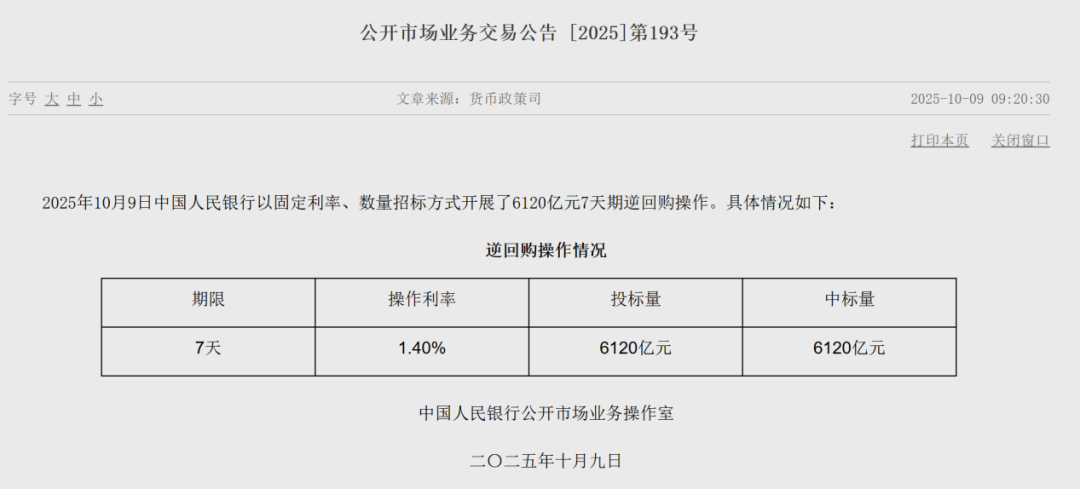
Core Viewpoint - The People's Bank of China (PBOC) is actively managing liquidity in the banking system through reverse repurchase agreements, indicating a supportive monetary policy stance to stabilize the economy and promote lending [1][3][6]. Group 1: Reverse Repo Operations - On October 9, the PBOC conducted a 7-day reverse repo operation amounting to 612 billion yuan at a fixed rate of 1.40%, with a total of 20,633 billion yuan in reverse repos maturing that day, resulting in a net withdrawal of 14,513 billion yuan [1][2]. - A total of 26,600 billion yuan in reverse repos will mature in October, with 6,000 billion yuan maturing on October 10 [3]. Group 2: Monetary Policy Implications - The PBOC's decision to conduct a 11,000 billion yuan buyout reverse repo operation for three months (91 days) indicates an increase in medium-term liquidity support, which is expected to stabilize the funding environment [3][5]. - Analysts suggest that the PBOC's actions are aimed at ensuring sufficient liquidity in the banking system, supporting government bond issuance, and encouraging financial institutions to increase credit supply [5][6]. Group 3: Future Outlook - The liquidity gap in October is expected to be similar to that of September, but with potential adjustments in funding rates, which may decrease to levels seen in July and August [5]. - The PBOC plans to utilize various monetary policy tools to maintain liquidity and support economic recovery, aiming to align social financing growth with economic growth and inflation expectations [6].

1.1万亿元!央行节后首日开展买断式逆回购
Zheng Quan Shi Bao· 2025-10-09 03:45
Core Viewpoint - The People's Bank of China (PBOC) is actively managing liquidity through various monetary policy tools, including reverse repos, to address seasonal cash demand and support government bond issuance [1][2]. Group 1: Monetary Policy Operations - On October 9, the PBOC conducted a 1.1 trillion yuan three-month reverse repo operation using a fixed quantity and multi-price bidding method [1]. - In October, there is a total of 1.3 trillion yuan in reverse repos maturing, with expectations for another six-month reverse repo operation to maintain net liquidity injection [1]. - The PBOC has been consistently increasing the scale of reverse repo operations for four consecutive months and has also increased the Medium-term Lending Facility (MLF) for seven months [2]. Group 2: Economic Context and Expectations - The PBOC's actions are influenced by seasonal cash demand due to the October holidays, leading to a significant liquidity gap [1]. - The PBOC aims to keep liquidity ample and guide financial institutions to increase credit supply, aligning social financing and money supply growth with economic growth and price level expectations [2]. - The recent monetary policy committee meeting emphasized the need for flexible and anticipatory policies in light of domestic demand shortages and ongoing global uncertainties, indicating room for further monetary policy adjustments [2].
1.1万亿元!央行节后首日开展买断式逆回购
证券时报· 2025-10-09 03:44
Group 1 - The People's Bank of China (PBOC) conducted a 1.1 trillion yuan reverse repo operation with a three-month term, indicating a continued net liquidity injection in October [1] - In October, there is an expected liquidity gap due to seasonal cash demand, with a total of 1.3 trillion yuan maturing [1] - The PBOC has been consistently using reverse repos to supplement medium to long-term funding gaps since last October, enhancing the timeliness of information disclosure regarding these operations [1] Group 2 - The PBOC's monetary policy tools, including MLF and reverse repos, have been actively used to maintain liquidity, with MLF seeing an increase for seven consecutive months [2] - The PBOC aims to keep liquidity ample and guide financial institutions to increase credit supply, aligning social financing scale and money supply growth with economic growth and price level expectations [2] - The recent monetary policy committee meeting emphasized the need for flexible and anticipatory policies in light of domestic demand shortages and ongoing external uncertainties [2]
买断式前置投放,呵护思路延续:——10月流动性月报-20251009
Huachuang Securities· 2025-10-09 03:44
债券研究 证 券 研 究 报 告 【债券周报】 买断式前置投放,呵护思路延续 ——10 月流动性月报 一、9 月资金面回顾:季末短暂摩擦,中枢持稳 资金面回顾:9 月税期央行投放相对克制叠加北交所打新影响,资金价格出现 波动,DR007 短暂突破 1.6%,季末在 14D 逆回购及 MLF 加码投放的呵护下, 资金面整体平稳。 邮箱:zhouguannan@hcyjs.com 执业编号:S0360517090002 超储水平:不考虑逆回购的超储水平或依旧偏低。流动性总量方面,9 月基础 货币全月或增加 1.2 万亿元,其中政府存款对基础货币的补充或在 3000 亿附 近,央行净投放合计 1 万亿,外汇占款延续小幅回笼 700 亿元;此外,准备金 对于超储的冻结或在 2000 亿元附近,取现对超储的冻结或在 2554 亿附近,非 金融机构存款变化对超储的消耗或在 525 亿元附近,故月末超储或增加 7231 亿,超储率或在 1.55%左右,处于季节性水平,扣除逆回购之后的狭义超储水 平或在 0.6%附近,仍属于偏低水平。 证券分析师:宋琦 二、9 月货币政策追踪:14D 招标方式调整,三季度货政例会召开 202 ...