信用债投资

Search documents
渤海证券研究所晨会纪要(2025.07.30)-20250730
BOHAI SECURITIES· 2025-07-30 01:35
Fixed Income Research - The report indicates that the overall issuance guidance rates for credit bonds have mostly decreased, with a change range of -5 BP to 2 BP [2] - The issuance scale of credit bonds has increased on a month-on-month basis, with net financing amounts for medium-term notes and short-term financing bonds rising, while corporate bonds, company bonds, and targeted tools saw a decrease [2] - In the secondary market, the transaction amount of credit bonds has increased, with all varieties showing growth; however, credit bond yields have risen by 4-14 BP [2] - The report suggests that despite the recent yield adjustments, the conditions for a trend reversal in credit bonds remain insufficient, but the support from insufficient supply and strong demand may lead to a potential decline in yields [2] - The report emphasizes a cautious yet optimistic approach to current configurations and trading strategies, focusing on the trends in interest rate bonds and the coupon value of individual bonds [2] Industry Research - In the steel sector, prices have rebounded, leading to some replenishment intentions downstream, with macro "anti-involution" news positively impacting steel prices [5] - The aluminum market is expected to experience price fluctuations due to insufficient fundamental support, with attention on the outcomes of the July Politburo meeting and US-China trade negotiations [5] - Lithium prices have been positively influenced by "anti-involution" news, but there is still significant pressure from oversupply, necessitating caution regarding speculative demand [5] - The rare earth sector has seen a significant increase in exports, with June exports rising by 32.02% month-on-month, indicating potential for further price strength due to improving export demand [5] - The report maintains a "positive" rating for the steel industry and the non-ferrous metals sector, highlighting specific companies for potential investment [6]





8月信用债投资策略思考
Minsheng Securities· 2025-07-28 11:56
Group 1 - The credit bond market is expected to experience strong fluctuations in August due to multiple factors, including the upcoming Politburo meeting and the end of the temporary period for "reciprocal tariffs" between China and the US on August 14, which may affect market sentiment [1][11] - The overall trend of credit bonds is likely to remain stable in the short term, with limited downward potential, as the central bank's supportive stance continues to provide backing for the bond market [1][11] - After recent adjustments, credit bond spreads are still compressing, and institutional investors are expected to gradually enter the market, driven by the current "asset shortage" environment [1][11] Group 2 - The supply of credit bonds is not expected to increase significantly, with the growth of sci-tech bonds potentially offsetting the reduction in local government bonds, but overall net supply is likely to remain constrained [2][14] - The weighted coupon rate of sci-tech bonds is below 2%, indicating a scarcity of high-yield assets, which maintains a strong demand for credit bonds in the market [2][14] - The investment value of credit bonds has improved after a significant adjustment, particularly for mid-to-high-grade short- to medium-term credit varieties, which are now yielding above 10% historical levels [19][20] Group 3 - Manufacturing, new infrastructure, and consumption are expected to be key areas of policy focus in the second half of the year, with various measures likely to be introduced to support these sectors [22][23] - The macroeconomic data for the first half of 2025 shows a resilient economy, with GDP growth of 5.3% and industrial output growth of 6.4%, indicating a stable economic environment for credit bonds [22][23] - The government is likely to implement more policies to regulate the competitive order in the new energy vehicle industry, which may improve cash flow for upstream suppliers [24][29]
信用债周报:成交金额继续下降,信用利差整体收窄-20250722
BOHAI SECURITIES· 2025-07-22 12:04
Report Industry Investment Rating No relevant content provided. Core Viewpoints - From July 14th to July 20th, the issuance guiding rates announced by the National Association of Financial Market Institutional Investors showed divergence, with high - grade rates rising overall and medium - low - grade rates falling overall, with a change range of - 5 BP to 3 BP. The issuance scale of credit bonds decreased slightly month - on - month, and the net financing amount also decreased. In the secondary market, the trading volume of credit bonds continued to decline, and the yields of credit bonds decreased overall. The credit spreads of medium - short - term notes, enterprise bonds, and urban investment bonds narrowed overall. [1][62] - From a long - term perspective, the yields of credit bonds are still in a downward channel. Due to the current high price, the risk of chasing high is relatively large. When allocating, investors can wait for opportunities and increase positions during adjustments. They should focus on the change trend of interest - rate bonds and the coupon value of individual bonds. At present, the effect of credit sinking is not good, and there is a demand to increase the duration to increase returns. High - grade 5 - year varieties can be considered first. [1][62] - The central and local governments have continuously optimized real - estate policies, which have played a positive role in promoting the real - estate market to stop falling and stabilize. For real - estate bonds, investors with high risk preferences can consider early layout, focusing on central and state - owned enterprises with stable historical valuations and high - quality private - enterprise bonds with strong guarantees. For urban investment bonds, the possibility of default is very low, and they can still be a key allocation variety of credit bonds. [2][66][68] Summary by Directory 1. Primary Market Situation 1.1 Issuance and Maturity Scale - From July 14th to July 20th, a total of 343 credit bonds were issued, with an issuance amount of 281.016 billion yuan, a month - on - month decrease of 0.66%. The net financing amount was 44.902 billion yuan, a month - on - month decrease of 38.421 billion yuan. [12] - In terms of different varieties, the issuance amounts of corporate bonds and private placement notes decreased, while those of enterprise bonds, medium - term notes, and short - term financing bills increased. The net financing amounts of enterprise bonds and private placement notes increased, while those of corporate bonds, medium - term notes, and short - term financing bills decreased. The net financing amounts of enterprise bonds, private placement notes, and short - term financing bills were negative, while those of corporate bonds and medium - term notes were positive. [13] 1.2 Issuance Interest Rates - The issuance guiding rates announced by the National Association of Financial Market Institutional Investors showed divergence. High - grade rates rose overall, and medium - low - grade rates fell overall, with a change range of - 5 BP to 3 BP. By term, the 1 - year, 3 - year, 5 - year, and 7 - year varieties had different interest - rate change ranges. By grade, different grades also had different interest - rate change ranges. [14] 2. Secondary Market Situation 2.1 Market Trading Volume - From July 14th to July 20th, the total trading volume of credit bonds was 864.586 billion yuan, a month - on - month decrease of 5.24%. The trading volumes of all varieties decreased. [19] 2.2 Credit Spreads - For medium - short - term notes, all varieties' credit spreads narrowed. For enterprise bonds, all varieties' credit spreads narrowed. For urban investment bonds, most varieties' credit spreads narrowed, but there were some exceptions in specific grades and terms. [22][33][37] 2.3 Term Spreads and Rating Spreads - For AA + medium - short - term notes, the 3Y - 1Y term spread narrowed by 0.35 BP, the 5Y - 3Y term spread narrowed by 0.44 BP, and the 7Y - 3Y term spread widened by 2.17 BP. For 3 - year medium - short - term notes, the (AA - )-(AAA) rating spread narrowed by 1.00 BP, the (AA)-(AAA) rating spread widened by 1.00 BP, and the (AA + )-(AAA) rating spread remained unchanged. [46] - For AA + enterprise bonds, the 3Y - 1Y term spread narrowed by 1.19 BP, the 5Y - 3Y term spread widened by 0.78 BP, and the 7Y - 3Y term spread widened by 1.28 BP. For 3 - year enterprise bonds, the (AA - )-(AAA) rating spread widened by 1.00 BP, the (AA)-(AAA) rating spread widened by 1.00 BP, and the (AA + )-(AAA) rating spread remained unchanged. [52] - For AA + urban investment bonds, the 3Y - 1Y term spread narrowed by 0.45 BP, the 5Y - 3Y term spread widened by 2.29 BP, and the 7Y - 3Y term spread widened by 1.24 BP. For 3 - year urban investment bonds, the (AA - )-(AAA) rating spread widened by 7.00 BP, the (AA)-(AAA) rating spread widened by 2.00 BP, and the (AA + )-(AAA) rating spread widened by 1.00 BP. [55] 3. Credit Rating Adjustment and Default Bond Statistics 3.1 Credit Rating Adjustment Statistics - From July 14th to July 20th, a total of 4 companies had their ratings (including outlooks) adjusted, with 1 downgraded and 3 upgraded. [59] 3.2 Default and Extended - Maturity Bond Statistics - From July 14th to July 20th, there were no credit - bond defaults or bond - maturity extensions. [61] 4. Investment Views - The investment views are basically the same as the core viewpoints, emphasizing the current situation of credit - bond issuance, trading, and spread changes, and providing investment suggestions from absolute and relative return perspectives. At the same time, it is necessary to pay attention to the impact of stable - growth policies, capital - market conditions, and supply - demand patterns on the bond market. [1][62] - For real - estate bonds, with the real - estate market showing signs of stabilization, investors with high risk preferences can consider early layout, focusing on high - quality bonds and properly speculating on the trading opportunities brought by the valuation repair of undervalued real - estate enterprise bonds. For urban investment bonds, they can still be a key allocation variety, and the short - term credit risk is controllable. [2][66][68]
超长信用债可以考虑逐渐止盈
Orient Securities· 2025-07-21 03:13
Group 1 - The report suggests that for most investors, it is time to gradually take profits on ultra-long credit bonds due to declining odds of capital gains, limited arbitrage opportunities, and weak coupon protection [6][14][18] - The performance of ultra-long credit bonds has been primarily driven by the compression of liquidity premiums in June, but this trend is expected to be difficult to sustain moving forward [7][14] - The report indicates that the current coupon advantage of ultra-long credit bonds is not significant, and their ability to protect against interest rate fluctuations is lacking, leading to a low probability of success for short-term holdings [12][18] Group 2 - The weekly review of credit bonds shows that the issuance volume remained stable, with a slight increase in maturity amounts, resulting in a net inflow of 452 billion yuan, which is a decrease compared to previous weeks [20][22] - The average coupon rates for newly issued AAA and AA+ rated bonds were 1.99% and 2.24%, respectively, indicating a mixed trend in issuance costs [20][21] - The liquidity of credit bonds continues to weaken, with a decrease in turnover rate to 1.76%, reflecting a return to a relatively low level [23]
信用债LOF: 建信信用增强债券型证券投资基金2025年度第2季度报告
Zheng Quan Zhi Xing· 2025-07-17 10:27
Core Viewpoint - The report provides an overview of the performance and management of the Jianxin Credit Enhanced Bond Fund for the second quarter of 2025, highlighting its investment strategy, financial indicators, and market conditions affecting the fund's performance [2][3][4]. Fund Product Overview - Fund Name: Jianxin Credit Enhanced Bond Fund - Fund Manager: Jianxin Fund Management Co., Ltd. - Fund Custodian: Bank of Communications Co., Ltd. - Total Fund Shares at Period End: 78,551,329.16 shares - Investment Objective: To achieve long-term stable appreciation of fund assets while maintaining liquidity and controlling risks [3][4]. Financial Indicators and Fund Performance - The fund's net value growth rates for different periods are as follows: - Last three months: 0.73% - Last six months: 0.91% - Last year: 2.47% - Last three years: 8.51% - Last five years: 25.99% [5][12]. - The fund's performance is benchmarked against the China Bond Total Index Yield [3]. Investment Strategy - The fund employs a top-down approach to determine the duration of the investment portfolio, combined with a bottom-up selection of individual bonds. It also participates in new stock issuances and additional stock subscriptions to enhance returns [3][4]. Market Conditions - The macroeconomic environment in Q2 2025 showed resilience despite external shocks, with a slight decline in manufacturing investment and a rebound in consumer spending. The CPI recorded a slight negative growth of -0.1% from January to May [9][10][11]. - The bond market experienced a downward trend in yields, with the 10-year government bond yield decreasing by 15 basis points to 1.69% [11][12]. Fund Management - The fund manager has adhered to regulations and internal controls to ensure fair treatment of investors and prevent conflicts of interest. The investment strategy has focused on maintaining a flexible bond duration and a higher allocation to convertible bonds [8][12].

信用债需求仍有一定支撑,信用债ETF基金(511200)盘中涨0.15%,流动性领先
Mei Ri Jing Ji Xin Wen· 2025-07-15 02:48
Group 1 - The core viewpoint of the news is that the credit bond ETF fund (511200) has shown resilience in the face of market adjustments, with a slight increase in value and strong demand supporting its performance [1] - As of July 15, 2025, the credit bond ETF fund has risen by 0.15%, with the latest price reported at 101.29 yuan [1] - The fund has achieved an average daily trading volume of 7.72 billion yuan over the past week, ranking first among comparable funds [1] Group 2 - In the past 10 trading days, the credit bond ETF fund has attracted a total of 585 million yuan in inflows [1] - Despite a slight adjustment in the bond market due to a strong stock market, the demand for credit bonds remains positive, with expectations for credit spreads to maintain low levels [1] - The underlying bonds of the credit bond ETF fund are primarily AAA-rated bonds from large issuers, mainly state-owned enterprises, with a total of 245 component bonds covering a maturity range of 0-30 years [1]
广发基金陈韫慧:拾级而上持续迭代固收投资框架
Shang Hai Zheng Quan Bao· 2025-07-06 14:56
Group 1 - The core viewpoint of the article emphasizes the continuous evolution of fixed income investment frameworks, highlighting the career development of Chen Yunhui, a seasoned fund manager at GF Fund [1][2] - Chen Yunhui has built a comprehensive credit bond investment system over her ten-year career, focusing on both top-down and bottom-up approaches to enhance her investment strategies [4][5] - The current macroeconomic environment presents both opportunities and challenges, necessitating a more strategic approach to asset allocation and investment in credit bonds [5] Group 2 - Chen Yunhui's career began in 2011 at Huatai Securities, where she transitioned from equity research to fixed income investment, developing a keen ability to manage positions actively [2][3] - Her experience across different financial sectors, including securities asset management and bank wealth management, has equipped her with a multifaceted skill set in risk control and investment management [2][3] - The investment strategies employed by Chen Yunhui focus on balancing risk and return, particularly in a low-return, low-risk environment, by emphasizing the importance of left-side positioning and dynamic position management [5]
2025信用月报之六:下半年信用债怎么配-20250702
HUAXI Securities· 2025-07-02 13:52
Group 1: Report Summary - Investment Rating: Not provided in the report - Core View: In the second half of 2025, credit bond investment should focus on three elements: the trend of funds and interest rates, the supply - demand pattern of credit bonds, and the cost - effectiveness of different varieties. Interest rates may continue to decline in a volatile manner, making the coupon value of credit bonds prominent, but the valuation volatility may increase. The overall supply of credit bonds may be difficult to expand, and the configuration demand may weaken from August to December. Different investment strategies are recommended for different periods and varieties [1][18] Group 2: 1. Steady Coupon as the Foundation, Grasp the Trading Rhythm 1.1. Short - to Medium - Duration Credit Spread Compression for Coupon Income, Seize Phased Opportunities in Long - Duration Bonds - H1 2025 Review: The credit bond market experienced an increase in yields and a widening of credit spreads from January to mid - March, followed by a rotation of the market to medium - to long - duration and then ultra - long - duration bonds from April to June. The main factors in the first quarter were the tight funds and the change in wealth management scale. In mid - to late March, the bond market recovered, driven by supply shrinkage and the cost - effectiveness of varieties. From April to June, the market was affected by interest rate fluctuations and the shift of the funds' central point [12][13] - June 2025 Highlights: The long - duration credit bond market was activated, mainly due to the compression of short - to medium - duration credit spreads to historical lows and the increased demand from funds, insurance, and other products. The scale of credit bond ETFs increased by 7.7 billion yuan in June, which also drove the demand for some long - duration component bonds [14][16] - H2 2025 Outlook: Interest rates may continue to decline in a volatile manner. The supply of credit bonds may be difficult to expand, with the decrease in urban investment bonds offset by the increase in industrial bonds. The wealth management scale usually increases significantly in July but weakens from August to December. The rectification of wealth management's net - value smoothing methods may suppress the demand for ultra - long - duration and low - rated medium - to long - duration bonds. It is recommended to increase positions in July, take profits in August, and reduce credit bond positions from August to December, switching to inter - bank certificates of deposit and interest - rate bonds [18][19][21] - Variety Cost - Effectiveness: The 10Y high - grade credit bonds have relatively large potential for credit spread compression. As of June 30, the credit spreads of 10Y high - grade medium - term notes are still 8 - 11bp higher than the average. Short - to medium - duration credit spread compression may still be the dominant strategy. Bonds with a yield of 2.0% - 2.2% in the 1 - 3 - year AA and AA(2) categories have high allocation value. High - grade 5 - year bonds can be considered when the credit spread adjusts to the mean + 1 standard deviation [22][30][35] 1.2. Grasp the Trading Rhythm of Bank Capital Bonds 1.2.1. Difficult for Bank Capital Bond Supply to Expand in H2 2025 - H1 2025 Review: The supply of bank capital bonds increased slightly. The net financing of secondary capital bonds increased year - on - year, while that of perpetual bonds decreased. The city commercial banks increased their issuance scale, while the supply from rural commercial banks was weak [39] - H2 2025 Outlook: The demand for new capital bonds from the Big Four banks may decrease after the capital injection in June. Although small and medium - sized banks may increase issuance if the cost is low, the overall net supply is difficult to expand [40] 1.2.2. Narrower Bandwidth for Band - Trading in Bank Capital Bonds, Reverse Trading May Yield Higher Win - Rates - H1 2025 Review: The yields of bank capital bonds showed differentiation. The yields of 1 - 5Y large - bank bonds generally increased, while those of 10Y secondary capital bonds and 1 - 4Y small - and medium - bank bonds mostly decreased. The credit spreads of most varieties compressed, with short - duration and low - grade bonds performing better [44] - H2 2025 Outlook: The bank capital bonds still have trading opportunities following interest - rate bonds, but the credit spread compression space is limited. Reverse trading (increasing positions during adjustments) may have a higher win - rate. The 4 - year and 6 - year bonds have higher riding yields and better holding experiences [50][51] Group 3: 2. Urban Investment Bonds: Negative Net Financing in H1, a Historical First - H1 2025 Supply: The supply of urban investment bonds shrank, with negative net financing for the first time in history. From January to June, the issuance was 2.9464 trillion yuan, a year - on - year decrease of 382.9 billion yuan, and the net financing was - 71.7 billion yuan, a year - on - year decrease of 218.5 billion yuan, mainly due to the tightening of bond - issuing policies [55] - Issuance Characteristics: The overall issuance sentiment was good, with a high proportion of over - subscribed issuances. The proportion of 3 - 5 - year issuances increased, while that of within - 1 - year issuances decreased. The issuance interest rates decreased overall, with greater declines in short - to medium - term bonds [55][56] - Regional Differences: The net financing performance of urban investment bonds varied by region. Most regions had negative net financing, mainly affected by district - level and park - level platforms. Guangdong and Shandong had relatively high positive net financing, while Jiangsu, Hunan, and Chongqing had large negative net financing [58] - Yield and Credit Spread: The yields of urban investment bonds generally decreased in H1, with high - grade long - duration and AA - low - grade bonds performing better. The credit spreads of all maturities and grades narrowed, with low - grade bonds performing more strongly [62][63] - Secondary Market: Since mid - March, the buying interest in the secondary market has been high, with a high proportion of TKN transactions and low - valuation transactions. There was a trend of increasing duration in transactions, and the proportion of AA(2) low - grade transactions remained high [66] Group 4: 3. Industrial Bonds: Supply Increase, Longer Durations in Both Primary and Secondary Markets - H1 2025 Supply: The issuance and net financing of industrial bonds increased year - on - year. From January to June, the issuance was 3.8718 trillion yuan, a year - on - year increase of 309.2 billion yuan, and the net financing was 1.0788 trillion yuan, a year - on - year increase of 40 billion yuan. The new regulations on science and technology innovation bonds contributed to the increase in issuance [18] Group 5: 4. Bank Capital Bonds: Low - Rated Bonds Perform Better, Weak Trading Sentiment - H1 2025 Performance: The yields of bank capital bonds showed differentiation, with short - duration and low - rated bonds performing better. The credit spreads of most varieties compressed, with 1 - 4Y small - and medium - bank capital bonds and 1 - 3Y AA - perpetual bonds having significant spread compression [44] - Trading Rhythm: The trading bandwidth of large - bank long - duration capital bonds has been narrowing, making band - trading more difficult. Reverse trading may be a better strategy. The 4 - year and 6 - year bonds have higher riding yields [48][51]
再创新高公司债ETF易方达(511110)规模突破200亿元
Sou Hu Cai Jing· 2025-06-27 03:26
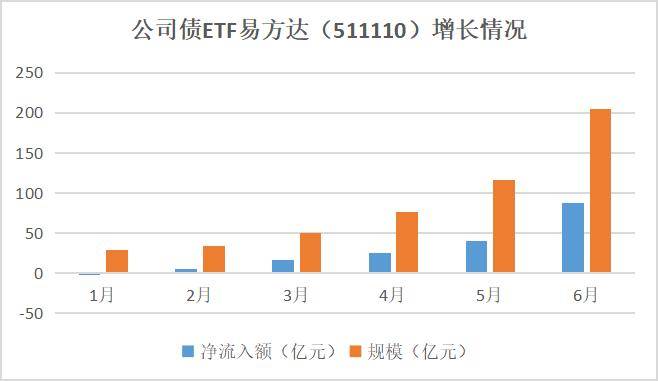
Core Insights - The rapid growth of the company bond ETF, E Fund (511110), reflects the explosive increase in credit bond ETFs, with a net inflow of approximately 16 billion yuan on June 26, bringing its total scale to 20.53 billion yuan, a historical high [1][3] - Year-to-date, credit bond ETFs have attracted over 130 billion yuan in net inflows, accounting for over 80% of the total net inflow in bond ETFs, with the current scale reaching 213 billion yuan, an increase of over 80 billion yuan from the end of last year [3][4] Group 1 - The E Fund company bond ETF has achieved a monthly net inflow record since its launch on January 24, with a growth rate of nearly 600% [1][3] - The popularity of credit bond ETFs is attributed to their attractive yield in a fluctuating interest rate environment, as well as lower credit risk, making them a cost-effective investment option [3][4] - The E Fund company bond ETF offers advantages such as T+0 trading, low costs, risk diversification, and high transparency, making it a preferred tool for investors [4] Group 2 - Credit bond ETFs are increasingly being utilized for collateralized repurchase transactions, enhancing funding efficiency and enabling diverse investment strategies [4] - Various types of investors, including pension funds, bank wealth management, and insurance asset management, are actively participating in the investment of benchmark market-making company bond ETFs, indicating strong demand [4] - E Fund has submitted the first batch of sci-tech bond ETFs, which will track the CSI AAA Technology Innovation Company Bond Index, facilitating efficient capital flow into high-quality technology innovation enterprises [4]

信用债ETF基金(511200)规模率先突破200亿元,领跑8只基准做市公司债ETF产品
Sou Hu Cai Jing· 2025-06-24 01:27
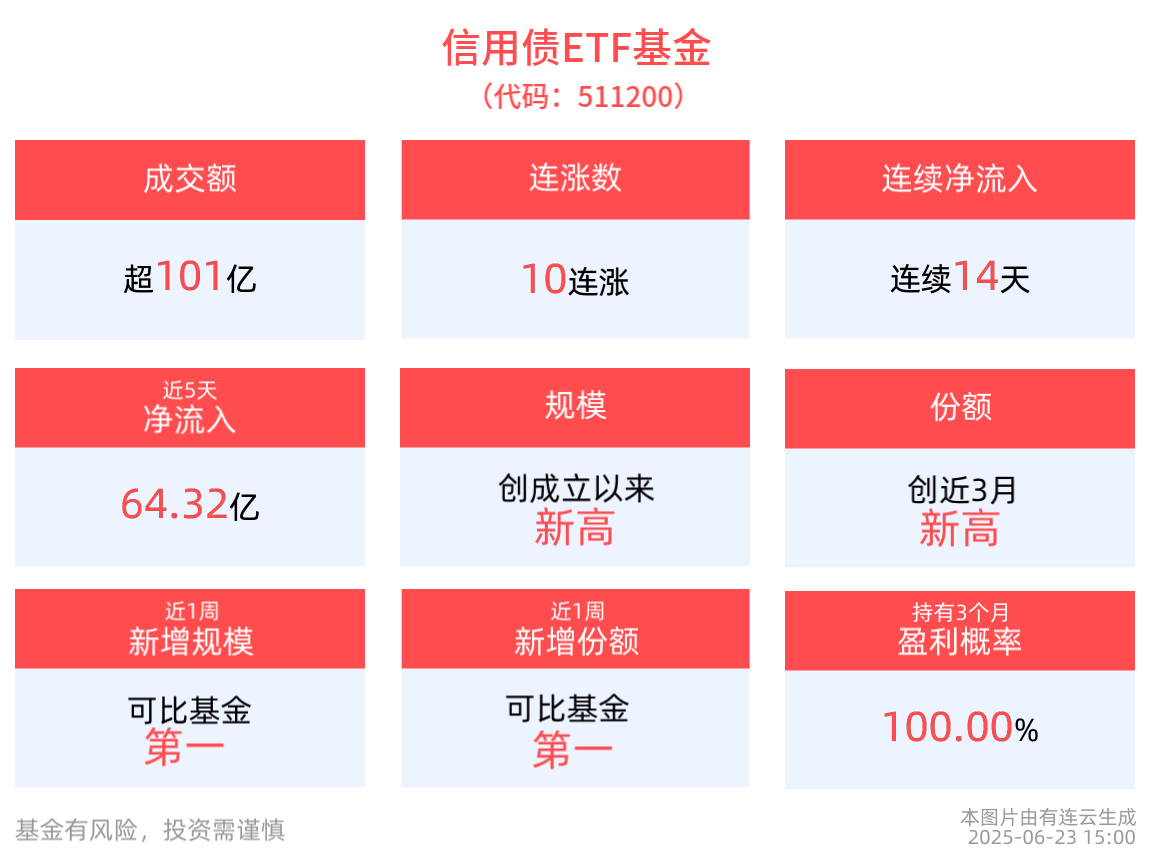
Core Viewpoint - The credit bond ETF fund (511200) has achieved a 10-day consecutive increase, indicating strong performance and investor interest in the fund. Group 1: Fund Performance - As of June 23, 2025, the latest price of the credit bond ETF fund is 101.24 yuan [1] - The fund has seen an average daily trading volume of 9.371 billion yuan over the past week, ranking first among comparable funds [1] - The latest share count of the credit bond ETF fund is 198 million, reaching a three-month high and also ranking first among comparable funds [1] Group 2: Fund Inflows - The credit bond ETF fund has experienced continuous net inflows over the past 14 days, with a maximum single-day net inflow of 2.923 billion yuan, totaling 12.978 billion yuan in net inflows [1] - The average daily net inflow is 927 million yuan [1] Group 3: Risk and Fee Structure - The maximum drawdown since the fund's inception is 1.04%, with a relative benchmark drawdown of 0.26% [4] - The fund has the fastest recovery time post-drawdown among comparable funds, taking 26 days [4] - The management fee is 0.15% and the custody fee is 0.05%, making it the lowest among comparable funds [4] Group 4: Market Outlook - Recent marginal improvements in the bond market suggest that investors should consider a moderate smoothing of yield strategies in a low-leverage environment [4] - The credit bond market's term spread has compressed, necessitating increased attention to individual bond liquidity and market elasticity in future operations [4] - The fund's underlying bonds are primarily AAA-rated credit bonds from large issuers, mainly state-owned enterprises, with a total of 212 component bonds covering a maturity range of 0-30 years [4]