
化工反内卷

Search documents
当前为什么要重视建筑央企的配置价值?
GOLDEN SUN SECURITIES· 2026-02-01 10:35
Investment Rating - The report maintains a "Buy" rating for key companies in the construction central enterprises sector, including China Railway, China Chemical, China Construction, and China Metallurgical [12][13][32]. Core Insights - The construction central enterprises are expected to see improved profitability driven by policy goals aimed at stabilizing investment. Order data shows a recovery in order growth starting from Q2 2025, with an anticipated narrowing of performance declines by Q4 2025 [1][16]. - The overall valuation of the nine major construction central enterprises is at historical lows, with a Price-to-Book (PB) ratio of 0.45 and a Price-to-Earnings (PE) ratio of 6.66, indicating strong safety margins [2][19]. - Institutional holdings in the construction sector are at low levels, suggesting a healthy chip structure and potential for recovery in key stocks [3][22]. Summary by Sections Order Growth and Performance - Cumulative order growth rates for construction central enterprises from Q1 to Q4 2025 are -2.0%, +0.2%, +1.3%, and +1.0%, respectively, indicating a recovery trend [1][16]. - The report anticipates that the performance decline of construction central enterprises will narrow in Q4 2025 due to improved order growth [1][16]. Valuation Metrics - As of January 30, 2026, the overall PB for the nine major construction central enterprises is 0.45, slightly above the historical low of 0.42, while the overall PE is 6.66, still below the historical median of 7.66 [2][19]. Institutional Holdings - As of Q4 2025, active funds hold 0.40% of the construction sector, while index funds hold 0.16%, leading to a combined holding of 0.28%, significantly lower than the 0.7%-1% range seen in 2021-2022 [3][22]. Catalysts for Growth - Several potential catalysts for the construction central enterprises include resource business revaluation for China Railway, chemical price rebounds for China Chemical, and increased investment in the power grid for China Electric Power and China Energy Construction [4][26]. - The upcoming "14th Five-Year Plan" is expected to bring about fiscal policies that could further stimulate the sector [4][26]. Recommended Stocks - Key recommendations include: - China Railway (A/H): Benefiting from resource revaluation, with a combined value of 1,894 billion CNY for its resource and engineering segments, indicating a potential upside of 35% [5][27]. - China Chemical: Positioned to benefit from chemical price rebounds, with a current PB of 0.84, indicating a strong safety margin [9][28]. - China Construction: Expected to benefit from stabilizing real estate expectations, with a projected dividend yield of 5.5% [10][30]. - China Metallurgical: Anticipated to improve significantly post divestment of its loss-making real estate business, with a combined valuation potential of 794 billion CNY [11][31].





建筑装饰行业周报:当前为什么要重视建筑央企的配置价值?
国盛证券有限责任公司· 2026-02-01 10:24
Investment Rating - The report maintains a "Buy" rating for key companies in the construction central enterprises sector, including China Railway, China Chemical, China Construction, and China Metallurgical [12][13][32]. Core Insights - The construction central enterprises are expected to see improved profitability driven by policy goals aimed at stabilizing investment and increasing central budget investment in 2026. Order growth has shown signs of recovery, with cumulative order growth rates for 2025 Q1-Q4 at -2.0%, +0.2%, +1.3%, and +1.0% respectively, indicating resilience among leading firms [1][16]. - The overall valuation of the nine major construction central enterprises is at historical lows, with a Price-to-Book (PB) ratio of 0.45 and a Price-to-Earnings (PE) ratio of 6.66, suggesting a strong margin of safety for investors [2][19]. - Institutional holdings in the construction sector are at low levels, with active funds holding only 0.40% of the sector, indicating significant underweighting compared to historical averages [3][22]. Summary by Sections Order Growth and Market Conditions - The report highlights a recovery in order growth for construction central enterprises, with expectations for performance improvement in Q4 2025 as orders stabilize and infrastructure investment accelerates in 2026 [1][16]. - The central government's focus on stabilizing investment and increasing budget allocations is expected to support revenue and profit growth for these enterprises [1][16]. Valuation Metrics - As of January 30, 2026, the construction central enterprises exhibit a PB of 0.45, slightly above the historical low of 0.42, and a PE of 6.66, which is still below the historical median of 7.66, indicating a favorable entry point for investors [2][19]. Institutional Holdings - As of Q4 2025, the construction sector's market capitalization represents only 1.6% of the total A-share market, with a significant reduction in institutional holdings compared to previous years, suggesting potential for recovery in stock prices as institutional interest returns [3][22]. Catalysts for Growth - Several catalysts are identified for the construction central enterprises, including resource revaluation for China Railway, chemical price rebounds for China Chemical, and increased investment in power grid infrastructure benefiting China Electric Power and China Energy Construction [4][26]. - The upcoming Two Sessions and the start of the 14th Five-Year Plan in 2026 are expected to bring additional fiscal policies that could further stimulate the sector [4][26]. Recommended Stocks - Key recommendations include: - **China Railway (A/H)**: Strong resource base with significant revaluation potential, estimated combined value of 1,894 billion CNY for A shares and 1,535 billion CNY for H shares, indicating a 35% and 54% upside respectively [5][27]. - **China Chemical**: Positioned to benefit from chemical price rebounds, with a current PB of 0.84, indicating a solid margin of safety [9][28]. - **China Construction**: Expected to benefit from stabilizing real estate expectations, with a projected dividend yield of 5.5% [10][30]. - **China Metallurgical**: Anticipated to improve significantly post divestment of loss-making real estate operations, with a potential valuation increase of 22% to 74% [11][31].
2026出海向中上游去-千万别忽视化工的转机与重生
2026-01-22 02:43
Summary of Key Points from Conference Call Industry Overview - The chemical industry in Europe is facing declining capacity utilization rates, currently at 74.6% in Q3 2025, down from 75.6% in Q2 2025, significantly below the long-term average of 80% [2][3] - In contrast, China's chemical exports have shown significant growth, with 60% of monitored chemical products achieving export volumes at over 80% of the past six years' levels [2] Core Insights and Arguments - European chemical companies are challenged by high energy costs and stringent environmental regulations, with natural gas prices approximately three times higher than in the US [3] - China is investing heavily in its chemical industry, accounting for 47% of global capital expenditure and 32% of R&D spending in 2023, which is driving industry scale and efficiency [4] - The "super factory" model in China is optimizing production costs and enhancing international competitiveness, allowing Chinese firms to capture market share more effectively [5][6] Trade Barriers and Their Impact - Trade barriers, such as the EU's carbon border tax, are affecting Chinese chemical exports, with potential additional costs of 300 to 2,700 RMB per ton for fertilizers [7] - The EU has temporarily suspended carbon tariffs on certain products, which may provide short-term relief but does not change the long-term trend towards stricter regulations [7] Industry Response to Market Dynamics - The chemical industry is responding to "involution" through both proactive measures, like joint production cuts, and reactive policies, such as energy consumption limits [8][9] - The PTA sector is expected to see improved profitability due to production cuts and a favorable demand-supply dynamic, with a projected increase in prices and earnings recovery [9][11] Specific Market Opportunities - The MDI market is influenced by US anti-dumping measures, but Chinese exports remain competitive in North America and Europe despite challenges [12] - China's ethylene production is expected to grow significantly, transitioning from a net importer to a potential net exporter by 2024, driven by increased domestic capacity and the exit of older European facilities [13][14] Investment Directions - The potassium fertilizer, phosphorus chemical, and pesticide sectors are highlighted as key areas for investment, with potassium fertilizer prices expected to remain strong due to tight supply-demand dynamics [16][17] - Companies with overseas resource development strategies, such as Yara International and Dongfang Iron Tower, are recommended for investment consideration [17] Future Development Logic - The underlying logic for the chemical industry's growth in 2026 is centered around international expansion and addressing market involution, with specific focus on MDI, PTA, ethylene, phosphorus chemicals, and potassium fertilizers as promising investment areas [18]
化工ETF(159870)盘中净申购1.37亿份,冲刺连续8天净流入
Sou Hu Cai Jing· 2026-01-12 03:13
Group 1 - The chemical sector is experiencing a capital inflow, with the chemical ETF (159870) seeing a net subscription of 137 million units, marking eight consecutive days of net inflow [1] - The core logic of the chemical industry is that capital expenditure has ended, with operating rates still at 80% to 90%. The trend remains positive despite internal competition, as only the chemical sector can achieve a healthy reduction in competition [1] Group 2 - Chemical stocks are currently in the first phase of a three-phase cycle, where EPS and commodity prices have bottomed out, indicating significant potential for future price increases [2] - Seasonal demand in the chemical industry is pronounced, with low inventory levels and strong spot market performance, suggesting that profitability will recover significantly during peak seasons [2] Group 3 - The chemical sector's leading companies are expected to see profit margins improve due to increased industry concentration and capital expansion from 2022 to 2025, which could lead to record high profits [3] - The current price-to-book (PB) ratios for leading companies differ from previous cycles, indicating potential for higher returns on equity (ROE) if leverage ratios return to historical levels [3] Group 4 - As of January 12, 2026, the CSI sub-industry chemical theme index (000813) shows mixed performance among its constituent stocks, with notable gains from companies like Guangwei Composite and Lanxiao Technology [3] - The top ten weighted stocks in the CSI sub-industry chemical theme index account for 45.31% of the index, including major players like Wanhua Chemical and Yanhua Co. [4]
多项产品出口退税政策调整,不改中国产业竞争优势
Orient Securities· 2026-01-11 15:38
Investment Rating - The industry investment rating is maintained as "Positive" [5] Core Viewpoints - The adjustment of export tax rebate policies does not alter the competitive advantage of China's chemical industry. The cancellation of export tax rebates for various chemical products is expected to increase export costs, reflecting China's energy and waste treatment capabilities. Despite theoretical concerns about competitiveness, high energy-consuming products like PVC lack global expansion capacity, and the price increase due to VAT will not significantly change competitive dynamics [2][7] - Market rumors do not change the profit recovery opportunities in the industry. Reports of regulatory discussions regarding monopolistic risks have led to stock price corrections for leading chemical companies. However, the industry is still in a self-rescue phase, with production cuts not aimed at achieving monopolistic profits but rather at facilitating recovery from previous losses [2][7] Investment Recommendations and Targets - Recommended leading companies in the refining industry include Sinopec (600028, Buy), Rongsheng Petrochemical (002493, Buy), and Hengli Petrochemical (600346, Buy). The report also highlights recovery opportunities in various chemical sub-industries, such as MDI leader Wanhua Chemical (600309, Buy) and PVC-related companies like Zhongtai Chemical (002092, Not Rated), Xinjiang Tianye (600075, Not Rated), Chlor-alkali Chemical (600618, Not Rated), and Tianyuan Co., Ltd. (002386, Not Rated). In the phosphoric chemical sector, companies like Chuanheng Co., Ltd. (002895, Not Rated) and Yuntianhua (600096, Not Rated) are noted for their growth potential driven by rapid energy storage growth. In the oxalic acid sector, attention is drawn to Hualu Hengsheng (600426, Buy), Huayi Group (600623, Buy), and Wankai New Materials (301216, Buy) [3]



2400亿化工茅宣布涨价
2 1 Shi Ji Jing Ji Bao Dao· 2026-01-04 16:11
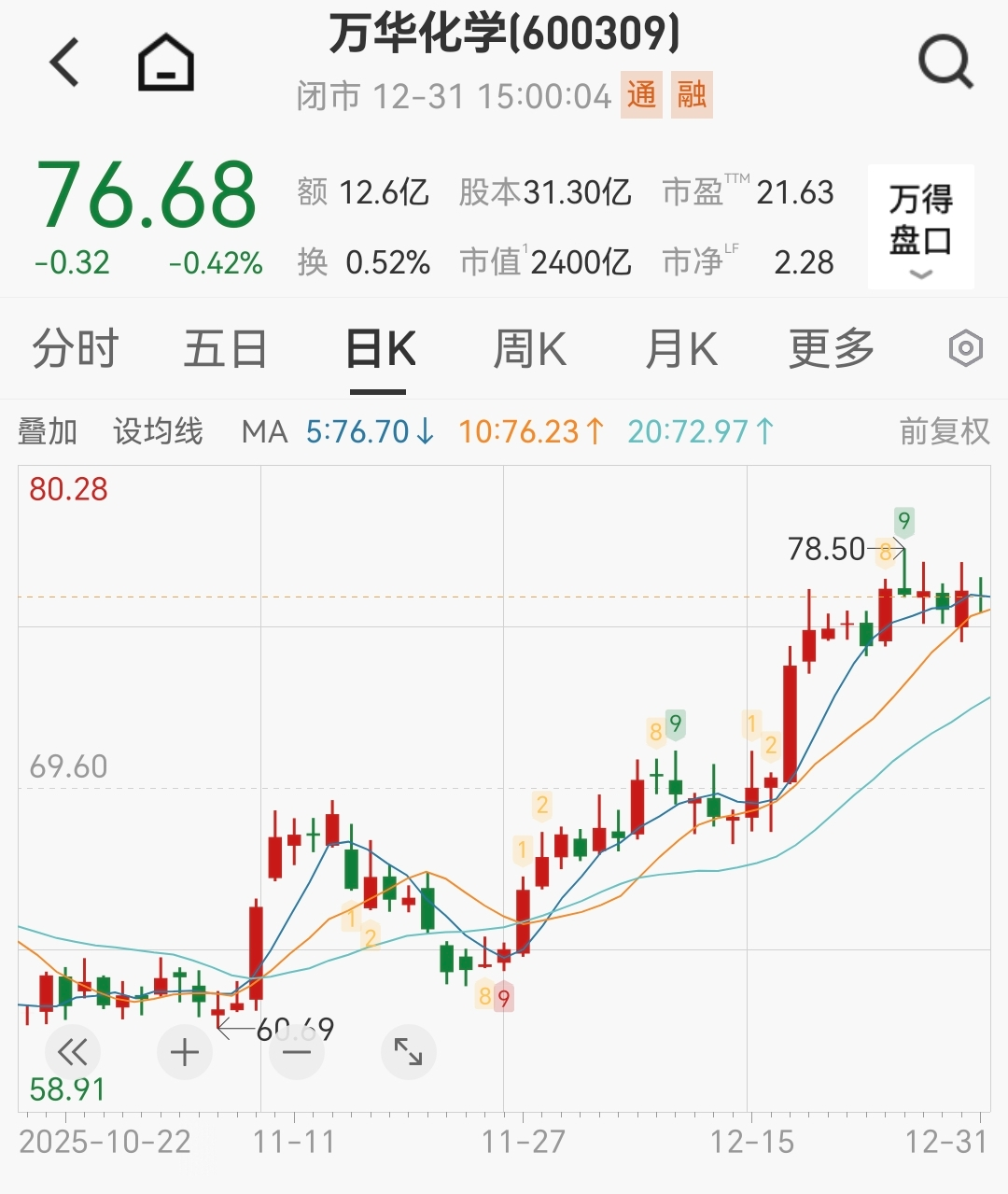
Core Viewpoint - Wanhua Chemical's price increases for MDI and TDI products are part of a broader global trend, driven by supply disruptions and rising raw material costs, amidst a high concentration of industry players [1][4][5]. Price Adjustments - Wanhua Chemical has announced multiple price hikes since December 2025, with increases of $200/ton for MDI in Southeast Asia and South Asia, and €300/ton in Europe [4]. - Other major companies like BASF and Dow have also raised prices, indicating a strong market adjustment across the polyurethane sector [4]. Supply Chain Disruptions - The price increases are attributed to unexpected production halts and geopolitical tensions affecting raw material costs [5]. - Notable production disruptions include a month-long shutdown of Hunstman’s MDI facility in the Netherlands and Wanhua's 100,000-ton MDI capacity in Ningbo, which is undergoing maintenance for 55 days [5][7]. Industry Dynamics - The polyurethane industry is characterized by high concentration, with major players like Wanhua, BASF, and Hunstman dominating the market, which limits the impact of domestic competition [1][5]. - The ongoing supply issues in Europe, particularly concerning ethylene, are expected to persist, affecting the overall production landscape [7][8]. Market Performance - Wanhua Chemical's stock has seen a rise of over 12% in the past 20 days, with a market capitalization of 240 billion yuan as of December 31, 2025 [1][2]. - The company's revenue for the first three quarters of the year was 144.23 billion yuan, a slight decline of 2.29% year-on-year, while net profit showed a smaller decline of 17.45% [10]. Future Outlook - Analysts suggest that the recovery of downstream demand is crucial for the overall improvement of the chemical sector, with expectations of a gradual recovery in Wanhua's operational performance [10][11]. - The ongoing capital investments in China's chemical industry and the exit of overseas capacities may stabilize the market in the coming years [11].


2400亿化工茅宣布涨价
21世纪经济报道· 2026-01-04 16:07
Core Viewpoint - The article discusses the recent price increases in the polyurethane industry, particularly focusing on Wanhua Chemical's price adjustments for MDI and TDI products, which are part of a broader trend influenced by supply disruptions and geopolitical factors [1][4][5]. Price Adjustments - Wanhua Chemical has announced multiple price increases for its core products, including MDI and TDI, starting from December 1, 2025, with increases of $200/ton in Southeast Asia and South Asia, and €300/ton in Europe [4]. - Following Wanhua, other major players like BASF and Dow also raised their MDI prices, indicating a synchronized market response [4][5]. - The price adjustments are attributed to unexpected production halts and rising raw material costs due to geopolitical tensions [5][6]. Supply Chain Disruptions - The polyurethane industry is experiencing significant supply chain disruptions due to unexpected maintenance and production halts at major facilities, including Wanhua's and BASF's plants [6]. - Notably, Hunstman’s MDI facility in the Netherlands faced an unexpected shutdown, exacerbating supply shortages [5][6]. - The article highlights that the European ethylene supply is under pressure, with several plants expected to close or reduce output, further tightening the market [8][9]. Market Dynamics - The article notes that the polyurethane industry has a high concentration of major global players, which limits the impact of domestic competition on pricing [1]. - Analysts suggest that the current price increases are part of a normal market adjustment rather than a reaction to domestic competition [1]. - The overall market sentiment is shifting towards a more optimistic outlook, with expectations of recovery in downstream demand being crucial for the industry's long-term health [12][13]. Future Outlook - The article indicates that while the current price increases are beneficial, the recovery of downstream demand is essential for sustained growth in the chemical sector [12]. - Analysts from UBS believe that the capital expenditure in China's chemical industry is beginning to decline, which may stabilize the industry's performance in the coming years [13]. - The article concludes that Wanhua Chemical's strategic positioning and the ongoing global supply adjustments could enhance its market share and profitability in the future [13].
万华化学:化工茅涨价,不止“反内卷”
2 1 Shi Ji Jing Ji Bao Dao· 2026-01-04 12:10
Core Viewpoint - The chemical industry, particularly the polyurethane sector, is experiencing a price increase led by Wanhua Chemical, but a full recovery is still distant due to ongoing challenges in downstream demand and supply chain issues [1][8]. Price Increase Dynamics - Wanhua Chemical has initiated multiple price hikes for its core products, including MDI and TDI, starting from December 2025, following similar moves by global giants like BASF and Dow [1][2]. - The price adjustments include a $200/ton increase for MDI in Southeast Asia and South Asia, and a €300/ton increase for all MDI products in Europe [2][3]. - The price surge is attributed to unexpected production halts and geopolitical factors affecting raw material costs, alongside seasonal maintenance peaks [3][5]. Supply Chain Challenges - Significant production disruptions have occurred, including a one-month shutdown of Hunstman’s MDI facility in the Netherlands and maintenance at Wanhua's 1 million ton/year MDI plant in Ningbo [4][5]. - The ongoing structural shortage of ethylene in Europe and Asia is a critical concern, exacerbated by the permanent closure of several ethylene cracking facilities by major companies [6][7]. Industry Outlook - The chemical industry in Europe faces long-term challenges due to energy structure issues and stringent carbon emission policies, which may weaken its international competitiveness [7]. - Despite the supply issues in Europe and Japan, a complete recovery of the industry hinges on the rebound of downstream demand [8][9]. - Wanhua Chemical's financial performance shows signs of stabilization, with a slight increase in net profit in Q3 2025, although overall revenue remains down year-on-year [11].
皖维高新(600063):PVA龙头动能升级切换,价值亟待重估
Yin He Zheng Quan· 2025-12-30 01:54
Investment Rating - The report initiates coverage with a "Buy" rating for the company [3]. Core Insights - The company, Wanhua Chemical, is a global leader in PVA production, with a comprehensive industrial chain and a production capacity of 310,000 tons, positioning it at the forefront of the industry [7][10]. - The PVA industry is expected to benefit from policy measures aimed at reducing overcapacity, which may lead to improved supply-demand dynamics [7][36]. - The company is the first in mainland China to achieve large-scale production of PVA optical films, which are critical components in LCD and OLED displays, and is set to significantly increase its production capacity [7][59]. - The automotive-grade PVB film market is poised for growth, with the company focusing on high-value applications in automotive safety glass [7][62]. Financial Forecasts - Revenue projections for the company are as follows: CNY 84.58 billion in 2025, CNY 92.33 billion in 2026, and CNY 99.23 billion in 2027, with corresponding net profits of CNY 4.74 billion, CNY 7.35 billion, and CNY 9.32 billion [2][7]. - The expected earnings per share (EPS) are CNY 0.23 for 2025, CNY 0.36 for 2026, and CNY 0.45 for 2027, with price-to-earnings (PE) ratios of 26.42, 17.03, and 13.43 respectively [8][7]. Company Overview - Wanhua Chemical has established three production bases in Anhui, Guangxi, and Inner Mongolia, focusing on various segments including chemical, fiber, building materials, and new materials [10][11]. - The company has a strong emphasis on research and development, continuously innovating to maintain its competitive edge in the PVA market [24][26]. Market Position - The company holds over 30% of the domestic market share for PVA products and is recognized for its advanced technology and comprehensive product range [24][26]. - The PVA optical film market is currently dominated by Japanese firms, but Wanhua Chemical is making significant strides in domestic production capabilities [55][59]. Strategic Initiatives - The company is actively expanding its production capacity for PVA optical films and automotive-grade PVB films, aiming to meet the growing domestic demand and reduce reliance on imports [59][60]. - Wanhua Chemical is also involved in collaborative research initiatives to enhance its technological capabilities in advanced functional films [27][59].

中银国际:供应端扩产高峰已过 “反内卷”助力化工业景气度回升
智通财经网· 2025-12-16 09:11
Core Viewpoint - The chemical industry is currently at the bottom of the cycle, with the "anti-involution" trend expected to accelerate the optimization of the competitive landscape, leading to an increase in both profitability and valuation for leading companies [1] Group 1: Industry Performance - Chemical product prices are at historical lows, with the chemical industrial PPI showing negative year-on-year growth for 37 consecutive months as of October 2025 [1] - Among 119 tracked chemical products, 26.89% are in the bottom 10% price percentile, and 60.50% are in the bottom 30% [1] - The basic chemical industry is expected to see a stabilization in net profit after three consecutive years of decline from 2022 to 2024 [1] Group 2: Supply Side Dynamics - Fixed asset investment in the chemical raw materials and products manufacturing industry has turned negative year-on-year for the first time in nearly five years as of June 2025 [2] - As of Q3 2025, the value of fixed assets in the basic chemical industry reached 1,462.858 billion yuan, a year-on-year increase of 15.56% [2] - The ongoing construction projects have seen a decline, with a year-on-year decrease of 15.11% as of Q3 2025 [2] Group 3: Demand Side Insights - The demand for chemical products is expected to grow due to stimulus policies and the continuous increase in exports [3] - The real estate sector is under pressure, while demand from the automotive and chemical fiber sectors remains strong [3] - As of September 2025, the export quantity index for chemical raw materials and products manufacturing was 122.40, indicating robust export performance [3] Group 4: Global Competitive Landscape - In 2023, China's chemical sales reached 22,381 billion euros, accounting for 43.1% of the global market, marking a 111.55% increase since 2013 [4] - China's chemical exports are projected to reach 254.96 billion USD in 2024, positioning it as the second-largest exporter globally [4] - The competitiveness of Chinese chemical companies has been enhanced due to the exit of overseas production capacities [4] Group 5: Future Outlook - The "14th Five-Year Plan" emphasizes the need to enhance the quality and competitiveness of key industries, including chemicals [5] - The industry is moving towards a model of "anti-involution" through self-discipline and policy collaboration, which is expected to facilitate a transition from scale expansion to high-quality growth [5] - Initiatives such as joint production cuts and policy support are anticipated to help restore product prices and profits in various sub-industries [5]