
宏观审慎政策

Search documents
我国银行业总资产位居世界第一
Xin Hua Wang· 2025-09-22 23:35
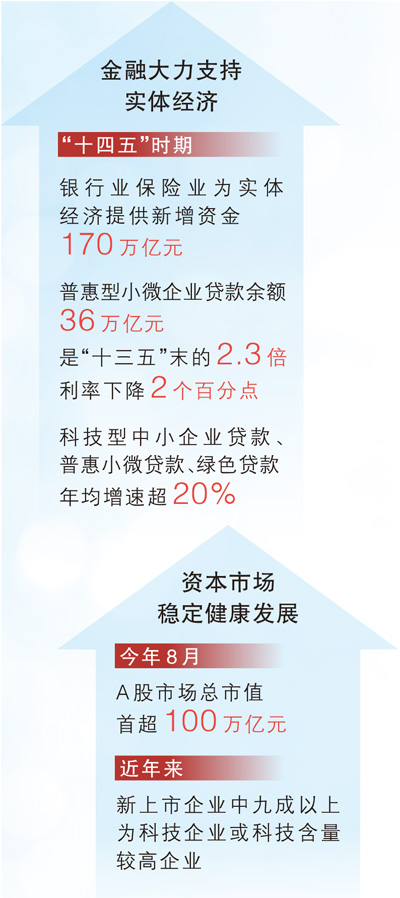
Core Insights - China's banking industry has the largest total assets in the world, reaching nearly 470 trillion yuan, and has made significant advancements in green finance, inclusive finance, and digital finance [4][5] - The financial governance system and capabilities have modernized, enhancing the quality, efficiency, and inclusiveness of financial services [3][4] - The financial sector has provided 170 trillion yuan in new funds to the real economy during the "14th Five-Year Plan" period, with a focus on supporting key areas and weak links in economic and social development [5][6] Financial Sector Achievements - The banking and insurance sectors have seen an annual growth rate of 9% over the past five years, with total assets exceeding 500 trillion yuan [7][10] - The average annual growth rates for loans to technology SMEs, inclusive microloans, and green loans have surpassed 20% [4] - The stock and bond markets rank second globally, with direct financing accounting for 31.6% of total financing, an increase of 2.8 percentage points from the end of the "13th Five-Year Plan" [5][7] International Financial Position - China's foreign exchange reserves have remained above 3 trillion USD, providing stability and support for the economy [8][9] - The RMB has become the largest settlement currency for China's foreign trade and ranks among the top three trade financing currencies globally [9] - The number of foreign institutions and individuals holding domestic stocks, bonds, and deposits has exceeded 10 trillion yuan, indicating increased foreign investment [9] Risk Management and Stability - The financial sector has effectively managed and resolved several prominent risk points, with non-performing asset disposal increasing by over 40% compared to the "13th Five-Year Plan" period [10] - Key regulatory indicators such as non-performing loans and capital adequacy are stable and within a healthy range, enhancing the industry's resilience to risks [10]

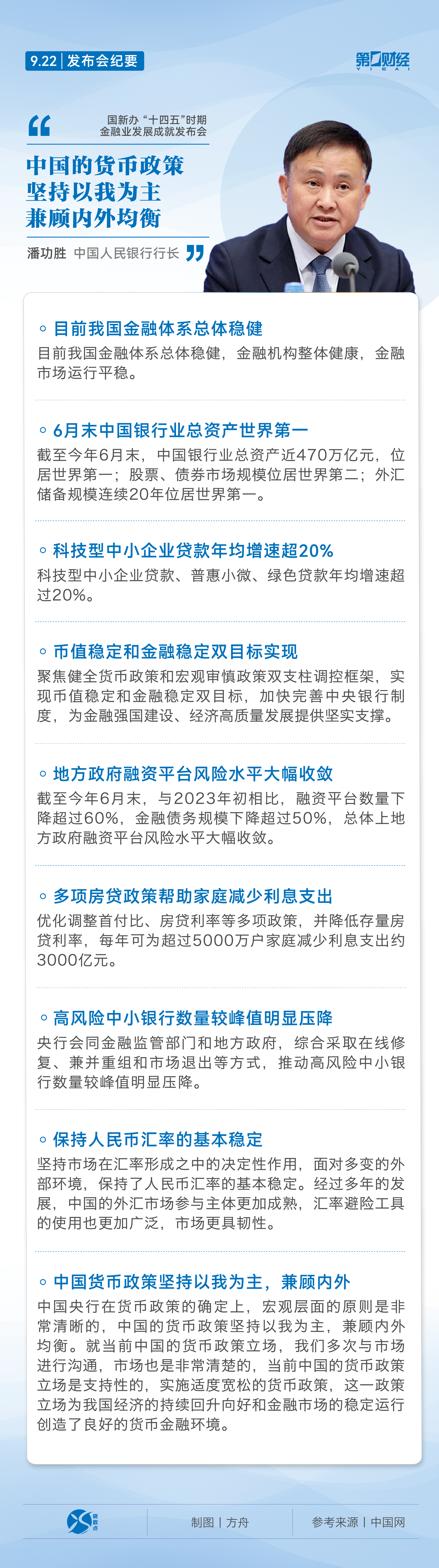
发布会纪要丨中国货币政策坚持以我为主、兼顾内外,潘功胜最新发声
Di Yi Cai Jing· 2025-09-22 11:17
Core Viewpoint - The press conference highlighted the achievements of China's financial industry during the 14th Five-Year Plan period, emphasizing the stability of the financial system and the effectiveness of monetary policy in supporting economic recovery. Group 1: Financial System Stability - China's financial system is overall stable, with smooth market operations [4] - As of June 2023, China's banking sector total assets ranked first globally, and the stock and bond market reserves have maintained a second-place position for 20 consecutive years [4] - The risk level of local government financing platforms has significantly decreased, with financial debt scale reduced by over 60% compared to 2023 [6] Group 2: Monetary Policy and Economic Support - The central bank's monetary policy focuses on maintaining currency stability and financial stability, creating a favorable monetary environment for economic recovery [5][8] - The People's Bank of China has implemented supportive monetary policies, including adjustments to down payment ratios and mortgage rates, benefiting over 500,000 families annually, with a financial impact of approximately 300 billion yuan [6] - The number of high-risk small and medium-sized banks has been significantly reduced from peak levels through measures such as restructuring and market exit [7] Group 3: Currency and Exchange Rate Management - The central bank maintains a market-oriented approach to the formation of the exchange rate, ensuring the stability of the RMB [7] - The use of the RMB in the foreign exchange market has become more widespread, contributing to a more robust market environment [7]
【环球财经】印尼央行再降息25个基点至5%
Xin Hua Cai Jing· 2025-08-20 14:15
Core Points - The Bank of Indonesia announced a 25 basis point cut in the benchmark 7-day reverse repo rate to 5%, marking the fifth rate cut since September last year and the lowest level since October 2022 [1] - The central bank aims to support economic growth while maintaining low inflation and stability of the Indonesian Rupiah, with inflation expected to remain within the target range of 2.5%±1% for this year and next [1] - Indonesia's GDP grew by 5.12% year-on-year in the second quarter, the highest growth rate in two years, while July's inflation rate rose to 2.37%, the highest in a year but still within the central bank's target [1] - The central bank projects GDP growth of 5.1% in 2025, driven by consumption, exports, and government spending, with an emphasis on increasing exports of mineral products, palm oil, and fishery products [1] - The central bank has urged banks to improve credit allocation efficiency, as credit growth slowed to 7.03% in July, and has implemented measures to enhance liquidity support [1] Market Reaction - Following the rate cut announcement, the Indonesian stock market responded positively, with the Jakarta Composite Index closing at 7939 points, up 0.97%, reaching a historical high, indicating strong recovery momentum and capital inflow trends, particularly in the financial, infrastructure, and agriculture sectors [2]
央行:进一步丰富宏观审慎政策工具箱
Xin Hua Wang· 2025-08-12 06:30
Core Viewpoint - The People's Bank of China emphasizes the need to enhance the dual-pillar regulatory framework of monetary policy and macro-prudential policy, while also enriching the macro-prudential policy toolbox for 2022 [1][2]. Group 1: Macro-Prudential Management - The meeting highlighted the achievements of 2021, including the establishment of a systemic financial risk monitoring system and the implementation of additional regulations for systemically important banks [1]. - The meeting called for a focus on macro-prudential management that emphasizes macroeconomic perspectives, counter-cyclical adjustments, and risk contagion prevention [2]. Group 2: Policy Implementation and Framework - There is a strong emphasis on the need to implement a standardized monitoring and assessment system for systemic risks, as well as to enhance the regulatory framework for systemically important insurance companies [2]. - The meeting also stressed the importance of improving the coordination between domestic and foreign currency policies to facilitate trade and investment [2]. Group 3: Capacity Building - The need for strengthening the capabilities of the workforce and enhancing business skills was underscored, in preparation for the upcoming 20th National Congress of the Communist Party [2].
2025陆家嘴论坛重磅政策前瞻
Wind万得· 2025-06-17 22:32
2025 年陆家嘴论坛将于 6 月 18 日至 19 日在上海举行 ,主题为 " 全球经济变局中的金融开放合作与高质量发展 " ,预计将释放重大金融政策信号,成为 各界关注的焦点。 此次论坛由中国人民银行、国家金融监督管理总局、中国证监会、国家外汇管理局及上海市人民政府共同主办。 据证券时报报道,上海市委金融办常务副主任周小全在 5 月 30 日透露, 2025 陆家嘴论坛期间, 中央金融管理部门将发布若干重大金融政策。 作为中国金融领域的高规格盛会,本次论坛 多项热点话题备受关注。 (图片来自海洛) // 市场关注的重点 // 货币政策与监管框架是市场关注的重点之一。央行是否会释放降准或降息信号,将直接影响市场流动性和资金成本 。 据《金融时报》此前报道,在当前经济形势下,市场对适度宽松的货币政策存在一定预期。同时,宏观审慎政策如何平衡稳增长与防风险,如房地产、地 方政府债务化解等问题,也备受关注。 资本市场改革同样是论坛的热门议题。 注册制深化、科创板流动性改善以及中概股跨境监管合作进展等,都是投资者关心的核心问题。近年来,注册制改革不断推进,科创板作为改革试验田, 其流动性提升对于吸引更多优质企业上市意 ...

资金无忧,关注利率下行触发因素
Shenwan Hongyuan Securities· 2025-05-18 09:11
Group 1 - The report emphasizes that credit risk has historically received more attention than interest rate risk in the bond market, with the People's Bank of China highlighting the need for improved mechanisms to address interest rate fluctuations, although short-term impacts may be limited [3][8][11] - The bond market is expected to gradually improve its macro-prudential mechanisms, but the short-term focus remains on loose trading conditions, with a low probability of further tightening in liquidity [3][30] - The report indicates that the current monetary policy aims to maintain a moderately loose environment to counter external uncertainties and support fiscal issuance, while also ensuring stable interest rates to protect asset prices [3][30] Group 2 - The report discusses the evolution of the yield curve, suggesting that it may steepen, with a focus on duration value and less active interest rate instruments, as the macro-prudential approach prioritizes stabilizing growth and managing risks [3][34] - It highlights that the long-end of the bond market has limited upward potential, with the 10-year government bond yield unlikely to exceed 1.7%, and emphasizes the importance of monitoring potential triggers for interest rate declines [3][34] - The report identifies several factors that could lead to lower interest rates, including fluctuating expectations regarding US-China trade relations, a downward trend in financial institutions' overall costs, and pressures on exports in the second quarter [3][34]
央行:启动2025年度系统重要性金融机构评估工作 稳步拓宽附加监管覆盖范围至非银领域
news flash· 2025-05-09 09:46
Core Viewpoint - The central bank is initiating the assessment of systemically important financial institutions for 2025, aiming to expand additional regulatory coverage to the non-bank sector while enhancing financial risk management and stability measures [1] Group 1: Financial Stability Measures - The central bank plans to actively and prudently prevent and resolve financial risks, exploring the expansion of its macroprudential and financial stability functions [1] - There will be an improvement in the macroprudential policy framework to enhance systemic risk monitoring, assessment, and early warning capabilities [1] - The toolbox for macroprudential policies will be enriched to strengthen the management of systemically important financial institutions [1] Group 2: Regulatory Enhancements - Systemically important banks will be urged to comply with additional capital and leverage ratio requirements, improving the operability and effectiveness of recovery and resolution plans [1] - The assessment work for systemically important financial institutions for 2025 has been initiated, with a steady expansion of additional regulatory coverage to the non-bank sector [1] Group 3: Risk Management and Monitoring - There will be a focus on the orderly resolution of key risk projects and areas, supporting the risk resolution of small and medium-sized banks based on market-oriented and legal principles [1] - Financial risk monitoring, early warning, and assessment will be strengthened, enhancing the judgment of systemic financial risks [1] - The financial stability mechanism will be solidified, promoting the accumulation of deposit insurance funds and financial stability guarantee funds, while reinforcing the specialized financial risk resolution functions of deposit insurance [1]
「改革创新」田轩:降准降息,如何“择机”?
Sou Hu Cai Jing· 2025-05-08 18:01
Group 1: Monetary Policy Adjustments - The central bank will selectively lower the reserve requirement ratio and interest rates based on economic growth momentum and liquidity conditions in the financial market [3] - Supportive monetary policy aims to maintain sufficient market liquidity, reduce financing costs, and guide funds to key areas to stimulate economic growth [4] - Coordination between monetary and fiscal policies is essential to enhance their effectiveness and ensure consistency in achieving economic stability and risk prevention [5] Group 2: Monetary Policy Tools - The toolbox for monetary policy includes tools like differentiated reserve requirement ratios, targeted medium-term lending facilities (TMLF), and open market operations to manage liquidity and credit [6] - Structural monetary policy tools will focus on directing financial support to strategic sectors such as technology innovation and green finance [6][7] Group 3: Price Stability and Asset Prices - The shift in the central bank's focus from "maintaining overall price stability" to "keeping prices at a reasonable level" indicates a more precise monetary policy target [8] - There is a complex debate about including asset prices in monetary policy goals, as it could complicate the balance between various economic objectives [10] Group 4: Government Bond Yields and Currency Exchange Rates - Current government bond yields are in a fluctuating range due to economic recovery expectations and monetary policy adjustments, with a potential for gradual increases in the long term [11] - The recent appreciation of the RMB reflects improved economic fundamentals and market confidence, while external pressures like tariffs may pose risks [13]

固收“申”音:月度策略
2025-05-08 15:31
Summary of Key Points from Conference Call Industry or Company Involved - The discussion primarily revolves around the fixed income market, particularly focusing on the U.S. economy, monetary policy, and the bond market dynamics. Core Points and Arguments 1. **Economic Outlook and Monetary Policy** - Economic external demand pressures are evident, leading to a pessimistic market outlook on economic expectations, with a flattening yield curve observed. Attention is drawn to the U.S. Federal Reserve's policies, the dollar exchange rate, and the progress of fiscal expansion, while cautioning against the potential impacts of the U.S. "twin deficits" on dollar asset credit [1][5][7]. 2. **U.S. Economic Conditions** - The U.S. economy is currently in a state of stagflation rather than recession, with the Michigan Consumer Sentiment Index declining primarily due to rising inflation expectations. Global trade growth is expected to peak in 2024, with increasing tensions in U.S.-China relations leading to a significant restructuring of the global trade economy [1][10][11]. 3. **Domestic Policy Focus** - Domestic policies are aimed at boosting internal demand, but negative overseas influences may weaken the effectiveness of these policies. Investment opportunities in real estate, infrastructure, and manufacturing are limited, while consumption is constrained by savings willingness, income expectations, and falling housing prices. Future policies should prioritize consumption promotion [1][13][14]. 4. **Monetary Policy Adjustments** - The monetary policy is characterized by maintaining stability in major tools while flexibly adjusting minor tools. A decline in real financing demand has led to spontaneous easing, with interest rates expected to decrease from May to August. The year is anticipated to be a period of declining interest rates nested within a macro-prudential framework, with caution advised regarding financial risks arising from this decline [1][15][16]. 5. **Bond Market Dynamics** - The convertible bond market remains strong with a clear bullish trend, supported by stock recovery enhancing valuation. Future performance will depend on equity market conditions, with smaller-cap convertible bonds showing more pronounced returns in a volatile market [4][20]. 6. **Credit Bond Market Performance** - The credit bond market showed weak performance in April, influenced by tariff policies leading to credit spread compression and subsequent adjustments. Higher coupon credit bonds present certain opportunities, particularly in mid-to-short-term strategies and municipal bonds [4][34]. 7. **U.S. Fiscal Policy and Deficits** - The U.S. has reached historical highs in fiscal expansion since 2020, with deficit rates significantly above pre-2019 levels. A shift towards fiscal tightening is anticipated in the coming years, with potential implications for the dollar's value [5][7]. 8. **Global Trade and Economic Growth Predictions** - Global trade is expected to peak in 2024, with a decline anticipated in 2025. The ongoing U.S.-China competition is likely to intensify, increasing the probability of a global economic restructuring [11]. 9. **Investment Opportunities in Specific Sectors** - Sectors such as public utilities and coal, which are less affected by tariff impacts and have stable fundamentals, are highlighted as worthy of attention. Additionally, the real estate industry in strong provinces and sectors supported by technology innovation policies may present potential investment opportunities [51][52]. 10. **Market Sentiment and Future Outlook** - The market sentiment towards dollar assets has weakened, particularly concerning U.S. debt repayment issues. While the immediate risk of default is low, the high debt rollover pressure and interest costs are significant concerns for decision-making [9][10]. Other Important but Possibly Overlooked Content - The discussion emphasizes the need for a macro-prudential perspective in evaluating the bond market, considering both external risks and domestic economic pressures. The potential for financial risks arising from interest rate declines is highlighted, necessitating careful monitoring of credit risk and liquidity conditions [17][18]. - The convertible bond market's performance is closely tied to equity market trends, with a focus on the impact of stock price movements on convertible bond valuations and investor strategies [20][21]. - The anticipated issuance of special bonds for debt resolution and the potential for significant municipal bond opportunities are noted, particularly in the context of land reserve special bonds [46][47]. This summary encapsulates the key insights and forecasts discussed in the conference call, providing a comprehensive overview of the current economic landscape and investment considerations.