
股市估值

Search documents
多家机构警告:标普500或将下跌10%至15%
Zheng Quan Shi Bao· 2025-08-05 00:33
Core Viewpoint - Major institutions such as Morgan Stanley, Deutsche Bank, and Evercore ISI warn that the S&P 500 index may decline by 10% to 15% in the coming weeks to months due to high market valuations, rising inflation, slowing job growth, and weak consumer spending [1] Group 1: Market Concerns - Historical data indicates that August and September are typically poor-performing months for the S&P 500 index [1] - The relative strength index (RSI) for the S&P 500 has exceeded 70, suggesting that the market may be "overheated" [1] Group 2: Options Market Insights - The cost of hedging against a market downturn is increasing, with the implied volatility premium for put options reaching its highest level since the regional banking crisis in 2023 [1]
闪崩、暴跌!外资,猛烈抛售!这国股市,发生了什么?
Zheng Quan Shi Bao Wang· 2025-07-29 12:40
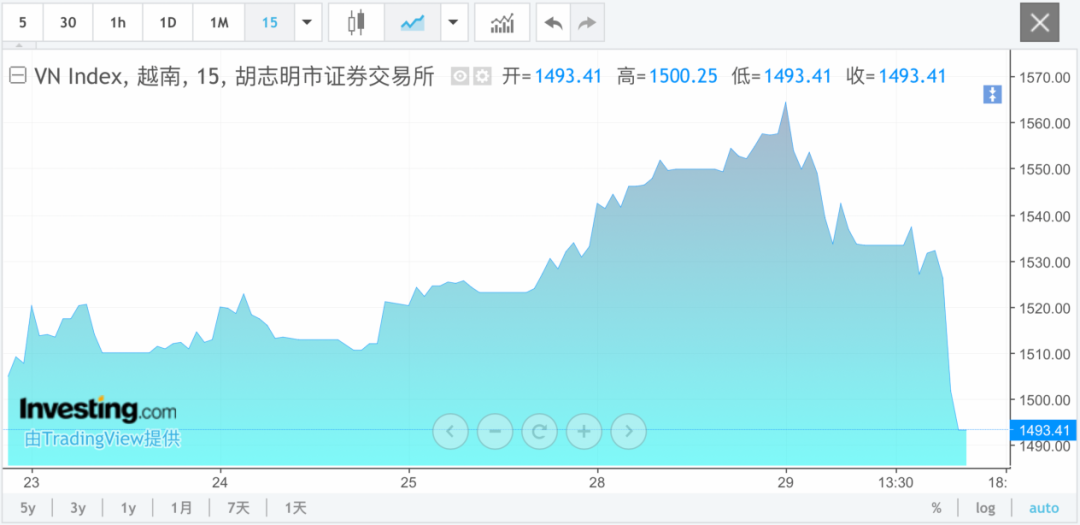
Core Viewpoint - The sudden sell-off in the Vietnamese stock market on July 29 was primarily driven by foreign investors cashing out after a period of strong market performance, leading to significant declines in major indices and sectors [2][3][5]. Group 1: Market Performance - On July 29, the Ho Chi Minh Index (VN Index) experienced a drop of 4.11%, closing at 1493.41 points, while the VN30 Index fell by 4.38% to 1621.29 points [3]. - The VN Index reached a historical high of 1566.74 points earlier that day, marking a cumulative increase of 45.9% compared to its low in early April [5][7]. - The trading volume surged dramatically, with nearly 14 trillion VND traded within the first hour, causing some brokerage systems to malfunction [5]. Group 2: Causes of the Sell-off - The primary reason for the market decline was the aggressive selling by foreign investors, who net sold over 9390 billion VND during the morning session, focusing on large-cap stocks that had previously supported the index [5]. - The high valuation of the market, with a price-to-earnings ratio around 15 times, has raised concerns about overvaluation, as corporate profit growth has not kept pace with stock price increases [5][6]. - Investors are reportedly increasing their leverage, with some brokerage firms reaching their margin limits, which could restrict short-term price increases [6]. Group 3: Economic Context - The Vietnamese economy showed strong growth, with a GDP growth rate of 7.52% in the first half of the year, the highest for the same period since 2011 [9]. - Foreign investors had net bought over 400 million USD in Vietnamese stocks in July, marking the second month of net inflows, contrasting with outflows from other Southeast Asian markets [9]. - The potential reclassification of Vietnam in the FTSE index could attract up to 6 billion USD in capital inflows, further influencing market dynamics [9].

美股Q2财报季开局强劲!企业盈利引擎持续发力有望支撑涨势
智通财经网· 2025-07-25 10:47
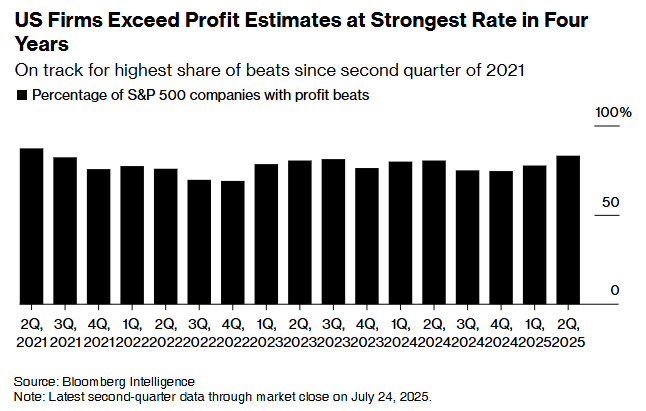
Core Viewpoint - The strong performance of the Q2 earnings season for U.S. stocks indicates that corporate earnings are robust, potentially alleviating concerns about the overheated market following record highs in stock prices [1][4]. Group 1: Earnings Performance - Approximately one-third of the S&P 500 companies have reported earnings, with about 83% exceeding analyst expectations, potentially marking the highest "surprise" ratio since Q2 2021 [1][4]. - Prior to the earnings season, the expected year-over-year earnings growth for S&P 500 companies was 2.8%, but the current overall growth rate has reached 4.5% [4]. Group 2: Market Sentiment and Outlook - The S&P 500 index has risen 28% since its low on April 8, with the equal-weighted S&P 500 also reaching record highs, as concerns over tariffs have diminished and investors return to the market [4]. - Companies like Alphabet, D.R. Horton, and Netflix have expressed optimism about their future prospects, with Alphabet citing increased demand for AI products [5]. - The labor market remains resilient, as evidenced by a decline in initial jobless claims for six consecutive weeks, which may reassure investors [5]. Group 3: Valuation Concerns - The expected price-to-earnings ratio for the S&P 500 is approximately 22.5, compared to the 10-year average of 18.6, raising concerns about high valuations and limited margin for error [5][6]. - Companies failing to meet both earnings and revenue expectations are facing the most severe stock price penalties since Q3 2022 [6]. - There are signs of "bubble" behavior in the market, with meme stocks experiencing significant price increases reminiscent of the extreme investor enthusiasm seen in 2021 [6].
从恐慌到“金发姑娘”:反弹太猛,投资者小心“乐极生悲”?
Jin Shi Shu Ju· 2025-07-07 03:52
Core Viewpoint - The U.S. stock market has shifted from panic to optimism over the past three months, but some strategists warn that the market may be overly optimistic given the uncertainties ahead [2]. Group 1: Market Sentiment and Economic Indicators - Investors are feeling reassured by the framework agreement between the U.S. and China, leading to a generally optimistic market outlook regarding the continuation of tariff suspension measures [2]. - The S&P 500 index experienced a significant drop of nearly 19% from its record high in February to the lows in April, but rebounded sharply after the announcement of tariff suspensions [2]. - The 50-day rebound since the April 8 low has been 19.8%, marking it as the ninth largest increase for the S&P 500 since 1950, indicating potential for further gains in the coming months [3][4]. Group 2: Fiscal Policy and Debt Concerns - The recent fiscal policy changes, including a projected increase of $3.4 trillion in government debt over the next decade, have raised concerns about the sustainability of economic growth and public debt levels [3]. - Analysts are questioning whether tariff revenues, which amounted to $15.6 billion in April alone, will significantly contribute to economic growth and help mitigate public debt increases over the next ten years [3]. Group 3: Investment Strategies and Sector Focus - Some strategists suggest that the current stock market gains may have outpaced the underlying fundamentals, leading to considerations for reducing exposure in overvalued sectors, particularly small-cap stocks, industrials, and consumer discretionary [4]. - Investment recommendations include holding cash for potential market corrections or reallocating to sectors perceived as more attractive, such as technology, financials, energy, utilities, and communication services [4].

英国股市深陷困局:富时100一年涨7%垫底欧洲,工党难解多重压力
智通财经网· 2025-07-04 09:35
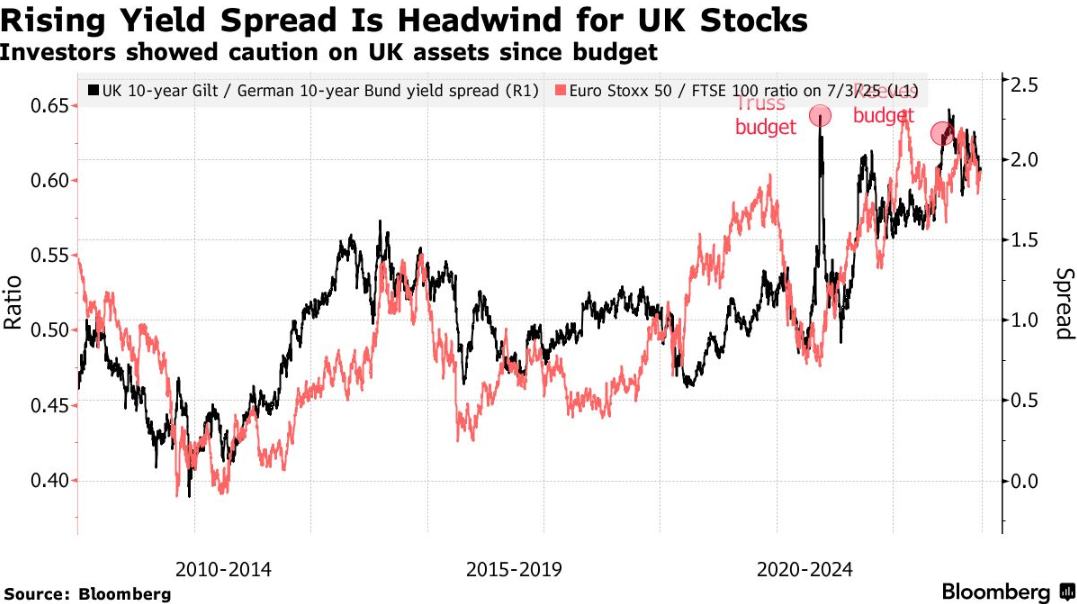
Core Viewpoint - The UK stock market remains troubled despite the Labour Party's political stability and investment opportunities, with the FTSE 100 index only rising 7% compared to 17% to 27% gains in Germany, Spain, and Italy during the same period [1] Group 1: Economic and Market Conditions - The current growth momentum in the UK is fragile, with market skepticism about the Labour Party's ability to stimulate economic growth without increasing fiscal pressure [1] - Expectations of tax increases or expanded government borrowing are rising, prolonging pressure on the UK bond market [1] - The Bank of England's cautious stance on interest rate cuts contributes to ongoing investor doubts about the UK economy and stock market outlook [1][4] Group 2: Valuation and Investment Sentiment - The FTSE 350 index's price-to-earnings ratio has increased from 11.4 to 13, but it remains about 35% cheaper than the MSCI global index, making it one of the cheapest stock markets among developed markets [4] - Further valuation increases depend on improved earnings growth, which is hindered by high borrowing costs [4] - The market anticipates only three interest rate cuts from the Bank of England over the next year, with rates expected to remain at 3.5%, double that of the Eurozone [4] Group 3: Currency and Earnings Impact - The upcoming earnings season will be critical for assessing whether companies can overcome the headwinds from rising interest rates [8] - The significant appreciation of the British pound, which has risen 9.3% against the US dollar this year, may impact earnings, as approximately 75% of FTSE 100 companies' revenues come from overseas [8] Group 4: Broader Market Challenges - The UK market faces additional challenges, including liquidity issues, excessive regulation, and low domestic investor appetite for equities [11] - The trend of companies considering relocating their listings is contributing to the shrinking size of the UK stock market, with AstraZeneca reportedly evaluating a move to the US [11] - Institutional investor sentiment remains negative, with global investors reducing their holdings in UK assets by 4% as of June, and Citigroup downgrading the UK's rating from "overweight" to "neutral" due to weak earnings growth and less attractive valuations [11]
国际投资者选择“脱美入欧”?英媒:对美政策担忧,投资者正涌向欧洲
Huan Qiu Shi Bao· 2025-07-01 22:46
Group 1 - Investors are shifting capital from the US to Europe due to concerns over US policies and the stability of the European market, with over $100 billion flowing into European equity funds this year, a threefold increase compared to the same period last year [1] - The influx of foreign direct investment in Germany has surged over 100% to €46 billion in the first four months of this year, marking the highest level since 2022, while many German companies have withdrawn investments from the US [1] - The European Central Bank's interest rate cuts and significant investments in infrastructure and defense spending are making Europe increasingly attractive to investors [2] Group 2 - Despite the attractiveness of European markets, there are warnings that the current investment enthusiasm may be fleeting, as Europe faces pressure to improve regulations and fulfill spending commitments [2] - The recent rebound in the US stock market is testing investor confidence in choosing Europe, with the S&P 500 index rising 10% in the second quarter, narrowing the gap with European markets [3] - Analysts suggest that while US stocks have strong balance sheet support, European investment themes are more speculative, depending on the actual implementation of infrastructure plans in countries like Germany [3]
股指期货:阶段性扰动阶段,大趋势不变
Guo Tai Jun An Qi Huo· 2025-06-23 01:21
Group 1: Report Overview and Core Views - The report is titled "Stock Index Futures: Phased Disturbance Phase, Long - term Trend Remains Unchanged" and was released on June 23, 2025 [1] - The core view is that this year's stock market is an oscillating upward trend driven by valuation expansion. However, the market valuation lacks a high margin of safety, and a shift from the crowded trading of small - cap stocks may lead to adjustments. In the later stage, maintain a long - position mindset but make comprehensive judgments based on technical, sentiment, and news factors, and consider the support levels of the CSI 300 spot index at 3800 and 3750 points. During market corrections, IH and IF are expected to be stronger than IM and IC [2] - Factors to watch include geopolitical situation changes and domestic policy directions [3] Group 2: Strategy Recommendations Short - term Strategy - The intraday trading frequency can refer to the 1 - minute and 5 - minute K - line charts. Set stop - loss and take - profit levels for IF, IH, IC, and IM as 76 points/95 points, 58 points/31 points, 66 points/121 points, and 84 points/142 points respectively [4] Trend Strategy - Temporarily wait and see. If the adjustment intensifies, try to go long at low levels. The core operating ranges for the main contracts of IF2507, IH2507, IC2507, and IM2507 are 3690 - 3880 points, 2571 - 2690 points, 5421 - 5784 points, and 5727 - 6113 points respectively [4] Cross - variety Strategy - Go long on IF (or IH) and short on IC (or IM) [5] Group 3: Spot Market Review Global Stock Index Performance Last Week - In the US stock market, the Dow Jones Industrial Average rose 0.02%, the S&P 500 fell 0.15%, and the Nasdaq Composite rose 0.21%. In the European stock market, the UK's FTSE 100 fell 0.86%, Germany's DAX fell 0.7%, and France's CAC 40 fell 1.24%. In the Asia - Pacific market, Japan's Nikkei 225 rose 1.5%, and the Hang Seng Index fell 1.52% [8] Performance of Major Domestic Indexes - Most major domestic indexes fell last week, with growth - style indexes experiencing larger declines [9] Industry Performance in Indexes - Most industries in the CSI 300 Index and the CSI 500 Index fell last week [14] Group 4: Stock Index Futures Market Review Performance of Futures Contracts - The main contract of IH rose last week, and the main contract of IM had the largest amplitude [17] Volume and Open Interest - The trading volume and open interest of stock index futures declined [21] Basis and Cross - variety Ratios - The report shows the basis (futures - spot) trends of stock index futures main contracts and cross - variety ratios of some index futures main contracts [22] Group 5: Index Valuation Tracking - As of June 20, the P/E (TTM) ratios of the Shanghai Composite Index, CSI 300 Index, SSE 50 Index, CSI 500 Index, and CSI 1000 Index were 14.64 times, 12.83 times, 11.07 times, 27.71 times, and 36.97 times respectively [23][24] Group 6: Market Fundamentals Review - The report presents data on the number of new investors in the two markets, the share of newly established equity - biased funds, the flat trend of capital interest rates last week, and the net capital injection of the central bank [26]
光大期货金融期货日报-20250516
Guang Da Qi Huo· 2025-05-16 03:03
1. Report Industry Investment Rating - Stock Index: Neutral [1] - Treasury Bonds: Bearish [1] 2. Core Viewpoints of the Report - The internal policy drive is the main theme for stock indices in 2025. A series of policies are beneficial for enterprises to repair their balance sheets, promote the stable development of the real - economy, and steadily increase stock market valuations [1]. - The bond market previously relied on expectations of monetary policy and weak fundamentals due to tariffs. However, with the implementation of a package of measures and the Sino - US joint statement on tariff cuts, the bond market is expected to run bearishly, and the yield curve is expected to steepen [2]. 3. Summary by Relevant Catalogs 3.1 Research Views - **Stock Index**: On May 15, the A - share market generally declined, with the Wind All - A down 1.14% and a trading volume of 1.19 trillion yuan. Credit demand in April was weak, with cumulative new RMB loans of 10.06 trillion yuan, a year - on - year increase of 2.86%, and M2 year - on - year growth of 8%. The Sino - US joint statement laid a good foundation for further trade negotiations. The central bank announced reserve requirement ratio and interest rate cuts, and the financial regulatory authority will promote long - term capital to enter the market. The CSRC will optimize the fee model of active equity funds. In the first quarter, the decline in the revenue growth rate of A - share listed companies narrowed for three consecutive quarters, net profit increased by about 4% year - on - year, and ROE is in the bottoming - out stage [1]. - **Treasury Bonds**: Treasury bond futures closed with mixed performance. The central bank conducted 645 billion yuan of 7 - day reverse repurchase operations, with a net withdrawal of 2.191 billion yuan. The bond market's previous support factors have changed. After the implementation of policies and the Sino - US tariff cut agreement, the bond market is expected to run bearishly, and the yield curve is expected to steepen [1][2]. 3.2 Daily Price Changes - **Stock Index Futures**: On May 15, IH decreased by 0.53%, IF by 0.89%, IC by 1.31%, and IM by 1.56% compared to May 14 [3]. - **Stock Indices**: On May 15, the Shanghai Composite 50 decreased by 0.49%, the CSI 300 by 0.91%, the CSI 500 by 1.45%, and the CSI 1000 by 1.68% compared to May 14 [3]. - **Treasury Bond Futures**: On May 15, TS decreased by 0.02%, TF by 0.02%, T increased by 0.02%, and TL increased by 0.15% compared to May 14 [3]. - **Treasury Bond Yields**: On May 15, the yields of 2 - year, 5 - year, 10 - year, and 30 - year treasury bonds changed by 1.32, 1.19, - 0.43, and - 0.65 respectively compared to May 14 [3]. 3.3 Market News - The People's Bank of China, the Hong Kong Securities and Futures Commission, and the Hong Kong Monetary Authority plan to enrich the product types of the "Swap Connect". They will extend the contract term of interest rate swaps to 30 years and launch interest rate swap contracts based on the LPR [5]. 3.4 Chart Analysis - **Stock Index Futures**: The report provides trend charts of IH, IF, IM, IC main contracts, and the corresponding basis trend charts [7][8][10][11]. - **Treasury Bond Futures**: The report provides trend charts of treasury bond futures main contracts, treasury bond yields, basis, inter - period spreads, cross - variety spreads, and capital interest rate charts [14][16][17][18]. - **Exchange Rates**: The report provides charts of the central parity rate of the US dollar, euro against the RMB, forward exchange rates, the US dollar index, and exchange rates between major currencies [21][22][23][25][26]
KVB PRIME:摩根大通警告美国并非经济放缓中的避风港!
Sou Hu Cai Jing· 2025-05-07 01:32
Core Viewpoint - Morgan Stanley's report suggests that the U.S. economy is not a safe haven amid economic slowdown, challenging previous assumptions about U.S. assets [1][3]. Group 1: Economic Outlook - The U.S. stock market has experienced high volatility followed by a prolonged rally, yet its valuation remains optimistic, with the S&P 500's forward P/E ratio at 21 times, based on projected earnings growth of 10% and 14% for the next two years [3]. - There is a significant increase in the probability of a U.S. recession, rising from 22% in January to 53% in a recent CNBC survey, indicating growing concerns about economic slowdown [4]. - Supply chain data indicates a sharp decline in U.S. port import and export volumes, signaling challenges in foreign trade activities [4]. Group 2: Market Sentiment - Consumer confidence has dropped significantly, with the Conference Board's consumer expectations index reaching its lowest level since 2011, suggesting weakened consumer spending, a critical driver of U.S. economic growth [4]. - The uncertainty surrounding trade policies is translating into real economic pain, complicating valuation analyses in the current economic environment [5]. - The notion that technology stocks and the dollar may no longer serve as safe havens during market turmoil is highlighted, indicating a shift in market dynamics [3].


独家洞察 | 关税阴影笼罩,美股三大指数年内跌10%
慧甚FactSet· 2025-04-24 03:41
关于近期股市下跌的原因,分析人士普遍认为与特朗普政府于4月初推出的大范围关税政策密切相关。关 税新政几乎覆盖了所有主要行业,还加剧了美国与中国、加拿大、墨西哥等主要贸易伙伴的摩擦,令投资 者对经济前景倍感忧虑。市场担忧关税会推高企业运营成本、扰乱全球供应链,加之消费者信心走弱,使 企业盈利预期被普遍下调。 与此同时,激进的贸易政策也加剧了美国经济衰退的风险。市场担心,若贸易冲突持续,将拖累经济增 长,压缩企业利润,并推高通胀水平,从而对股市估值构成不利影响。高盛、摩根大通等机构均发出预 警,称美国经济陷入衰退的可能性显著上升。据估算,关税对美国GDP的冲击可能高达3个百分点,政策 反复(例如暂缓征税后又迅速恢复)亦进一步加剧了市场的不确定性和波动性。 另外,过去支撑美股上涨的重要板块——科技股,在本轮下跌中也未能幸免。受中美科技摩擦影响,像英 伟达(Nvidia)等半导体公司面临出口限制,业绩预期承压,成为拖累市场的重要因素。 面对上述种种不利因素,华尔街大行纷纷下调对今年标普500指数的盈利预期。瑞银策略团队指出,美股 短期内可能继续承压,预计未来经济将显著放缓。不过,他们仍预计标普500指数在2025年底 ...