
能耗双控

Search documents
日度策略参考-20260107
Guo Mao Qi Huo· 2026-01-07 03:11
Report Industry Investment Ratings - The report does not provide an overall industry investment rating but gives specific ratings for some individual industries, such as "看多" (Bullish) for glass [1]. Core Viewpoints - The stock index is expected to continue its strong trend in the short - term and may rise further in 2026 due to macro - policy support, inflation recovery, and capital market reforms [1]. - The bond futures are favored by the asset shortage and weak economy, but the central bank has warned of interest rate risks in the short - term [1]. - Metal prices are generally affected by macro - sentiment and supply - demand fundamentals. Some metals like copper, aluminum, zinc, and nickel may show strong trends, while others like alumina may oscillate [1]. - Agricultural products' prices are influenced by factors such as seasonality, supply - demand, and policy. For example, corn is expected to be strong in the short - term [1]. - Energy and chemical product prices are affected by factors like geopolitical conflicts, supply - demand, and cost. For example, the price of crude oil has an upward risk due to geopolitical conflicts [1]. Summary by Industry Macro - Financial - Stock index: Expected to continue a strong trend in the short - term and rise in 2026 with policy support, inflation recovery, and capital inflow [1]. - Bond futures: Favored by asset shortage and weak economy, but short - term interest rate risks are warned [1]. Non - Ferrous Metals - Copper: Higher due to supply disruptions and improved macro - sentiment [1]. - Aluminum: Expected to remain strong with tight supply expectations and positive macro - sentiment [1]. - Alumina: Likely to oscillate as supply has room to release but the price is near the cost line [1]. - Zinc: Price has risen, but the upside space is limited due to fundamental pressure [1]. - Nickel: May be strong in the short - term due to supply concerns and policy uncertainties [1]. - Stainless steel: Expected to be strong in the short - term, with suggestions of short - term long positions [1]. - Tin: Strengthened due to positive macro - sentiment, but the follow - up is affected by market sentiment [1]. - Precious metals: Expected to be strong in the short - term due to geopolitical risks and safe - haven demand [1]. - Platinum and palladium: May have strong and wide - range fluctuations in the short - term, with platinum recommended for long - term long positions or arbitrage [1]. Industrial Metals - Industrial silicon: Capacity is expected to decline in the long - term, with high short - term speculative sentiment [1]. - Polysilicon: Terminal installation increases, and big manufacturers are reluctant to sell [1]. - Lithium carbonate: Rising rapidly in the short - term due to peak season and strong demand [1]. - Rebar and hot - rolled coil: Valuations are not high, and short - selling is not recommended [1]. - Iron ore: Near - month contracts are restricted, but far - month contracts have upward potential [1]. - Ferrous metals: Facing a situation of weak reality and strong expectations, price is under pressure in the short - term but may be affected by supply policies [1]. - Glass: Bullish, with supply - demand support and low valuation [1]. - Soda ash: Follows glass, with limited downside space [1]. - Coke and coking coal: Likely to oscillate widely, with attention on price drops during the price - cut implementation period [1]. Agricultural Products - Palm oil: May reverse due to seasonal factors and policies after the MPOB December data shows a possible short - term negative impact [1]. - Soybean oil: Recommended for long positions in the oil market, with a suggestion of long Y and short P spreads [1]. - Rapeseed oil: May decline due to global supply increase, but beware of short - term rebounds [1]. - Cotton: Currently in a situation of support but lack of drivers, with future attention on policies and weather [1]. - Sugar: Globally oversupplied, with cost support if the price drops further [1]. - Corn: Expected to be strong in the short - term due to low inventory and potential downstream restocking [1]. - Soybean meal: M03 - M05 is expected to be in a positive spread in the short - term, but operation should be cautious [1]. - Pulp: Expected to oscillate between 5400 - 5700 yuan/ton [1]. - Logs: Expected to oscillate between 760 - 790 yuan/m³ [1]. - Livestock: Demand is stable, but capacity needs further release [1]. Energy and Chemicals - Crude oil: Has an upward risk due to geopolitical conflicts, but supply may increase [1]. - Fuel oil: Follows crude oil, with short - term supply - demand contradictions not prominent [1]. - Asphalt: High profit, with supply and demand affected by various factors [1]. - BR rubber: High - inventory operation, with attention on price trends [1]. - PX and PTA: PX has a strong market, and PTA maintains high - level operation [1]. - Ethylene glycol: Rebounded due to supply - side news, with high downstream demand [1]. - Short - fiber: Follows cost fluctuations [1]. - Styrene: In a weak - balance state, with upward momentum depending on overseas markets [1]. - Urea: Limited upside space due to weak domestic demand, but supported by cost [1]. - Propylene: Supply pressure is large, but cost support is strong [1]. - PVC: Future expectations are mixed, with potential capacity reduction [1]. - LPG: Cost - supported, with short - term risk premiums rising [1].
日度策略参考-20260106
Guo Mao Qi Huo· 2026-01-06 02:51
Report Industry Investment Rating No relevant information provided. Report Core Viewpoints - Short - term, the stock index may continue a relatively strong trend, but attention should be paid to the impact of overseas geopolitical events on market risk appetite. In the long - term, the stock index is expected to rise in 2026 based on 2025 [1]. - Asset shortage and weak economy are beneficial to bond futures, but the central bank has recently warned of interest - rate risks, and attention should be paid to the Bank of Japan's interest - rate decision [1]. - Different commodities have various trends, including price increases, oscillations, and potential reversals, with corresponding investment strategies recommended [1]. Summary by Related Catalogs Macro Finance - Short - term, the stock index may continue to be strong, and in the long - term (2026), it is expected to rise on the basis of 2025 due to factors like continuous policy efforts, inflation recovery, capital market reform, and the support of Central Huijin [1]. - Asset shortage and weak economy benefit bond futures, but the central bank warns of interest - rate risks, and the Bank of Japan's interest - rate decision should be watched [1]. Metals Non - ferrous Metals - Copper: The price has further increased due to weak industry fundamentals but positive macro sentiment and continuous premium. However, short - term adjustment risks should be guarded against, and the upward trend is expected to continue [1]. - Aluminum: Domestic electrolytic aluminum has accumulated inventory, but positive macro sentiment and the early fermentation of supply - tightness expectations are likely to keep the price strong [1]. - Alumina: The supply side has a large release space, and the weak industry fundamentals put pressure on the price. However, the current price is near the cost line, so it is expected to oscillate [1]. - Zinc: The fundamentals have improved, the cost center has moved up, recent negative factors have been mostly realized, and market sentiment is volatile, leading to price oscillations [1]. - Nickel: Positive macro sentiment, concerns about supply due to Indonesian events, slow inventory accumulation, and unconfirmed Indonesian policies are likely to keep the short - term price strong. It is recommended to go long at low prices and control risks [1]. - Stainless Steel: Positive macro sentiment, concerns about raw - material supply, a rebound in nickel - iron prices, a slight reduction in social inventory, and an increase in January production plans are likely to keep the short - term futures price strong. It is recommended to go long at low prices, and enterprises should wait for opportunities to sell and hedge [1]. - Tin: The industry association's initiative has put pressure on the price, but considering the tense situation in Congo - Kinshasa, the supply may still be affected. After a short - term decline, the downward space is limited, and low - long opportunities near the support level are recommended [1]. - Precious Metals: Geopolitical risks and international - order uncertainties have boosted the demand for hedging, making the price strong in the short - term. However, the high VIX of silver indicates potential risks. Platinum and palladium are expected to fluctuate widely in the short - term, and platinum can be bought at low prices or a [long - platinum short - palladium] arbitrage strategy can be adopted in the long - term [1]. Black Metals - Iron Ore: There is a combination of weak reality (weak direct demand, high supply, and inventory accumulation) and strong expectation (potential supply disturbances from energy - consumption control and anti - involution). The near - month contract is restricted by production cuts, while the far - month contract has upward potential [1]. - Steel (including Rebar): The valuation of the price is not high, and it is not recommended to short. Positions in cash - and - carry arbitrage can take rolling profits [1]. - Glass: Supply and demand are acceptable, and the valuation is low, so the downward space is limited, and it may be under pressure to oscillate [1]. - Soda Ash: It follows the trend of glass, with acceptable supply and demand, low valuation, and limited downward space, and may oscillate under pressure [1]. - Coking Coal: The fourth - round spot price cut has started. After the futures price dropped to the corresponding position and rebounded, attention should be paid to whether it can reach a new low during the implementation of the price cut. There is a high possibility of wide - range oscillations [1]. - Coke: The logic is the same as that of coking coal [1]. Energy and Chemicals - Crude Oil: OPEC + has suspended production increases until the end of 2026, the uncertainty of the Russia - Ukraine peace agreement, and US sanctions on Venezuelan oil exports have an impact on the price [1]. - Fuel Oil: The short - term supply - demand contradiction is not prominent, and it follows the trend of crude oil. The probability of the 14th Five - Year Plan's rush - work demand is falsified, the supply of Marey crude oil is sufficient, and the asphalt profit is high [1]. - Asphalt: The cost is strongly supported, the spot - futures price difference is low, and the mid - stream inventory may tend to accumulate [1]. - Rubber: For natural rubber, the mid - stream inventory may tend to accumulate, and the price oscillates. For BR rubber, the futures position has declined, the price increase has slowed down, the processing profit is gradually repaired, it maintains high - level operation in terms of production and inventory, and the spot trading is weak [1]. - PTA: The PX market has experienced a sharp increase, and the domestic PTA maintains high - level operation, benefiting from stable domestic demand and the recovery of exports to India since the end of November [1]. - MEG: Two sets of MEG devices in Taiwan, China, are planned to stop production due to efficiency reasons. The price has rebounded rapidly due to supply - side news, and the downstream polyester operating rate is over 90%, with better - than - expected demand [1]. - Short - fiber: The price continues to fluctuate closely following the cost [1]. - Styrene: The Asian styrene market is generally stable. Suppliers are reluctant to reduce prices due to continuous losses, while buyers keep pressing prices due to weak downstream demand and profit compression. The market is in a weak - balance state, and the short - term upward momentum depends on overseas market drive [1]. - Steam: The upward space is limited due to insufficient domestic demand, but there is support from anti - involution and the cost side [1]. - Propylene: The supply pressure is large, the downstream improvement is less than expected, the cost is strongly supported by high - level propylene monomers and rising crude - oil prices, and there is a risk of rising crude - oil prices due to intensified geopolitical conflicts [1]. - PVC: The global production in 2026 is expected to be low, but currently, new capacity is being released, the supply pressure is increasing, and the demand is weak [1]. - Chlorine: The inventory pressure in Shandong is large, the supply pressure is high due to high - level operation and few overhauls, the non - aluminum demand is in the off - season, and the cost support is weakened by the rising price of liquid chlorine [1]. - LPG: The January CP has risen unexpectedly, providing strong cost - end support. Geopolitical conflicts in the US, Venezuela, and the Middle East have increased the short - term risk premium. The EIA weekly C3 inventory is in an accumulation trend, with a temporary slowdown in overseas demand. The domestic PDH maintains high - level operation but is deeply in deficit, and the overseas olefin blending - oil demand is acceptable [1]. New Energy and Silicon Industry - Polysilicon: There is production increase in the northwest and decrease in the southwest. The December production plan has decreased. A capacity storage platform company has been established, with a long - term expectation of capacity reduction. The terminal installation in the fourth quarter has increased marginally. Large enterprises are willing to support the price but not to deliver. The short - term speculative sentiment is high [1]. - Lithium Carbonate: It is the traditional peak season for new - energy vehicles, the energy - storage demand is strong, the supply - side production resumption has increased, and the price has risen rapidly in the short - term [1]. Agricultural Products - Palm Oil: The MPOB December data is expected to be negative, but it may reverse under themes such as seasonal production reduction, the B50 policy, and US biodiesel. If the price gaps up due to geopolitical events, short - selling can be considered [1]. - Soybean Oil: It follows the trend of other oils in the short - term, and waiting for the January USDA report is recommended [1]. - Rapeseed Oil: News of blocked trader purchases and Australian seed imports has led to a large rebound in the single - side price and the 1 - 5 spread, but it is difficult to change the subsequent loosening of the fundamental situation. A decline in sentiment is expected, and short - selling on rebounds can be considered [1]. - Cotton: The domestic new - crop harvest is expected to be good, but the purchase price of seed cotton supports the cost of lint. The downstream operation rate remains low, but the yarn - mill inventory is not high, with rigid restocking demand. The cotton market is currently in a situation of "having support but no driver", and attention should be paid to factors such as the central government's No. 1 Document in the first quarter of next year, planting - area intentions, weather during the planting period, and peak - season demand [1]. - Sugar: There is a global surplus and a large supply of domestic new - crop sugar, with a strong consensus on short - selling. If the futures price continues to fall, the cost support is strong, but the short - term fundamentals lack continuous driving forces, and attention should be paid to changes in the capital side [1]. - Corn: The grass - roots grain - selling progress is relatively fast, the current port and downstream inventory levels are still low, and most traders have not started strategic inventory building. The spot price is expected to be strong in the short - term, and the futures price is expected to have limited decline and then maintain an oscillating and strengthening trend [1]. - Soybeans: Attention should be paid to the adjustment in the January USDA report and the impact of Brazilian harvest selling pressure on CNF premiums. The M05 contract is expected to be relatively weak, while the M03 - M05 spread is expected to be in a positive - arbitrage situation in the short - term, but caution should be exercised due to potential changes in customs policies, soybean auctions, and directional policies [1]. - Pulp: The 05 contract is expected to oscillate in the range of 5400 - 5700 yuan/ton due to the tug - of - war between "strong supply" and "weak demand" [1]. - Logs: The spot price has shown signs of bottom - rebounding, and the downward space of the futures price is limited. However, the January overseas quotation has slightly declined, and there is a lack of upward - driving factors in the spot - futures market. It is expected to oscillate in the range of 760 - 790 yuan/m³ [1]. Livestock - Hogs: The spot price has gradually stabilized recently, with demand support. The slaughter weight has not been fully cleared, and the production capacity still needs to be further released [1].
日度策略参考-20251231
Guo Mao Qi Huo· 2025-12-31 05:05
Report Industry Investment Ratings - No clear overall industry investment ratings are provided, but specific investment suggestions for various products are given, such as "bullish" for PVC, "bearish" for container shipping on the European line, and "suggested to buy on dips" for some metals [1] Core Views - The overall market presents a complex situation with different trends in various sectors. The stock index is expected to remain strong in the short - term, while the bond futures are affected by asset shortage and weak economy but face interest - rate risks. Commodities show diverse trends, with some metals like nickel and stainless steel expected to be strong, and agricultural products and energy - chemical products having their own supply - demand and price trends [1] Summary by Relevant Categories Financial Products - **Stock Index**: The stock index has further risen, with increased trading volume, positive market sentiment, and liquidity. It has broken through the previous shock range and is expected to maintain a strong trend in the short - term [1] - **Bond Futures**: Asset shortage and weak economy are favorable for bond futures, but the central bank has recently warned of interest - rate risks. Attention should be paid to the Bank of Japan's interest - rate decision [1] Metals - **Copper**: Although the industrial situation is weak, the positive macro - sentiment and the continuous premium of US copper have led to a further increase in copper prices. There is a short - term adjustment risk, but the upward trend is expected to remain [1] - **Aluminum**: Domestic electrolytic aluminum has accumulated inventory, with limited industrial drivers, so the aluminum price will fluctuate in the short - term. The National Development and Reform Commission's policies on resource - constrained industries may affect the price of alumina, which has rebounded from an oversold state [1] - **Zinc**: The fundamentals of zinc have improved, with the cost center moving up. Most of the recent negative factors have been realized, but market sentiment is volatile, so the zinc price will fluctuate [1] - **Nickel**: Due to the expected reduction in Indonesia's nickel ore production in 2026 and concerns about supply, the Shanghai nickel price has risen significantly, and it may remain strong in the short - term. Short - term low - buying is recommended, but over - chasing high is not advisable [1] - **Stainless Steel**: The price of raw material nickel - iron has stabilized, and the social inventory of stainless steel has slightly decreased. Steel mills have increased production cuts in December. The stainless steel futures may fluctuate strongly in the short - term, and short - term low - buying is recommended [1] - **Tin**: The initiative of the non - ferrous tin industry branch to guide the price back to the normal range has pressured the tin price. Considering the tense situation in Congo - Kinshasa, there is still a possibility of supply fermentation. It is recommended to look for low - buying opportunities near the support level after a short - term correction [1] - **Precious Metals**: After a sharp adjustment, precious metals may gradually stabilize and enter a high - level shock in the short - term. It is recommended to focus on low - buying opportunities for gold in the follow - up [1] - **Platinum and Palladium**: After two consecutive daily limit drops, the futures - spot divergence has improved, and the premium over the foreign market has narrowed. In the short - term, they are expected to enter a range - bound shock. In the long - term, platinum can still be bought on dips or use the "long platinum, short palladium" arbitrage strategy [1] Energy - Chemical Products - **Polysilicon and Silicone**: A capacity storage platform company has been established, with a long - term expectation of capacity reduction. The terminal installation has increased marginally in the fourth quarter. Large manufacturers have a strong willingness to support prices but a low willingness to deliver, and short - term speculative sentiment is high [1] - **Lithium Carbonate**: The long - short positions in the futures - spot arbitrage can take rolling profits. The futures - spot basis and production profit are not high, indicating that the price valuation is not high, and short - selling is not recommended [1] - **Iron Ore**: The near - month contracts are restricted by production cuts, but the commodity sentiment is good, and the far - month contracts still have upward potential [1] - **Black Metals**: The black metal market is a combination of weak reality and strong expectation. The current direct demand is weak, supply is high, and inventory is accumulating, but energy - consumption control and anti - involution may affect supply [1] - **Coke and Coking Coal**: The fourth - round spot price cut has started. After the futures price dropped to the level of the fourth - round cut and rebounded, attention should be paid to whether it can reach a new low during the price - cut implementation period [1] - **Palm Oil**: It follows the trend of other oils in the short - term. It is recommended to wait and see and wait for the January USDA report [1] - **Rapeseed Oil**: Recent news has led to a significant rebound in the single - side price and the 1 - 5 spread, but it is difficult to change the subsequent weakening fundamentals. It is expected to have a wide - range shock, and waiting and seeing is recommended [1] - **Cotton**: The domestic new crop has a strong expectation of a bumper harvest, and the purchase price of seed cotton supports the cost of lint. The downstream start - up rate is low, but the yarn mill inventory is not high, with rigid restocking demand. The cotton market is currently in a state of "supported but without a driver" [1] - **Sugar**: The global sugar market is in surplus, and the domestic new - crop supply has increased. There is a strong consensus among short - sellers. If the futures price continues to fall, there is strong cost support below, but the short - term fundamentals lack continuous drivers [1] - **Corn**: The grass - roots grain sales progress of corn is fast, and the current port and downstream inventory levels are still low. Most traders have not started strategic inventory building. The futures price is expected to fluctuate strongly due to the mid - downstream restocking demand [1] - **Soybeans**: The domestic rumor of customs control on soybean imports is beneficial to the near - month contracts and the long - short arbitrage. The US soybean exports are weak, and the South American weather has no obvious speculation drivers [1] - **Paper Pulp**: The paper pulp futures are affected by the "weak demand" reality and the "strong supply" expectation, and it is recommended to wait and see for single - side trading and consider the 1 - 5 inverse spread [1] - **Log Fibreboard**: Affected by the decline in foreign quotes and spot prices, the 01 contract is under pressure as it approaches the delivery month and is expected to fluctuate weakly [1] - **Crude Oil**: OPEC+ has suspended production increases until the end of 2026, the uncertainty of the Russia - Ukraine peace agreement, and US sanctions on Venezuelan crude oil exports affect the price [1] - **Fuel Oil**: It follows the trend of crude oil in the short - term. The demand for the 14th Five - Year Plan is likely to be falsified, and the supply of Ma Rui crude oil is sufficient, with high profits [1] - **BR Rubber**: The raw material cost has strong support, the futures - spot price difference is low, and the mid - stream inventory may show a cumulative trend [1] - **PTA**: The PX price is strong, the PTA device maintains a high load, the polyester pre - holiday inventory and sales have improved, and the new polyester device has been put into production, maintaining a high consumption of PTA [1] - **Ethylene Glycol**: Two MEG devices in Taiwan, China, are planned to stop production next month. After a continuous decline, it rebounded rapidly due to supply - side news. The downstream polyester start - up rate is high, and the overall sales are high [1] - **Styrene**: The price of Asian styrene has rebounded briefly after continuous decline, mainly due to supply - side contraction. The demand for polymer downstream products is weak, but the warming of the commodity market sentiment has significantly boosted the styrene futures price [1] - **PE**: The number of overhauls has decreased, the operating load is high, and the supply has increased. The downstream demand has weakened, the crude oil price has decreased, and the market expectation is weak in 2026 [1] - **PP**: The number of overhauls is small, the operating load is high, and the supply pressure is large. The downstream improvement is less than expected, but the high price of propylene monomers and the rising crude oil price provide strong cost support [1] - **PVC**: The global production capacity will be less in 2026, and the future is expected to reach the bottom of the cycle. There will be less subsequent overhauls, new production capacity will be released, supply pressure will increase, and demand will weaken [1] - **Caustic Soda**: The delivery of alumina in Guangxi has started, some alumina plants have postponed production, and the procurement rhythm has slowed down. The operating load is high, and there is inventory pressure in Shandong, with a price - cut pressure [1] - **LPG**: Geopolitical and tariff tensions have eased, and the international oil and gas market has returned to the fundamental loosening logic. The CP/FEI has recently rebounded, the northern hemisphere's combustion demand is gradually released, and the domestic C3/C4 production and sales are smooth, with no inventory pressure [1] Others - **Container Shipping on the European Line**: The price increase in December was less than expected, the expectation of price increase in the peak season was priced in advance, and the shipping capacity supply was relatively loose in December, so it is bearish [1]
国家发改委:抓节能实际上也是抓降碳
Xin Lang Cai Jing· 2025-12-27 18:41
Core Viewpoint - China has seen a significant reduction in energy consumption intensity, with a cumulative decrease of 27.2% in energy consumption per unit of GDP since the 18th National Congress, supporting an average economic growth of 6.1% per year. However, there is a growing concern about the understanding and importance of energy conservation as the focus shifts from "energy consumption dual control" to "carbon emission dual control" [1]. Group 1: Energy Conservation and Carbon Emission Control - The National People's Congress Standing Committee has raised concerns about the impulsive investment in high energy-consuming and high-emission projects, indicating a lack of supervision on the execution of elimination systems and mandatory energy consumption limits [1]. - Energy conservation is recognized as a crucial aspect of carbon reduction, with energy activities accounting for approximately 90% of total carbon emissions. Reducing one ton of standard coal is equivalent to reducing over two tons of carbon emissions [1]. Group 2: Future Work Focus - The next steps will focus on three main areas: - Reducing existing energy consumption, with a total annual energy consumption of about 6 billion tons of standard coal, where a 1% reduction can lead to a decrease of over 10 million tons of carbon emissions [2]. - Controlling new energy consumption by strictly implementing energy conservation reviews and carbon emission evaluation systems to manage high energy-consuming projects effectively [2]. - Ensuring the implementation of energy conservation and carbon reduction requirements in the 14th Five-Year Plan and related annual plans, integrating energy consumption intensity and carbon emission targets into the dual carbon evaluation system [2].
黑色金属数据日报-20251226
Guo Mao Qi Huo· 2025-12-26 02:30
Report Summary 1. Report Industry Investment Rating No investment rating information is provided in the given content. 2. Core Views - Steel prices have weak driving force for continuous increase. The current low - volatility structure remains unbroken. Short - term long positions can be appropriately closed near price integer levels, and in the absence of new drivers, operate with an oscillatory mindset [2]. - Silicon iron and manganese silicon face a situation of weak reality and strong expectations, with prices oscillating. Their fundamentals are under pressure due to high supply and weak demand, but policy benefits and cost support may lead to a risk of price decline after a rise [3]. - Coking coal and coke futures are oscillating after basis repair. There is currently no sign of an upward trend in coking coal, but it is difficult to break below the high - cost margin of 1000. After short - term valuation repair, it waits for the spot rhythm. Industrial customers can consider purchasing some cost - effective spot [5]. - Iron ore prices are under pressure due to rising port inventories. However, as iron - making molten iron is expected to stabilize and rebound at the end of the month and steel mills need to replenish inventories, the decline in iron ore prices may slow down [6]. 3. Summary by Category Steel - The supply and demand of steel are both weak, but the inventory can still be depleted, mainly contributed by rebar. The iron - making molten iron output may not have reached the bottom, but the subsequent resumption of production power is also strong. There is also incremental demand for winter storage replenishment in the future. Short - term long positions can be appropriately closed near price integer levels, and operate with an oscillatory mindset [2]. - For trading strategies, short - term long positions should pay attention to closing, and hot - rolled coil futures - spot positive arbitrage can be rolled, or option strategies can be used to assist spot sales [7]. Silicon Iron and Manganese Silicon - The demand for silicon iron and manganese silicon has weakened significantly, and the weekly apparent demand has dropped to the lowest point of the year. The supply is still high, with a large pressure of over - supply in the medium term. The cost support for manganese silicon has strengthened. The overall fundamentals are under pressure, and industrial customers can sell short for hedging at high prices [3][7]. Coking Coal and Coke - The spot market has a fourth - round price cut expectation, and the trading atmosphere is general. The futures market is oscillating after basis repair. There is potential for inventory replenishment in the future. Industrial customers can consider purchasing some cost - effective spot, and the short - term strategy is to wait and see [5][7]. Iron Ore - The iron - making molten iron output has stabilized in the short term, and the port inventory of iron ore will continue to rise, putting pressure on prices. However, as the iron - making molten iron is expected to rebound and steel mills need to replenish inventories, the decline in iron ore prices may slow down [6].
黑色金属数据日报-20251224
Guo Mao Qi Huo· 2025-12-24 02:55
周二期价略偏强运行,现货小涨,但涨价后成交转弱。往后看,从钢厂检修计划来推导,铁水产量尚未见底,但后续可能复 | 焦煤基差(右轴) 大津港:库提价:主焦煤( (家古,A10%,V27%,0. 2000 800 4000 600 3000 400 2000 1000 产的动力也不差;更重要的是,时间再往后,还有冬储补库的增量需求,给低位价格提供支撑。煤焦的盘面异动是否会带动 现货企稳甚至出现补库的行为,是决定当下行情能否再延续的重要驱动力。从估值的角度,可适当短多,设置止损;止盈 -200 标位观察前一处高点位置。 【硅铁锰硅】能源端犹动较多,同上走强 近期有关能耗双控,清洁能源和反内卷等政策消息较多,双硅价格受情绪助推向上。由于电力和煤炭是双硅的主要成本,短 期情绪发酵下,双硅价格仍将偏强为主。基本面上,钢材价格承压格局不变,钢厂利润不佳,铁水向下调整,直接需求走 焦炭基差(右轴) 弱。随着终端需求淡季来临,负反馈压力大。整体合金厂利润不佳,但产量依旧偏高。合金厂自身减产或控产的驱动不足, 中期供给过剩压力仍不减。由于供需过剩,合金厂库存累积较快,仓单数量趋于累积。对比双硅,近期猛硅供需弱于硅铁 = 青岛港: ...
PX、PTA期货价格逆势大涨!核心驱动是什么?
Qi Huo Ri Bao· 2025-12-21 00:02
其中,PX期货价格创下自3月以来的阶段高点,PTA期货价格成功突破年内高点4900元/吨。在当前原油 和化工品市场整体表现偏弱的背景下,PX和PTA的价格表现引发市场关注。 最近两个交易日,聚酯品种表现较强。本周五,PX和PTA期货主力合约开盘后增仓上行,双双创下近3 个月以来的新高。 PX价格弹性更强 值得注意的是,在本轮上涨行情中,PX和PTA的价格表现存在明显差异,PX的价格弹性较PTA偏强。 强预期成为行情"发动机" 期货日报记者在采访中了解到,本轮上涨行情的核心驱动是市场对2026年聚酯产业链的乐观预期。 "从产能投放格局来看,2026年聚酯产业链分化将会比较明显。"中信建投期货能化高级分析师李思进表 示,PX环节计划新增产能约260万吨,且集中在明年三季度投放,产能增长约6.0%;而PTA环节则处于 投产真空期,全年无新增产能落地。值得注意的是,在"反内卷"政策背景下,供应端收缩可能在未来几 年成为常态,将会进一步优化产业供需结构。需求端,下游需求预计增长4.5%。 "在2026年三季度PX新产能集中释放之前,PX需求增速高于供应增速,预计PX存在供应缺口,成为聚 酯产业链中基本面最强的品种。"李 ...

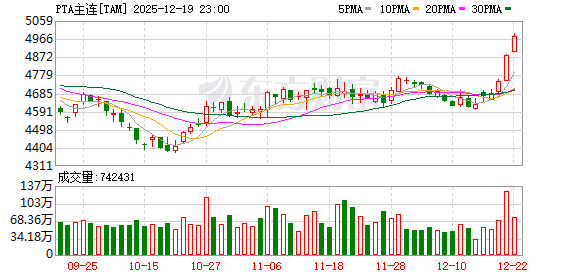
PX、PTA期货价格逆势大涨!核心驱动是……
Qi Huo Ri Bao· 2025-12-20 23:55
最近两个交易日,聚酯品种表现较强。本周五,PX和PTA期货主力合约开盘后增仓上行,双双创下近3个月以来的新高。 库存方面,12月PTA维持去库态势,1至2月聚酯开工负荷大概率季节性下降,有小幅累库预期,但整体累库压力明显偏低,短期基本面的稳健表现为行情 提供了有力支撑。 PTA2605 ▲ TA2605 期货 主力 夜盛 2.03% 74.24万 4992 振幅 高 메레 4980 4822 117.3万 4894 持仓 俱 昨结 158 3.28% 4896 +87088 开 今结 日增 l 相关ETF 2 能源化工 ETF 1.215 0.75% > 日K 周K 月K 五日 分时 更多。 0 均线 ▼ 日线 MA5:4792 10:4745 20:4754 30:4749 筹码 5028 4992-> 4873 4718 4563 L7 -4444 2025/10/20 2025/11/20 2025/12/22 其中,PX期货价格创下自3月以来的阶段高点,PTA期货价格成功突破年内高点4900元/吨。在当前原油和化工品市场整体表现偏弱的背景下,PX和PTA的 价格表现引发市场关注。 强预期成为行情"发动 ...

黑色金属数据日报-20251219
Guo Mao Qi Huo· 2025-12-19 02:43
Report Industry Investment Rating - Not provided in the given content Core Viewpoints - For steel, cost support strengthens, but the independent driving force for finished products is weak. The supply - demand structure is weak, and short - term long positions can be considered from a valuation perspective with stop - loss set [3]. - For ferrosilicon and silicomanganese, energy - related policies boost prices in the short term, but there is a medium - term supply surplus, and it is recommended to go long on ferrosilicon and short on silicomanganese [3]. - For coking coal and coke, the futures market rebounds rapidly. It is recommended to wait and see for now, and industrial customers can consider purchasing cost - effective spot [3]. - For iron ore, iron water production is falling, and prices are under pressure. However, prices may decline more slowly after the expected iron water stabilization and subsequent restocking [3]. Summary by Related Content Futures Market - On December 18, the closing prices of far - month contracts RB2610, HC2610, J2605, and JM2609 were 3151.00 yuan/ton, 3288.00 yuan/ton, 1743.00 yuan/ton, and 1200.00 yuan/ton respectively, with corresponding increases of 1.25%, 0.98%, 4.75%, and 5.68% [1]. - The closing prices of near - month contracts RB2605, HC2605, J2601, and JM2605 were 3125.00 yuan/ton, 3277.00 yuan/ton, 1603.50 yuan/ton, and 1126.50 yuan/ton respectively, with corresponding increases of 1.40%, 1.05%, 5.39%, and 6.07% [1]. - The cross - month spreads of RB2605 - 2610, HC2605 - 2610, J2601 - 2605, and JM2605 - 2609 were - 26.00 yuan/ton, - 11.00 yuan/ton, - 139.50 yuan/ton, and - 73.50 yuan/ton respectively [1]. - The spread/ratio/profit indicators such as coil - to - rebar spread, rebar - to - ore ratio, coal - to - coke ratio, rebar paper profit, and coking paper profit on December 18 were 152.00, 4.02, 1.42, - 17.38, and 105.26 respectively [1]. Spot Market - On December 18, the spot prices of Shanghai rebar, Tianjin rebar, Guangzhou rebar, and Tangshan billet were 3320.00 yuan/ton, 3190.00 yuan/ton, 3520.00 yuan/ton, and 2950.00 yuan/ton respectively, with corresponding increases of 30.00 yuan/ton, 20.00 yuan/ton, 40.00 yuan/ton, and 10.00 yuan/ton [1]. - The spot prices of Shanghai hot - rolled coil, Hangzhou hot - rolled coil, and Guangzhou hot - rolled coil were 3300.00 yuan/ton, 3300.00 yuan/ton, and 3290.00 yuan/ton respectively, with corresponding increases of 20.00 yuan/ton, 30.00 yuan/ton, and 10.00 yuan/ton [1]. - The spot prices of Qingdao Port super - special powder, Ganqimao coal, and Qingdao Port quasi - first - grade coke were 678.00 yuan/ton, 1120.00 yuan/ton, and 1530.00 yuan/ton respectively, with corresponding increases of 9.00 yuan/ton, 0.00 yuan/ton, and - 50.00 yuan/ton [1]. - The basis values of HC, RB, J, and JM on December 18 were 23.00 yuan/ton, 195.00 yuan/ton, 76.66 yuan/ton, and 23.50 yuan/ton respectively, with corresponding changes of - 12.00 yuan/ton, - 11.00 yuan/ton, - 126.76 yuan/ton, and - 64.50 yuan/ton [1].
金融赋能 护航实体——内蒙古银行“陪伴式”服务助力本土企业迈向国际市场
Jin Rong Jie· 2025-12-18 03:42
Group 1 - Inner Mongolia Chuangyuan Metal Co., Ltd. officially listed on the Hong Kong Stock Exchange on November 24, marking a significant milestone for private enterprises in Tongliao City and the aluminum industry in China [1] - The company has established an annual production capacity of 800,000 tons of electrolytic aluminum and six 330MW thermal power units since its foundation in 2012, becoming a benchmark for green transformation in the regional aluminum industry [1] - Inner Mongolia Bank played a crucial role in supporting the IPO process by providing financial services tailored to the company's needs, demonstrating a commitment to local economic development [1] Group 2 - In March, Inner Mongolia Bank responded to Chuangyuan Metal's funding needs for raw material procurement by initiating a multi-level collaboration mechanism, resulting in a 400 million yuan working capital loan and a 370 million yuan loan for wind power projects [2] - The bank's financial support is aligned with national "dual carbon" goals and energy consumption control policies, as Chuangyuan Metal is proactively developing green electricity projects to reduce carbon emissions and enhance sustainability [2] - The green electricity project is expected to significantly lower operational costs and improve the company's environmental image and market competitiveness, contributing to the narrative of "Chinese green aluminum" on the international stage [2] Group 3 - Inner Mongolia Bank has consistently focused on serving the real economy, aligning with national financial strategies and actively participating in the region's industrial development [3] - The bank has introduced innovative financial products such as "Glass Fiber Loan" and "Integrity Loan" to address the financing challenges faced by startups and small enterprises, with total funding exceeding 5.87 billion yuan [3] - The bank aims to provide comprehensive financial services throughout the lifecycle of enterprises, fostering a symbiotic relationship between banks and local businesses [3]