
自有品牌战略

Search documents
若羽臣(003010):公司事件点评报告:自有品牌放量,盈利能力优化
Huaxin Securities· 2025-08-20 15:04
Investment Rating - The report maintains a "Buy" investment rating for the company [1] Core Views - The company's self-owned brand strategy is showing significant value, driving rapid revenue growth [4] - The company plans to repurchase shares worth 100-200 million yuan at a price not exceeding 76.8 yuan per share, which will be used for employee stock ownership plans [4] - The overall profitability has improved, with a net profit margin increase of 1 percentage point to 5.48% in the first half of 2025 [5] Financial Performance - In H1 2025, total revenue reached 1.319 billion yuan, a year-on-year increase of 68%, while net profit was 72 million yuan, up 86% [4] - The gross margin increased by 11 percentage points to 56.92%, with sales and management expense ratios changing significantly due to new brand cooperation methods [5] - The company's self-owned brands, including "Feicui" and "Zhanjia," generated revenues of 160 million yuan and 444 million yuan respectively, with "Zhanjia" seeing a 157% year-on-year increase [6] Market Channels - Revenue from online channels such as Douyin, Tmall, and JD.com saw substantial growth, with Douyin's revenue increasing by 239% and accounting for 37% of total sales [6] - The company is focusing on enhancing brand presence on Douyin to boost sales and brand equity [6] Brand Development - The "Zhanjia" brand is strengthening its market position with differentiated advantages, while "Feicui" is rapidly expanding its product range [7][8] - The company aims to enhance brand awareness and invest in high-potential product categories to capture market growth [8] Earnings Forecast - The company is expected to maintain high growth rates, with projected EPS of 0.79, 1.21, and 1.66 yuan for 2025, 2026, and 2027 respectively [9] - The current stock price corresponds to PE ratios of 76, 49, and 36 for the respective years [9]
汇通达网络 + 掌门人传媒:共拓“线上+线下”融合新生态
Cai Fu Zai Xian· 2025-08-18 10:05
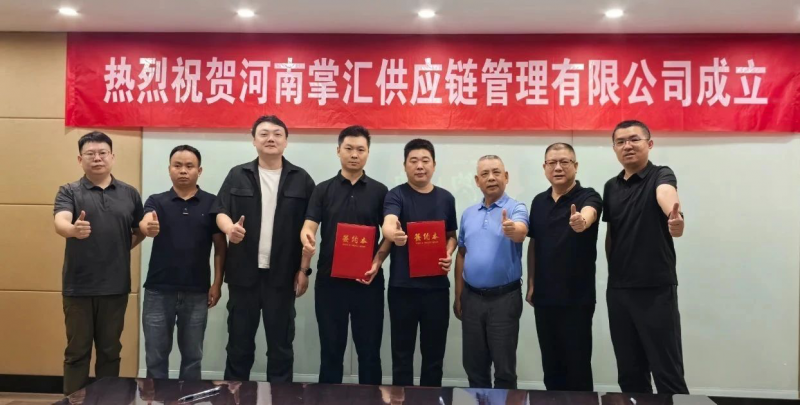
Core Viewpoint - The strategic partnership between Huitongda Network and Zhangmen Media Group aims to enhance brand development, product innovation, and channel integration through the establishment of Henan Zhanghui Supply Chain Management Co., Ltd [2][4][6] Group 1: Company Overview - Zhangmen Media Group has over a decade of experience in advertising marketing services and online brand operations, positioning itself as a leader in internet content production and management [4] - The group has successfully transformed from Jiangsu Zhangmen Network Technology Co., Ltd into one of the first full-domain MCNs in China, holding a leading position in the internet content sector [4] - It operates over 20 established self-owned brands across six core areas, including cosmetics, apparel, food and beverage, pet products, and home appliances [4] Group 2: Strategic Collaboration - The partnership is seen as a crucial element in Huitongda's self-owned brand strategy, with significant potential for collaboration in product development, advertising, and brand co-creation [6] - Huitongda Network has built a strong foundation in the lower-tier market over the past decade, aiming to leverage this partnership for mutual empowerment and enhanced efficiency in product and service distribution [6] - The establishment of Henan Zhanghui Supply Chain Management Co., Ltd represents a tangible outcome of the strategic collaboration, focusing on innovative supply chain models in the new retail environment [6]

步步高上半年净利润超2亿元 自有品牌成新亮点
Zheng Quan Shi Bao Wang· 2025-08-14 13:17
Group 1 - The company reported a revenue of 2.129 billion yuan for the first half of 2025, representing a year-on-year increase of 24.45%, and a net profit of 201 million yuan, marking a turnaround from losses [1] - The significant growth in revenue is attributed to store optimization, improved product management, and enhanced supply chain efficiency, particularly in supermarket sales [1] - The company has implemented restructuring measures that confirmed substantial restructuring gains, while focusing on core advantageous regions to enhance overall store efficiency and profitability [1] Group 2 - The company has adopted strategies from the successful model of "胖东来" by gradually closing inefficient stores and transforming potential ones, leading to improved overall operational performance [2] - The reopening of the Yongzhou Shunde store on August 9 marked the completion of adjustments in 19 stores, which have become key drivers of revenue growth, with sales during the Spring Festival season increasing by 3-6 times and customer traffic rising over 300% [2] - The company has established strategic partnerships with over 200 quality suppliers, enhancing product pricing advantages and freshness, which has effectively driven sales growth across all categories [3] Group 3 - The self-owned brand BL, launched in March 2025, has become a highlight for the company, with products rapidly climbing sales rankings and showing a steady increase in gross margin and market share [4] - As of the end of July, over 50 products under the BL brand have been launched, covering a diverse range of categories, and the monthly sales in July were nearly six times that of March [4] - The company plans to continue focusing on core regions and deepening retail fundamentals, leveraging the "胖东来" model to solidify its development foundation and showcase a retail transformation example [4]

华源证券:量贩龙头充分享受下沉市场升级+渠道效率提升红利 渠道未来仍有较大成长空间
Zhi Tong Cai Jing· 2025-08-14 08:14
Group 1 - The core viewpoint is that the bulk snack retail model, characterized by "vertical + thousands of stores" hard discount strategies, is fundamentally a business driven by traffic growth, benefiting from market upgrades and improved channel efficiency [1] - The total number of stores in the industry has rapidly expanded from 13,000 in January 2022 to over 40,000 currently, leading to an increase in the share of specialty store channels from 7.6% in 2019 to 11.2% in 2024, with the market size of the leisure food and beverage sector projected to reach 3.7 trillion [1] - The bulk retail format shows strong competitiveness in terms of payback period and capital efficiency compared to other retail formats, with a theoretical potential for approximately 86,000 stores nationwide based on various supply and demand parameters [1] Group 2 - The transition from vertical bulk retail to horizontal product expansion is seen as a challenging yet correct strategy, with discount supermarkets optimizing single-store models and expanding store space through refined operations and supply chain efficiencies [2] - The competitive landscape is becoming clearer with leading players in the bulk retail sector focusing on mergers and acquisitions, with distinct advantages in market distribution and operational efficiency between major players [3] - The profitability of leading bulk retailers is expected to improve in the short term due to reduced subsidies and scale efficiencies, while the development of private label brands is crucial for long-term growth and valuation enhancement [4]
休闲零食专题系列报告(一):量贩模式发展:渠道渗透与品类拓展机遇,行业双超对比思考
Hua Yuan Zheng Quan· 2025-08-14 06:29
Investment Rating - The report maintains a "Positive" investment rating for the leisure snack industry [1]. Core Insights - The bulk discount snack channel is fundamentally a business driven by traffic growth, benefiting from the "good, fast, and economical" model, which has allowed leading players to capitalize on the upgrading of lower-tier markets and improved channel efficiency. The total number of stores in the industry has rapidly expanded from 13,000 in January 2022 to over 40,000 currently, contributing to an increase in the share of specialty store channels from 7.6% in 2019 to 11.2% in 2024, with the market size of the leisure food and beverage sector expected to reach 3.7 trillion yuan by 2024 [4][13][8]. Summary by Sections 1. Review of Bulk Snack Channel Development and Future Opportunities - The leisure food and beverage market in China is projected to grow at a CAGR of approximately 5.5% from 2019 to 2024, reaching around 3.7 trillion yuan by 2024. The traditional supply chain is undergoing efficiency transformations due to urbanization, information equality, and logistics and digitalization improvements [8][13]. - The bulk snack channel, characterized as a hard discount model, has thrived by maximizing efficiency and price competitiveness, successfully capturing market share during the rise of value-conscious consumption and the new retail transformation [9][13]. - The number of bulk snack stores has surged from 13,000 in early 2022 to over 40,000, with leading companies like Mingming Hen Mang and Wancheng Group projected to achieve GMV of approximately 55 billion yuan and 43.5 billion yuan, respectively, in 2024 [13][8]. 2. Bulk Channel: Mingming Hen Mang vs. Wancheng - The competitive landscape is becoming clearer as the leading players transition from rapid expansion to mergers and acquisitions. The report highlights the distinct advantages of Mingming Hen Mang and Wancheng in terms of store distribution and operational efficiency [65][66]. - By the end of 2024, both Mingming Hen Mang and Wancheng are expected to operate over 14,000 stores each, with a combined market share of approximately 68%, reflecting a 20 percentage point increase from 2023 [65][73]. 3. Future Profitability and Valuation Considerations for Bulk Channels - The report emphasizes that the profitability of leading players is expected to improve as the competitive landscape stabilizes, with a focus on self-owned brand strategies to enhance scale and profitability. The self-owned brand strategy of Mingming Hen Mang aims to provide differentiated products and higher added value, aligning with future consumer demands [4][13][65]. - The report draws parallels with international discount retail leaders, indicating that similar strategies could lead to sustained growth and valuation improvements, with potential PE ratios exceeding 30x for successful brands [4][13].
电商品牌若羽臣筹划赴港上市,独家回应自有品牌绽家出海计划
Nan Fang Du Shi Bao· 2025-08-07 12:08
Group 1 - Company is planning to issue H-shares and apply for listing on the Hong Kong Stock Exchange, viewing this as a key step in its globalization strategy [1] - The H-share listing is expected to enhance the company's international perspective and resource integration, benefiting its global business expansion [1] - The Hong Kong market offers preferential treatment for A+H company listings, providing a more convenient pathway for the company [1] Group 2 - The company aims to focus on the Southeast Asian market, particularly with its own brand, Zhenjia, which is expected to grow due to a compound annual growth rate of at least 5% in the cleaning products sector [2][10] - In Southeast Asia, the laundry products segment is projected to reach a market size of $10 billion in 2024, accounting for 52% of the cleaning products market [10] - The household cleaning market is expected to reach $4 billion, representing 20% of the total cleaning products market, indicating significant growth potential [10] Group 3 - The company has seen a decline in its agency operation business, while its brand management and own brand businesses have experienced substantial growth [5] - In 2024, the brand management business generated revenue of 501 million yuan, a year-on-year increase of 212.24%, and accounted for 28.38% of total revenue [5][6] - The own brand business also achieved revenue of 501 million yuan, with a year-on-year growth of 90.28%, making up 28.37% of total revenue [5][6] Group 4 - The company reported a total revenue of approximately 1.77 billion yuan in 2024, a 29.26% increase from the previous year [6] - The agency operation business generated revenue of 764 million yuan, down 18.95%, and accounted for 43.25% of total revenue [6] - The company anticipates a significant increase in net profit for the first half of 2025, projected between 63 million and 78 million yuan, representing a year-on-year growth of 61.81% to 100.33% [6] Group 5 - The company has established deep collaborations with over 100 well-known international and domestic brands in various sectors, including health, beauty, and food [7] - For instance, Bayer's product sales increased by 283% in 2024, with significant growth across various online platforms [7] Group 6 - The own brand LYCOCELLE Zhenjia achieved revenue of 480 million yuan in 2024, with a year-on-year growth of 90.09%, and has seen sales double across multiple channels [9] - The own health brand FineNutri, launched in September 2024, generated revenue of 12.12 million yuan, with strong performance on the Tmall platform [9]
A股百亿市值美妆公司冲刺港股
3 6 Ke· 2025-08-07 04:53
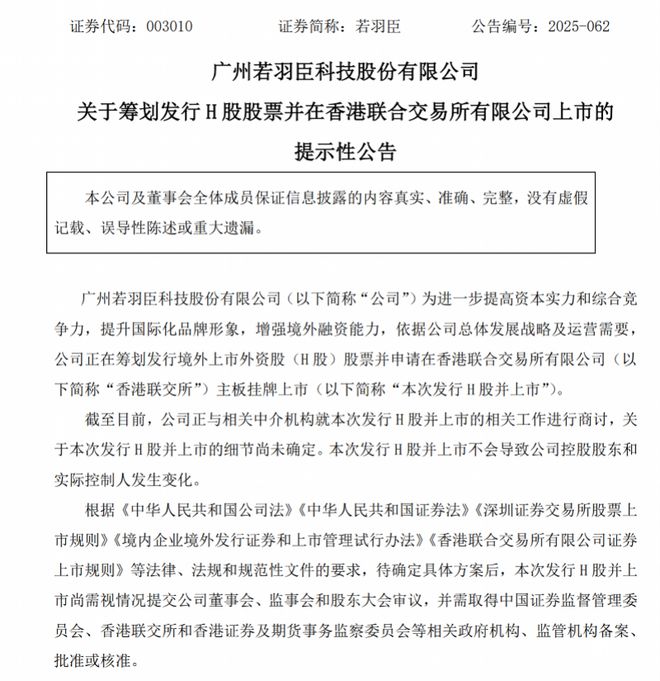
Core Viewpoint - Guangzhou Ruoyuchen Technology Co., Ltd. is planning to issue H-shares and apply for listing on the Hong Kong Stock Exchange, following other beauty TP companies, indicating a trend of dual listing in the beauty industry [1][2][3] Company Overview - Ruoyuchen, established in 2011 and listed on the Shenzhen Stock Exchange in 2020, is a beauty TP enterprise that provides comprehensive e-commerce services for brand owners, including online store operations and marketing [3][4] - The company has expanded its business from maternal and infant products to beauty, health products, and household cleaning, establishing itself as a global consumer brand digital management company [3][4] Financial Performance - For the first half of 2025, Ruoyuchen's net profit is projected to be between 63 million and 78 million yuan, a year-on-year increase of 61.81% to 100.33% compared to 38.93 million yuan in the same period last year [3][4] - In 2024, Ruoyuchen achieved revenue of 1.766 billion yuan, a year-on-year growth of 29.26%, and a net profit of 106 million yuan, up 94.58% from the previous year [4][6] Industry Context - The beauty TP industry is currently undergoing a deep adjustment period, with many companies struggling to survive. The total revenue of six listed beauty TP companies dropped from 9.99 billion yuan in 2022 to 7.653 billion yuan in 2024, a cumulative decline of 23.3% [4][5] - Despite the industry's downturn, Ruoyuchen has emerged as a rare success story, demonstrating strong growth resilience [5][7] Business Transformation - Ruoyuchen is transitioning from a "TP operator" to a "comprehensive brand service provider," focusing on self-owned brands and brand management to achieve structural growth [8][12] - The company's brand management business has rapidly grown, with revenue increasing from 160 million yuan in 2023 to 501 million yuan in 2024, marking a growth of 212.24% [10][11] Strategic Positioning - Ruoyuchen has diversified its business model by developing a balanced portfolio across various categories, reducing reliance on a single category. In 2024, the beauty category accounted for 34%, while household cleaning, maternal and infant products, and health products made up 28%, 21%, and 13%, respectively [12]
永辉超市为什么重视自有品牌?
Sou Hu Cai Jing· 2025-08-04 13:42
Core Insights - Yonghui Supermarket aims to focus on its private label strategy, targeting the development of 15 major products with annual sales of 1 billion yuan each within five years [3][5]. Group 1: Private Label Strategy - Yonghui has officially announced a renewed focus on its private label products, emphasizing the need for a national brand that resonates with consumers [3][4]. - The company plans to increase the number of private label products from 60 in 2025 to 500 by 2029, with a target of achieving a penetration rate of 40% by 2029 [5][6]. - Yonghui's private label strategy includes the introduction of "Yonghui Preferred," which encompasses various product lines such as snacks, daily groceries, and personal care items [2][8]. Group 2: Major Product Strategy - Yonghui's strategy includes the development of "major products," defined as items that can generate over 10% of total store sales, with a goal of having 15 such products by 2029 [3][4]. - The company aims to learn from successful models like "Pang Donglai" to create products with over 100 million yuan in sales, focusing on high turnover rates and customer value [6][7]. - Yonghui emphasizes the importance of unique value propositions (UVP) and high-quality standards in product development, ensuring that products are both competitively priced and of superior quality [4][6]. Group 3: Supply Chain and Operational Improvements - Yonghui is transitioning its supply chain strategy from a focus on key accounts (KA) to a customer value (CA) approach, fostering long-term, transparent relationships with suppliers [5][9]. - The establishment of Zhejiang Huilian Supply Chain Co., Ltd. aims to enhance the development and operation of Yonghui's private label products, with a commitment to integrity and quality control [5][9]. - The company has already formed partnerships with 101 manufacturers and established 19 self-owned breeding bases to strengthen its supply chain [9].


若羽臣(003010):自有品牌强势驱动,期待新品牌继续放量
Shenwan Hongyuan Securities· 2025-07-16 14:45
Investment Rating - The investment rating for the company is "Buy" (maintained) [1] Core Views - The company is expected to continue strong growth driven by its proprietary brands and the launch of new brands [7] - The company reported a net profit of 63 million to 78 million yuan for the first half of 2025, representing a year-on-year increase of 61.81% to 100.33% [7] - The self-owned brand strategy has proven to be a significant growth engine, with notable performance from the "Zhanjia" product line and the introduction of new health products [7] - The company has optimized internal management, leading to improved efficiency and reduced costs [7] - The company has launched a new health product brand, "VitaOcean," which is expected to open new growth opportunities [7] Financial Data and Profit Forecast - Total revenue is projected to reach 3,014 million yuan in 2025, with a year-on-year growth rate of 70.7% [6] - The net profit attributable to the parent company is expected to be 180 million yuan in 2025, reflecting a year-on-year growth of 70.6% [6] - Earnings per share are forecasted to be 0.82 yuan in 2025, up from 0.65 yuan in 2024 [6] - The gross profit margin is expected to be 49.4% in 2025 [6] - The return on equity (ROE) is projected to be 14.3% in 2025 [6]
名酒代理不香了?酒类大商集体转向了
Mei Ri Jing Ji Xin Wen· 2025-07-16 12:54
Core Viewpoint - The traditional liquor distribution model in China is facing significant challenges, with high inventory levels and declining profits, prompting companies to seek new business strategies and self-branded products to adapt to changing market conditions [1][2][3]. Group 1: Industry Challenges - Overall consumption during the Spring Festival was below expectations, leading to higher-than-expected inventory levels, which will impact shipment volumes in the following months [1]. - The era of easy profits from high-end liquor sales is ending, with companies now needing to sell significantly more volume to achieve the same profit margins [2]. - 79.31% of liquor distribution companies view price inversion as the primary factor eroding operating profits and affecting growth [2]. Group 2: Shift to Self-Branded Products - Companies are moving away from relying solely on high-margin name-brand liquors and are now focusing on developing their own brands to create sustainable competitive advantages [3][4]. - The liquor industry is witnessing a consensus on seeking new profit models, with companies like JiuXian Group launching new products aimed at becoming well-known brands in the mid-price range [3]. - 1919 is transitioning its profit model from "name-brand price difference" to "strategic brand-driven," with sales of its strategic brand products expected to reach 600 million yuan this year [3]. Group 3: New Business Models - The liquor retail sector is evolving to combine offline experiences with online sales, emphasizing the importance of enhancing product categories to meet social and lifestyle needs [5][6]. - 1919 is implementing a "restaurant + liquor" strategy, integrating retail with dining experiences to create a stronger consumer engagement [5]. - The growth of e-commerce and live streaming is becoming crucial, with companies like JiuXian Group seeing significant revenue from live streaming sales, which have become a major growth driver [6].