
货币政策工具

Search documents
央行公布最新数据,解读来了
21世纪经济报道· 2025-12-13 12:05
记者丨唐婧 编辑丨周炎炎 12月12日,中国人民银行公布《2025年11月金融统计数据报告》,政府债券快发多发对贷款 的替代效应继续显现。 具体来看,2025年11月末社会融资规模存量为440.07万亿元,同比增长8.5%。其中,对实体 经济发放的人民币贷款余额为267.42万亿元,同比增长6.3%;企业债券余额为34.08万亿元, 同比增长5.6%;政府债券余额为94.24万亿元,同比增长18.8%。 从结构看, 11月末对实体经济发放的人民币贷款余额占同期社会融资规模存量的60.8%,同比 低1.3个百分点;企业债券余额占比7.7%,同比低0.3个百分点;政府债券余额占比21.4%,同 比高1.8个百分点。 从增量看, 2025年前十一个月社会融资规模增量累计为33.39万亿元,比上年同期多3.99万亿 元。其中,对实体经济发放的人民币贷款增加14.93万亿元,同比少增1.28万亿元;企业债券 净融资2.24万亿元,同比多3125亿元;政府债券净融资13.15万亿元,同比多3.61万亿元。 业内专家表示,今年以来,宏观政策加大逆周期调节力度,对提振内需、稳定经济发挥了积极 作用,也为金融总量合理增长提供了 ...


保障岁末年初流动性充裕 央行将进行6000亿元买断式逆回购
Shang Hai Zheng Quan Bao· 2025-12-12 19:25
◎记者 张琼斯 12月12日,央行发布公告,12月15日将以固定数量、利率招标、多重价位中标方式开展6000亿元买断式 逆回购操作,期限为6个月(182天)。 业内专家表示,央行通过各种流动性工具的配合使用,有效应对财政税收、政府债券发行等短期波动, 货币市场运行整体平稳,银行体系流动性保持充裕。这些工具相互配合、各有侧重,已经形成了立体化 的流动性管理工具体系。 保障岁末年初流动性充裕 央行本月加量续作6个月期买断式逆回购,实现净投放2000亿元,继续向市场注入中短期流动性,以更 好地维护市场流动性充裕,保障岁末年初金融市场平稳运行。 王青认为,本次操作主要是考虑到12月政府债券发行规模会处于较高水平,新型政策性金融工具会带动 配套贷款增长,以及12月银行同业存单到期量达3.7万亿元,这些因素会在一定程度上带来资金面收紧 效应。 "着眼于应对潜在的流动性收紧态势,央行继续通过买断式逆回购向银行体系注入流动性,将助力政府 债券发行,引导金融机构加大货币信贷投放力度。"王青表示。 12月还有3000亿元中期借贷便利(MLF)到期。招联首席研究员董希淼预计,央行将在25日前后等量 或加量操作MLF,继续向市场投放 ...
千亿金融活水集聚五大重点领域
Jin Rong Shi Bao· 2025-12-09 02:09
为全力落实好一揽子货币政策措施,紧扣重庆市建设"六区一高地"目标任务,中国人民银行重庆市分行 安排1000亿元低成本资金,围绕科技创新、绿色金融、提振消费、稳定外贸以及民营小微五大领域,创 设"渝科融""渝绿融""渝消融""渝通融""渝民融"五个百亿级货币政策工具支持计划,并通过构建"政策宣 贯+科技赋能+融资对接+效果评估+协调调度"五位一体的全链条金融服务体系,为五大领域高质量发展 提供有力资金支持。 货币政策工具支持计划实施以来,重庆落地支持计划专用额度1478亿元,支持经营主体16万余户。其 中,科创、民营领域超300亿元、绿色领域超100亿元,货币政策工具的牵引带动作用充分显现。 强化部门协同联动 科技赋能融资对接"提速" 中国人民银行重庆市分行加强与行业主管部门协同联动,在需求摸排、融资对接、问诊把脉方面形成合 力,推动金融机构运用科技化手段优化线上信贷流程。该行通过"长江渝融通"大数据平台向辖内银行累 计推送重点领域企业8.1万余户,全面提升服务效率。 重庆友强高分子材料股份有限公司深耕高分子改性材料研发与制造领域近二十年。近期,该企业精准把 握市场需求趋势,急需资金用于新型材料配方的研发工作。 ...
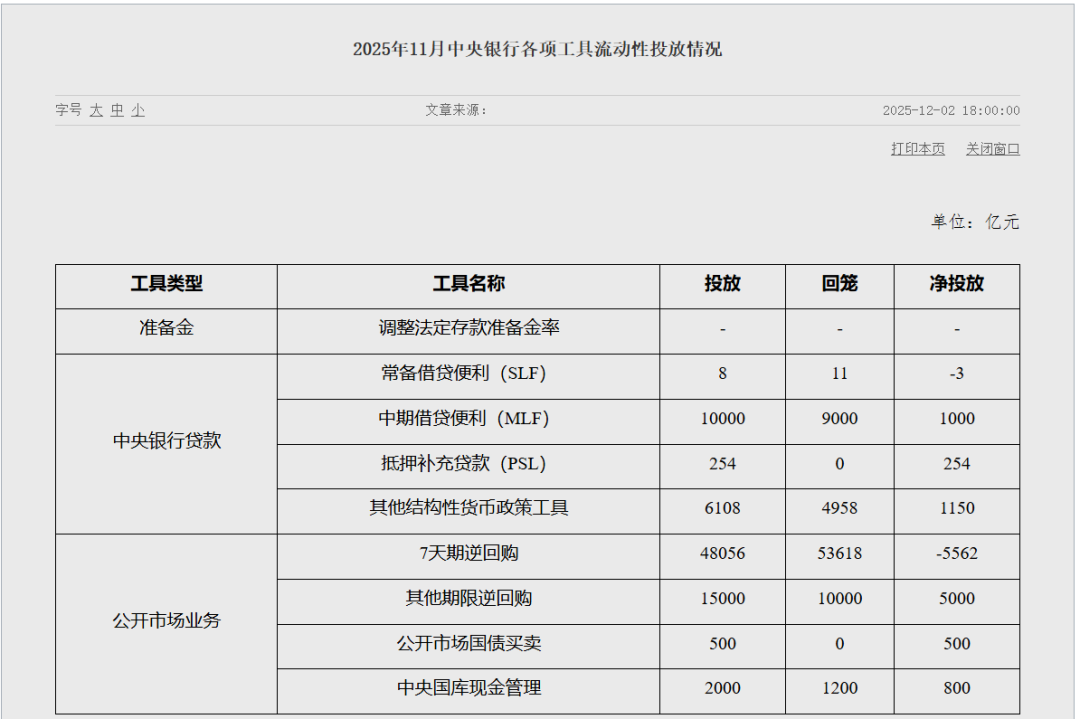
刚刚,央行发布11月中央银行各项工具流动性投放情况
Jin Rong Shi Bao· 2025-12-02 11:56
Summary of Key Points Core Viewpoint - The central bank's liquidity injection in November 2025 shows a mixed approach with net withdrawals in some areas and significant net injections in others, indicating a strategic balance in monetary policy to manage liquidity in the economy [1]. Group 1: Central Bank Loan Tools - The central bank's standing lending facility (SLF) had a net withdrawal of 3 million yuan, indicating a reduction in liquidity through this channel [2][3]. - The medium-term lending facility (MLF) saw a net injection of 1000 million yuan, reflecting an effort to provide longer-term liquidity support [2][3]. - The pledged supplementary lending (PSL) had a net injection of 254 million yuan, contributing positively to liquidity [2][3]. - Other structural monetary policy tools resulted in a net injection of 1150 million yuan, further enhancing liquidity in the market [2][3]. Group 2: Open Market Operations - The 7-day reverse repurchase agreements experienced a net withdrawal of 5562 million yuan, indicating a tightening of short-term liquidity [2][3]. - Other term reverse repos had a net injection of 5000 million yuan, suggesting a targeted approach to manage liquidity over different time horizons [2][3]. - The net injection from open market transactions in government bonds was 500 million yuan, contributing to overall liquidity management [2][3]. - Central treasury cash management operations resulted in a net injection of 800 million yuan, supporting the liquidity framework [2][3].
分析师称不排除中国央行年底前后实施新一轮降准的可能
Sou Hu Cai Jing· 2025-11-24 22:29
Core Viewpoint - The central bank has injected 1 trillion yuan through MLF, marking the ninth consecutive month of increased MLF operations, aimed at maintaining liquidity and supporting credit growth to stabilize economic expectations [1] Monetary Policy Actions - The central bank is utilizing various monetary policy tools to ensure ample liquidity in the market, which is expected to encourage financial institutions to increase credit issuance [1] - There is a possibility of implementing a new round of reserve requirement ratio (RRR) cuts by the end of the year, as indicated by analysts [1] Economic Outlook - Given the fluctuations in the external environment and changes in domestic economic growth momentum, new policies aimed at stabilizing growth may be introduced to support macroeconomic performance in the fourth quarter and the first quarter of the following year [1]
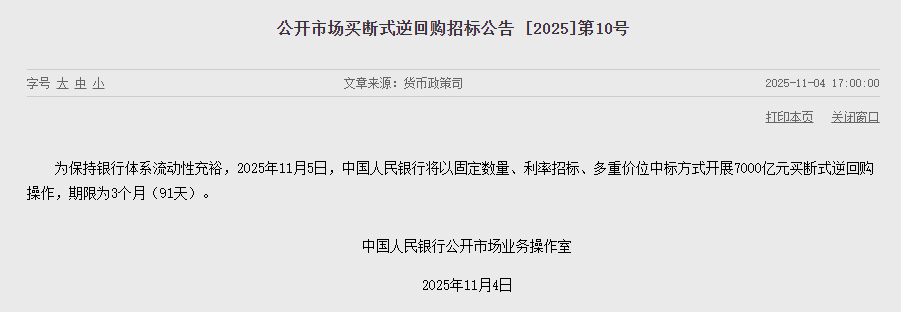
央行开展7000亿元买断式逆回购操作 有助保持市场流动性充裕
Zhong Guo Jing Ying Bao· 2025-11-04 15:52
Core Viewpoint - The People's Bank of China (PBOC) announced a 700 billion yuan reverse repurchase operation to maintain liquidity in the banking system, indicating a continuation of supportive monetary policy [2][3]. Group 1: Reverse Repo Operations - On November 5, 2025, the PBOC will conduct a fixed-quantity, interest-rate tender, multi-price reverse repurchase operation of 700 billion yuan with a term of 3 months (91 days) [2]. - The operation is aimed at injecting medium-term liquidity into the banking system, helping to stabilize the funding environment and support government bond issuance [2][3]. - In November, an additional 300 billion yuan of 6-month reverse repos is expected, with a likelihood of increased amounts, marking the sixth consecutive month of medium-term liquidity injection [3]. Group 2: Market Liquidity and Policy Tools - The PBOC has been actively using reverse repo operations to adjust short-term liquidity and has also employed medium-term lending facilities (MLF) to enhance medium and short-term liquidity [3]. - In October, the PBOC net withdrew 595.3 billion yuan through short-term reverse repos, while net injecting 400 billion yuan through buyout reverse repos and 200 billion yuan through MLF [3]. Group 3: Future Expectations - Experts anticipate a potential reserve requirement ratio (RRR) cut before the end of the year, as the fourth quarter is a critical period for growth-stabilizing policies [4]. - The PBOC's actions are seen as timely and necessary to maintain ample market liquidity and encourage financial institutions to increase credit issuance [4].
国务院关于金融工作情况的报告:金融市场顶住高强度外部冲击考验
Bei Jing Shang Bao· 2025-10-28 12:00
Financial Performance and Regulatory Overview - Financial institutions' operational and regulatory indicators remain within a reasonable range, with total assets exceeding 520 trillion yuan by September 2025. The capital adequacy ratio for commercial banks is 15.36%, and the non-performing loan ratio stands at 1.52%. Insurance companies have a comprehensive solvency adequacy ratio of 186%, while securities and futures companies have average risk coverage ratios of 295% and 226%, respectively, all significantly above regulatory standards, indicating overall sufficient loss absorption capacity [1][2]. Market Stability and Recovery - The financial market has withstood significant external shocks, with improved expectations and a substantial increase in confidence. The Shanghai Composite Index rose by 18.4% from November 2024 to September 2025, reaching over 3900 points in October, a ten-year high. Daily trading volume in the Shanghai and Shenzhen stock markets averaged approximately 2.3 trillion yuan since August, significantly higher than the previous year's average of about 700 billion yuan. The yield on 10-year government bonds has stabilized between 1.75% and 1.85%, reversing a downward trend observed in 2024 [2]. Regulatory Improvements - Financial regulatory systems have been further refined, enhancing governance, regulatory ratings, and consumer protection across financial institutions. Measures have been implemented to combat fraud and gambling-related financial activities, including the introduction of product suitability management guidelines and revisions to regulations governing public companies. A crackdown on financial fraud in listed companies has been initiated, alongside stricter regulations on share reduction practices [3]. Enforcement and Legal Framework - Regulatory enforcement has become more standardized, with the People's Bank of China penalizing 1978 individuals/entities, the financial regulatory bureau sanctioning 4127 banking and insurance institutions, and the China Securities Regulatory Commission penalizing 1423 entities since November 2024. The legal framework for finance is progressing, with efforts to revise various financial laws and regulations, including those governing the central bank, banking supervision, and securities management [3].
9000亿元!央行预告
Qi Huo Ri Bao· 2025-10-25 09:44
Core Viewpoint - The People's Bank of China (PBOC) is set to conduct a 900 billion yuan MLF operation on October 27, aiming to maintain ample liquidity in the banking system [1] Group 1: Monetary Policy Actions - The PBOC will implement a fixed quantity, interest rate bidding, and multiple price bidding method for the MLF operation [1] - In October, the central bank has also conducted a net injection of 400 billion yuan through reverse repos, leading to a total net liquidity injection of 600 billion yuan for the month, consistent with the previous month [1] Group 2: Economic Context - Over the past five months, there has been a continuous net injection of medium-term liquidity, with a significant increase in the net injection scale over the last three months [1] - The expected net financing of government bonds in October is projected to reach one trillion yuan [1] Group 3: Regulatory and Policy Signals - Regulatory authorities are encouraging financial institutions to increase credit issuance [1] - The PBOC's ongoing implementation of net liquidity injections signals a sustained commitment to quantitative monetary policy tools [1] - The central bank aims to ensure liquidity is ample, reduce overall financing costs, support consumption, expand effective investment, and stabilize the financial market [1]
瑞达期货铝类产业日报-20251020
Rui Da Qi Huo· 2025-10-20 09:47
1. Report Industry Investment Rating - Not provided in the content 2. Core Viewpoints of the Report - The alumina market may face a situation where supply gradually decreases while demand remains stable. It is recommended to conduct light - position oscillating trading, paying attention to controlling rhythm and trading risks [2] - The Shanghai aluminum market may be in a stage of slightly increasing supply and boosted demand. The option market sentiment is bullish. It is also advised to conduct light - position oscillating trading and control risks [2] - The cast aluminum market may experience a situation of converging supply and stable demand, with relatively high industry inventory. Similar to the above, light - position oscillating trading is recommended [2] 3. Summary by Related Catalogs 3.1 Futures Market - **Prices and Spreads**: The closing price of the Shanghai aluminum main contract was 20,910 yuan/ton with no change; the closing price of the alumina futures main contract was 2,806 yuan/ton, up 6 yuan. The LME electrolytic aluminum three - month quotation was 2,778.50 US dollars/ton, down 17.50 US dollars. The main - to - second - consecutive contract spreads for Shanghai aluminum, alumina, and cast aluminum all changed, with some increasing and some decreasing [2] - **Positions and Inventories**: The main contract positions of Shanghai aluminum, alumina, and cast aluminum changed, with Shanghai aluminum and alumina positions increasing and cast aluminum positions decreasing. The LME aluminum inventory decreased by 4,100 tons to 491,225 tons, while the alumina total inventory increased by 33,021 tons to 239,607 tons [2] - **Other Indicators**: The Shanghai - London ratio was 7.53, up 0.05. The net position of the top 20 in Shanghai aluminum decreased by 2,258 hands to 15,505 hands [2] 3.2 Spot Market - **Prices**: The prices of Shanghai Non - ferrous A00 aluminum, alumina spot in Shanghai Non - ferrous, and other products changed, with some prices decreasing and some remaining unchanged [2] - **Basis**: The basis of cast aluminum, electrolytic aluminum, and alumina all weakened [2] - **Premiums and Discounts**: The Shanghai Wuma aluminum premium and discount, and LME aluminum premium and discount also changed, with the former increasing by 20 yuan/ton to 0 yuan/ton and the latter decreasing by 4.64 US dollars/ton to 12.88 US dollars/ton [2] 3.3 Upstream Situation - **Production and Utilization**: Alumina production increased by 35.98 million tons to 792.47 million tons, and the capacity utilization rate increased by 1.53 percentage points to 88.27%. The demand for alumina in the electrolytic aluminum part increased by 3.73 million tons to 725.80 million tons [2] - **Import and Export**: The export volume of alumina increased by 7 million tons to 25 million tons, while the import volume decreased by 3.44 million tons to 6 million tons. The import volume of aluminum scrap decreased by 17,195.97 tons to 155,414.40 tons, and the export volume increased by 15.31 tons to 68.54 tons [2] 3.4 Industry Situation - **Production and Capacity**: The total production capacity of electrolytic aluminum remained unchanged at 4,523.20 million tons, and the production of primary aluminum, aluminum products, and recycled aluminum alloy ingots increased [2] - **Import and Export**: The import and export volumes of primary aluminum both increased, while the export volume of unforged aluminum and aluminum products decreased [2] 3.5 Downstream and Application - **Production**: The production of aluminum alloy and automobiles increased, while the national real - estate prosperity index decreased [2] - **Volatility**: The historical volatility of Shanghai aluminum decreased, while the implied volatility of the Shanghai aluminum main - contract at - the - money increased slightly [2] 3.6 Industry News - The Chinese central bank and other departments created two monetary policy tools to support the capital market, injecting billions of yuan into the market and boosting investor confidence [2] - The US President sent a signal to ease trade tensions, and the Trump administration relaxed some tariff policies [2] - A video call was held between Chinese and US economic and trade representatives, and they agreed to hold a new round of economic and trade consultations [2]

沪铜产业日报-20251020
Rui Da Qi Huo· 2025-10-20 09:46
Report Summary 1. Report Industry Investment Rating No relevant information provided. 2. Core View of the Report - The Shanghai copper main contract fluctuates strongly, with increasing open interest, spot premium, and weakening basis. Fundamentally, the tight supply situation of copper concentrates has not improved, TC fees hover in the negative range, and the impact of overseas mine disturbances persists, keeping ore prices firm. - On the supply side, due to many maintenance cases and the tight supply of copper ore and blister copper, smelting capacity may be restricted. In addition, the price of smelting by - product sulfuric acid shows signs of decline, which also affects smelting profits, and the operating rate may decline, leading to a gradual convergence of domestic refined copper supply. - On the demand side, copper prices remain high due to cost support and overseas macro - sentiment. Downstream buyers are cautious due to high prices, adopting a wait - and - see procurement strategy, resulting in a weak trading sentiment in the spot market. High copper prices suppress downstream demand. - Overall, the fundamentals of Shanghai copper may be in a situation of weak supply and demand, with industrial inventory accumulation. In the options market, the call - put ratio of at - the - money options is 1.34, up 0.0238 month - on - month, indicating a bullish sentiment, and the implied volatility slightly decreases. Technically, the 60 - minute MACD shows that the two lines are near the 0 axis, and the red bars slightly converge. The operation suggestion is to lightly go long on dips and pay attention to controlling the rhythm and trading risks [2]. 3. Summary According to Relevant Catalogs Futures Market - The closing price of the main futures contract of Shanghai copper is 85,380 yuan/ton, up 990 yuan; the price of LME 3 - month copper is 10,665 dollars/ton, up 60.5 dollars. - The spread between the main contract and the next - month contract is 20 yuan/ton, down 20 yuan; the open interest of the main contract of Shanghai copper is 226,910 lots, up 11,337 lots. - The net position of the top 20 futures holders of Shanghai copper is - 10,843 lots, down 3,770 lots; the LME copper inventory is 137,225 tons, down 225 tons. - The inventory of cathode copper in the Shanghai Futures Exchange is 110,240 tons, up 550 tons; the LME copper cancelled warrants are 7,825 tons, up 275 tons. - The warehouse receipts of cathode copper in the Shanghai Futures Exchange are 41,319 tons, down 2,856 tons [2]. Spot Market - The price of SMM 1 copper spot is 85,630 yuan/ton, up 855 yuan; the price of Yangtze River Non - Ferrous Metals Market 1 copper spot is 85,920 yuan/ton, up 1,025 yuan. - The CIF (bill of lading) price of Shanghai electrolytic copper is 50 dollars/ton, unchanged; the average premium of Yangshan copper is 35 dollars/ton, down 0.5 dollars. - The basis of the CU main contract is 250 yuan/ton, down 135 yuan; the LME copper cash - to - 3 - month spread is - 16.83 dollars/ton, down 5.67 dollars. - The import volume of copper ore and concentrates is 258.69 million tons, down 17.2 million tons; the rough smelting fee (TC) of domestic copper smelters is - 40.97 dollars/kiloton, down 0.61 dollars [2]. Upstream Situation - The price of copper concentrate in Jiangxi is 76,190 yuan/metal ton, up 1,050 yuan; the price of copper concentrate in Yunnan is 76,890 yuan/metal ton, up 1,050 yuan. - The processing fee of blister copper in the south is 1,000 yuan/ton, unchanged; the processing fee of blister copper in the north is 700 yuan/ton, unchanged. - The output of refined copper is 1.301 billion tons, up 31 million tons; the import volume of unwrought copper and copper products is 490,000 tons, up 60,000 tons [2]. Industry Situation - The social inventory of copper is 41.82 million tons, up 0.43 million tons; the price of 1 bright copper wire scrap in Shanghai is 57,990 yuan/ton, down 350 yuan. - The ex - factory price of 98% sulfuric acid of Jiangxi Copper is 590 yuan/ton, unchanged; the price of 2 copper scrap (94 - 96%) in Shanghai is 71,550 yuan/ton, down 350 yuan [2]. Downstream and Application - The output of copper products is 2.2219 billion tons, up 52.6 million tons; the cumulative completed investment in power grid infrastructure is 379.576 billion yuan, up 48.079 billion yuan. - The cumulative completed investment in real estate development is 6.7706 trillion yuan, up 739.681 billion yuan; the monthly output of integrated circuits is 4.37 billion pieces, up 119,712.9 pieces [2]. Option Situation - The 20 - day historical volatility of Shanghai copper is 22.79%, up 0.01%; the 40 - day historical volatility of Shanghai copper is 16.96%, up 0.19%. - The at - the - money implied volatility (IV) of the current month is 19.2%, down 0.0153%; the call - put ratio of at - the - money options is 1.34, up 0.0238 [2]. Industry News - The head of the Financial Stability Bureau of the central bank said that during the "14th Five - Year Plan" period, China's financial risks are generally controllable, financial institutions operate steadily, and the financial market runs smoothly, providing strong support for high - quality economic development. - Fed's Musalem said that if employment faces more risks and inflation is under control, he may support another rate - cut path. - US President Trump continued to send conciliatory signals in a recent interview, suggesting that the door remains open. The Trump administration is quietly relaxing a number of tariff policies, exempting dozens of products from the so - called "reciprocal tariffs" in recent weeks and proposing to exclude more products from tariffs when countries reach trade agreements with the US. - The People's Bank of China and other departments have created two monetary policy tools to support the capital market - stock repurchase and increase re - loans and swap facilities, with an initial quota of 800 billion yuan in total. In the past year, the two monetary tools have injected hundreds of billions of yuan into the market through counter - cyclical adjustment, effectively boosting investors' confidence, reducing the volatility of the A - share market, and enhancing the internal stability of the capital market. - Chinese and US economic and trade leaders held a video call, agreeing to hold a new round of China - US economic and trade consultations as soon as possible [2].