AI革命

Search documents
有色板块“炸锅”!“超级牛股”飙涨,公募基金却“躲着走”?
Hua Xia Shi Bao· 2026-02-04 09:17
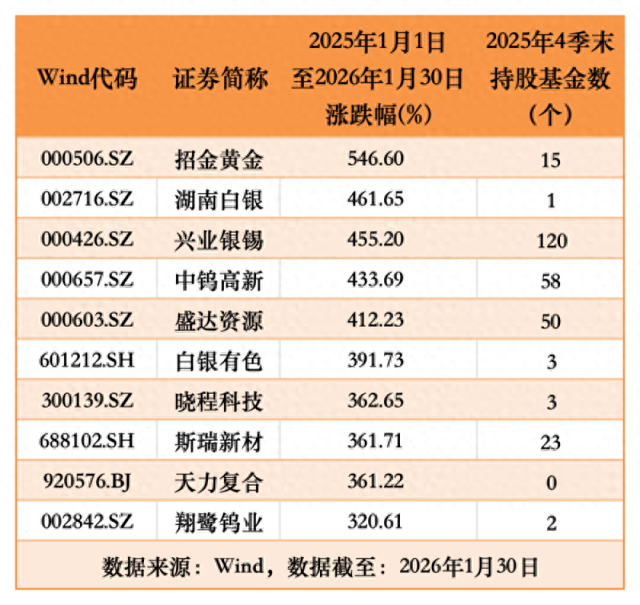
Core Insights - The article highlights a paradox in the non-ferrous metals sector where despite a significant bull market, very few public funds have captured the top-performing stocks [1][2] - The analysis indicates that institutional investors are generally avoiding stocks with historical governance issues or high uncertainty, even if market expectations are strong [2][3] Group 1: Stock Performance and Fund Holdings - Some non-ferrous metal stocks have seen remarkable price increases, with Zhaojin Gold rising over 540% and Xiaocheng Technology increasing over 362% since 2025 [2] - As of the end of 2025, Zhaojin Gold was held by only 15 funds, Xiaocheng Technology by 3 funds, and Hunan Silver by just 1 fund, indicating a lack of institutional interest in these high-performing stocks [2][4] Group 2: Institutional Investment Behavior - Public funds are constrained by strict compliance frameworks and risk management systems, leading to cautious investment decisions regarding companies with historical flaws or high operational uncertainty [3][4] - The preference for larger, more stable companies is evident, as only 17 non-ferrous stocks are held by over 100 funds, primarily those with market capitalizations exceeding 50 billion [4][5] Group 3: Market Trends and Future Outlook - The current non-ferrous metal market is supported by a multi-dimensional logic, including global liquidity easing and anticipated continued monetary and fiscal stimulus [6][8] - Supply constraints and new demand from sectors like AI and energy transition are focal points for institutional investors, with copper, gold, and aluminum identified as key investment directions [8][9]






别抄底黄金了!普通人跟风必亏,长期持有才是王道
Sou Hu Cai Jing· 2026-02-04 07:10
如果你现在想的还是能不能趁着暴跌抄底黄金、大赚一笔,那么你大概率是挣不到这个钱的。但如果你考虑的是做资产配置,那么金价这波回撤之 后,确实比之前性价比更高了。 这两天黄金的暴跌,让很多因为求稳才买黄金的朋友,第一次感受到了资本市场的残酷。那么现在黄金还有机会吗?我们先看核心数据——黄金在 历史上,一共只出现过两次规模超过美债规模的情况,而我们目前正在经历第三次。 第一次黄金超过美债,是在布雷顿森林体系刚瓦解时。当时石油危机叠加美国经济衰退,大资金一股脑抛弃美元去买黄金;在黄金规模超过美债之 后的第八个月,美联储下场干预、直接抛售黄金,金价见顶开始转跌。 第二次则发生在5年之后的1979年,第二次石油危机爆发,全球资本再次转向黄金,黄金规模再度超过美债,并迎来了历史性大涨。这剧本,和现在 惊人的相似。 但就在黄金规模超过美债7个月后,著名的"沃尔克时刻"出现,美联储大幅加息,导致金价再次见底,并开启了长达20年的下跌。之后美国开始一路 印钞、一路发债,黄金再也没有追上美债的脚步。 直到2026年1月份,我们再次见证历史:黄金规模追上了全球美债规模,随之而来的,就是打破40年纪录的单日大跌。 就像我之前视频里一直 ...

杨德龙:近期国际金价大幅波动的原因与启示
Xin Lang Cai Jing· 2026-02-04 01:51
Core Viewpoint - Recent fluctuations in international gold prices have raised concerns among investors, with gold reaching $5600 per ounce before a significant drop, particularly in silver, which saw a 30% decline in a single day [1][2][6] Group 1: Market Dynamics - The recent drop in gold prices is attributed to a hawkish stance from the new Federal Reserve Chairman, leading to fears of tightening liquidity and balance sheet reduction [1][2] - The rapid increase in gold prices, exceeding $1000 in just a couple of weeks, was unsustainable, indicating that such sharp rises often precede significant corrections [1][2][6] - The current rebound in gold prices, now above $4800 per ounce, suggests that many investors are taking advantage of the dip, presenting a re-entry opportunity for those who missed earlier gains [2][7] Group 2: Investment Strategy - Investors are advised to view gold and silver as part of a long-term asset allocation strategy rather than short-term trading opportunities, with a recommendation to allocate about 20% of their portfolio to gold-related assets [2][7] - The volatility in gold and silver prices serves as a reminder that no asset is immune to fluctuations, emphasizing the importance of a rational investment approach [2][7] Group 3: Long-term Outlook - Looking ahead to 2026, gold and silver are expected to remain attractive assets, although the likelihood of a one-sided price surge like in 2025 is low, with increased volatility anticipated [3][8] - Factors such as rising U.S. national debt, which has surpassed $38 trillion, and concerns over fiscal sustainability are likely to support the long-term upward trend in gold prices [3][9] - The ongoing trend of "de-dollarization" is expected to gradually reduce the dollar's dominance in global payments and reserves, enhancing the appeal of gold and other hard currencies [4][9] Group 4: Economic Context - Domestic investors are facing a pivotal moment in asset allocation, with a significant amount of fixed-term deposits maturing and interest rates declining, prompting a search for new investment avenues [10] - The A-share market is showing signs of a slow bull market, with historical patterns suggesting potential for a spring rally, which could lead to increased investment in equities [10][11] - The focus for 2025 will be on technology stocks, while 2026 is expected to highlight innovations in various sectors, indicating a potential shift in capital market dynamics [10][11]
为什么越乱,黄金美股反而一起跌?未来几年90%的人可能赚不到钱
Sou Hu Cai Jing· 2026-02-02 16:48
2026年1月30日,金融市场出现了罕见一幕:黄金价格暴跌16%,白银狂泻39%,美股三大指数集体跳水,比特币也跌破8万美元大关。 最让人看不懂的是, 一向被视作"避风港"的黄金,竟然和风险资产美股同步暴跌。 这种反常现象背后,是一场全球投资逻辑的彻底颠覆。 过去"乱世买黄金"的常识失效了,取而代之的是一个更加复杂和危险的新格局。 当市场同时抛售黄金和美股时,唯一合理的解释就是:美元流动性收缩了。 这不是简单的市场波动,是全球资本面临现金短缺的明确信号。 2025年底至2026年初,市场对美联储降息的预期发生剧烈反转。 随着新任美联储主席凯文·沃什的上任,投资者意识到美元流动性可能被大幅收紧。 这位以 激进主张闻名的掌门人,公开支持大幅缩减美联储资产负债表。 流动性就像金融市场的血液。 一旦收紧,机构投资者会不惜一切代价获取现金——哪怕是抛售原本被视为安全的黄金。 . 2022年俄罗斯海外资产被冻结事件,让各国意识到存放在海外的美元资产可能不再是"资产",而是可以被随时冻结的"人质"。 这种安全担忧推动全球央行 加速购买黄金。 美联储面临的困境远超市场想象。 一方面,美国联邦政府债务总额已突破38万亿美元,利 ...
轮椅 vs 皮衣:张忠谋黄仁勋的芯片对话
是说芯语· 2026-02-02 11:02
这两天,朋友圈被这条消息炸了——94岁的张忠谋,坐着轮椅,见了61岁的黄仁勋。 不是简单的商业会面。这是半导体界的"冰与火之歌",是芯片王朝的权力交接,是两个疯子跨越33岁年 龄差的终极对话! 你们知道这意味着什么吗?这意味着,当你还在为35岁被裁员焦虑时,有人94岁依然坐在全球科技命脉 的牌桌上!这意味着,当你觉得60岁该退休时,有人正穿着皮衣点燃全球AI革命! 轮椅不是弱势,那是王座! 两个疯子子的创业史 张忠谋57岁创办台积电时,全世界都觉得他疯了。 "57岁了!该退休的年纪创什么业?""芯片代工?这是什么鬼模式?""台湾想搞半导体?做梦!" 但就是这个"疯子",用37年时间,把台积电做到了全球芯片代工市场份额55%!苹果、英伟达、高通、 AMD——全球所有科技巨头,都得跪着求他产能! 眼神中的帝国 看到照片那一刻,我浑身起鸡皮疙瘩。 94岁的张忠谋被助理推着入场,脸上布满老年斑,双手放在轮椅扶手上——但你看他的眼神!那根本不 是老人的眼神!那是鹰!是狮!是巡视自己帝国的王! 而对面站着的黄仁勋,一身黑色皮衣,手臂纹身若隐若现,像个摇滚巨星——不,他本来就是摇滚巨星, 只是恰好统治了全球AI芯片市场。 ...



贵金属:欲戴王冠,必承其重
Fang Zheng Zhong Qi Qi Huo· 2026-02-02 05:18
Group 1: Report Industry Investment Rating - Not provided in the content Group 2: Core Viewpoints of the Report - The underlying logic of the current precious metals bull market is global de - dollarization, which remains intact. Central bank gold purchases continue [81]. - Despite Trump's nomination of Warsh as the new Fed chair, the Fed is expected to continue cutting interest rates, leading to a decline in real US Treasury yields and benefiting gold and silver. Fed balance - sheet reduction is difficult to implement [81]. - The impairment of the US dollar's credit is due to multiple factors and is likely to enter a medium - to - long - term decline. 2026 is a big year for US Treasury issuance, with the total scale expected to exceed $40 trillion [81]. - Gold and silver are being redefined as anti - inflation assets and important components of global asset allocation. Silver's supply - demand contradiction remains unresolved, and it may have better price elasticity and return in 2026 [81]. - In the short term, there is a need for a technical correction, but the medium - to - long - term upward trend remains unchanged [81]. Group 3: Summary by Directory I. Market Review 1. Gold - In January 2026, the global gold market had a spectacular performance. London gold broke through the $5000 mark and reached nearly $5600, then had a significant drop. However, both London gold and Shanghai gold had cumulative gains of over 10%. Factors influencing the market included increased geopolitical uncertainty, accelerated de - dollarization, the Fed's inaction, the end of a series of negative factors, and Trump's appointment of a new Fed chair [14]. 2. Silver - In January 2026, the silver market also had an epic performance, with a more violent fluctuation. It had a cumulative gain of over 30%. The driving factors were similar to those of gold, and the potential risk of overseas delivery was also priced in. It also had a significant correction at the end of the month [17]. II. Macro Logic 1. Change in the Pricing Logic of Precious Metals - The traditional relationship between US Treasury real yields and gold has changed since 2023. The US debt, deficit, and the impairment of the US dollar's credit are becoming the new pricing anchors for gold. The pricing logic has shifted from the financial to the monetary attribute [21]. 2. De - dollarization Trend - The US dollar index has been declining since 2025, indicating a long - term decline in the US dollar premium. The "Triffin Dilemma" and the "Sea Lake Manor Agreement" are related to the US's economic strategy, which may lead to a reduction in the US dollar's status as a reserve currency. Global central banks have been de - dollarizing and increasing their gold holdings [24]. 3. Weakening of the Safe - haven Attributes of the US Dollar and US Treasuries - The US dollar and US Treasuries have started to show risk - asset characteristics, with the US stock, bond, and currency markets experiencing multiple sell - offs. Gold and silver's safe - haven attributes have been highlighted [28]. 4. Expansion of US Treasury Debt - The US Treasury debt has been expanding rapidly, with the total expected to exceed $40 trillion in 2026. This has led to a diversion of global safe - haven funds to gold, silver, and other assets [30]. 5. Gold as a Hedge against Credit Risk - Gold and silver have become the ultimate choice to hedge against the risks of the global credit currency system due to high global debt and the weakening of the US dollar's credibility [32]. 6. US Dollar Cycle - The US dollar has an approximately 17 - year cycle, and currently, it is at the start of a downward cycle. A decline in the US dollar index is expected to boost gold prices [34]. 7. US Economic and Policy Situation - The US GDP showed certain growth in 2025, consumer confidence improved in January 2026, the labor market cooled down, and inflation remained above the Fed's target. The Fed's independence has been challenged, and the market has different expectations for its policy [37][39][40]. 8. Redefinition of Gold - Gold has both "safe - haven" and "risk - asset" attributes. It can resist inflation and is an important part of global asset allocation [43]. III. Fundamental Logic 1. Central Bank Gold Purchases - In 2025, global central bank gold purchases reached a high level, though the pace slowed down. Some central banks increased their holdings, while others sold gold. De - dollarization is expected to continue in 2026, and central bank gold purchases will remain a fundamental demand for gold [49]. 2. Gold Investment Demand - In 2025, global gold total demand reached a record high, mainly driven by investment demand. Gold ETFs and physical gold investment demand increased, while gold jewelry demand declined in quantity but increased in value. Gold supply also increased [52]. 3. Silver Supply - The silver supply side has strong constraints, with limited growth in mineral and recycled silver. In 2025 and 2026, the total supply is expected to increase slightly [55]. 4. Silver Demand - Industrial demand accounts for nearly 60% of total silver demand. In 2025, total silver demand is expected to decline slightly, and industrial demand has different trends in different fields. AI is expected to be an important source of future demand growth [58]. 5. Silver Supply - Demand Gap - The silver market has been in short supply for five consecutive years, and the gap is expected to continue in 2026. The available inventory is extremely limited, and the price elasticity is high [62]. 6. Gold - Silver Ratio - The gold - silver ratio reflects the premium of gold over silver in terms of safe - haven demand. It is affected by economic cycles, inflation, and other factors. Currently, the ratio has dropped to a relatively low level, and there is room for further adjustment [63][64]. 7. Asset Management and ETF Holdings - For gold, the non - commercial net long position in the COMEX market has decreased, while the holdings of the largest gold ETF have increased. For silver, both the non - commercial net long position in the COMEX market and the holdings of the largest silver ETF have decreased [68][71]. 8. Technical Analysis - The monthly chart of London gold shows an upward trend, and the weekly chart of London silver shows a correction within the upward channel [76][77]. IV. Summary and Outlook - In February, the price ranges of London gold, Shanghai gold, London silver, and Shanghai silver are predicted. After the adjustment, there may be medium - to - long - term investment opportunities, and it is recommended to buy on dips [80].
板块中长期上行趋势未改,工业有色ETF鹏华(159162)盘中成交额超9000万
Xin Lang Cai Jing· 2026-01-30 05:55
Group 1 - Microsoft reported FY2026 Q2 earnings, exceeding market expectations for revenue and net profit, but faced significant capital expenditure increase of 66% to $37.5 billion, slowing growth in Azure business, and high dependency on OpenAI [1] - Following the earnings report, Microsoft's stock price dropped 10%, marking the largest single-day decline since March 2020, contributing to increased market volatility and tightening short-term liquidity [1] - Precious metals like gold and silver reached historical highs before experiencing significant declines due to profit-taking and market liquidity issues, with gold dropping 8.8% and silver falling 13.75% [1] Group 2 - The industrial and non-ferrous metals sector maintains a long-term upward trend, with short-term emotional disturbances presenting potential investment opportunities [2] - Copper faces a clear long-term supply gap due to insufficient capital expenditure, increased demand from the AI revolution, and macroeconomic recovery expectations [2] - The aluminum sector benefits from ongoing supply-side constraints and expanding applications, while rare earth metals are expected to see valuation increases due to stricter export controls [2] Group 3 - The CSI Industrial Non-Ferrous Metals Theme Index (H11059) includes 30 major companies in copper, aluminum, lead, zinc, and rare earth industries, reflecting the overall performance of the sector [3] - As of December 31, 2025, the top ten weighted stocks in the index accounted for 56.18% of the total, including companies like Luoyang Molybdenum and Northern Rare Earth [3] - The MACD golden cross signal indicates positive momentum for these stocks [3]
CSIWM个股点评:2026年关键里程碑
citic securities· 2026-01-29 12:23
Group 1: Company Overview and Market Position - SoftBank Group has achieved significant growth over the past 30 years through investments in mobile communications and internet assets[12] - The company maintains a strong market position in Japan's mobile communications and internet culture sectors, characterized by defensive strength and high profitability[12] Group 2: Key Financial Metrics - As of January 28, 2026, SoftBank's stock price was 4,201.0 JPY, with a market capitalization of 159.99 billion USD[13] - The stock has a 12-month high of 6,828.75 JPY and a low of 1,458.75 JPY[13] - Revenue breakdown shows 90.0% from SoftBank, 6.9% from Arm, and 0.0% from the Vision Fund and Delta Fund, with 91.8% of revenue generated in Asia[13] Group 3: Investment and Growth Drivers - Key catalysts for SoftBank's stock performance in 2026 include AI adoption speed, OpenAI financing progress, and the company's robot strategy[7] - SoftBank is reportedly considering a 30 billion USD investment in OpenAI, which could enhance market confidence in OpenAI's development[6] - The company is also involved in a commitment to invest 550 billion USD in the U.S., which could further drive growth[8] Group 4: Risks and Challenges - The CEO's involvement is critical; any change in management could lead to market concerns[11] - Increased competition in the telecommunications sector poses potential risks to SoftBank's business[11] - Rising interest rates could impact SoftBank's high debt levels, which are currently manageable due to Japan's low-interest environment[11]
美股上演冰火两重天,道指狂泄500点,但半导体、黄金、中概股却逆势狂欢,游戏直播巨头虎牙带飞整个中概股板块
Sou Hu Cai Jing· 2026-01-29 07:27
Market Overview - The Dow Jones Industrial Average fell over 500 points, closing down 1.02%, while the Nasdaq index rose by 0.81% [1][3] - The S&P 500 index saw a slight increase of 0.31% [3] - The market experienced a significant shift in capital, with semiconductor, gold, silver, and Chinese concept stocks emerging as major winners [1] Sector Performance - Semiconductor stocks, particularly Micron Technology, saw gains exceeding 5% due to favorable news regarding price increases for memory chips supplied to Apple [4][5] - Traditional sectors, including silver mining and healthcare, faced declines, with major companies like UnitedHealth and HCA Healthcare seeing stock drops of nearly 17% and over 16%, respectively [3] - The precious metals market saw gold prices rise to $5065 per ounce, while silver prices increased by over 2% [5] Chinese Stocks - Chinese concept stocks performed well, with the Nasdaq Golden Dragon China Index showing significant gains [7] - Individual stocks like Huya surged over 20%, driven by the success of a new game, while other companies like Su Xuan Tang Pharmaceuticals and Kingsoft Cloud also saw substantial increases [7] Macroeconomic Factors - The U.S. dollar index fell to 96.37, marking a five-month low, which made dollar-denominated assets cheaper for foreign investors [3] - The Federal Reserve is expected to maintain interest rates in its upcoming meeting, marking a pause after three consecutive rate cuts [8] - Goldman Sachs predicts the next rate cut could occur in June, with a potential reduction of 25 basis points [9]

期市“锵锵谈”:一场与未来市场的深度对话
Qi Huo Ri Bao· 2026-01-29 04:37
Group 1 - The article discusses the rising prices of gold and copper, indicating a significant interest in the commodities market, which is seen as either a response to global risk aversion or a precursor to a new inflation cycle [1][2] - The narrative around copper is evolving, with it being referred to as the "new oil" in the context of energy transition and AI revolution, suggesting a fundamental shift in trading logic [2][4] - The upcoming video interview series "期市'锵锵谈'" aims to bridge the gap between macroeconomic insights and investors, focusing on complex market dynamics and providing a "thinking map" for understanding trends [1][3] Group 2 - The first episode will focus on copper, featuring industry experts who will discuss its transformation from an economic indicator to a strategic asset, and the implications for market participants [2][4] - The discussions will cover various topics, including the changes in trading logic, the truth behind COMEX inventory dynamics, and the identification of key risks and opportunities for 2026 [2][3] - The series intends to balance professional insights with accessible information for a wide audience, covering other core commodities in future episodes [3][5]