春季躁动

Search documents
机构论后市丨12月或成为布局跨年行情的窗口期;春季躁动中值得关注的仍然是成长风格
Di Yi Cai Jing· 2025-12-07 09:45
信达证券:12月或成为布局跨年行情的窗口期;国海证券:春季躁动中值得关注的仍然是成长风格;开 源证券:可提前布局春季躁动。 沪指本周累计上涨0.37%,深证成指涨1.26%,创业板指涨1.86%。A股后市怎么走?看看机构怎么说: ①信达证券:12月或成为布局跨年行情的窗口期 开源证券指出,近期市场回调暂告一段落,可提前布局春季躁动,交易和配置上应注意:(1)科技与 周期双轮驱动,反内卷下周期机会凸显;(2)科技依然具备中长期占优的条件;(3)在近期的调整 中,我们认为部分超跌的成长行业的机会已经有所显现:军工、传媒(游戏)、AI应用、港股互联网、 电力设备等;而未来机构的核心科技蓝筹或也将跟随修复。 ④银河证券:A股市场中长期向好逻辑不改 银河证券指出,年末行情轮动较快,或仍以震荡结构为主。同时,A股市场中长期向好逻辑不改。监管 层下调险企股票投资风险因子,将进一步释放保险资金入市潜力,为市场注入更多增量流动性。 ⑤华宝证券:建议12月优选景气度向上的行业进行提前布局 华宝证券指出,由守转攻,积极布局高景气方向等风起。内外部波动风险均有所缓和,前期热门成长板 块多数出现了止跌企稳的现象,12月有望进一步整固企 ...


东吴证券:春季躁动之十五五规划
Xin Lang Cai Jing· 2025-12-07 09:29
Core Viewpoint - The spring market rally may occur earlier this year due to various catalysts and the late timing of the Spring Festival, with a shift in market focus from large-cap value stocks to small-cap growth stocks, particularly in the AI application sector [1][8]. Group 1: Spring Rally Dynamics - Historical patterns indicate that spring rallies are more likely when the market is in a state of speculation, particularly when there are divergences in the DDM three-factor model [2][9]. - The current economic environment is characterized by moderate recovery, making a spring rally a high-probability event under speculative conditions [2][9]. - The late timing of the Spring Festival this year may lead to earlier market movements influenced by policy changes, economic data, and risk events, similar to trends observed in 2013 and 2018 [2][9]. Group 2: Five-Year Planning Impact - The release of five-year planning proposals historically correlates with stronger spring rallies, as seen in the aftermath of proposals in 2010, 2015, and 2020 [3][11]. - The current proposal emphasizes a shift towards growth styles following the initial dominance of value styles, reflecting a broader trend observed in previous five-year plans [3][11]. - Key sectors highlighted in the five-year plans, such as high-end manufacturing, energy construction, and new technologies, tend to perform well during spring rallies [4][12]. Group 3: Strategic Focus of the 15th Five-Year Plan - The 15th Five-Year Plan focuses on optimizing traditional industries, expanding emerging industries, and forward-looking layouts for future industries, particularly in AI and technology [5][13]. - The plan prioritizes the construction of a modern industrial system, high-level opening up, and improving people's livelihoods, which are expected to drive economic growth [6][13]. - Specific sectors such as quantum technology, biotechnology, and renewable energy are identified as future growth points, aligning with global trends in technology and innovation [6][14]. Group 4: Investment Opportunities - The upcoming spring rally is expected to favor sectors related to technology trends, such as AI applications and consumer electronics, which have shown signs of stagnation [7][14]. - High-demand sectors like semiconductors, energy storage, and wind power are anticipated to benefit from the rally [7][14]. - The market is advised to pay attention to low-positioned technology sectors, including robotics and innovative pharmaceuticals, which may have rotation potential [7][14].

开源证券:本轮春季躁动的共性&个性
Xin Lang Cai Jing· 2025-12-07 09:07
Core Viewpoint - The article discusses the reasons behind the seasonal market rally known as "spring excitement," emphasizing its historical significance and the factors contributing to its occurrence [1][2][4]. Group 1: Significance of Spring Rally - The spring rally serves as a market response to economic expectations and policy directions for the coming year, allowing investors to position themselves for the main themes of the year [1][8]. - It provides a favorable opportunity for institutions to adjust their portfolios, especially after year-end assessment pressures ease [1][8]. - The rally reflects seasonal liquidity improvements, driven by capital inflows around the Spring Festival and heightened policy expectations [1][8]. Group 2: Core Causes of Spring Rally - The three main causes of the spring rally include: 1. Concentrated release of policy expectations [1][8]. 2. Seasonal changes in liquidity, including a narrowing M1-M2 gap and strong credit issuance at the beginning of the year [1][8]. 3. An earnings vacuum period that allows institutions to adjust their holdings [1][8]. Group 3: Factors Influencing Rally Intensity - Historical analysis indicates that a strong spring rally typically requires one or a combination of the following conditions: 1. Short-term macroeconomic data (e.g., PMI, social financing, industrial value-added) significantly exceeding expectations, signaling economic stabilization or recovery [2][8]. 2. Overall corporate profitability entering an upward trajectory, with positive annual and quarterly earnings forecasts, free from major external disruptions [2][8]. 3. Clearly accommodative monetary policy, characterized by rising M1 growth, declining short-term interest rates, and enhanced credit pulses, providing ample liquidity support for high-elasticity assets [2][8]. Group 4: Changes in Funding Ecology - The current market sees two significant changes in funding ecology that may contribute to a stable increase in China's securitization rate: 1. The weakening of real estate investment attributes, with the equity market becoming a new primary venue for household assets [2][9]. 2. Indirect movement of household funds into the market, resulting in a continuous and stable influx of new capital [2][9]. Group 5: Investment Strategy - The investment strategy suggests a dual focus on technology and cyclical sectors, highlighting: 1. The dual driving forces of technology and cyclical opportunities, with cyclical prospects becoming more prominent amid anti-involution trends [4][11]. 2. Continued long-term advantages for technology sectors [4][11]. 3. Identification of opportunities in recently undervalued growth sectors such as military, media (gaming), AI applications, Hong Kong internet, and power equipment [4][11]. Group 6: Sector Allocation Recommendations - Recommendations for sector allocation include: 1. Internal recovery and high-low cuts within technology: military, media (gaming), AI applications, Hong Kong internet, batteries, and core AI hardware [5][12]. 2. Benefits from PPI improvement and broad anti-involution: solar energy, chemicals, steel, non-ferrous metals, electricity, and machinery [5][12]. 3. Long-term core holdings: stable dividends, gold, and optimized high-dividend stocks [5][12].
投资策略专题:本轮春季躁动的共性、个性
KAIYUAN SECURITIES· 2025-12-07 07:15
Group 1: Commonality of Spring Rally - The spring rally signifies the market's early response to economic expectations and policy directions for the coming year, allowing investors to position themselves for the main themes of the year [12][13] - The three core drivers of the spring rally include concentrated policy expectations, seasonal liquidity changes, and the performance vacuum during the earnings reporting period [16][20] - Strong spring rallies typically occur when macroeconomic data significantly exceeds expectations, overall corporate earnings enter an upward trajectory, and monetary policy is notably accommodative [21][20] Group 2: Changes in Funding Ecology Behind the Index Bull Market - The weakening of real estate investment attributes has led to the equity market becoming the new main stage for residents' assets, with a structural migration of funds from real estate to stocks and funds [23][24] - Residents' funds are indirectly entering the market, bringing stable incremental capital, with a shift from high-yield financial products to new categories such as fixed income+, secondary bond funds, and higher-risk bank wealth management products [25][26] Group 3: Investment Strategy - Technology and Cyclical Sectors - The market correction is seen as a temporary pause, with an emphasis on early positioning for the spring rally, focusing on both technology and cyclical sectors as dual drivers [29][30] - Specific sectors showing potential include military industry, media (gaming), AI applications, Hong Kong internet, and power equipment, with core technology blue chips expected to recover [29][30]
财通证券:春季躁动的十问十答
Xin Lang Cai Jing· 2025-12-07 07:07
Core Viewpoint - The market is transitioning towards a "spring rally" with potential catalysts emerging, particularly as the year-end approaches and new policies are anticipated [2][13]. Group 1: Market Trends and Strategies - The strategy for 2026 emphasizes embracing "Galloping Assets" which are global competitive leaders, indicating a shift towards value reassessment [1][12]. - The A-share market has shown a recovery with the Shanghai Composite Index rising over 10% to above 3800 points [1][12]. - The current market phase is characterized by a period of observation and consolidation, with the potential for a spring rally to begin as early as December [2][13]. Group 2: Spring Rally Insights - The "spring rally" is expected to occur around the Lunar New Year, typically 1-2 weeks prior, with historical data suggesting a strong upward trend during this period [3][5]. - The likelihood of a spring rally varies based on market conditions: high during bottom-stimulus periods, moderate during continuation phases, and limited during downturns [4][6]. - Key indicators for the timing of the rally include significant new positive or negative developments, with potential early triggers in December [6][10]. Group 3: Sector and Style Preferences - The market favors smaller-cap indices like CSI 1000 and CSI 2000, which have shown a nearly 90% success rate with an average excess return of over 4% [6][19]. - Growth and technology sectors are highlighted as having an 80% success rate, also with an average excess return of over 4% [7][19]. - The top-performing industries are expected to be in the first tier: computer, communication, and electronics, with a second tier including machinery, chemicals, and military industries, all showing excess returns of over 3% [8][19]. Group 4: Long-term Investment Directions - The focus for long-term investments includes quality cyclical stocks benefiting from policy expectations in sectors like real estate, consumer goods, and resources [10][20]. - The strategy for the upcoming year includes a focus on "Galloping Assets" that align with China's economic transformation and global competition, particularly in technology, high-end manufacturing, consumption, and resource sectors [10][20].

如果春季躁动提前,哪些方向值得关注?
Guohai Securities· 2025-12-06 15:17
Core Insights - The report discusses the potential for an early spring rally in the market, traditionally expected in February, and analyzes historical patterns to assess the likelihood of this occurring in the current market environment [5][35]. - Historical data indicates that in most bull market years, the spring rally often starts earlier than the conventional timeframe, with notable examples from 2005-2006, 2013-2014, and 2019-2020 [5][14]. - Current market conditions suggest that the upcoming spring rally may be catalyzed by factors such as the anticipated interest rate cuts by the Federal Reserve and the strong performance of certain sectors [5][39]. Historical Context - The highest probability for a spring rally is typically in February, but in previous bull markets, this rally has often started earlier due to favorable liquidity conditions and market sentiment [11][14]. - In 2013, the spring rally did not occur early due to liquidity concerns, contrasting with other years where early rallies were supported by strong market fundamentals and liquidity [33][35]. - The report highlights that in 2005, 2006, 2014, and 2019, the spring rallies were driven by various factors including policy changes and improved economic indicators [15][26][28]. Current Market Analysis - The report identifies that the current market may see an early spring rally due to the "calendar effect," with sectors like white goods and banking already showing signs of strength [35][39]. - The anticipated interest rate cuts by the Federal Reserve are expected to enhance liquidity and support market sentiment, potentially leading to an earlier rally [39][51]. - The report suggests that sectors such as AI applications, robotics, innovative pharmaceuticals, and energy storage are promising areas for investment as the spring rally approaches [52]. Sector Performance Expectations - Historically, growth sectors tend to perform well during spring rallies, but financial sectors may lead the initial rally, especially in strong economic expectation phases [42][43]. - The report emphasizes that the technology, media, and telecommunications (TMT) sectors have historically shown high performance during spring rallies, with a success rate exceeding 70% in February [45][46]. - Specific industries such as environmental protection, electronics, and IT services are highlighted as having strong probabilities of outperforming during the upcoming spring rally [47].
春季躁动期间周期板块胜率较高,聚焦石化ETF(159731)布局价值
Mei Ri Jing Ji Xin Wen· 2025-12-05 05:37
Group 1 - The core viewpoint of the article highlights the positive performance of the petrochemical sector, with specific stocks leading the gains and significant net inflows into related ETFs [1] - The Huatai Securities report indicates that the "spring rally" is a notable calendar effect in A-shares, driven by improved fundamental expectations, macro liquidity, and policy catalysts, suggesting a higher elasticity in market performance when multiple factors resonate [1] - The petrochemical ETF (159731) and its linked funds closely track the CSI Petrochemical Industry Index, with the basic chemical industry accounting for 60.39% and the oil and petrochemical industry for 32.71% of the index [1] Group 2 - The article notes that the new round of capacity expansion in the petrochemical industry is nearing its end, leading to a rebalancing of supply and demand, with expectations of gradual recovery in industry prosperity [1]
A500ETF易方达(159361)全天成交活跃,关注春季躁动布局机会
Sou Hu Cai Jing· 2025-12-04 13:18
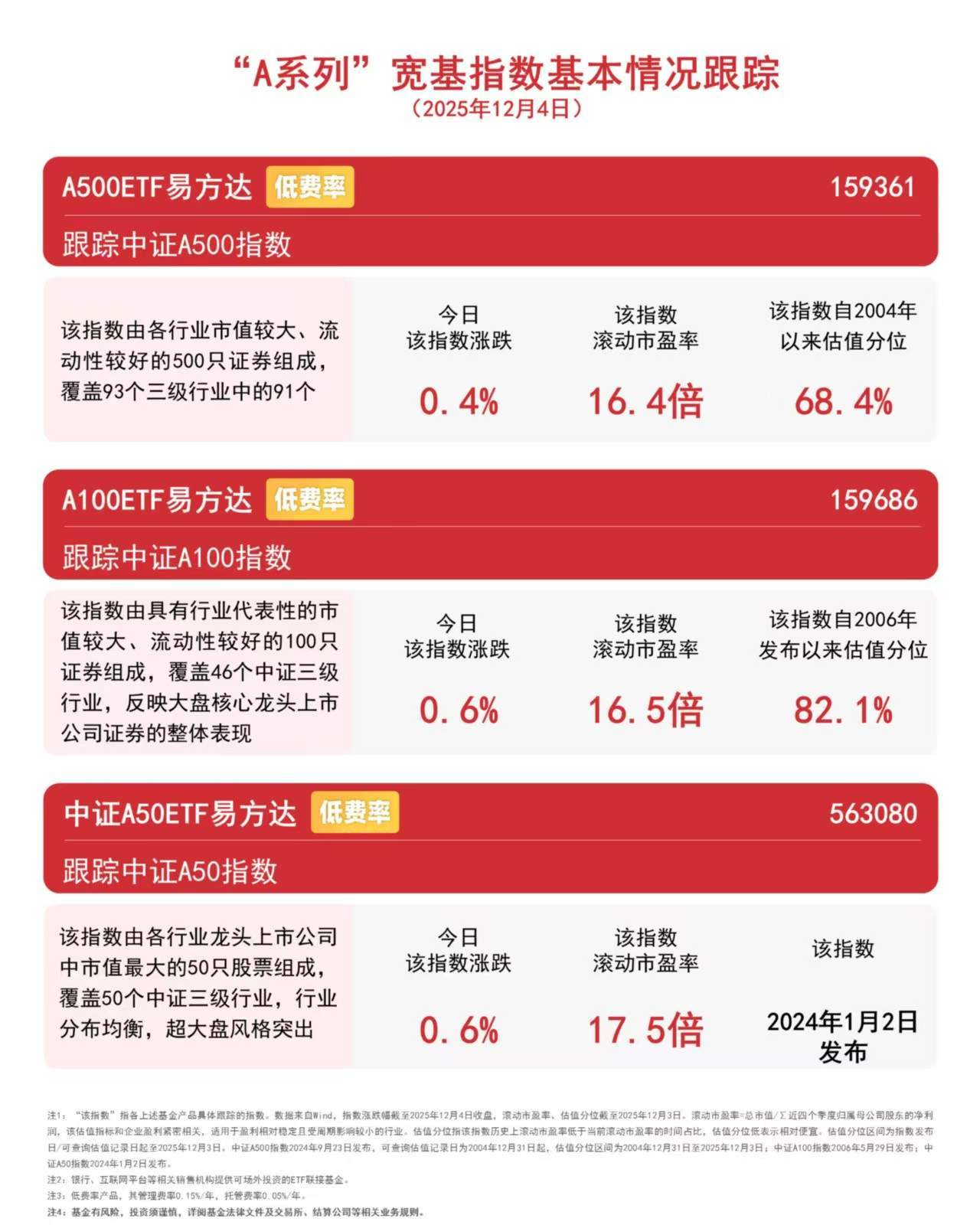
截至收盘,中证A500指数上涨0.4%,中证A100指数、中证A50指数均上涨0.6%,A500ETF易方达(159361)全天成交额近45亿元。 华泰证券表示,展望后市,12月有望迎来基本面预期及宏观流动性改善、政策及产业主题催化以及筹码压力消化的先后落地,春季躁动或提前启动。配置方 面,关注"春躁"中的高胜率方向,成长与周期均衡配置高性价比的细分方向。 | A500ETF易方达 低费率 | | | | | --- | --- | --- | --- | | 跟踪中证A500指数 | | | | | 该指数由各行业市值较大、流 | ▽日 | 该指数 | 该指数 | | 动性较好的500只证券组成, | 该指数涨跌 | 滚动市盈率 | 以来估 | | 覆盖93个三级行业中的91个 | 0. 4% | 16. 41 | 68. | | A100ETF易方达 低费率 | | | | | 跟踪中证A100指数 | | | | | 该指数由具有行业代表性的市 | ▽日 | 该指数 | 该指数! | | 值较大、流动性较好的100只 | 该指数涨跌 | 滚动市盈率 | 发布以来 | | 证券组成,覆盖46个中证三级 | ...

A股收评 | 沪指小幅收跌 双创集体反弹!芯片赛道冲锋
智通财经网· 2025-12-04 07:17
Market Overview - The market experienced fluctuations with the ChiNext and STAR Market rebounding, but overall strength was weak, leading to a slight decline in the Shanghai Composite Index [1] - The total market turnover was 1.5 trillion, a decrease of over 100 billion compared to the previous trading day, with over 3,800 stocks declining [1] Sector Performance - The robotics sector saw a strong surge, with stocks like Huawu Co. and Rifa Precision Machinery hitting the daily limit [1] - The commercial aerospace sector was active, with stocks like China Satellite also reaching the daily limit, supported by policies promoting high-quality development in the industry [1] - Semiconductor and chip stocks rose, with companies like Huahong Semiconductor and Zhongwei Technology leading the gains, driven by advancements in AI and domestic production capacity expansions [1] Key Developments - The Trump administration is considering an executive order on robotics technology for next year, which may impact the sector positively [1] - The launch of the T800 humanoid robot by Zhongqing Robotics marks a significant advancement in the robotics field, with sales processes officially starting [1] Investment Insights - Major funds are focusing on sectors such as home appliance components, automotive parts, and specialized equipment, with significant net inflows into stocks like Sanhua Intelligent Controls and Jilun Intelligent [3] - Analysts from招商证券 suggest a bullish outlook for December, recommending investments in cyclical sectors like coal and basic chemicals, as well as high-end manufacturing [9] - 广发证券 indicates that the market is transitioning from large-cap to small-cap stocks, with December and January being favorable for spring market movements [10]
A股开盘速递 | 指数弱势震荡!海南股集体调整 后续市场风格如何轮动?
智通财经网· 2025-12-04 02:02
Market Overview - The three major indices rebounded collectively, with the Shanghai Composite Index up 0.06%, the Shenzhen Component Index up 0.22%, and the ChiNext Index up 0.4% as of 9:40 AM [1] Active Sectors 1. Humanoid Robots - The humanoid robot sector was active, with Junya Technology, Longxi Co., and Ruineng Technology hitting the daily limit, while Daying Electronics, Huichen Co., and Siling Co. also saw gains. The sector's growth is supported by Tesla's release of a running video of its "Optimus" humanoid robot, indicating rapid advancements in the industry [4] 2. Industrial Metals - The industrial metals sector opened higher, with Luoyang Molybdenum rising over 4% and Jiangxi Copper up over 3%. The surge in copper prices is attributed to a significant increase in orders for copper extraction from London Metal Exchange warehouses, raising supply concerns. Analysts expect continued high copper prices due to supply shortages and low domestic inventory levels [3] Institutional Insights 1. Investment Recommendations - According to招商证券, December is expected to favor large-cap stocks, particularly in coal and basic chemicals, as the market is likely to break upward after three months of consolidation. The firm highlights the importance of upcoming economic policy announcements in December [5] 2. Market Trends - 广发证券 suggests that the market will shift from large-cap to small-cap stocks as the correlation between market movements and fundamentals strengthens in December. The period from December to January is seen as an excellent time for spring rally positioning, especially in sectors with positive earnings forecasts [6] 3. Fund Flow Dynamics - 华西证券 notes that the slowdown in incremental capital entering the market has led to faster sector rotation. With year-end approaching, investor risk appetite is decreasing, prompting a focus on sectors that align with upcoming policy changes and economic goals for 2026 [7]