量化紧缩

Search documents
事关降息、缩表!鲍威尔最新发声;加密货币市值蒸发1500亿美元;刘强东放大招:卖“国民好车”!张兰、汪小菲胜诉,对方“绝不道歉”丨每经早参
Mei Ri Jing Ji Xin Wen· 2025-10-14 22:03
Economic Policy and Market Updates - Chinese Premier Li Qiang emphasized the need for effective counter-cyclical adjustments and resource utilization to boost domestic demand and strengthen the domestic circulation [4] - The People's Bank of China announced a 600 billion yuan reverse repurchase operation to maintain liquidity in the banking system [8] - The automotive market in China is expected to see over 12 million vehicles replaced under the trade-in policy, driving new car sales close to 1.7 trillion yuan [11] Corporate Developments - DJI has filed an appeal against the U.S. Department of Defense regarding its classification as a "Chinese military company" [16] - JD.com announced a collaboration with CATL and GAC Group to launch a "national good car" during the Double 11 shopping festival, focusing on consumer insights and sales [16][17] - Anshi Semiconductor is actively seeking exemptions from export controls imposed by the Chinese Ministry of Commerce [20] Financial Market Performance - U.S. stock indices showed mixed results, with the Dow Jones up 0.44% while the Nasdaq and S&P 500 fell by 0.76% and 0.16% respectively [4] - The international oil prices declined, with WTI crude oil down 1.51% to $58.59 per barrel [5] - The cryptocurrency market saw significant losses, with Bitcoin dropping nearly 5% to a low of $109,866 [6] Regulatory and Legal Matters - The European Commission fined Gucci, Chloé, and Loewe over 157 million euros for anti-competitive pricing practices [23] - The Chinese government has taken countermeasures against Hanwha Ocean's U.S. subsidiaries for their involvement in a U.S. investigation into China's maritime and logistics sectors [7] Industry Trends - Shanghai's smart terminal industry aims to exceed 300 billion yuan by 2027, with plans to cultivate globally influential consumer brands [9] - Polestar, once seen as a competitor to Tesla, has closed its last direct store in China, shifting to an online sales model [21]


英伟达市值一夜蒸发超1.4万亿元!黄金收涨、原油跌超1%;鲍威尔发表重要讲话;美联储,降息大消息
Mei Ri Jing Ji Xin Wen· 2025-10-14 21:49
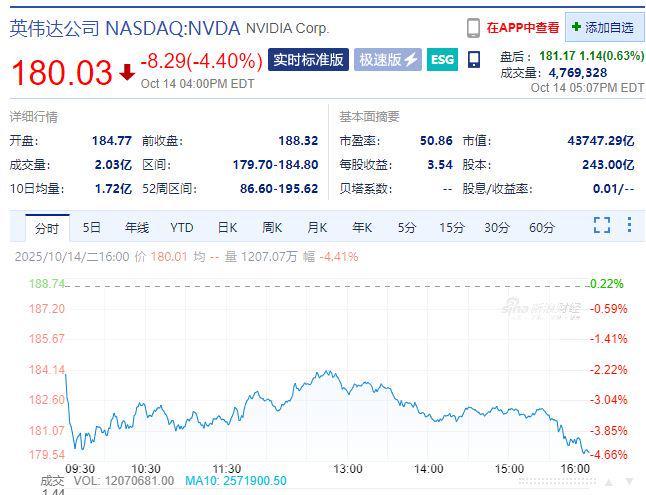
Market Performance - On October 14, US stock indices closed mixed, with the Dow Jones up 0.44%, the Nasdaq down 0.76%, and the S&P 500 down 0.16% [1] - Major tech stocks mostly declined, with Broadcom down over 3%, and Tesla and Amazon down over 1% [1] - Semiconductor and cryptocurrency stocks saw significant declines, with Intel down over 4%, Strategy and Coinbase down over 4%, and Micron Technology and Arm down over 2% [1] - The rare earth, airline services, and infrastructure operation sectors saw gains, with JetBlue Airways up nearly 8%, Caterpillar and Delta Air Lines up over 4%, and American Airlines up over 3% [1] - Walmart's stock rose 5%, reaching a record closing high [1] Nvidia Performance - Nvidia's stock price was reported at $180.03, down 4.40%, resulting in a market value loss of $20.14 billion (approximately 143.78 billion RMB) [2] Chinese Stocks - The Nasdaq Golden Dragon China Index fell 1.95%, with popular Chinese stocks generally declining, including NIO down over 5%, Baidu down over 4%, and Bilibili down over 3% [4] Commodity Prices - FTSE A50 futures rose 0.38%, closing at 14,779 points [5] - COMEX gold futures increased by 0.64%, priced at $4,159.6 per ounce, while COMEX silver futures decreased by 0.17%, priced at $50.345 per ounce [5] - WTI crude oil futures fell by 1.33%, closing at $58.70 per barrel, and Brent crude oil futures dropped by 1.47%, closing at $62.39 per barrel [5] Federal Reserve Insights - Federal Reserve Chairman Jerome Powell indicated a potential for interest rate cuts this month, citing a deteriorating labor market despite the government shutdown affecting economic assessments [7] - Powell noted that economic growth might be slightly more robust than expected, with the unemployment rate remaining low and wage growth slowing significantly [7] - Powell suggested that the Fed may halt its balance sheet reduction in the coming months [7] - Fed Governor Bowman expressed expectations for two more rate cuts by the end of the year [10] - John Williams, President of the New York Fed, highlighted concerns over the labor market's gradual cooling, although he did not foresee an imminent recession [10] - Williams estimated that tariffs have raised inflation by 0.25 to 0.5 percentage points, but he noted that the overall inflation risk has stabilized [11]

“美联储传声筒”:鲍威尔为美联储的政策进行了辩护
Sou Hu Cai Jing· 2025-10-14 17:10
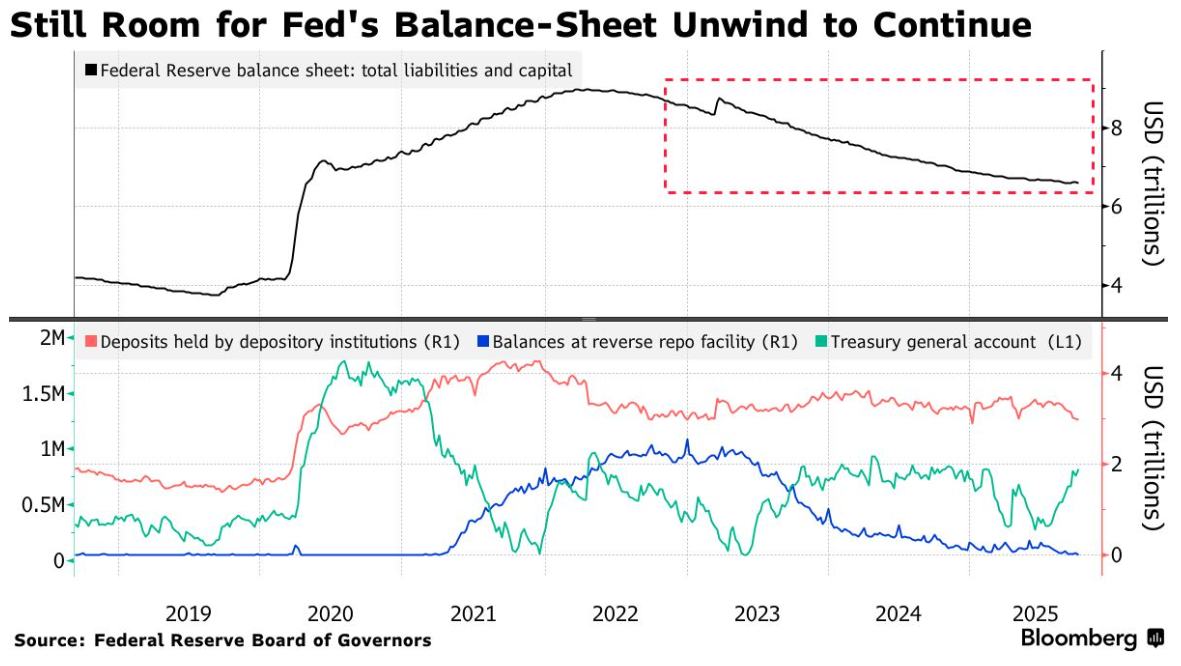
Group 1 - The core viewpoint of the article highlights Federal Reserve Chairman Powell's recent remarks on the balance sheet, addressing the current outlook on quantitative tightening in light of rising overnight lending rates [1] - Powell's comments counter recent criticisms from figures like Treasury Secretary Yellen, who deemed pandemic-era support measures as misguided policy interventions, acknowledging that a quicker halt to quantitative easing might have been wiser, but the rapid shift in 2022 had no substantial macroeconomic impact [1] - The remarks also defended the Federal Reserve's ability to pay interest on excess reserves (IOR) against bipartisan populist senators' attempts to revoke this policy tool, warning that its removal could lead to greater market disruption [1]
9月全球投资十大主线
一瑜中的· 2025-10-10 16:04
Group 1 - The global asset performance in September shows that global stocks outperformed other asset classes, with a return of 3.31%, followed by global bonds at 0.65%, and commodities at 0.05% [2] - The international spot gold price has recently continued its strong upward momentum, breaking through $3,800 per ounce at the end of September, driven by multiple systemic factors and market sentiment [4][12] - Despite the U.S. government shutdown, the stock market showed resilience, with the Dow Jones Industrial Average and S&P 500 reaching historical highs, buoyed by optimistic market sentiment and expectations of a Federal Reserve rate cut [4][17] Group 2 - The credit spread for U.S. high-yield corporate bonds narrowed to a historical low of 2.67% by the end of September 2025, indicating high investor confidence in corporate credit quality [5][20] - Global fund managers increased their allocations to stocks, pharmaceuticals, communications, consumer discretionary, and technology, while reducing exposure to the UK, utilities, energy, Eurozone, and emerging markets [6][23] - The Indian stock market has underperformed the MSCI Asia-Pacific index for five consecutive months, reflecting a divergence between foreign and domestic investor sentiment [6][28] Group 3 - Speculative net positions in Japanese yen have decreased to 79,500 contracts, indicating a waning bullish sentiment towards the yen [6][31] - The volatility ratio of emerging market currencies to G7 currencies has continued to decline, reaching a low of 0.76, improving the risk-return profile for carry trades [6][36] - The scale of reserves held by banks at the Federal Reserve has fallen below $3 trillion, the lowest level since the beginning of the year, due to large-scale Treasury issuance and ongoing quantitative tightening [6][39] Group 4 - The S&P 500 index and the MOVE index (a measure of U.S. Treasury market volatility) have shown a strong correlation, suggesting that the current stock market rally is supported by low interest rate volatility [6][42] - The overnight interbank offered rate in Hong Kong surged to 5.35%, the highest level in nearly a year, highlighting short-term funding market tensions [6][45] Group 5 - From a fundamental perspective, the weekly economic activity index has shown signs of recovery, indicating a potential divergence between asset prices and economic fundamentals [6][47] - From a sentiment perspective, the market sentiment index has rebounded, reflecting improved investor confidence [6][63]

9月全球投资十大主线:【宏观月报】-20251010
Huachuang Securities· 2025-10-10 09:14
Group 1: Market Performance - Global equities outperformed other asset classes with a return of 3.31% in September, followed by global bonds at 0.65% and commodities at 0.05%[1] - The S&P 500 and Dow Jones Industrial Average reached historical highs despite the U.S. government shutdown, driven by optimistic market sentiment and expectations of interest rate cuts by the Federal Reserve[3] - The Bloomberg U.S. high-yield corporate bond credit spread narrowed to 2.67%, indicating strong investor confidence in corporate credit quality[4] Group 2: Investment Trends - Global fund managers increased their allocations to equities, particularly in sectors like technology and healthcare, while reducing exposure to utilities and emerging markets[4] - The Indian stock market lagged behind the MSCI Asia-Pacific index for five consecutive months, reflecting a divergence in outlook between domestic and foreign investors[5] - Speculative net positions in the Japanese yen decreased to 79,500 contracts, signaling a shift in market sentiment towards a weaker yen[6] Group 3: Economic Indicators - The ratio of exchange rate volatility between emerging markets and G7 countries fell to 0.76, the lowest level since 2013, improving the risk-return profile for carry trades[7] - The Federal Reserve's reserve balances dropped below $3 trillion, the lowest level since the beginning of the year, due to increased Treasury issuance and ongoing quantitative tightening[8] - The correlation between the S&P 500 and the MOVE index (a measure of U.S. Treasury market volatility) reached -0.88, indicating that stock market gains are supported by low interest rate volatility[9] Group 4: Regional Developments - Hong Kong's overnight interbank lending rate surged to 5.35%, the highest in nearly a year, due to liquidity tightening measures by the Hong Kong Monetary Authority[10] - Gold prices continued to rise, surpassing $3,800 per ounce, driven by expectations of Fed rate cuts and geopolitical uncertainties[2]
君諾外匯:美联储会议纪要关注流动性,缩表进程或近节点
Sou Hu Cai Jing· 2025-10-09 09:08
Core Insights - The Federal Reserve's September policy meeting minutes indicate a focus on monitoring money market conditions and assessing whether bank reserves remain at a "sufficient" level to ensure financial stability [1][4] - There are signs that the Fed's balance sheet reduction process may be nearing a phase of stabilization, with liquidity pressures emerging in the market due to increased Treasury borrowing [3][5] Group 1: Liquidity and Market Conditions - The U.S. Treasury's increased borrowing to rebuild cash balances has led to signs of tightening liquidity in the market, with bank reserves in the Federal Reserve system dropping to approximately $3 trillion, the lowest level this year [3] - Higher market interest rates reflect an upward trend in funding costs, indicating a gradual decline in financial system liquidity [3] Group 2: Federal Reserve Tools and Strategies - The Standing Repo Facility (SRF) is playing a crucial role in providing short-term liquidity support to financial institutions, helping to stabilize the federal funds rate within the target range [4] - This mechanism acts as a "safety valve" for the market, enhancing the financial system's ability to cope with temporary pressures [4] Group 3: Balance Sheet Management - Since the initiation of quantitative tightening in 2022, the Fed has been reducing its bond holdings, with projections suggesting that by March 2026, the balance sheet could shrink to around $6 trillion, with bank reserves hovering around $2.8 trillion [5] - This level is close to the "sufficient" reserve standard proposed by some officials, indicating limited future space for further balance sheet reduction [5] Group 4: Diverging Policy Perspectives - There is a divergence among officials regarding the ultimate size of the balance sheet, with some advocating for a more streamlined approach that would bring reserves closer to a "scarce" state, while others prefer to maintain a "sufficient" level [6] - This reflects differing views on balancing financial stability and liquidity efficiency within the policy-making framework [6] Group 5: Market Expectations - The market generally perceives the Fed's overall policy direction as cautious and flexible, focusing on maintaining stability in the interest rate target range to prevent systemic risks arising from liquidity imbalances [7]
美联储会议纪要显示内部现分歧:缩减资产负债表之争仍未结束
Zhi Tong Cai Jing· 2025-10-08 23:33
Group 1 - The Federal Reserve is closely monitoring the conditions of the money market and assessing how far bank reserves are from "ample" levels, while continuing to reduce its large securities portfolio [1][4] - The U.S. Treasury's increased borrowing to rebuild cash balances after raising the debt ceiling is consuming liquidity from the Fed's balance sheet, leading to higher yields on various instruments [4] - Bank reserves have fallen below $3 trillion, marking the lowest level since January, as the Fed continues its quantitative tightening process initiated in 2022 [4][5] Group 2 - Some Federal Reserve participants believe that the Standing Repo Facility (SRF) will help maintain the federal funds rate within its target range and ensure that temporary pressures in the money market do not disrupt the ongoing balance sheet reduction [1] - There is a divergence among Fed officials regarding how much to reduce the balance sheet, with some advocating for a smaller balance sheet to bring reserves closer to scarcity rather than ample levels [5] - Fed officials have indicated that once reserves approach ample levels, likely by the end of this year, the balance sheet reduction should cease [5]
Fed policy will dominate market narrative when shutdown end, says Fed Watch Advisors' Ben Emons
Youtube· 2025-10-08 22:04
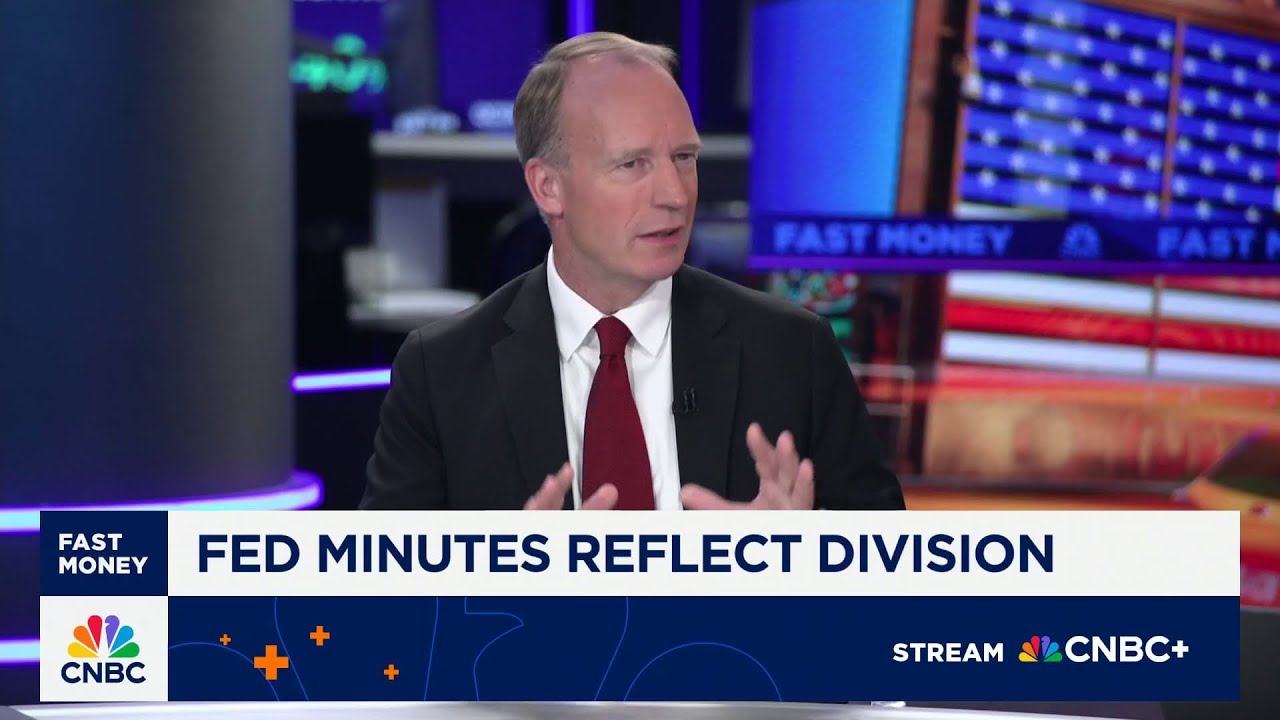
Group 1 - The Federal Reserve is experiencing a division among governors regarding the direction of interest rates, with a slim majority expecting two more cuts this year [1][3] - There is a lack of data due to the government shutdown, which is complicating the Fed's decision-making process [1][3] - The 10-year yield has remained relatively stable over the past 18 months, indicating a sideways trading pattern, which may suggest uncertainty in the market [4][5][6] Group 2 - The Japanese yen has been weakening significantly, leading to higher yields on Japanese Government Bonds (JGBs), which may impact the U.S. bond and equity markets [7][8] - The Bank of Japan faces pressure to raise rates due to high inflation, creating a complex relationship with global bond markets [8] - The Fed's balance sheet is at a critical level just below $3 trillion, raising concerns about the potential impact on the banking system if reserves become too low [10][11] Group 3 - The Fed's cautious stance may lead to a more dovish approach in future meetings, which could positively influence the stock market [12][13] - Faster rate cuts could push yields higher, reflecting increased stimulus in the economy, especially with the stock market reaching record highs [13]
美国货币市场压力敲响警钟,美联储缩表或近终点
Hua Er Jie Jian Wen· 2025-10-08 02:46
美国货币市场持续出现的资金压力,以及美联储银行准备金的逐步减少,表明美联储可能即将结束其大 规模的资产负债表缩减计划。 自9月初以来,美国担保隔夜融资利率(SOFR)与美联储基准利率之间的利差已接近2024年底以来的最高 水平,该利差是衡量短期融资成本的关键指标。 此外华尔街见闻曾提及,美国银行准备金也已跌破3万亿美元,创1月以来新低。这些迹象均表明美国金 融体系中的过剩流动性正在被快速吸收。 然而,在何时停止缩表的问题上,美联储内部似乎存在分歧。本周四即将公布的美联储9月会议纪要, 或将为外界提供更多关于决策者在此问题上立场的线索。 资金市场压力持续显现 当前金融体系流动性的持续流失,主要源于两大因素的叠加。 首先,美联储继续其量化紧缩进程,允许其持有的债券到期而不进行再投资,这直接从金融系统中抽走 了资金。由于QT可能加剧流动性限制并导致市场动荡,美联储已在今年早些时候放慢了其缩表步伐。 这直接导致担保隔夜融资利率(SOFR)等一系列与美国国债抵押回购协议相关的利率基准,持续徘徊 在美联储的准备金利率(IORB)附近,表明较高的融资成本或将持续。 随着流动性紧张的压力正越来越集中地体现在商业银行的准备金账 ...
美联储缩表 3 万亿, A 股牛市暗藏四大假象!
Sou Hu Cai Jing· 2025-10-04 12:46
Group 1 - The core observation is the apparent contradiction between the tightening liquidity indicated by the Federal Reserve's reduction in bank reserves below $3 trillion and the strong performance of the A-share market, which has surpassed 3400 points with increasing trading volume [1][4] - The A-share market's resilience is highlighted by the fact that while the market appears vibrant, less than 50% of stocks have risen more than 6%, indicating a significant disparity between the index performance and individual stock movements [1][4] - The concept of "locking" by institutional investors is emphasized, where they reduce trading frequency during periods of apparent market calm, suggesting strategic positioning rather than withdrawal [2][5] Group 2 - A specific case study illustrates that a stock can rise by 30% over a period while experiencing a 20% correction, showcasing the misleading nature of market signals such as "waiting for a rebound" and "false prosperity" created by rapid sector rotations [4][7] - The behavior of retail investors is analyzed, noting that they often panic and sell during downturns, missing subsequent gains, while institutions capitalize on these moments to accumulate shares at lower prices [7][9] - The complexity of capital markets is underscored, where macroeconomic tightening and strong market performance coexist, reflecting the multifaceted nature of market dynamics [4][8] Group 3 - Investors are advised to not be misled by superficial market exuberance, as underlying disparities can be severe [9] - Understanding the operational strategies of institutional investors is crucial, as their actions often contradict retail investor instincts [9] - Emphasis is placed on the importance of data-driven analysis over emotional responses, as quantitative analysis can reveal the true market conditions [9]