
财政政策

Search documents
王青:预计明年财政促消费资金规模将上调
Sou Hu Cai Jing· 2025-12-11 13:14
【大河财立方 记者 陈诗昂】中央经济工作会议12月10日至11日在北京举行,总结2025年经济工作,分 析当前经济形势,部署2026年经济工作。 强大国内市场放在2026年重点工作首位 三大政策基调未变, 将提振市场信心 他进一步解释说,首先,目标财政赤字率预计会保持在4.0%,不会进一步上调。背后是2025年该指标 已经较大幅度上调1个百分点,节奏上需要稳一下,留出观察时间。不过,由于我国名义GDP规模扩 大,明年目标财政赤字率不变,但赤字规模会有所扩大。 东方金诚首席宏观分析师王青认为,关于2026年的宏观政策安排,会议显示三大政策基调没有变,包括 更加积极有为的宏观政策,更加积极的财政政策,适度宽松的货币政策。"这显示宏观政策保持很强的 连续性、稳定性,将有效稳定社会预期,提振市场信心。" 其次,2026年新增专项债额度有望在今年4.4万亿基础上进一步扩大,主要是当前专项债资金用途拓 宽,而2026年基建投资稳增长需求会高于今年,因此专项债增发的必要性较强。 另外,视经济实际运行情况,2026年四季度有可能继续盘活地方债务结存限额。2026年超长期特别国债 发行规模将在今年基础上进一步扩大。他分析,一方 ...
货币市场日报:12月11日
Xin Hua Cai Jing· 2025-12-11 12:40
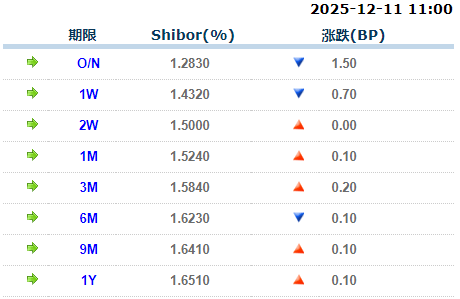
Group 1 - The People's Bank of China conducted a 118.6 billion yuan reverse repurchase operation with a rate of 1.40%, maintaining the previous level, resulting in a net withdrawal of 62.2 billion yuan due to 180.8 billion yuan of reverse repos maturing on the same day [1] - The Shanghai Interbank Offered Rate (Shibor) showed a slight decline in the overnight and 7-day tenors, with the overnight Shibor down by 1.50 basis points to 1.2830% and the 7-day Shibor down by 0.70 basis points to 1.4320% [1][2] - The weighted average rates in the interbank pledged repo market also decreased slightly, with the DR001 rate down by 1.2 basis points to 1.2768% and the DR007 rate down by 0.1 basis points to 1.4516% [5][6] Group 2 - The money market maintained a balanced state on December 11, with overnight transactions occurring in the range of 1.45%-1.46% and 7-day transactions around 1.49% [9] - A total of 91 interbank certificates of deposit (CDs) were issued on December 11, with an actual issuance volume of 104.99 billion yuan, indicating stable trading sentiment in the primary market [10] - The Central Economic Work Conference emphasized the continuation of a proactive fiscal policy and an appropriately loose monetary policy to support economic stability and growth [11]

工银国际程实:货币政策从强调操作时点的“适时”“择机” 转向更注重政策效果的“提质增效”
Xin Lang Cai Jing· 2025-12-11 12:19
来源:上海证券报·中国证券网 上证报中国证券网讯(记者 张琼斯)中央经济工作会议指出,要继续实施适度宽松的货币政策。把促 进经济稳定增长、物价合理回升作为货币政策的重要考量,灵活高效运用降准降息等多种政策工具,保 持流动性充裕,畅通货币政策传导机制,引导金融机构加力支持扩大内需、科技创新、中小微企业等重 点领域。 工银国际首席经济学家程实接受上海证券报记者采访时称,今年中央经济工作会议延续了"适度宽松的 货币政策"取向,并把"促进经济稳定增长、物价合理回升"作为货币政策的重要考量。这一判断契合当 前"外部环境变化影响加深,国内供强需弱矛盾突出"的经济形势,也为未来政策操作明确了主线。 中央经济工作会议首次提出"灵活高效运用降准降息等多种政策工具"。相较于过去"适时降准降息"等提 法,程实认为,这一新表述标志着货币政策从强调操作时点的"适时""择机"转向更注重政策效果的"提 质增效"。 "货币政策将通过更充裕的流动性、更顺畅的传导机制以及更精准的结构性工具组合,强化逆周期和跨 周期调节力度,以促进需求修复、推动物价合理回升,从而促进经济稳定增长。"程实表示。 程实表示,"灵活高效"也意味着货币政策将在宏观政策体 ...
中央经济工作会议,极简版要点来了!
Zhong Guo Xin Wen Wang· 2025-12-11 12:14
来源:三里河 时间:2025年12月10日至11日 事件:中央经济工作会议在北京举行 要点:总结2025年经济工作,分析当前经济形势,部署2026年经济工作 总结2025年经济工作 必须坚持投资于物和投资于人紧密结合 必须以苦练内功来应对外部挑战 经济社会发展主要目标将顺利完成 我国经济顶压前行、向新向优发展 现代化产业体系建设持续推进,改革开放迈出新步伐 重点领域风险化解取得积极进展,民生保障更加有力 "十四五"即将圆满收官,第二个百年奋斗目标新征程实现良好开局 五个"必须" 必须充分挖掘经济潜能 必须坚持政策支持和改革创新并举 必须做到既"放得活"又"管得好" 形势研判 我国经济发展中老问题、新挑战仍然不少,外部环境变化影响加深,国内供强需弱矛盾突出,重点领域 风险隐患较多。 这些大多是发展中、转型中的问题,经过努力是可以解决的,我国经济长期向好的支撑条件和基本趋势 没有改变。 要坚定信心、用好优势、应对挑战,不断巩固拓展经济稳中向好势头。 部署2026年经济工作 ——政策取向 坚持稳中求进、提质增效 发挥存量政策和增量政策集成效应 加大逆周期和跨周期调节力度 提升宏观经济治理效能 ——财政政策 把促进经 ...
用足用好财政政策,为高质量发展提供坚实支撑
Qi Lu Wan Bao· 2025-12-11 07:05
Group 1: Fiscal Policy and Economic Growth - Qingdao's fiscal bureau is implementing a proactive fiscal policy to promote high-quality economic and social development, including securing 40.5 billion yuan in central funding and 7.15 billion yuan in local matching funds to stimulate consumption in sectors like automobiles and home appliances [1][2] - The city aims to expand effective investment by securing 270.1 billion yuan in transfer payments, a year-on-year increase of 8%, and increasing the general bond limit by 36.8% to 78 billion yuan, alongside a 16.5% increase in special bond limits to 677 billion yuan [2] - Qingdao has been selected as a pilot city for international consumption environment construction, receiving 500 million yuan in central financial support [2] Group 2: Support for Private Sector and Employment - The city has launched a "direct and fast enjoyment" reform pilot for enterprise support policies, disbursing 4.082 billion yuan through the "Qingdao Policy Pass" platform, with government financing guarantees reaching 166.29 billion yuan, a 26.21% increase [3] - Employment stability measures include allocating 1.56 billion yuan for employment support, resulting in 330,000 new urban jobs [7] Group 3: Investment in Innovation and Technology - Qingdao is increasing its fiscal technology special funds by 15% annually and has established a special fund for equity investment in technology to support research and development [4] - The city has introduced 28 measures to foster new productive forces, with an annual investment exceeding 5 billion yuan, and is supporting 899 enterprises in technological upgrades [4] Group 4: Rural Revitalization and Agricultural Support - A total of 1.1 billion yuan is allocated for rural revitalization, including high-standard farmland construction and agricultural insurance expansion, providing risk protection for farmers [5] - Emergency disaster relief funding of 13.57 million yuan has been allocated to support agricultural recovery efforts [5] Group 5: Social Welfare and Housing - Qingdao has prioritized social welfare spending, with 1,094.7 billion yuan allocated to social expenditures, accounting for 76.2% of total fiscal spending, an increase of 1.6 percentage points from the previous year [6] - The city is providing 1.5 billion yuan for rental subsidies and has initiated housing projects to meet diverse housing needs, including the renovation of old residential areas [7][8] Group 6: Fiscal Management and Governance - The city is enhancing fiscal management by implementing a zero-based budgeting reform and improving budget management systems to ensure efficient use of funds [9] - Qingdao is focusing on maintaining fiscal safety and ensuring adequate funding for essential services while managing government debt repayment [9]
宏观金融数据日报-20251211
Guo Mao Qi Huo· 2025-12-11 05:21
投资咨询业务资格:证监许可【2012】31号 = 宏观金融数据日报 | | 项目 | 当月合约 | 下月合约 | 当季合约 | 下季合约 | | --- | --- | --- | --- | --- | --- | | ਮੇ | IF升贴水 | 15.57% | 7.35% | 4.58% | 4.33% | | 贴 | IH升贴水 | 10. 64% | 4.63% | 2.20% | 2.09% | | 水 | IC升贴水 | 19. 15% | 12.43% | 10.81% | 11.30% | | 情 Я | IM升贴水 | 20. 17% | 15.75% | 14.05% | 13.68% | 注:括号里的数值为年化计算后的升贴水率(标绿为升水,标红为贴水)。 数据来源:wind 本报告中的信息均源于公开可获得的资料,国贸期货力求准确可靠,但不对上述信息的准确 性及完整性做任何保证。本报告不构成个人投资建议,也未针对个别投资者特殊的投资目标 免责 、财务状况或需要,投资者需自行判断本报告中的任何意见或建议是否符合其特定状况,据 此投资,责任自负。本报告仅向特定客户推送,未经国贸期货授权许可,任 ...
独家洞察 | 大局已定!美数据掀底牌:12月必须降息
慧甚FactSet· 2025-12-11 02:57
Core Viewpoint - The Federal Reserve is expected to announce a 25 basis point interest rate cut during its December meeting, with a high probability of 88.6% according to CME data, indicating a shift towards a more accommodative policy environment due to declining inflation and signs of cooling employment [1]. Group 1: Inflation Trends - The PCE price index for September showed a month-on-month increase of 0.3% and a year-on-year increase of 2.8%, which is better than the previous value of 2.7% [3]. - The core PCE price index also rose by 0.2% month-on-month and 2.8% year-on-year, slightly lower than the previous year's 2.9%, indicating a stable inflation environment that supports the case for monetary policy easing [3]. - Overall, consumer spending has stagnated, reflecting financial strain among Americans prior to the government shutdown, which further supports the argument for a more lenient monetary policy [3]. Group 2: Employment Market Dynamics - The latest ADP employment data indicates an average weekly addition of 4,750 jobs in private enterprises, showing improvement from previous negative growth, but highlights significant structural disparities, particularly affecting small businesses [4]. - Small businesses experienced a net job loss of 120,000 in November, while larger firms added approximately 90,000 jobs, indicating a troubling trend for the overall employment landscape [4]. - The non-farm payroll data for September showed an addition of 119,000 jobs, exceeding expectations, but the unemployment rate rose to a four-year high of 4.4%, suggesting underlying weaknesses in the labor market [5]. Group 3: Interest Rate Cut Expectations - Goldman Sachs has indicated that a December rate cut is "basically a done deal," with market pricing reflecting a probability exceeding 85%, driven by labor market slowdowns and risk management needs [6]. - The report emphasizes that despite strong non-farm job additions, rising unemployment and increased layoffs signal a weakening labor structure, supporting the case for a "preventive rate cut" to mitigate economic slowdown risks [6]. - Looking ahead, fiscal policies, such as infrastructure and industrial stimulus measures, are expected to drive economic growth, with projections of U.S. economic growth remaining in the 2%–2.5% range [6].


股指短线震荡整理
Bao Cheng Qi Huo· 2025-12-10 11:14
Report Industry Investment Rating - Not specified in the provided content Core Viewpoints - Today, all stock indices fluctuated and consolidated. The total trading volume of the Shanghai, Shenzhen, and Beijing stock markets throughout the day was 1.79 trillion yuan, a decrease of 126 billion yuan compared to the previous day. The policy side indicated that in 2026, a more proactive fiscal policy and a moderately loose monetary policy will continue to be implemented, sending out positive signals [4]. - The expectation of policy benefits is gradually fermenting, and market risk appetite is rising. However, it is still necessary to wait for more policy details to be introduced in the subsequent Central Economic Work Conference. In the short term, due to the strong resilience of macro - economic data and the fact that the Politburo meeting's statement on aggregate policies did not exceed expectations, the stock indices still need to fluctuate and consolidate in the short term and are currently within the fluctuation range [4]. - Overall, the expectation of policy benefits is gradually fermenting, and in the short term, the stock indices will mainly fluctuate strongly. For options, considering the long - term upward trend of the stock indices, a bull spread or ratio spread strategy with a mild bullish view can be adopted [4]. Summary by Relevant Catalogs 1 Option Indicators - **Stock Index Performance**: On December 10, 2025, the 50ETF fell 0.32% to close at 3.132; the 300ETF (Shanghai Stock Exchange) fell 0.13% to close at 4.702; the 300ETF (Shenzhen Stock Exchange) fell 0.17% to close at 4.775; the CSI 300 Index fell 0.14% to close at 4591.83; the CSI 1000 Index rose 0.37% to close at 7408.24; the 500ETF (Shanghai Stock Exchange) rose 0.54% to close at 7.263; the 500ETF (Shenzhen Stock Exchange) rose 0.56% to close at 2.860; the GEM ETF rose 0.13% to close at 3.192; the Shenzhen 100ETF rose 0.23% to close at 3.475; the SSE 50 Index fell 0.31% to close at 2988.64; the STAR 50ETF rose 0.07% to close at 1.42; the E Fund STAR 50ETF remained unchanged at 1.37 [6]. - **Volume PCR and Open Interest PCR**: The volume PCR and open interest PCR of various options changed compared to the previous trading day. For example, the volume PCR of SSE 50ETF options was 85.15 (previous day: 79.26), and the open interest PCR was 97.51 (previous day: 100.45) [7]. - **Implied Volatility and Historical Volatility**: The implied volatility and 30 - day historical volatility of the 2025 December at - the - money options of various options were reported. For instance, the implied volatility of the SSE 50ETF options' 2025 December at - the - money options was 11.35%, and the 30 - day historical volatility of the underlying was 11.09% [8]. 2 Related Charts - **SSE 50ETF Options**: Charts include the SSE 50ETF trend, option volatility, volume PCR, open interest PCR, implied volatility curve, and each - term at - the - money implied volatility [10][11][12]. - **SSE 300ETF Options**: Charts cover the SSE 300ETF trend, option volatility, volume PCR, open interest PCR, implied volatility curve, and each - term at - the - money implied volatility [21][22][23]. - **SZSE 300ETF Options**: Charts involve the SZSE 300ETF trend, option volatility, volume PCR, open interest PCR, implied volatility curve, and each - term at - the - money implied volatility [33][34][35]. - **CSI 300 Index Options**: Charts include the CSI 300 index trend, option volatility, volume PCR, open interest PCR, implied volatility curve, and each - term at - the - money implied volatility [36][37][38]. - **CSI 1000 Index Options**: Charts cover the CSI 1000 index trend, option volatility, volume PCR, open interest PCR, implied volatility curve, and each - term at - the - money implied volatility [49][50][51]. - **SSE 500ETF Options**: Charts involve the SSE 500ETF trend, option volatility, volume PCR, open interest PCR, implied volatility curve, and each - term at - the - money implied volatility [62][63][64]. - **SZSE 500ETF Options**: Charts include the SZSE 500ETF trend, option volatility, volume PCR, open interest PCR, implied volatility curve, and each - term at - the - money implied volatility [75][76][77]. - **GEM ETF Options**: Charts cover the GEM ETF trend, option volatility, volume PCR, open interest PCR, implied volatility curve, and each - term at - the - money implied volatility [88][89][90]. - **Shenzhen 100ETF Options**: Charts involve the Shenzhen 100ETF trend, option volatility, volume PCR, open interest PCR, implied volatility curve, and each - term at - the - money implied volatility [101][102][103]. - **SSE 50 Index Options**: Charts include the SSE 50 index trend, option volatility, volume PCR, open interest PCR, implied volatility curve, and each - term at - the - money implied volatility [115][116][117]. - **STAR 50ETF Options**: Charts cover the STAR 50ETF trend, option volatility, volume PCR, open interest PCR, implied volatility curve, and each - term at - the - money implied volatility [128][129][130]. - **E Fund STAR 50ETF Options**: Charts involve the E Fund STAR 50ETF trend, option volatility, volume PCR, open interest PCR, implied volatility curve, and each - term at - the - money implied volatility [135][136][137].
ETF盘后速递 | A股港股先抑后扬!房地产、旅游、港股通科技等相关ETF涨幅居前
Mei Ri Jing Ji Xin Wen· 2025-12-10 09:21
Market Overview - On December 10, both A-shares and Hong Kong stocks experienced a rebound after an initial decline, with the Shenzhen Dividend, CSI 500, and STAR 200 indices rising by 0.64%, 0.49%, and 0.38% respectively [1] - In the sector themes, real estate, retail (consumption), and telecommunications led the gains [1] - In the ETF market, real estate and tourism ETFs showed the highest increases [1] - In Hong Kong, the CSI Hong Kong Stock Connect Technology and Hang Seng Technology indices rose by 0.58% and 0.41% respectively [1] Technology Sector - Alibaba's Qianwen AI application became the fastest-growing AI application globally, surpassing 30 million monthly active users within 23 days of public testing [2] - Xiaomi Group is actively recruiting for AI education-related positions, indicating a strategic move towards a systematic educational content ecosystem [2] - CICC's strategy analyst Liu Gang highlighted the need for new catalysts in the AI industry chain, with hardware visibility being more significant than applications [2] Consumer Sector - The Consumer Price Index (CPI) rose by 0.7% year-on-year in November, the highest since March 2024, with the core CPI increasing by 1.2% [3] - Sales revenue in the home appliance and telecommunications retail sectors, supported by the old-for-new consumption policy, grew by 26.5% and 20.3% respectively from January to November [3] - The government plans to maintain a proactive fiscal policy and moderately loose monetary policy in 2024, focusing on new economic investments and enhancing consumer spending [3] Real Estate Sector - Vanke held its first bondholders' meeting regarding the extension of its 22 Vanke MTN004 bonds, which is crucial for the company's financial recovery [4] - Following the announcement, Vanke's A-shares hit the daily limit, and its Hong Kong shares rose by 15%, indicating strong market expectations for fiscal support to stabilize the real estate market [4] - The Vanke-related bonds also showed active trading in the market [4] Related ETFs - The real estate ETF rose by 2.95% on the same day [5] - Other ETFs related to tourism and entertainment also saw price increases of 1.46% and 1.11% respectively [3][5]

11月通胀数据点评:物价延续回升态势
Western Securities· 2025-12-10 09:04
Group 1: Inflation Data - November CPI year-on-year growth increased to 0.7%, the highest since March 2024[1] - Month-on-month CPI decreased by 0.1%, better than the same period last year[1] - Food CPI month-on-month growth was 0.5%, marking four consecutive months of increase[5] Group 2: Producer Price Index (PPI) - November PPI month-on-month growth was 0.1%, continuing growth for two consecutive months[2] - Year-on-year PPI decreased by 2.2%, with a slight increase in the decline compared to the previous month[2] - Prices of non-ferrous metals continued to rise, while black metal processing prices fell[2] Group 3: Economic Outlook - The political bureau meeting indicated a focus on more proactive fiscal and moderately loose monetary policies for 2026[2] - Economic stability is expected in 2026, with inflation likely to rise and nominal GDP growth accelerating[2] - Risks include declining real estate demand and increased external uncertainties[3]