
量化宽松

Search documents
数百亿利息或征税!英国银行股遭遇“黑色星期五”
Zhi Tong Cai Jing· 2025-08-29 13:41
Group 1 - A think tank has called for a new tax on UK banks, leading to significant declines in bank stocks amid concerns that the government may target the banking sector for increased taxation to boost fiscal revenue [1][2] - The Institute for Public Policy Research (IPPR) suggests that the Chancellor of the Exchequer, Rachel Reeves, should tax the billions in interest paid by the Bank of England on reserves held by banks, which amounts to approximately £22 billion (around $29.7 billion) annually [1] - The IPPR argues that taxing this interest income would provide more fiscal space for Reeves to meet her financial rules, especially as the economic outlook remains weak and borrowing costs rise [1][2] Group 2 - Analysts note that there has been increasing pressure within the Labour Party to tax banks, contrasting with the Chancellor's previous protective stance towards the banking sector [2] - The UK Treasury spokesperson emphasized that enhancing public finances could be achieved through economic growth rather than solely through tax adjustments [2] - Various tax options are being considered, including new taxes on property sales, increased landlord taxes, freezing personal income tax thresholds, and adjusting pension tax relief policies [2] Group 3 - The Bank of England's Governor, Andrew Bailey, defended the importance of the current reserve interest system for transmitting official rates to the economy, amidst criticisms regarding its costs [3] - The UK banking sector paid nearly £45 billion in taxes last year, and industry representatives warn that imposing new taxes could undermine the UK's international competitiveness and contradict government efforts to support the financial services sector [3] - Calls to reassess the reserve interest system have persisted for years, with former Deputy Governor Paul Tucker suggesting a review of the system in 2022 [3]
从呼吁降息到“财政主导”? 特朗普盯上美联储的真正目的或许是“化债”
智通财经网· 2025-08-27 13:20
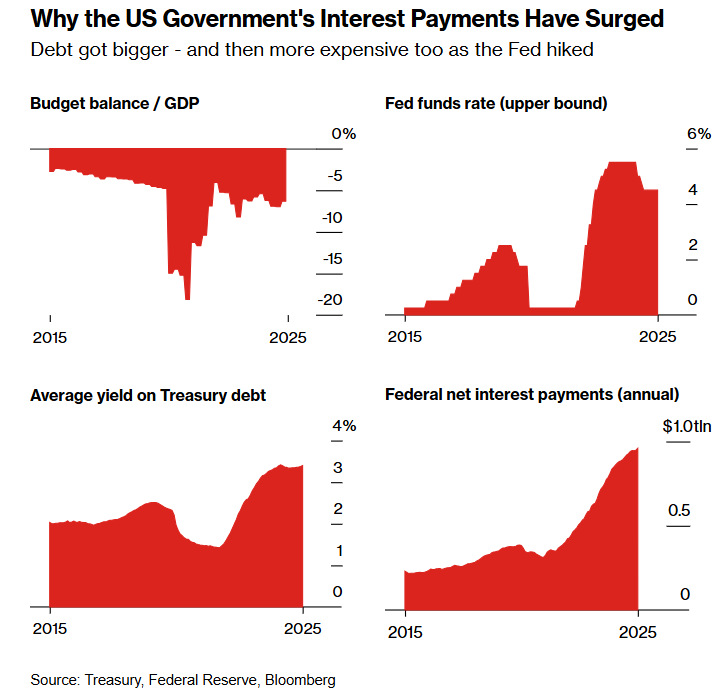
Core Viewpoint - Concerns are rising among investors regarding President Trump's attempts to exert control over the Federal Reserve's monetary policy, particularly in light of the increasing U.S. government debt and budget deficits [1][5][19] Group 1: Government Debt and Monetary Policy - The U.S. government's total debt has surged due to expanding budget deficits and rising interest rates, with economists suggesting that solutions should focus on reducing government borrowing through spending cuts and tax increases rather than relying on the Federal Reserve to lower borrowing costs [1][7] - Trump's push for a majority of rate-cutting seats on the Federal Reserve Board could lead to a series of movements aimed at lowering interest rates, which he claims would save the nation "hundreds of billions" [1][9] - The Federal Reserve's core objective is to curb inflation, but if interest rates become tools for maintaining government solvency, the task of controlling inflation could become unmanageable [5][8] Group 2: Fiscal Dominance and Economic Implications - The term "fiscal dominance" describes a situation where monetary policy is heavily influenced by political pressures, a scenario that analysts believe the U.S. may be approaching due to Trump's actions against the Federal Reserve [7][12] - There are indications that the U.S. is not yet in a textbook definition of fiscal dominance, but the situation is evolving, with budgetary pressures increasingly shaping policy decisions [12][19] - The anticipated budget deficit is projected to remain around 6% of GDP, which is significantly higher than the 3% target set by the Treasury Secretary [12][15] Group 3: Market Reactions and Future Outlook - As Trump advances his plans to remove Fed Governor Lisa Cook, U.S. Treasury yields and the dollar have declined, reflecting market concerns about the potential shift in Federal Reserve policy focus [9][10] - A recent Bank of America survey indicated that over half of fund managers expect the next Federal Reserve chair to resort to quantitative easing or yield curve control to alleviate the debt burden [10] - The ongoing pressure on the Federal Reserve may lead to a weakening of the dollar and an increase in bond yields, potentially driving investment towards alternative assets like cryptocurrencies and gold [9][10]

央行国债交易操作的国际经验与中国路径
Xin Hua Cai Jing· 2025-08-26 22:08
Core Viewpoint - The People's Bank of China (PBOC) is gradually incorporating government bond trading into its monetary policy toolkit to manage liquidity and support economic growth, reflecting a cautious approach compared to major developed economies [1][5][8]. Group 1: Central Bank Bond Trading Practices - Major developed economies, including the US, Japan, and the Eurozone, have utilized government bond trading extensively as a tool for liquidity adjustment and quantitative monetary policy since the 2008 financial crisis [2][3]. - The scale of government bonds held by central banks in these economies has significantly increased, with the Federal Reserve holding $5.77 trillion in US government bonds by June 2022, accounting for 64.7% of its total assets [2][3]. - The Bank of Japan's bond holdings reached approximately $5.3 trillion by the end of 2020, representing 76.5% of its total assets, indicating aggressive bond purchasing strategies [2][3]. Group 2: China's Central Bank Strategy - The PBOC's bond trading strategy is characterized by caution, having only engaged in limited short-term bond trading in specific circumstances over the past decades [5][6]. - As of May 2025, the PBOC held approximately 2.4 trillion yuan (about $338.3 billion) in government bonds, which is significantly lower than the holdings of central banks in developed countries [13][14]. - The PBOC's bond trading is designed to be flexible and responsive, allowing for small-scale, short-term operations to maintain liquidity without causing significant market disruptions [9][14]. Group 3: Future Directions and Policy Focus - The PBOC is expected to maintain a steady pace of increasing its government bond holdings, with a focus on balancing liquidity needs and market stability [16][18]. - There is a need for the PBOC to align its bond trading operations with fiscal policy expansion and the overall economic growth trajectory, ensuring that bond supply meets market demand [19][20]. - The central bank's bond trading operations will likely remain limited by the overall supply of government bonds and the fiscal constraints on debt expansion [15][19].
全球牛市有望延续
Di Yi Cai Jing· 2025-08-24 23:56
Group 1 - The global market appears to be driven by liquidity, with significant capital inflows into defense and cyclical stocks in the Eurozone, and nearly 1 trillion yuan from insurance funds into the Chinese stock market [2] - The expectation of a 25 basis point rate cut by the Federal Reserve in September is seen as a high probability event, which could inject momentum into Asian markets [2][4] - The S&P 500 index reached 6445.76 points in August, with major US indices up approximately 7% to 8% year-to-date, driven by expectations of Fed rate cuts [6] Group 2 - The Japanese stock market remains strong, with the Nikkei 225 index surpassing 43000 points, largely influenced by the AI boom [7] - Nvidia is expected to report second-quarter revenue of $53.8 billion, a 15% quarter-over-quarter increase, driven by high shipments of GB200 and early shipments of GB300 chips [8] - The A-share market has seen significant inflows, with approximately 1.5 trillion to 1.7 trillion yuan net inflow in the first half of the year, primarily from insurance companies [9][10]

全球牛市有望延续
第一财经· 2025-08-24 23:53
Core Viewpoint - The global market appears to be driven by liquidity, with significant movements in various sectors, particularly AI and defense stocks, influenced by central bank policies and economic data [3][6][9]. Group 1: U.S. Market Dynamics - The U.S. market is experiencing a surge in AI-related investments, with expectations of a 25 basis point rate cut by the Federal Reserve in September, which is anticipated to inject momentum into Asian markets as well [3][6][9]. - Federal Reserve Chairman Jerome Powell indicated a potential shift in policy stance due to changing economic conditions, highlighting the resilience of the U.S. economy despite mixed economic signals [6][7]. - The market anticipates further rate cuts, with projections suggesting a total of 125 basis points of cuts by the end of next year, contributing to a weaker dollar and a favorable environment for economic growth [8][9]. Group 2: Global Stock Market Trends - Global stock markets have shown strong performance, with the S&P 500 index reaching 6445.76 points and the Nasdaq hitting new highs, driven by expectations of Federal Reserve rate cuts [9]. - European markets have also performed well, with the Euro STOXX 50 index up approximately 11% year-to-date, benefiting from low valuations and economic recovery expectations [9]. - Japan's Nikkei 225 index recently surpassed 43000 points, marking a historical high, largely influenced by the AI investment trend [9]. Group 3: Chinese Market Insights - The Shanghai Composite Index surpassed 3800 points, supported by the anticipated shift in U.S. monetary policy, with significant inflows from insurance funds contributing to the market's rise [12][13]. - In the first half of the year, approximately 1.5 trillion to 1.7 trillion yuan flowed into the A-share market, with two-thirds coming from insurance companies due to regulatory changes [12][13]. - Analysts suggest that the momentum in the A-share market may continue into September, with key indicators to watch including the stability of 10-year government bond yields and the performance of financing activities in the market [14].

美联储转向、9月降息在即,全球牛市有望延续
Di Yi Cai Jing· 2025-08-24 12:28
Group 1 - The Chinese stock market shows continued momentum driven by low interest rates and stable fundamentals, with significant inflows from insurance funds amounting to nearly 1 trillion yuan [1][8] - The U.S. Federal Reserve's potential interest rate cut in September is expected to inject momentum into Asian markets, including China, despite previous market gains [1][3] - The A-share market has seen a net inflow of approximately 1.5 trillion to 1.7 trillion yuan in the first half of the year, with two-thirds coming from insurance companies due to regulatory changes [8][9] Group 2 - The global stock market is buoyed by expectations of interest rate cuts, with the S&P 500 index reaching 6445.76 points and the Nasdaq hitting new highs [5][6] - European markets have also performed well, with the Euro STOXX 50 index up about 11% year-to-date, benefiting from low valuations and economic recovery expectations [6] - Japan's Nikkei 225 index recently surpassed 43,000 points, marking a historical high, driven by strong market sentiment [6] Group 3 - The A-share index surpassed 3,800 points, supported by the Fed's shift towards rate cuts, indicating a favorable environment for continued growth [8] - The margin financing balance in the A-share market has exceeded 2 trillion yuan for the first time since 2015, suggesting manageable leverage risks [9] - Key indicators to monitor for the sustainability of the A-share rally include the stability of 10-year government bond yields and the performance of corporate earnings in the upcoming quarters [9]
海外高频 | 美欧日制造业PMI反弹、美国扩大钢铝关税(申万宏观·赵伟团队)
申万宏源宏观· 2025-08-24 12:22
Group 1 - The article highlights a rebound in manufacturing PMIs for the US, Eurozone, and Japan, indicating a recovery in overseas manufacturing demand, potentially linked to reduced tariff uncertainties [64][61] - The US expanded tariffs on steel and aluminum derivatives, affecting 407 product categories with a 50% tariff, impacting approximately $138 billion in imports [42][48] - The article notes that the S&P 500 and other developed market indices saw increases, while emerging markets showed mixed results, with the UK FTSE 100 rising by 2.0% [2][3] Group 2 - The article reports that the US 10-year Treasury yield decreased by 7.0 basis points to 4.3%, while emerging market yields generally increased, particularly in Turkey, which rose by 208.0 basis points to 31.3% [16][18] - The article mentions that commodity prices mostly declined, with WTI crude oil rising by 1.4% to $63.7 per barrel, while coking coal fell by 5.5% to 1162 yuan per ton [32][37] - The article indicates that the US fiscal deficit for 2025 reached $1.1 trillion, with total expenditures of $5.19 trillion and total revenues of $3.21 trillion [48] Group 3 - The article discusses the dovish stance taken by Federal Reserve Chair Powell during the Jackson Hole meeting, suggesting a potential adjustment in policy due to risks in the labor market [57][59] - The article notes that the US initial jobless claims exceeded market expectations, with 235,000 claims reported, indicating potential labor market weaknesses [68] - The article highlights that the Eurozone and US manufacturing sectors are experiencing inflationary pressures, with the US manufacturing PMI price component continuing to rise [64][61]

深夜美股三大指数下挫,中概股逆势飘红,小鹏汽车大涨超13%
21世纪经济报道· 2025-08-21 15:43
Market Overview - The U.S. stock market opened lower on August 21, with the Dow Jones down 0.21%, S&P 500 down 0.19%, and Nasdaq down 0.16% as of 23:25 [1] - Popular tech stocks showed mixed performance, with Walmart's latest earnings report falling short of expectations, leading to a stock price drop of over 5% [2] - Chinese concept stocks rose against the trend, with the Nasdaq Golden Dragon China Index increasing by 1.43% [3] Individual Stock Performance - Notable individual stock movements included BOSS Zhipin rising over 8%, NIO and Miniso up over 7%, while Bilibili fell nearly 7% and Pony.ai dropped over 3% [5] - Xpeng Motors saw a significant increase of over 13% after its chairman and CEO, He Xiaopeng, purchased 3.1 million shares at an average price of HKD 80.49 per share, raising his ownership to approximately 18.9% [7] - Xpeng Motors reported a record high quarterly revenue of RMB 18.27 billion for Q2 2025, marking a 125.3% increase year-over-year and a 15.6% increase from Q1 2025 [7] Economic Events - The Jackson Hole Economic Symposium, a significant annual event for the financial sector, took place from August 21 to 23, focusing on the transformation of the labor market and macroeconomic policy [9] - Investors are particularly attentive to potential key statements from Federal Reserve Chairman Jerome Powell, as past meetings have led to significant market movements [10] Federal Reserve Insights - The minutes from the Federal Open Market Committee (FOMC) meeting on July 29-30 revealed a divide between hawkish and dovish members, with some officials expressing concerns about inflation risks [12] - The outlook for the Federal Reserve's policy remains uncertain, with potential for a rate cut in September if upcoming employment and inflation data do not show significant improvement [12] - Powell's cautious stance on inflation during the July meeting and the upcoming Jackson Hole speech are critical for market expectations regarding future interest rate decisions [13][15]

全球市场紧盯杰克逊霍尔:鲍威尔能否顶住压力|直击华尔街
2 1 Shi Ji Jing Ji Bao Dao· 2025-08-21 13:04
Core Viewpoint - The Jackson Hole Global Central Bank Conference is a significant event that influences global capital flows, focusing this year on the transformation of the labor market amid challenges like aging populations and productivity slowdowns [1][2]. Group 1: Conference Details - The conference will take place from August 21 to 23, gathering central bank leaders, policymakers, economists, and market experts to discuss pressing global economic challenges and policy choices [1]. - The theme of this year's conference is "Labor Market Transformation: Demographics, Productivity, and Macroeconomic Policy," addressing real-world issues such as aging, productivity growth, and the rise of AI and automation [1]. Group 2: Historical Significance - Historically, key statements made at this conference have led to significant market movements, such as Paul Volcker's defense of aggressive rate hikes and Ben Bernanke's hints at quantitative easing during the global financial crisis [2][3]. - The conference serves as a pivotal moment for market direction, with past remarks from Federal Reserve chairs often marking turning points in market trends [3]. Group 3: Current Economic Context - Recent data shows that the U.S. Producer Price Index (PPI) for July exceeded expectations, indicating a potential resurgence of inflation, which has led to a shift in market expectations regarding interest rate cuts [4]. - The Federal Reserve's July meeting minutes revealed that most participants view inflation risks as outweighing employment risks, highlighting internal divisions on the path to interest rate cuts [4]. Group 4: Political Pressure on the Fed - There is increasing political pressure on the Federal Reserve, particularly from the Trump administration, which is advocating for quicker rate cuts, raising concerns about the Fed's independence [5][6]. - The upcoming conference will be closely watched for how Fed Chair Jerome Powell addresses these political pressures and maintains the Fed's credibility [6]. Group 5: Key Investor Focus Areas - Investors should pay attention to three main areas during the conference: 1. The signaling of interest rate paths and whether Powell will downplay expectations for a September rate cut [8]. 2. The impact of tariffs on corporate costs and inflation, particularly how Powell articulates this relationship [8]. 3. The Fed's independence in the face of political noise and how Powell responds to these challenges [8].
英国赤字创三年来最低 只是财政困境的短暂喘息
智通财经网· 2025-08-21 07:47
Group 1 - The UK government experienced a significant reduction in the budget deficit for July, with a deficit of £1.1 billion (approximately $1.5 billion), compared to £3.4 billion in the same month last year, marking the lowest July deficit in three years [1] - The Office for Budget Responsibility had previously predicted a July deficit of around £2.1 billion, indicating that the actual figures were better than expected [1] - The improvement in the deficit is attributed to increased self-assessment income tax payments, although rising interest costs on government debt continue to pose challenges [1][2] Group 2 - The UK Treasury is under pressure to reduce government borrowing and may need to raise taxes by £17 billion to £27 billion in the upcoming budget due to a projected fiscal gap of up to £51 billion [2][3] - The unexpected increase in tax revenue is primarily driven by better-than-expected economic performance in the first half of the year, but persistent inflation could disrupt financial markets and increase debt servicing costs [3] - The Treasury has transferred £3.4 billion to the Bank of England to cover losses from its quantitative easing bond portfolio, bringing total losses since 2022 to £93.3 billion [4][5]