
戴维斯双击

Search documents
研选行业丨1.2万亿雅江水电开工!工程机械需求或达1500亿,机械龙头戴维斯双击在即。一文读懂>>
第一财经· 2025-07-23 01:54
Core Viewpoint - The article highlights significant investment opportunities in the engineering machinery and environmental sectors, driven by large-scale infrastructure projects and the increasing trend of high-dividend stocks in the market [2][4][6]. Engineering Machinery - The commencement of the 1.2 trillion yuan Yarlung Tsangpo River hydropower project is expected to create a demand for engineering machinery worth approximately 150 billion yuan, with a potential annual profit increase of up to 4 billion yuan [2][8]. - The project involves the construction of five hydropower stations with a total investment of about 1.2 trillion yuan, which is one-ninth of the Three Gorges Project's static investment, and aims for a total installed capacity of 60 GW, generating an estimated annual output of 3,000 billion kWh [8]. - The high-altitude location of the project presents opportunities for electric and unmanned engineering machinery, which could lead to higher equipment value due to the harsh operating conditions [9]. - The overseas market for engineering machinery is showing signs of recovery, with profits from exports expected to exceed 80%, supported by favorable conditions in regions such as Indonesia, South America, Africa, the Middle East, and Europe [10]. Environmental Sector - The article discusses the potential for RWA (Risk-Weighted Assets) in environmental operations, emphasizing the importance of digitalization and data monitoring in enhancing asset value [4][6]. - The industry’s dividend payout ratio has increased by 14 percentage points over the past five years, reaching 48.5%, indicating a strong trend towards high-yield stocks [2][6]. - The expectation of national subsidies in 2025 is anticipated to improve cash flow within the sector, further supporting investment strategies focused on dividend returns [5][6].

九方金融研究所:迎接突破时刻——下半年看好A股的十大理由
Sou Hu Cai Jing· 2025-07-21 04:12
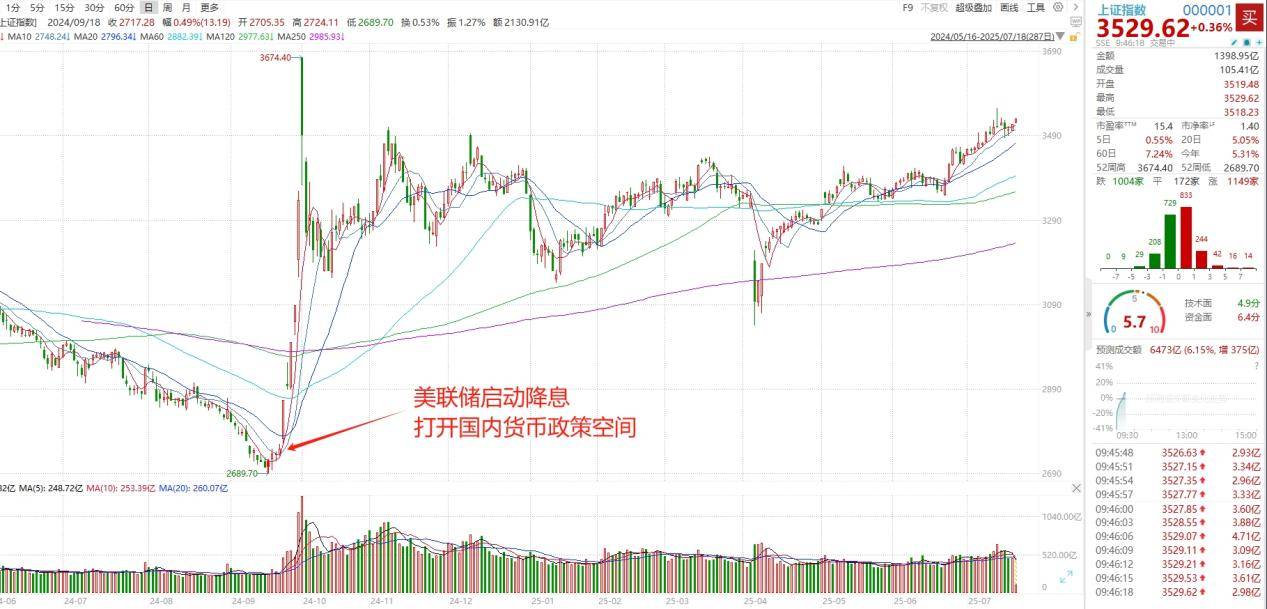
Group 1 - A-shares are expected to break upward in the second half of 2025 due to the gradual recovery of the Chinese economy, supportive policies, and innovation-driven growth [1] - The Federal Reserve's potential interest rate cuts may improve global liquidity, reducing pressure on the RMB and supporting domestic monetary policy easing, which could lead to a new upward trend in A-shares [2] - The evolving "new stable state" in China-US relations may enhance predictability and risk appetite, contributing to a more stable external environment for A-shares [4] Group 2 - The dual easing of monetary and fiscal policies is expected to initiate a new recovery cycle in the Chinese economy, positively impacting A-share performance [5] - M1 growth has been rising since last September, indicating a potential turning point for the A-share market [7] - The recovery of corporate profits and the positive performance of listed companies suggest that A-shares may experience a "Davis Double" effect [10] Group 3 - The low interest rate environment is driving a reallocation of household assets towards A-shares, particularly in high-dividend sectors [12] - Policies aimed at stabilizing and activating the capital market will enhance funding supply, optimize systems, improve corporate quality, and strengthen risk prevention [14] - The "14th Five-Year Plan" is expected to significantly influence A-shares through its focus on new productive forces and domestic demand expansion [16][17] Group 4 - The innovation cycle is underway, with AI and other sectors expected to lead significant market movements, similar to past technology booms [18][21] - Technical analysis suggests that if the index breaks above 3500, it may challenge last year's high of 3647, with a growing probability of surpassing 3674 by year-end [23]
南方基金熊潇雅——AI赋能消费 必将超过互联网的深度改造
Zheng Quan Shi Bao· 2025-07-20 18:52
Core Insights - The article highlights the exceptional performance of the Southern Hong Kong Preferred Fund managed by Xiong Xiaoya, emphasizing her unique investment philosophy focused on real cash flow generation and the transformative impact of AI on the consumer sector, surpassing the changes brought by the internet era [1][6]. Investment Philosophy - Xiong Xiaoya combines deep fundamental analysis with long-term value exploration, focusing on cash flow generation as the core of investment decisions. As of July 20, 2025, the fund achieved a year-to-date return of 42.33% and a three-year return of 57.89% [2]. - The investment strategy emphasizes identifying companies' value creation capabilities, with a focus on the sustainability of profit growth and yield levels as key decision-making factors [2][3]. Cash Flow Focus - The weight of cash flow indicators should be dynamically adjusted based on the company's development stage, with emerging industries focusing on future cash flow potential, while mature businesses typically have more stable cash flow reserves [3]. - Xiong Xiaoya stresses that regardless of cash flow indicators, the key is a reasonable purchase price, with performance certainty being central to stock selection [3]. Investment Strategy - The investment approach adheres to a defined "circle of competence," avoiding blind pursuit of market trends. The fund's holdings span various emerging sectors, including trendy toys, beauty, internet, and new energy vehicles, while maintaining a strategic low allocation to the pharmaceutical sector (approximately 2%) [4]. - The Chinese innovative drug industry is undergoing significant changes, with the number of drugs in the pipeline increasing dramatically, yet the fund remains cautious in its pharmaceutical investments due to the high professional barriers in this field [4][5]. Future Investment Opportunities - Future investment opportunities are anticipated to arise primarily from the integration of consumer and artificial intelligence sectors. Despite economic pressures, the consumer industry continues to show structural opportunities, particularly in new consumption areas where traditional companies innovate across design, product forms, and digital operations [6][7]. - AI is viewed as a transformative force for the consumer sector, with expectations that its impact will exceed that of the internet. The development of AI technologies is expected to create numerous investment opportunities, such as enhancing customer service and optimizing advertising through data analysis [7].
广发基金苏文杰:以产业周期视角投资成长股看好资源品与“反内卷”主题
Shang Hai Zheng Quan Bao· 2025-07-20 15:54
Core Viewpoint - The recent "anti-involution" theme has led to a strong performance in sectors such as solar energy, cement, steel, and automobiles, with expectations for manufacturing profitability to rebound due to supply contraction [1][7]. Group 1: Investment Strategy - The investment approach combines macro and micro perspectives, focusing on cyclical growth opportunities while exhibiting distinct sub-industry rotation characteristics [2]. - The investment framework emphasizes "mid-cycle comparison, cyclical thinking, and growth perspective," with a preference for left-side positioning to navigate market cycles [3]. Group 2: Market Analysis - The current global economy is in a Kondratiev wave down phase, transitioning from incremental competition to stock competition, with a focus on maintaining positions while seizing structural opportunities [6]. - The long-term outlook for gold and copper is positive, with gold's price driven by factors beyond interest rate expectations, such as the weakening of the dollar's credit [6]. Group 3: Sector Focus - The "anti-involution" movement is expected to enhance manufacturing profitability, presenting potential rebound opportunities in related sectors [7]. - Copper is identified as a key asset due to its critical role in electricity transmission and electromagnetic conversion, making it a resilient choice in the current economic cycle [6].
券商中报集体预增 “牛市旗手”迎戴维斯双击
Zhong Guo Jing Ying Bao· 2025-07-18 19:10
Core Viewpoint - The performance of the brokerage industry has significantly improved in the first half of 2025, driven by increased investor confidence and market activity, with all 29 listed brokerages reporting profit growth [1][2]. Group 1: Brokerage Performance - As of July 15, 2025, the median net profit growth for the 29 listed brokerages is approximately 100%, with an average growth rate of 203%, and the smallest growth reported is 55% [2][3]. - Notably, Huaxi Securities and Guolian Minsheng are expected to see net profit growth exceeding 1000% [2]. - The brokerage sector has experienced a maximum index increase of 22% from April 7 to July 15, with 28 stocks rising over 20% and some exceeding 55% [1][2]. Group 2: Market Drivers - The growth in brokerage profits is attributed to active capital markets and favorable policies, particularly in self-operated and brokerage businesses [2][3]. - A-shares' average daily trading volume reached 1.6 trillion yuan, a 66% year-on-year increase, while Hong Kong's market saw a 118% increase in daily trading volume [3][4]. - The IPO financing scale in the A-share market for the first half of 2025 was 37.4 billion yuan, a 15% increase year-on-year, with the second quarter seeing a 27% quarter-on-quarter growth [3][4]. Group 3: Mergers and Acquisitions - Active mergers and acquisitions have contributed to the earnings elasticity of brokerages, with Guotai Junan expected to report a net profit of 15.283 to 15.957 billion yuan, a 205% to 218% increase year-on-year [4][5]. - Guolian Minsheng anticipates a net profit of approximately 1.129 billion yuan, reflecting a growth of around 1183% [5]. Group 4: Market Outlook and Differentiation - The brokerage sector is expected to continue its upward trend, supported by high market activity and low valuations, with a potential for valuation recovery [6][7]. - There is a notable differentiation within the brokerage sector, influenced by factors such as company size, business structure, and involvement in mergers and acquisitions [7]. - The average net profit for the 29 brokerages is around 2.1 billion yuan, but the median is only about 700 million yuan, indicating significant performance disparities [7].

太平洋证券:各大板块百家争鸣,目前有三大主线
天天基金网· 2025-07-18 11:15
Group 1 - The core viewpoint of Pacific Securities is that there are three main lines in the market, with various sectors showing signs of recovery, particularly in areas like photovoltaic, pig farming, and glass, which are at historical lows and present opportunities for active participation [3] - The second main line involves sectors undergoing significant industrial transitions, such as solid-state batteries and innovative pharmaceuticals [3] - The third main line focuses on high-dividend sectors, particularly coal, which benefits from anti-involution policies, and energy sectors supported by oil prices remaining above $40, alongside banks and insurance benefiting from changes in fund inflows [3] Group 2 - According to Caixin Securities, the A-share market is expected to operate with a strong oscillation trend, transitioning from a "weight-based" to a "theme-based" market, with structural opportunities emerging [4][5] - The macroeconomic environment shows no significant negative factors before August, indicating a new bullish window, with improved investor sentiment and incoming funds providing upward momentum for indices [5] - The implementation of anti-involution policies could alleviate the "increasing revenue without increasing profit" dilemma for companies, potentially leading to a new phase of market growth [5] Group 3 - China Galaxy Securities emphasizes that the technology growth sector remains a long-term mainstay in the market, driven by policy support and industrial upgrades, with areas like AI computing, robotics, and semiconductors showing long-term development potential [6] - The recommendation is to focus on high-performing value stocks within the technology sector, targeting high-growth sub-sectors while managing overall risk [7]

应流股份涨停!通用航空ETF华宝(159231)午后直线拉升2.42%
Xin Lang Ji Jin· 2025-07-17 05:44
Group 1 - The military aviation sector experienced a sudden surge on July 17, with companies like Yingliu Co. hitting the daily limit, and Morningstar Aviation rising by 11% [1] - The General Aviation ETF Huabao (159231) saw a price increase of 2.42%, strongly surpassing the 5-day, 10-day, and 20-day moving averages [1] - The China Civil Aviation Administration established a leadership group for general aviation and low-altitude economy on July 4, along with six special working groups [2] Group 2 - Local governments are actively promoting low-altitude economy initiatives, with Heilongjiang Province introducing 17 policy measures and Guangzhou holding a development meeting [3] - The low-altitude industry fund in Henan was established with a scale of 2 billion yuan, and a total of 40 projects have been signed since 2024, with a planned total investment of 8.33 billion yuan [3] - Pacific Securities predicts a recovery in the military industry, suggesting a "Davis Double-Click" phase for the sector, with a focus on advanced fighter jets, low-altitude economy, domestic large aircraft, satellite internet, and deep-sea technology [3] Group 3 - The General Aviation ETF Huabao (159231) covers a broad index of 50 constituent stocks, with over 46% from state-owned enterprises and more than 20% from the top ten military groups [4] - The ETF focuses on key areas such as low-altitude economy (52.12%), large aircraft (34.60%), military aircraft (31.51%), commercial aerospace (26.18%), satellite navigation (25.76%), and drones (18.52%) [4]

AI产业链的“戴维斯双击时刻”
2025-07-16 15:25
Summary of Key Points from the Conference Call Industry Overview - The conference call discusses the AI industry, particularly focusing on the AI commercial cycle and its impact on revenue growth for companies like OpenAI and Anthropic, indicating a significant increase in user numbers and revenue [1][2]. Core Insights and Arguments - **AI Commercial Cycle**: The AI industry is experiencing a "Davis Double-Click" moment, where both PE (Price-to-Earnings) and EPS (Earnings Per Share) are rising simultaneously, reflecting a higher market valuation for leading companies despite no significant adjustments in EPS [2]. - **Revenue Growth**: OpenAI's user base grew from 400 million to 800 million, with revenue increasing from $5.5 billion in December 2024 to $10 billion by June 2025, marking an 80% growth [3][4]. - **ASIC Demand Surge**: The demand for ASIC (Application-Specific Integrated Circuit) is expected to rise significantly due to its cost-effectiveness compared to GPUs (Graphics Processing Units), with ASIC's cost per Flops being 1/2 to 1/3 of that of GPUs [8][10]. - **Impact on Traditional Internet Applications**: AI is transforming traditional internet applications such as advertising, search, and e-commerce, with companies like Meta and Google leveraging AI for improved ROI and operational efficiency [6]. - **Future Potential of AI Model Companies**: AI model companies are predicted to have substantial growth potential, akin to mobile internet operators, with revenue from token-based models potentially reaching hundreds of billions [7]. Additional Important Insights - **Emerging Startups**: Startups in the AI sector are rapidly growing, with companies like Coser nearing $1 billion in annual recurring revenue and GitHub Copilot generating several hundred million [5]. - **Market Concerns**: There are doubts regarding the cloud service demand guidance for 2026, but the increased share of ASIC is expected to drive high growth in related sectors like optical modules and PCBs [11]. - **Investment Timing**: The current period is deemed the best time to invest in the AI sector, as the commercial monetization of AI is gaining momentum [19]. - **Risks and Catalysts**: Key catalysts include the release of the GPT-5 model and the upcoming Q2 reports from North American cloud service providers, while risks involve potential tariff policies and the performance of token data post-GPT-5 release [17][18]. Conclusion - The AI industry is at a pivotal moment with significant revenue growth, transformative impacts on traditional sectors, and promising future potential for both established companies and startups. The current investment climate is favorable, with several catalysts and risks to monitor closely.
港股科技板块午后领涨,港股科技ETF(513020)涨超1.5%,连续5日流入超3.7亿元
Mei Ri Jing Ji Xin Wen· 2025-07-16 06:37
Group 1 - The Hong Kong technology sector is at a convergence point of "valuation trough" and "industry transformation," with policy, technology, and capital driving significant enhancement in allocation value [1] - Southbound funds and foreign capital are improving the liquidity of the sector, while dual benefits from industrial support and capital market reforms are boosting market confidence from both profitability and valuation perspectives [1] - Bloomberg consensus forecasts indicate that the EPS of the Hang Seng Technology Index is expected to maintain an upward trend from 2025 to 2027, suggesting a potential "valuation repair" and "profit growth" scenario, referred to as a Davis double-click [1] Group 2 - The Hong Kong Technology ETF (code: 513020) tracks the Hong Kong Stock Connect Technology Index (code: 931573), which selects up to 50 quality companies from the technology sector listed within the Stock Connect range [1] - The index aims to comprehensively reflect the overall performance of securities of technology companies that can be invested through the Stock Connect channel, with constituent stocks showing significant growth potential and market volatility characteristics [1] - Investors without stock accounts can consider the Cathay CSI Hong Kong Stock Connect Technology ETF Initiator Link C (015740) and Link A (015739) [1]
军工板块横盘震荡,航空航天ETF(159227)规模再创新高,成交额同类第一
Mei Ri Jing Ji Xin Wen· 2025-07-16 04:32
Group 1 - The A-share market showed mixed performance on July 16, with sectors such as telecommunications, social services, and automotive leading the gains, while the defense and military industry saw slight increases. The military industry has entered a phase of consolidation after previous corrections, with funds showing a clear trend of buying on dips [1] - The Aerospace ETF (159227) experienced a decline of 0.27% with a trading volume of 30.82 million yuan, ranking first among its peers. Notable stocks within its holdings, such as China Ship Emergency, New Jingang, and Changcheng Military Industry, showed significant gains [1] - The Aerospace ETF has seen a continuous net inflow of funds for 14 trading days, totaling 334 million yuan, reaching a new high of 589 million yuan in total assets, maintaining its position as the largest product tracking the sector [1] Group 2 - Pacific Securities indicates that the military industry is expected to emerge from a two-year period of stagnation, entering a phase of comprehensive recovery. As orders normalize and are gradually released, the military sector may experience a "Davis Double-Click" phase characterized by performance improvement and valuation enhancement [1] - The Aerospace ETF (159227) closely tracks the National Aerospace Index, focusing on core areas of military aerospace. This index has a high concentration, with the Shenwan first-level military industry accounting for 98.2%, making it the highest purity military index in the market [2] - The ETF serves as an efficient tool for investing in leading "fighter jet stocks," and it is currently the largest product tracking the National Aerospace Index by scale [2]