滞胀

Search documents
施罗德投资:亚洲深度融入环球制造业价值链 资金回流美国有困难
Zhi Tong Cai Jing· 2025-07-24 06:31
Group 1: Market Outlook - Schroders Investment presents a macroeconomic outlook for global financial markets, highlighting the impact of potential tariff policies and changes in consumer behavior [1] - Asian stocks have outperformed U.S. stocks year-to-date, driven by increased investor interest in Asia, despite uncertainties surrounding tariffs [1] - The U.S. inflation is gradually declining, raising concerns about the long-term impact of tariffs on inflation [1] Group 2: Economic Indicators - The U.S. job market remains resilient with active hiring, but there are indications that the market may be overestimating the Federal Reserve's dovish stance [1][2] - Global fiscal policies are shifting towards expansion, with increased defense spending outside the U.S. and policy changes like the "Inflation Reduction Act" [1] - Eurozone inflation has returned to the 2% target, but economic growth forecasts for 2025 continue to be downgraded [1] Group 3: Consumer Behavior and Investment Strategy - The potential threat of new tariffs may lead to stagflation pressures, with consumers becoming more cautious in their spending [2] - Despite the risks, Schroders maintains a positive outlook on overall stock performance, focusing on broad allocations across different regions, particularly in the U.S. and European financial sectors [2] - The company emphasizes the importance of internal demand trends, stable corporate earnings, and a favorable interest rate environment for investment strategies [2] Group 4: Fixed Income and Credit Market - Schroders holds a neutral stance on overall bond duration, balancing the expectations of interest rate cuts by the Federal Reserve against fiscal deficits and supply pressures that may elevate long-term yields [2] - The company maintains a neutral view on the credit market, noting high valuations but stable technical fundamentals, with U.S. credit still favored by overseas investors [2] Group 5: Commodity Outlook - Schroders continues to favor gold as a traditional hedge against inflation, with strong demand expected as central banks increase their holdings [3] - The overall financial market outlook remains uncertain, prompting Schroders to adopt a cautious and flexible investment approach to capture resilient and potentially rewarding opportunities amid volatility [3]
“对等关税2.0”来袭:15%只是起步,最高达50%! 当市场豪赌TACO 特朗普关税算盘也在升级
智通财经网· 2025-07-24 01:23
Group 1 - The core viewpoint of the articles revolves around President Trump's announcement of increasing tariffs, with a minimum rate of 15% and a potential range of 15% to 50% depending on the country, indicating a significant shift in trade policy [1][2] - Trump has indicated that he will send letters to over 150 countries regarding the potential tariff rates, which marks an increase from the previously expected 10% baseline [1] - The announcement of higher tariffs is seen as a catalyst for further escalation in trade tensions, with the market showing indifference to these developments, potentially encouraging more aggressive tariff actions from the Trump administration [3][6] Group 2 - Analysts from major banks, including Bank of America and Morgan Stanley, predict that the impact of the new tariffs will not be fully reflected in economic data until later in the year, with inflationary pressures expected to rise significantly [4][5] - The TACO trading strategy has gained popularity among investors, betting that Trump will ultimately back down from his aggressive tariff threats, leading to market rebounds after initial declines [6][7] - There is a growing concern among analysts that the market's confidence in Trump's eventual retreat from tariffs may be misplaced, as the rapid market gains could lead to disappointment if expectations are not met [7]
美银:警惕!关税算术背后,美国正面临更大滞胀压力
Zhi Tong Cai Jing· 2025-07-23 10:52
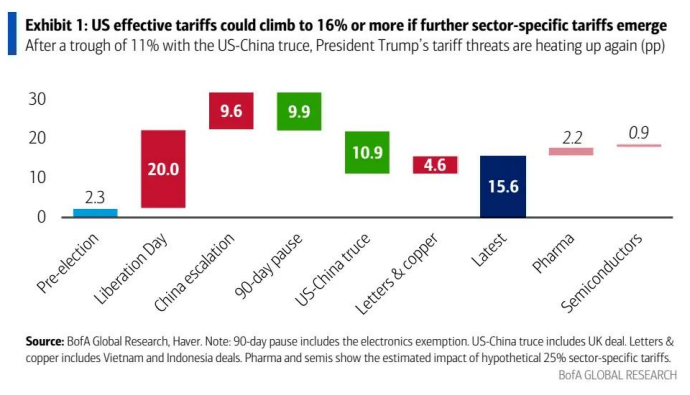
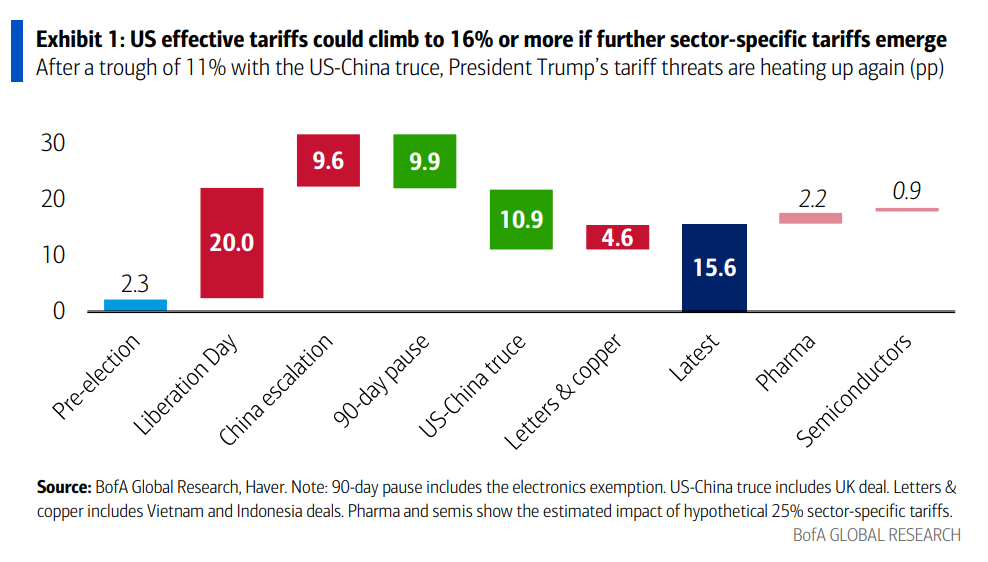
虽然美银的结构性观点保持不变,但最新进展给美银的基准情景带来了上行风险(基准情景即有效关税将稳定在 10% 左右)。特别是可能会有更多针 对特定行业的关税出台。不确定性和关税冲击的持续时间在延长。即使有特朗普看跌期权,关税可能也不会完全回到中美协议中 5 月份的低点。 7月22日,美银发布研究报告指出,美国最新的关税公告可能使有效税率提高约 5 个百分点。根据过去 12 个月的进口构成,美银估计有效税率将升至 近 16%(图表 1)。 有效关税税率大约提高 5 个百分点,将使美国财政赤字降低约 50 个基点,对于仍高于 GDP 6% 的赤字来说不算多,并且会给通胀带来约 30 个基点的 上行风险,给增长带来下行风险。 但最新的关税公告远非板上钉钉。相反,截止日期从 7 月 9 日延长至 8 月 1 日表明还有谈判的空间。尽管如此,由于滞胀冲击可能延续到 2026 年,美 联储更有可能按兵不动,这与美银与众不同的观点一致,即今年美联储不会降息。 截至 5 月,美银对有效关税的估计与实际征收的关税非常接近,总体有效关税税率为 9.6%。 不过,美银发现了一些差异。5 月份对中国的关税征收超过了美银的估计,实际计算 ...

市场越信TACO、特朗普越敢加税、美联储越不敢降息
Hua Er Jie Jian Wen· 2025-07-23 08:56
Core Viewpoint - The market's calm reaction to Trump's tariff policy may provide the government with room to impose further tax increases, pushing the Federal Reserve towards a more cautious stance, with the effective tariff rate potentially rising to 16% or higher, leading to stagflation risks extending until 2026 [1][7]. Tariff Escalation Exceeds Market Expectations - On July 4, President Trump announced new unilateral tariff rates, with potential rates ranging from 10% to 70%, expected to take effect on August 1 [2][5]. - Bank of America analysts indicated that the latest tariff announcement could raise the effective tariff rate by nearly 5 percentage points to about 16%, significantly higher than the previously expected 10% [2]. Market's Indifferent Reaction as a Catalyst for Policy Escalation - Bank of America noted that the market's indifferent response to tariff news could inadvertently encourage the government to escalate the trade war further [6]. - The lack of market reaction may provide the Trump administration with a buffer to absorb new uncertainties and tensions with major trading partners [6]. Stagflation Risks Intensify, Narrowing Federal Reserve's Policy Space - An increase in the effective tariff rate by approximately 5 percentage points could reduce the fiscal deficit by about 50 basis points, but its impact on a deficit exceeding 6% of GDP is limited [7]. - The new tariff announcement introduces significant inflationary and economic growth risks, with potential inflation rising by about 30 basis points [7]. - The uncertainty surrounding tariffs poses a downside risk to economic growth, potentially undermining the stimulus effect of the "Big Beautiful Plan" on capital expenditures [10]. Long-term Inflation Impact and Federal Reserve's Position - If tariffs are implemented on August 1, there is a risk of larger and more persistent inflation shocks, with core PCE potentially peaking at 3.5% by 2026 [10]. - The Federal Reserve's ability to act may be constrained by the need for clearer insights into the impacts of policy changes, especially if significant changes to the tariff system are anticipated [10]. - The likelihood of the Federal Reserve being "frozen in place" increases as stagflation shocks may extend until 2026, aligning with Bank of America's non-consensus expectation of no rate cuts this year [10].
日本选举风波后,日元资产如何看
2025-07-22 14:36
Summary of Key Points from the Conference Call Industry Overview - The discussion primarily revolves around the Japanese economy and its currency, the yen, in the context of recent political developments and economic challenges [1][3][5]. Core Insights and Arguments - **Economic Stagnation and Inflation Risks**: Japan is facing stagflation risks due to external trade war pressures and rising domestic food prices, particularly affecting the export of transportation equipment due to high tariffs, which has weakened overall export data and reduced residents' purchasing power [1][3]. - **Political Landscape**: Following the recent Senate elections, the ruling Liberal Democratic Party (LDP) lost its majority, leading to a mismatch in government power and legislative authority. This has raised concerns about fiscal discipline, as the opposition advocates for fiscal expansion and tax cuts, while the ruling party is cautious about increasing debt levels [1][3][4]. - **Monetary Policy Normalization**: The Bank of Japan's move towards normalizing monetary policy has resulted in rising long-term Japanese government bond yields, compounded by high U.S. bond yields, which exacerbates Japan's debt issues and raises market concerns about fiscal management [1][5]. - **Short-term Outlook for Yen Assets**: Yen assets are expected to remain under pressure in the short term due to weak economic fundamentals, stalled U.S.-Japan trade negotiations, and internal political instability. A recovery in market risk appetite is contingent on the resolution of election-related uncertainties and clarity on tax reduction policies [1][3][4]. - **Structural Opportunities in Specific Sectors**: Despite the overall economic challenges, there are structural investment opportunities in sectors such as high-end manufacturing, particularly semiconductors and communication equipment, which are expected to perform well due to policy support [1][6][8]. Additional Important Content - **Military Spending**: Japan's military spending has reached a historical high in the new fiscal year, which could benefit domestic stocks if the opposition pushes for tax cuts. This increase in military expenditure is also a factor to consider in the broader economic context [1][6]. - **Impact of Political Risks on Currency**: The yen's performance is influenced by multiple factors, including internal political risks and debt constraints. While there are concerns about long-term credit risks if the opposition promotes fiscal stimulus, the current political risks are deemed limited, reducing the likelihood of significant currency depreciation [2][7][9]. - **High-end Manufacturing Investment**: The ruling party's cautious fiscal approach does not extend to high-end manufacturing, where there is active investment, indicating potential growth in this sector despite broader economic weaknesses [8]. This summary encapsulates the key points discussed in the conference call, highlighting the challenges and opportunities within the Japanese economy and its currency dynamics.
杰富瑞上调标普500目标价至5600点:警惕核心CPI上升,看好防御板块
Zhi Tong Cai Jing· 2025-07-22 06:32
Core Viewpoint - Jefferies has raised the S&P 500 index target price for the end of 2025 to 5600 points, corresponding to a price-to-earnings ratio of approximately 20 times, while cautioning about historical seasonal patterns and macroeconomic indicators [1] Economic Outlook - The U.S. economy is facing stagflation risks, with GDP growth expected to slow to 1.9% by July 2025 according to UN forecasts [1] - Core CPI and unemployment rates are projected to rise to 3% and 4.4%, respectively [1] - The Trump administration's tariffs, effective from April 2025, are disrupting global supply chains and causing a sharp decline in export growth in the Asia-Pacific region [1] Earnings and Valuation - The S&P 500 index's current valuation is considered high, with expected earnings growth of only 5% year-over-year for 2025, which is seen as insufficient compared to the current valuation levels [1] Sector Allocation - Jefferies recommends an overweight position in communication services (XLC.US) and utilities (XLU.US), while maintaining a neutral stance on real estate, information technology, financials (XLF.US), industrials (XLI.US), and healthcare (XLV.US) [2] - A reduction in holdings is suggested for energy (XLE.US), consumer discretionary (XLY.US), and materials (XLB.US) sectors, reflecting a preference for stable cash flow areas amid macroeconomic uncertainty [2] Geopolitical Considerations - Trump's tariff policies are reshaping global trade dynamics, forcing traditional allies like the EU and Japan to adjust their strategies, with Japan even postponing planned talks to resist defense spending pressures [2] - Geopolitical instability and policy reversals are increasing market concerns regarding cyclical sectors such as non-essential consumer goods [2]
美联储降息救市!7月20日,今日传出五大消息已袭来!
Sou Hu Cai Jing· 2025-07-22 04:31
Core Viewpoint - A power struggle is unfolding between Wall Street and the White House regarding interest rates, with Federal Reserve Chairman Jerome Powell facing pressure from hawkish sentiments and potential leadership changes [1][3]. Group 1: Federal Reserve and Interest Rates - Dallas Fed President Logan's hawkish speech emphasized the need to maintain a 4.25% interest rate range for at least 6 to 12 months, dampening hopes for rate cuts [3][4]. - Market reactions to Logan's speech were immediate, with the probability of a rate cut in September dropping from 65% to 58%, and the likelihood of two cuts this year plummeting from 93% to 76% [3]. - The latest June meeting minutes revealed a split among Fed officials, with some advocating for immediate rate cuts, while others expressed concerns about inflation driven by tariffs [4]. Group 2: Economic Indicators and Market Reactions - The Consumer Price Index (CPI) rose by 2.7% year-on-year, marking a four-month high, while core CPI increased by 2.9%, significantly above the Fed's 2% target [4]. - Concerns about tariffs affecting consumer prices were highlighted, with 88% of manufacturing firms and 82% of service firms planning to pass on tariff costs to consumers [4]. - The trade war's impact was underscored by Trump's announcement of a 30% tariff on Mexico, prompting retaliatory measures and raising fears of broader economic repercussions [4]. Group 3: Market Volatility and Political Dynamics - Trump's contemplation of firing Powell led to significant market volatility, with stock prices dropping and bond yields rising, only for his stance to reverse shortly after [5]. - Logan's use of the term "trauma" to describe current risks indicates the precarious balance the Fed must maintain between rising inflation and the need for potential rate cuts [7]. - The ongoing political dynamics and potential leadership changes at the Fed create uncertainty in the financial markets, as the next chair will face tough decisions amid conflicting pressures [7].
美国国债到期未能如期偿还,未来对美元会有什么影响?
Sou Hu Cai Jing· 2025-07-22 01:09
Group 1 - The potential default on U.S. Treasury bonds could lead to a collapse of the dollar's credit system and a weakening of its status as a global reserve currency, resulting in a loss of trust in the dollar and a shift towards alternative assets like gold and the yuan [1][3] - The process of de-dollarization may accelerate, with countries like Saudi Arabia pushing for oil trade settlements in non-dollar currencies, further diminishing the dollar's dominance in global commodity pricing [3][6] - A global financial crisis could ensue, characterized by a liquidity crisis and asset price collapse, as U.S. Treasury yields surge, increasing global borrowing costs and making corporate financing more difficult [3][5] Group 2 - Hedge funds and pension funds with significant exposure to U.S. Treasuries may face bankruptcy, and the risk of bank runs could re-emerge, leading to systemic liquidity shortages [5][6] - Emerging market countries may experience heightened debt repayment pressures and an increased risk of sovereign debt defaults due to the depreciation of the dollar, which could trigger volatility in commodity prices [5][6] - The U.S. economy may fall into a "stagflation" scenario, with rising unemployment and shrinking consumer spending, compounded by the dollar's depreciation driving up import prices [6][8] Group 3 - Long-term structural risks persist, even if a default is avoided, as the U.S. faces unsustainable fiscal policies, with federal debt projected to reach 180% of GDP by 2050 and interest payments consuming a growing share of tax revenues [10] - Credit ratings for U.S. debt have been downgraded by major rating agencies, leading to a long-term increase in financing costs [10] - A default on U.S. debt could trigger a credit crisis for the dollar, a global financial tsunami, and a geopolitical realignment, with even a technical default exposing the unsustainable fiscal situation [10]
死也不辞职!鲍威尔死磕特朗普:放话“任期坐到满”
Sou Hu Cai Jing· 2025-07-21 06:02
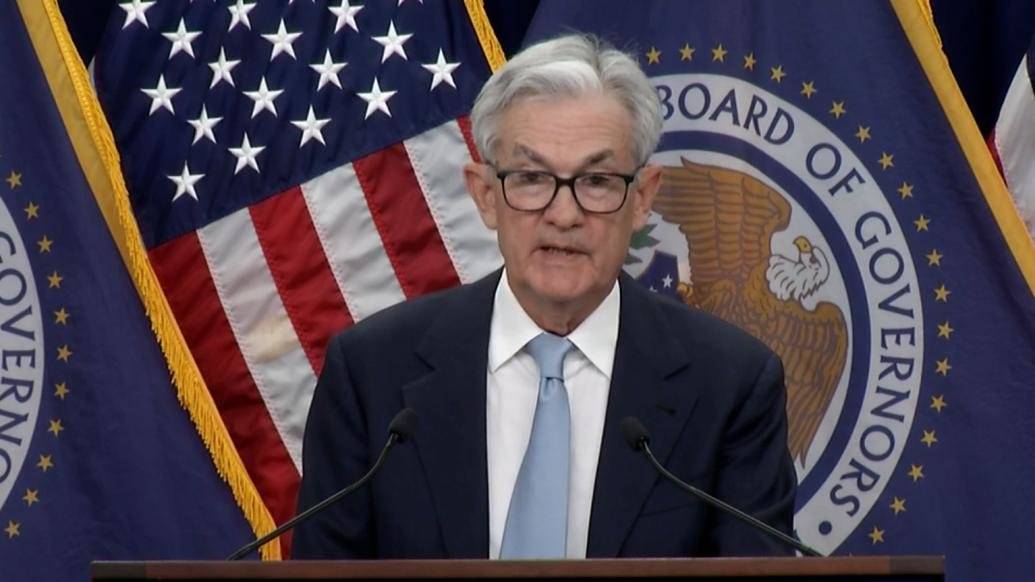
随着唐纳德·特朗普总统持续向美联储主席杰罗姆·鲍威尔施加压力,早些时候两人曾经的对峙或许能为当前的僵局提供些许线索。 回顾2019年,和今天的局面相似,特朗普当时强烈要求美联储迅速降息,并因此引发了有关鲍威尔是否能继续担任美联储主席以及他是否会被解职的广泛讨 论。 鲍威尔再次重申:"答案是'不'。" 沃特斯不甘心地追问:"你认为总统没有解雇你的权力?这就是你不愿离开的原因吗?" 鲍威尔表示:"法律明确规定我有四年的任期,我完全打算为这个任期服务。" 2019年,鲍威尔曾公开表示,为了保护美联储的独立性,他宁愿随船沉没,也不愿为了保住个人职位而屈服于政治压力。 如今,特朗普继续对鲍威尔施压,似乎这场对峙的背后,隐藏着一些可能对当前局面产生影响的深层次因素。 那时候的特朗普,除了为加快降息施压,还因为他发动的贸易战而要求美联储采取更多宽松政策。这一举动,再次引发了关于鲍威尔是否能继续领导美联储 的质疑,特别是他是否会在特朗普的压力下下台。 在2019年7月的众议院金融服务委员会听证会上,时任委员会主席的玛克辛·沃特斯曾问鲍威尔:"如果今天或明天你接到总统的电话,他说'我要解雇你,收 拾东西,准备离开',你会怎么做 ...
美联储降息救市!7月18日,今日凌晨的四大消息已全面发酵
Sou Hu Cai Jing· 2025-07-19 04:08
Group 1 - The Federal Reserve is experiencing internal divisions, with 19 decision-makers split into three camps regarding interest rate policies, indicating a significant "hawk-dove" debate [1][5] - Dallas Fed President Logan's strong stance suggests that the current interest rate level of 4.25% may persist for 6 to 12 months, providing theoretical support for high interest rate policies despite a slight decline in inflation data [1][5] - Political pressure is mounting as President Trump criticizes Fed Chair Powell and calls for immediate interest rate cuts, which could influence the Fed's decision-making process [1][3] Group 2 - The global trade landscape is volatile, with the Trump administration imposing high tariffs on several countries, while simultaneously lifting tariffs on China, leading to unpredictable market reactions [3][5] - Employment data shows a mixed picture, with non-farm payrolls increasing by 147,000 in June, but private sector job growth nearly stagnant when excluding certain sectors [5][7] - Market indicators are fluctuating, with the probability of a rate cut in September dropping from 75% to 54.4%, reflecting uncertainty in economic conditions [5][7] Group 3 - Gold prices are hovering around $3,330, while the dollar index has fallen below 97, marking a new low since February 2022, indicating shifts in investor sentiment [7] - The stock market is reacting unevenly, with the Nasdaq reaching a historical high while the Dow Jones experienced a significant drop of 436 points, showcasing the divergent performance of technology stocks [7] - Economists at the New York Fed are analyzing the complexities of the Fed's June meeting minutes to navigate the challenges of inflation, employment, and economic resilience [7][5]