货币政策

Search documents
俄罗斯央行宣布下调基准利率至15.5%
Sou Hu Cai Jing· 2026-02-13 15:15
Core Viewpoint - The Central Bank of Russia has decided to lower the benchmark interest rate by 50 basis points to 15.5%, marking the sixth consecutive rate cut, while indicating a gradual easing of monetary policy but maintaining a generally tight stance [1]. Group 1: Monetary Policy Adjustments - The Central Bank of Russia continues to gradually relax its monetary policy while still keeping it tight overall [1]. - The bank's announcement highlights that the Russian economy is returning to a balanced growth trajectory [1]. - The feasibility of further rate cuts will depend on the sustainability of inflation slowdown and changes in inflation expectations [1]. Group 2: Inflation and Economic Forecasts - In January, inflation accelerated significantly due to "one-off factors," but the Central Bank expects that sustainable indicators of price increases have not changed significantly [1]. - The Central Bank forecasts that under the current monetary policy, the annual inflation rate will decline to 4.5% to 5.5% by 2026, with a target of around 4% in the second half of 2026 [1]. - The annual inflation rate for 2025 is projected to be lower than the Central Bank's forecast at 5.6% [1]. Group 3: Inflation Risks - The Central Bank identifies that medium-term inflation risks outweigh deflation risks, with key inflation risks including long-term deviations from balanced growth, high inflation expectations, and the impact of VAT and regulated price increases [2]. - Trade tensions, global economic slowdown, and low oil prices could create inflationary effects through the ruble exchange rate [2]. - Geopolitical tensions remain a significant source of uncertainty [2]. Group 4: Upcoming Meetings - The Central Bank of Russia will hold a board meeting on March 20 to review subsequent adjustments to the benchmark interest rate [3].
首月金融数据“开门红”!信贷、社融、M2平稳增长
Sou Hu Cai Jing· 2026-02-13 14:57
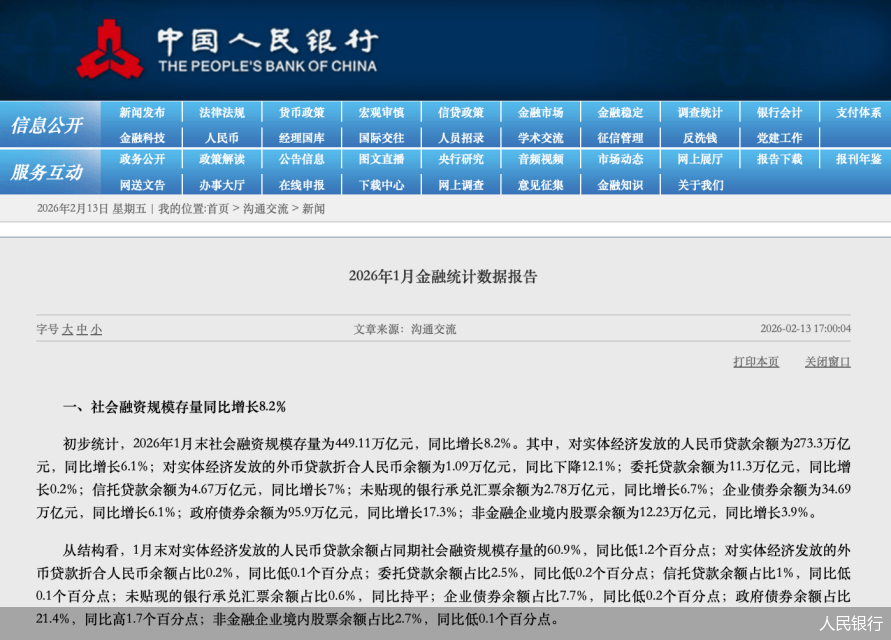
Core Viewpoint - The People's Bank of China (PBOC) reported stable growth in new credit and social financing in January 2026, indicating a continued supportive monetary policy stance. The central bank's structural interest rate cuts and proactive fiscal policies are expected to maintain a moderate level of new loans and significant year-on-year growth in social financing throughout the year [1][11]. Group 1: Credit Growth - As of the end of January, the balance of RMB loans reached 276.62 trillion yuan, with a year-on-year growth of 6.1%. In January, RMB loans increased by 4.71 trillion yuan, reflecting stable growth and a recovery in demand [6][11]. - The January loan increment of 4.71 trillion yuan was 420 billion yuan lower than the same period last year, attributed to weak investment and consumption, as well as limited effects from recent growth stabilization policies [6][7]. - The PBOC has shifted its focus from total credit volume to optimizing credit structure, supporting key areas such as domestic demand, technological innovation, and small and medium enterprises [7]. Group 2: Social Financing - The social financing scale increased by 7.22 trillion yuan in January, 1.662 trillion yuan more than the same month last year, with a total social financing stock of 449.11 trillion yuan, reflecting a year-on-year growth rate of 8.2% [8][11]. - Government bonds, corporate bonds, and bank acceptance bills were the main contributors to the year-on-year increase in social financing, with net financing from government bonds reaching 9.764 trillion yuan, marking a significant rise [8][9]. - The issuance of local government bonds in January amounted to 863.3 billion yuan, a year-on-year increase of 54.84%, providing strong fiscal support for the economy [9]. Group 3: Monetary Supply - As of the end of January, the broad money supply (M2) reached 347.19 trillion yuan, growing by 9% year-on-year, while the narrow money supply (M1) increased by 4.9% [10]. - The M2 growth rate exceeded expectations, driven by factors such as concentrated loan disbursements and seasonal increases in deposits due to year-end financial activities [10][11]. - The PBOC aims to maintain a suitable monetary environment to support economic stability and reasonable price recovery, with expectations of potential interest rate cuts in the second quarter of 2026 [11].

首月金融数据“开门红”,有力支持年初经济平稳开局
Sou Hu Cai Jing· 2026-02-13 14:39
Core Viewpoint - The People's Bank of China released January financial statistics, indicating a stable growth in credit and social financing, reflecting a supportive monetary policy environment for the beginning of the year [1][2]. Group 1: Financial Data Overview - In January 2026, new RMB loans amounted to 4.71 trillion, a year-on-year decrease of 420 billion [1]. - The new social financing scale reached 7.22 trillion, an increase of 1,662 billion compared to the same period last year [1]. - The broad money supply (M2) grew by 9.0% year-on-year, accelerating by 0.5 percentage points from the previous month [1]. - The narrow money supply (M1) increased by 4.9% year-on-year, with a growth rate acceleration of 1.1 percentage points from the previous month [1]. Group 2: Economic Insights - Despite a year-on-year decrease in new RMB loans, the demand side shows signs of recovery, with a credit growth rate of 6.1%, surpassing nominal economic growth [1]. - The increase in social financing reflects a high level of support from the monetary policy, contributing to a stable economic start for the year [1][2]. - The chief economist of China Minsheng Bank noted that January is a traditional peak month for credit, with early project releases and significant infrastructure loan approvals contributing to the high loan volume [1][2]. Group 3: Consumer and Business Loan Trends - Household loans increased by 456.5 billion, with a year-on-year increase of 127 billion, supported by pre-holiday consumption [4]. - Short-term loans for residents rose by 109.7 billion, with a year-on-year increase of 1,594 billion, while medium to long-term loans increased by 346.9 billion, showing a year-on-year decrease of 1,466 billion [4]. - The demand for personal loans was boosted by seasonal consumption trends and marketing efforts, with policies optimizing personal consumption and business loans [5]. Group 4: Future Outlook - The overall data for new credit and social financing in January appears stable, with expectations for a potential opening of a window for interest rate cuts in the second quarter [5]. - Factors such as increased bond financing, local government debt replacement, and weak credit demand from businesses and households may keep new loan levels moderate in 2026 [5]. - Social financing is expected to maintain a significant year-on-year increase, serving as a key indicator of financial support for the real economy [5].

美国财长力推美联储新主席提名进程 预计沃什将获得参议院听证机会
智通财经网· 2026-02-13 14:00
Group 1 - U.S. Treasury Secretary Scott Bessenet expects a hearing for Kevin Walsh, the nominee for Federal Reserve Chair, despite disagreements with a Republican senator [1] - Senator Tom Tillis has vowed to pause any appointments to the Federal Reserve until the Department of Justice's investigation into the Fed's $2.5 billion headquarters renovation is concluded [1] - Bessenet emphasized the importance of starting the hearing and indicated that an agreement has been reached on this matter [1] Group 2 - Bessenet declined to comment on the DOJ case but noted that a subpoena does not necessarily imply charges [2] - The current Federal Reserve Chair, Jerome Powell, is facing scrutiny as his term ends in May, with past pressures from the Trump administration regarding interest rate cuts [2] - Bessenet stated that inflation is decreasing and predicted that the U.S. could return to the Federal Reserve's 2% target by mid-year, with potential GDP growth exceeding 3% in 2025 based on Q4 data [2]
1月金融数据解读:居民信贷破冰
Guoxin Securities· 2026-02-13 13:38
Financial Data Overview - In January, China's new social financing (社融) reached 7.22 trillion yuan, exceeding the expected 6.51 trillion yuan[2] - New RMB loans amounted to 4.71 trillion yuan, surpassing the forecast of 4.50 trillion yuan[2] - M2 money supply grew by 9.0% year-on-year, above the expected 8.4%[2] Market Trends and Analysis - The total social financing in January showed a strong performance, with a month-on-month increase of 5.01 trillion yuan, marking a historical high[5] - Year-on-year growth rate of social financing slightly declined to 8.2% due to a high base effect from the previous year[5] - New loans to residents turned positive, increasing by 127 billion yuan, ending a six-month trend of year-on-year declines, indicating a marginal recovery in residents' willingness to leverage[5] Credit Structure Insights - Total credit continued to show a year-on-year decrease, but the structure improved, with a notable reduction in corporate bill financing[5] - New corporate loans totaled 4.45 trillion yuan, reflecting a year-on-year decrease of 3.3 billion yuan, while short-term loans increased by 310 billion yuan[12] - New resident loans amounted to 456.5 billion yuan, with short-term loans showing significant improvement, indicating a recovery in consumer demand[15] Deposit and Monetary Supply Dynamics - Total deposits increased by 8.09 trillion yuan, with a year-on-year increase of 3.77 trillion yuan, contributing to a rise in M2 growth[25] - M1 growth rate rebounded to 4.9%, indicating an acceleration in actual money circulation, corroborating the improvement in resident financing[26] - The M2-M1 growth differential narrowed to 4.1%, while the social financing-M2 differential expanded to -0.8%[26]
1月金融数据解读:居民信贷“破冰”
Guoxin Securities· 2026-02-13 13:21
Group 1: Financial Data Overview - In January, China's new social financing (社融) reached 7.22 trillion yuan, exceeding the expected 6.51 trillion yuan[2] - New RMB loans amounted to 4.71 trillion yuan, surpassing the forecast of 4.50 trillion yuan[2] - M2 money supply grew by 9.0% year-on-year, above the expected 8.4%[2] Group 2: Credit and Financing Trends - The total social financing increased by 5.01 trillion yuan month-on-month, marking a historical high for January[5] - Year-on-year growth of social financing slowed to 8.2%, influenced by a high base from the previous year[5] - New loans to residents turned positive with an increase of 127 billion yuan, ending a six-month trend of year-on-year declines[5] Group 3: Structural Changes in Financing - Corporate bill financing saw a significant year-on-year decrease, while short-term and medium-to-long-term loans showed structural improvement[5] - New government bond financing reached 976.4 billion yuan, a year-on-year increase of 283.1 billion yuan, ending a five-month decline[20] - Direct financing for enterprises increased by 532.4 billion yuan year-on-year, with credit bonds contributing 503.3 billion yuan[20] Group 4: Deposit and Money Supply Insights - Total deposits increased by 8.09 trillion yuan, with a year-on-year increase of 3.77 trillion yuan[25] - M1 growth rate rebounded to 4.9%, indicating an acceleration in actual money circulation[26] - The M2-M1 growth rate differential narrowed by 0.6 percentage points to 4.1%[26]
英国央行首席经济学家皮尔:当前利率的限制性程度愈发模糊
Xin Lang Cai Jing· 2026-02-13 13:12
格隆汇2月13日|英国央行首席经济学家皮尔周五警告称,货币政策对需求的压制程度正变得难以判 断。"我们的货币政策立场确实仍有一定限制性,"皮尔表示,"但这种限制性程度现在更加模糊,或许 其模糊性甚至超过了反通胀进程尚未达标的不确定性。"皮尔在桑坦德银行伦敦活动中表示,通胀回落 至2%目标的速度慢于预期,并强调薪酬协议水平对央行而言仍然过高。作为央行最具鹰派色彩的声音 之一,皮尔在2月5日会议上与多数委员一同投票支持维持利率不变。 ...
【立方债市通】3家券商债券业务违规/漯河国投拟首次发债/10家公司被核减232亿债务融资工具额度
Sou Hu Cai Jing· 2026-02-13 12:54
Regulatory Actions - The China Securities Regulatory Commission (CSRC) issued warning letters to three securities firms: Pacific Securities, Zhongtian Guofu Securities, and Caitong Securities due to issues such as inadequate internal controls and improper due diligence in bond underwriting [1] - The Shanghai and Shenzhen Stock Exchanges released a special notice to standardize investor education regarding general bond repurchase transactions, requiring member units to conduct self-inspections and complete rectifications by April 30, 2026 [3] Monetary Policy - The People's Bank of China (PBOC) conducted a 10 trillion yuan six-month reverse repurchase operation, with a net injection of 5 trillion yuan after 5 trillion yuan matured [6] - The PBOC's January financial statistics report indicated that the total social financing stock was 449.11 trillion yuan, a year-on-year increase of 8.2%, with a net cash injection of 519.1 billion yuan in January [7] Foreign Investment in Bonds - As of the end of January 2026, foreign institutions held 3.35 trillion yuan in the interbank bond market, accounting for approximately 1.9% of the total custody amount, with government bonds making up 59.4% of this holding [9] Local Government Debt Management - The government of Anyang city emphasized the need to monitor local debt comprehensively and to prevent the emergence of new hidden debts, while also addressing overdue payments to enterprises [10] Bond Issuance Activities - Chengfa Group issued its first bond to support small and micro enterprises, raising 400 million yuan at an interest rate of 2.43%, with a subscription multiple of 5.45 times [11] - Beijing State-owned Assets Management Company submitted a registration for a corporate bond issuance of 10 billion yuan [12] - The Linyi City Investment Group and the Weishi County Ronggang Investment Development Company announced plans for their first bond issuances, with amounts of 15 million yuan and 6 million yuan, respectively [15][16] Debt Financing Adjustments - The China Interbank Market Dealers Association announced a reduction of 232.065 billion yuan in debt financing tool quotas for 10 companies, indicating tighter control over corporate debt issuance [16][17] Corporate Leadership Changes - The State-owned Assets Supervision and Administration Commission (SASAC) announced personnel changes involving 11 leaders across 14 central enterprises, including appointments and removals [18][19]

2026年1月金融数据解读:居民存款搬家提速
Yin He Zheng Quan· 2026-02-13 12:54
Group 1: Monetary Supply and Growth Rates - M1 growth rate increased to 4.9% in January 2026, up from 3.8% in December 2025[1] - M2 growth rate rose to 9.0% in January 2026, compared to 8.5% in December 2025[1] - New social financing (社融) reached 7.2 trillion yuan in January 2026, an increase of 165.4 billion yuan year-on-year, with a growth rate of 8.2%[1] Group 2: Household Deposits and Trends - Household deposit growth rate estimated at 7.18% in January 2026, down from 9.68% in December 2025[1] - The difference between household deposit growth and M2 growth turned negative for the first time in 7.5 years, at -1.82 percentage points[1] - Non-bank deposits showed a rapid increase in the rolling 12-month sum[1] Group 3: Loan and Credit Dynamics - New RMB loans totaled 4.71 trillion yuan in January 2026, a decrease of 420 billion yuan year-on-year, with a growth rate of 6.1%[1] - The decline in loans was primarily driven by a decrease in corporate loans, particularly in medium to long-term loans, which fell by 280 billion yuan[19] - Residential credit showed a slight increase of 128 billion yuan, with short-term loans up by 159.4 billion yuan, while medium to long-term loans decreased by 146.6 billion yuan[19] Group 4: Financing Sources and Trends - Government bond financing increased by 2.83 trillion yuan year-on-year, with a net financing of 9.76 trillion yuan in January 2026[26] - Corporate bond financing rose by 579 billion yuan, driven by technology innovation bonds, which net financed approximately 2.52 trillion yuan[25] - The effective social financing growth rate, excluding government financing, was 5.31%, down from 5.62%[5]
存款再搬家!1月居民存款少增超3万亿,非银多增2.6万亿
Nan Fang Du Shi Bao· 2026-02-13 12:06
Core Viewpoint - The People's Bank of China reported that as of the end of January 2026, the total social financing stock reached 449.11 trillion yuan, reflecting an 8.2% year-on-year growth, indicating a stable support for the real economy amidst discussions on the maturity of large deposits [2][4]. Group 1: Social Financing and Monetary Supply - The total social financing stock increased by 8.2% year-on-year, with a total of 449.11 trillion yuan as of January 2026, despite a month-on-month decrease of 0.1 percentage points [4][5]. - The broad money supply (M2) grew by 9.0% year-on-year, which is significantly higher than the nominal GDP growth rate, supporting the stability of the real economy [4][5]. Group 2: Loan Data - In January 2026, new RMB loans amounted to 4.71 trillion yuan, which is a decrease of 420 billion yuan compared to the previous year [5]. - Resident loans in January totaled 456.5 billion yuan, with short-term and medium-to-long-term loans increasing by 109.7 billion yuan and 346.9 billion yuan, respectively, showing year-on-year increases of 1.594 trillion yuan and 3.1 trillion yuan [5]. Group 3: Deposit Trends - In January 2026, resident deposits decreased by 3.39 trillion yuan year-on-year, while non-bank financial institutions saw an increase of 2.56 trillion yuan in deposits [6]. - The discussion around the maturity of over 50 trillion yuan in fixed deposits has led to a "deposit migration" phenomenon, where residents are reallocating their savings towards higher-yielding assets [6][7]. Group 4: Financial Market Implications - Analysts suggest that the divergence in growth rates between resident deposits and non-bank financial institution deposits indicates a potential shift of funds towards capital markets, although significant direct investment from residents is not expected in the short term [7]. - The recent monetary policy report indicates a trend where asset management products and bank deposits are experiencing a "see-saw" effect, with funds moving towards asset management products while still remaining within the banking system [7].