量化宽松

Search documents
欧洲央行管委维勒鲁瓦:量化宽松是最佳的非常规政策工具
news flash· 2025-07-07 19:58
Core Viewpoint - The European Central Bank (ECB) Governing Council member and Bank of France Governor, Villeroy, stated that quantitative easing (QE) is the best unconventional policy tool when interest rates are at zero [1] Group 1: Quantitative Easing - Villeroy emphasized that despite criticisms of QE for causing asset bubbles, increasing inequality, and leading to losses for some Eurozone central banks, its effectiveness surpasses that of negative interest rates [1] - He highlighted that the ECB's recent strategic review supports the continued use of QE as a primary monetary policy tool [1] Group 2: Other Policy Tools - Long-term refinancing operations (LTRO) and the Transmission Protection Instrument (TPI) should primarily be used to ensure effective transmission of monetary policy to the economies of the 20 Eurozone countries [1]
好书推荐·赠书|《货币之手》
清华金融评论· 2025-07-04 10:16
Core Viewpoint - The article discusses the book "The Hand of Money," which analyzes the role and impact of central banks in the global economy, particularly focusing on unconventional monetary policies and their consequences during financial crises [3][4]. Summary by Sections Book Overview - The book provides a deep analysis of the central bank's role in the economy, particularly during the 2007-2009 financial crisis and the COVID-19 pandemic, examining unconventional monetary policies like quantitative easing and negative interest rates [3]. - It highlights the effectiveness and shortcomings of these policies in stabilizing financial markets and stimulating economic growth, while also addressing unintended negative consequences such as debt accumulation and increased wealth disparity [3]. Author Background - Johan Van Overtveldt, the author, is a former Belgian Minister of Finance and has extensive experience in economic management and central banking policy [4]. - Stijn Rocher, the co-author, serves as a policy advisor to the Flemish Minister of Finance and holds a PhD from the University of Antwerp [5]. Key Themes - The book emphasizes the importance of trust in the functioning of central banks, drawing parallels to Confucian teachings on governance and the necessity of trust for effective monetary policy [14]. - It warns of the over-reliance on central bank policies since the Great Moderation era, introducing various "syndromes" that may arise from the misuse of monetary policy, such as the "Butch Cassidy Syndrome" and the "Michael Jackson Syndrome," which reflect the dangers of excessive debt and economic dependency on central bank interventions [15][16]. Conclusion - The book aims to demystify central banking and monetary policy, encouraging a better understanding of their complexities and promoting a more responsible financial system that serves society [16].


10连阳,注意风险
Sou Hu Cai Jing· 2025-07-04 09:46
Group 1 - The Nasdaq has experienced a ten-day consecutive rise, indicating long-term upward potential, but short-term rapid increases have accumulated certain risks [1] - The valuation percentile of the Nasdaq 100 has reached over 80%, suggesting it is significantly overvalued [2] - A potential adjustment of 20% to 30% is possible despite the long-term upward trend [3] Group 2 - Investment should focus on seizing key opportunities and making correct decisions at the right time [4] - The strategy of dollar-cost averaging is preferred over lump-sum investments, emphasizing a steady and cautious approach to wealth accumulation [4][5] - Current market conditions, including ongoing quantitative easing by the Federal Reserve and China, do not support a long-term bear market, making being out of the market a significant risk [7] Group 3 - The investment landscape is constantly changing, but there are fundamental logics to follow [9] - The debt ceiling issue in the U.S. is a concern, with recent legislation increasing the debt limit by $4 trillion to continue fiscal stimulus [13] - The focus on investing in Nasdaq is driven by optimism about the development of artificial intelligence and the concentration of talent in Silicon Valley [13]
美财政部搞“影子QE”,美联储独立性遭70年来重大危机!
Jin Shi Shu Ju· 2025-07-04 06:33
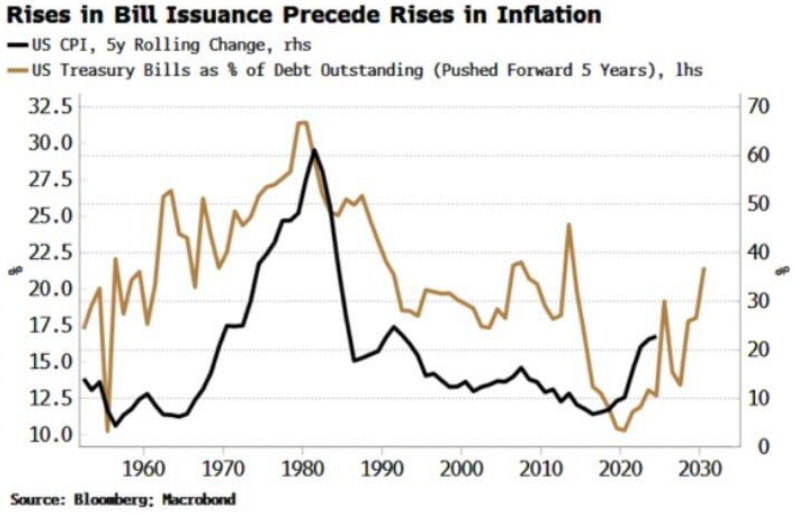
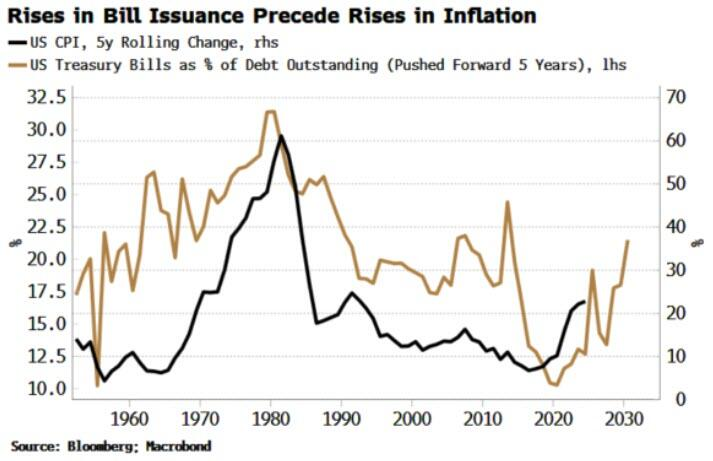
Core Viewpoint - The U.S. Treasury's shift towards increasing financing through short-term debt will undermine the Federal Reserve's independence, effectively placing monetary policy under fiscal control, leading to a steeper yield curve and a weakened dollar [1][6][9]. Group 1: Impact on Federal Reserve Independence - The Treasury's strategy to issue more short-term debt will severely limit the Federal Reserve's ability to independently formulate monetary policy, marking a potential crisis in its autonomy [1][4][8]. - The increase in short-term debt issuance is expected to further erode the Fed's independence, which has been compromised over the years [1][4][6]. Group 2: Inflation and Economic Implications - The issuance of more short-term Treasury bills may lead to structural increases in the Consumer Price Index (CPI), as these instruments possess a stronger "monetary attribute" compared to long-term bonds [1][4][6]. - Historical data indicates that changes in the proportion of short-term bills in outstanding debt often precede long-term inflation trends, suggesting a causal relationship [4][6]. Group 3: Market Dynamics and Asset Prices - The explosion of short-term debt issuance is likely to push risk assets to higher levels, driven by more efficient clearing and deeper liquidity in repurchase agreements [6][8]. - The current stock market is at historical highs, and the effectiveness of short-term debt issuance as a stimulus may be diminishing due to extreme market saturation and high valuations [6][8]. Group 4: Long-term Debt and Liquidity - Increased issuance of short-term debt correlates positively with the growth of Federal Reserve reserves, while long-term debt issuance tends to tighten liquidity [8]. - The combination of rising asset prices and short-term debt accumulation poses a significant challenge for the Federal Reserve, potentially forcing a reversal of monetary easing policies [8][9].
谁将影响全球最重要的利率?贝森特“夺权”鲍威尔
Hua Er Jie Jian Wen· 2025-07-04 03:49
Core Viewpoint - The U.S. Treasury's strategy to increase short-term bond issuance is significantly undermining the Federal Reserve's independence, effectively shifting monetary policy authority to the Treasury [1][13][18] Group 1: Treasury's Strategy and Its Implications - Treasury Secretary Yellen's recent preference for short-term debt financing contrasts with her previous criticism of reliance on short-term bonds, resembling a fiscal version of quantitative easing [1][12] - The shift towards more short-term Treasury issuance is expected to stimulate risk asset prices further away from long-term fair value and structurally raise inflation levels [1][12] - The increase in short-term debt issuance will severely limit the Federal Reserve's ability to independently formulate anti-inflation monetary policy, leading to a fiscal-dominated landscape [1][13] Group 2: Inflation Dynamics - The decision to increase short-term debt issuance may become a structural factor driving inflation higher in the coming years [2][5] - Historical data indicates that fluctuations in the proportion of Treasury bills in total outstanding debt often precede long-term inflation trends, suggesting a causal relationship [2][5] Group 3: Market Liquidity and Short-Term Bonds - The explosive growth of the repurchase market has amplified the impact of short-term bonds, as improved clearing mechanisms and increased liquidity make repurchase transactions resemble money [8][9] - A high net bond issuance relative to fiscal deficits can lead to market troubles, as seen in the 2022 bear market, prompting the Treasury to release a large volume of Treasury bills in 2023 to inject liquidity into the market [9][12] Group 4: Federal Reserve's Policy Dilemma - The combination of irrational asset price growth, high consumer inflation, and substantial short-term debt creates a challenging policy environment for the Federal Reserve [13][14] - Traditionally, the central bank would respond to such a situation with tightening policies; however, in an economy burdened with short-term debt, rate hikes would lead to soaring government borrowing costs [14][18] - The increasing short-term debt burden will constrain the Federal Reserve's ability to raise interest rates, effectively allowing the government's substantial deficits and issuance plans to dominate monetary policy [14][18] Group 5: Long-Term Market Effects - The potential reactivation of policy tools like quantitative easing, yield curve control, and financial repression may increase to artificially suppress long-term yields, marking a significant victory for the Treasury [17][18] - If inflation remains sufficiently high and the government manages to control its budget deficits, the debt-to-GDP ratio could decline, albeit at the cost of the Federal Reserve's hard-won independence [18]
新华社:“大而美” 真的美?全球为美国危机买单 社会信任崩塌
Xin Hua She· 2025-07-03 23:50
Core Points - The "Big and Beautiful" tax and spending bill, pushed by President Trump, was passed by the U.S. Senate with a vote of 51 to 50 [1] - Elon Musk criticized the bill, warning it could escalate tensions and exacerbate existing issues [1] - Analysts noted the bill reflects deep contradictions in American democracy, claiming it benefits the wealthy while harming the poor [1] Tax Structure - The bill aims to make permanent the corporate tax rate at 21% and increase the estate tax exemption to $15 million, while maintaining a 37% income tax rate for those earning over $500,000 [4] - The Congressional Budget Office (CBO) reported that the top 10% of households would see a 2% increase in assets, while the bottom 10% would experience a 4% decrease due to welfare cuts, widening the wealth gap [4] Fiscal Impact - The bill is projected to increase the national debt by $2.4 trillion over the next decade, with total debt reaching $30 trillion when including interest costs [5] - The tax foundation estimates a $2.6 trillion increase in the fiscal deficit over the same period [5] - The bill's policies may lead to a stagnation in economic growth by 2025, contradicting claims that economic growth can absorb debt [5] Social Welfare Cuts - The bill imposes strict work requirements for Medicaid, potentially leaving 10.9 million people without health insurance by 2034 [5] - Food stamp benefits are reduced, with daily subsidies dropping from $5.90 to $4.80, leading to a 40% increase in applications for food aid [7] - The bill also increases defense spending to a record $895 billion, raising concerns about prioritizing military funding over social welfare [7] Global Economic Ramifications - The U.S. national debt surpassed $36.22 trillion, with a debt-to-GDP ratio of 124% [8] - The bill includes provisions that could impose punitive tariffs on countries implementing digital service taxes, potentially disrupting global trade [10] - Analysts predict that these measures could lead to significant sell-offs in U.S. stocks and bonds, affecting the overall market [11] Public Trust and Political Climate - Public trust in the federal government has reached its lowest level since 1958, with only 16% of respondents expressing confidence in the government's ability to act correctly [13] - Over half of the surveyed population believes that American democracy needs a complete overhaul, indicating widespread dissatisfaction with the current political system [14] - The bill is seen as a reflection of the deepening crisis in American democracy, exacerbating social inequality and undermining the U.S.'s global leadership [14]

对冲风暴来袭!高盛预警:美元恐加速下滑
智通财经网· 2025-06-25 00:59
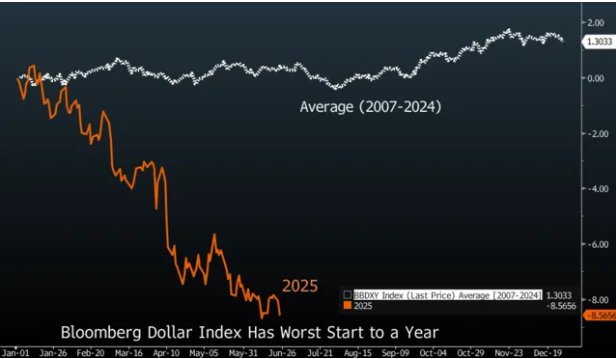
Group 1 - Goldman Sachs' global head of repurchase trading, Richard Chambers, indicates that the dollar may continue its worst annual start on record as foreign investors increase their foreign exchange hedging efforts [1] - The Bloomberg Dollar Index has dropped over 8% this year, marking the worst annual start on record, influenced by unpredictable policies from former President Trump that have shaken investor confidence [1] - Foreign investors' holdings of U.S. securities have doubled to $31 trillion over the past decade, including stocks, government bonds, and corporate bonds [1] Group 2 - There are currently no signs of a large-scale withdrawal of foreign investors from the U.S. bond market, but Chambers predicts a gradual weakening of foreign demand [3] - European countries are increasing fiscal borrowing and spending, enhancing the euro's depth as an alternative reserve currency, leading European investors to prefer local markets [3] - Chambers notes that investors are likely to favor nationalism and localized investments over shifting to the dollar, resulting in the U.S. relying more on domestic buyers to absorb growing debt [3] Group 3 - Bridgewater's interest rate strategy head, Alex Schiller, highlights the challenge of finding potential buyers for the expanding debt, which is a global issue [3] - Schiller points out that U.S. 10-year Treasury bonds have performed the best among major bond markets this year [3] - The structural adjustments in Japan and Europe are more significant than in the U.S. as central banks reverse their policies to combat inflation [3] - Gold has emerged as the biggest beneficiary as governments worldwide compete to expand their debt [3]

理解宏观金融崩溃
经济观察报· 2025-06-24 11:10
Core Viewpoint - The article discusses the lessons learned from the 2008 financial crisis and other macroeconomic crises over the past three decades, emphasizing the interconnectedness of financial markets and the real economy, as well as the mechanisms that lead to financial crises [2][3]. Mechanisms of Crisis Formation - The 2008 crisis was primarily triggered by subprime mortgages linked to the real estate market, a pattern observed in various financial crises throughout history, including the Southeast Asian financial crisis [5]. - Real estate booms often result from capital inflows, as real estate is a favored collateral for financial institutions due to its stable value, leading to a misallocation of funds away from productive sectors like manufacturing [5]. - The definition and identification of bubbles are debated, but they are characterized by irrational investor behavior and speculative price increases, which can persist for extended periods based on collective beliefs [6]. - Financial crises manifest as bank runs or "runs" on shadow banking institutions, where liquidity issues can escalate into solvency crises, particularly when banks rely on short-term wholesale funding [7][9]. - The relationship between banks and sovereign debt is crucial, as systemic banking crises can lead to sovereign debt crises, creating a vicious cycle that exacerbates economic instability [10]. Policy Responses - Central banks play a critical role in responding to macroeconomic crises by providing liquidity and distinguishing between liquidity shortages and solvency issues, which can prevent systemic crises [12][13]. - The use of unconventional monetary policies, such as quantitative easing and interest on reserves, has become standard practice to stimulate the economy during crises [13]. - Fiscal policies, including running deficits and increasing public spending, are recommended to counteract the effects of reduced private sector consumption during crises [14]. - Emerging economies are advised against devaluing their currencies as a means to stimulate exports, as this can worsen the financial health of institutions with foreign currency liabilities [15]. - Innovative fiscal measures, such as automatic triggers for subsidy disbursement based on early recession indicators, and proposals to shift monetary policy targets to nominal GDP, are being discussed as potential future tools for crisis management [16].

理解宏观金融崩溃
Jing Ji Guan Cha Bao· 2025-06-23 06:59
Core Insights - The article discusses the lessons learned from the 2008 financial crisis and the evolution of macroeconomic and financial theories in understanding financial crises [1][2] Mechanisms of Crisis Formation - The 2008 crisis was primarily triggered by subprime mortgages linked to the real estate market, a pattern observed in various financial crises over the past century [4] - Real estate booms often result from capital inflows, making the sector a favored destination for financing, particularly in developing countries [4] - The influx of funds into real estate does not necessarily promote growth in productive sectors like manufacturing, leading to asset price bubbles [4][5] Nature of Financial Crises - Financial crises are characterized by bank runs, where liquidity issues can escalate into solvency problems, affecting both traditional banks and shadow banking institutions [6] - The interconnectedness of financial institutions means that a crisis in one area can lead to widespread asset sell-offs, exacerbating market downturns [7][8] Sovereign Debt Crisis - The relationship between banks and governments is crucial, as systemic banking crises can lead to sovereign debt crises due to the intertwined fates of financial institutions and state finances [9] Policy Responses - Central banks play a vital role in responding to crises, utilizing tools like liquidity provision and quantitative easing to stabilize markets [11][12] - Fiscal policies, such as increasing public spending during crises, are recommended to counteract reduced private sector consumption and prevent liquidity traps [13] Emerging Policy Proposals - New policy suggestions include automatic fiscal measures triggered by economic downturn indicators and a shift in monetary policy targets from inflation to nominal GDP [14]
深度 | 谁会是下任美联储主席?—— “特朗普经济学”系列之十八【陈兴团队·财通宏观】
陈兴宏观研究· 2025-06-22 09:40
Group 1: Potential Candidates for the Next Federal Reserve Chair - The three main candidates for the next Federal Reserve Chair are Kevin Warsh, Kevin Hassett, and Christopher J. Waller [1][4][5] - Warsh is viewed favorably by Trump and emphasizes the need for balance sheet reduction before interest rate cuts, while Hassett is the most dovish, advocating for rate cuts to stimulate economic growth [1][7] - Waller predicts a moderate economic slowdown and supports rate cuts under specific conditions, such as rising unemployment and declining inflation [1][7] Group 2: Economic Perspectives of Candidates - Warsh believes high inflation is primarily due to quantitative easing (QE) and that the economy remains strong despite external shocks [6][7] - Hassett is optimistic about the economic outlook, asserting that tax cuts and deregulation will exert downward pressure on inflation [6][7] - Waller anticipates a slight increase in unemployment and temporary inflation spikes due to tariffs, indicating a more cautious approach [6][7] Group 3: Monetary Policy and Fiscal Responsibility - The candidates generally agree on the need for the Federal Reserve to maintain independence and not intervene in government debt management [2][9] - Warsh and Waller express concerns about unsustainable deficit growth, while Hassett downplays these worries, suggesting that historical debt ceilings will be resolved [2][9][13] - The article discusses the historical context of Federal Reserve responses to fiscal expansions, noting that past chairs have often called for fiscal discipline [10][12] Group 4: Basis for Interest Rate Cuts - The Federal Reserve's shift to an average inflation targeting framework aims to support employment growth in a low inflation environment [3][14] - Recent comments from Powell suggest that the current economic conditions may require a reevaluation of the emphasis on maintaining low inflation, potentially allowing for higher inflation to support employment [14][15] - The upcoming adjustments to the monetary policy framework may influence future decisions on interest rate cuts, with a focus on balancing inflation and employment goals [14][15]