信用周期

Search documents
海外资产与港股市场研究框架
2025-09-07 16:19
Summary of Conference Call Records Industry or Company Involved - Focus on the comparison between the U.S. and Chinese economies, particularly in terms of monetary policy, economic structure, and stock market performance - Analysis of the Hong Kong stock market (港股) and its dynamics Core Points and Arguments Economic Structure and Monetary Policy - Significant differences exist between the economic structures and monetary policies of the U.S. and China, with the U.S. having a high proportion of second-hand home transactions and fixed-rate mortgages, while China focuses on new homes and floating-rate mortgages [2][4] - The evaluation of stock valuations and risk premiums should focus on relative levels rather than absolute values, considering macroeconomic environments and corporate earnings [1][8] Stock Market Valuation and Risk Premium - The risk premium in the U.S. stock market is extremely low, even negative, potentially due to issues in the calculation of the risk-free rate, warranting further investigation [9] - Differences in valuations between U.S. and Hong Kong stocks can be explained by the credit cycle, with China's credit pulse slope being stronger but with a smaller magnitude and opposite direction compared to the U.S. [10] Credit Cycle and Economic Demand - The credit cycle influences economic demand and profitability through three core sectors: government, traditional private demand, and emerging investments [11] - The determination of whether a credit cycle has begun depends on relative return rates, necessitating attention to the relationship between interest rates and rental yields [18] Hong Kong Stock Market Dynamics - The funding landscape in the Hong Kong stock market is primarily driven by retail and trading investors, with foreign capital not significantly returning [32] - The structural differences between Hong Kong and A-share markets are notable, particularly in sector composition and investor sentiment [5][27] Macroeconomic Indicators - Key indicators for overseas asset allocation include cyclical indicators, U.S. ISM manufacturing and non-manufacturing indices, CPI vs. PCE, and ADP employment data [3] - The U.S. has experienced monetary tightening with strong economic performance, while China has seen monetary easing with weaker growth [4] Investment Opportunities and Risks - Long-term growth factors include population dynamics, capital investment, and technological advancement, with new consumption trends linked to demographic changes [12] - The relationship between corporate competitive advantages and the phenomenon of "anti-involution" is complex, with certain sectors like innovative pharmaceuticals and robotics still presenting significant investment opportunities [13] Market Predictions and Trends - The U.S. economy is expected to stabilize or improve in the second half of the year, influenced by the implementation of the "Great Beautiful Act" and ongoing AI investments [28] - Current market conditions reflect a stable credit cycle with abundant liquidity, suggesting a need for strategic asset allocation rather than aggressive market entry [29] Other Important but Possibly Overlooked Content - The analysis framework for the Hong Kong stock market includes dynamic weighting methods based on southbound capital transaction ratios, highlighting the importance of local factors over foreign capital [27] - The impact of the Federal Reserve's monetary policy on market conditions is nuanced, with past rate cuts not always leading to positive market outcomes [22] - The current market's oscillation and structural characteristics suggest a cautious approach to investment, focusing on long-term positioning rather than short-term speculation [34]
超百亿资金,大笔买入
Zheng Quan Shi Bao· 2025-08-27 07:53
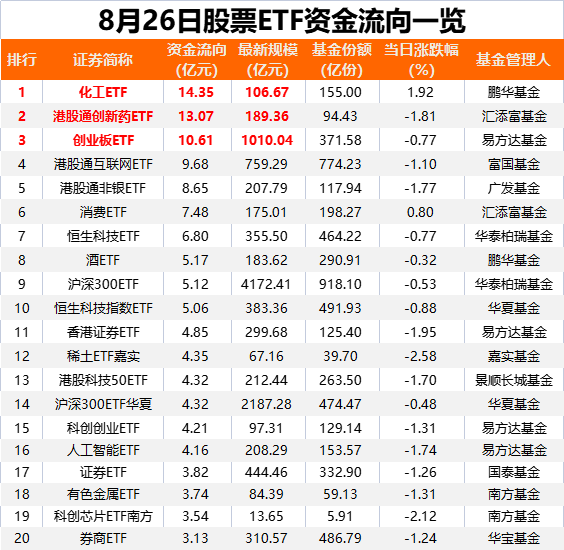
Core Insights - The A-share market experienced a divergence in performance on August 26, ending a streak of gains, with stock ETFs seeing a net inflow of approximately 13.5 billion yuan [1][2]. ETF Market Overview - As of August 26, the total scale of stock ETFs reached 4.21 trillion yuan, with a single-day net inflow of about 13.5 billion yuan. The trading volume decreased by nearly 30% compared to the previous day, totaling 221.4 billion yuan [2]. - Industry-themed ETFs and Hong Kong market ETFs led the net inflows, with 9.68 billion yuan and 6.8 billion yuan respectively, while broad-based ETFs experienced significant outflows [2][6]. Sector Performance - Over the past five days, the securities company index saw inflows exceeding 8.4 billion yuan, while the chemical sector index attracted over 5.4 billion yuan [3]. - The AI sector showed strong performance, with the AI ETF in the Sci-Tech sector rising by 25.63% since August, leading among nine ETFs tracking the same index [3]. Fund Flows - Top-performing ETFs included the Chemical ETF with a net inflow of 1.4 billion yuan, followed by the Hong Kong Innovation Drug ETF and the ChiNext ETF, both exceeding 1 billion yuan in net inflows [4]. - Conversely, the CSI 500 ETF experienced the largest outflow, with 1.8 billion yuan, followed by the ChiNext 50 ETF and the NOJ ETF, each with outflows exceeding 500 million yuan [6][8]. Fund Company Performance - Leading fund companies like E Fund and Huaxia Fund reported significant net inflows in their ETFs, with E Fund's total ETF scale reaching 759.51 billion yuan, an increase of 158.86 billion yuan this year [5]. - Huaxia Fund's ETFs, particularly the Hang Seng Technology Index ETF and the CSI 300 ETF, also saw substantial net inflows, indicating strong investor interest [5]. Market Outlook - Analysts suggest that the current market may have entered a stabilization phase in the credit cycle, with expectations of improved investment sentiment driven by structural upgrades and high-quality development [7][9].

汇添富基金胡慧颖:打造稳中求进的低波动境外美元固收策略
Zhong Guo Zheng Quan Bao· 2025-08-14 04:35
Core Viewpoint - The high interest rate environment created by the Federal Reserve has made offshore dollar bonds and related fixed-income products attractive, but the inherent volatility of dollar bonds should not be overlooked [1][2] Group 1: Volatility Sources - The main sources of volatility in the offshore dollar bond market stem from interest rates and credit spreads [2] - U.S. Treasury rates, particularly for medium to long-term bonds, exhibit more frequent and severe fluctuations compared to domestic RMB bond rates due to complex macroeconomic factors [2] - Credit spreads for dollar-denominated bonds can fluctuate independently of risk-free rates, driven by market sentiment, especially during periods of significant risk appetite changes [2][3] Group 2: Impact of Global Events - Global and local events, including unpredictable occurrences like the 2008 financial crisis and recent tariff policies, significantly impact the dollar bond market [3][4] - These events can lead to market sell-offs and re-evaluations of risk assets, causing notable volatility in the credit bond market, albeit less severe than in equity markets [3] Group 3: Regional and Individual Factors - Regional industry factors and geopolitical issues can lead to varying degrees of local market risk and volatility, as seen in the Chinese real estate sector's credit risks [4] - Individual credit events, such as the liquidity crisis of Credit Suisse, can trigger significant sell-offs in specific bond categories [4][5] Group 4: Strategies for Low-Volatility Products - To create competitive low-volatility offshore dollar products, strategies should include avoiding interest rate volatility by controlling duration and being cautious with short-term predictions [5][6] - Actively managing credit cycle-induced credit spread volatility is essential for pursuing excess returns, leveraging research capabilities to adjust credit exposure [5][6] - Rigorous credit selection and concentration management are necessary to mitigate individual credit event risks [5][6] Group 5: Dynamic Management of Global Events - A pragmatic approach to global event shocks involves accepting their unpredictability while dynamically managing risk exposure based on market conditions [6][7] - Adjusting high-volatility exposures and increasing cash positions during periods of market weakness can prepare for potential downturns [6][7] Group 6: Regional Event Management - Diversifying across regions and sectors while focusing on high-certainty, risk-reward favorable segments is crucial for managing regional event impacts [7] - The ability to actively manage volatility and risk will determine the potential for excess returns in the offshore dollar bond market [7]
固定收益周度策略报告:“二次调整”的空间评估-20250727
SINOLINK SECURITIES· 2025-07-27 10:01
Group 1 - The report indicates that the recent adjustment in the bond market is driven by a strong rebound in commodity prices, which has led to a rise in market risk appetite and a corresponding increase in stock prices [3][7]. - The current commodity price rebound is characterized as a "lagging pricing" response to the previous mild expansion of the credit cycle, rather than the start of a new macroeconomic cycle [4][10]. - The report suggests that the market environment in the second half of the year may resemble that of 2019 and 2022, with a mild expansion of the credit cycle followed by a potential decline in social financing momentum [5][25]. Group 2 - The report emphasizes that the recent commodity price increases are more of a "catch-up" effect due to previous underpricing in relation to the credit cycle recovery, rather than an indication of a new macroeconomic expansion [11][18]. - It is noted that the leading commodities in the recent price surge were those that had previously underperformed, indicating a tendency towards "oversold recovery" [14][17]. - The analysis highlights that the current credit cycle is nearing its peak, and any adjustments in the bond market are expected to be less severe than those observed in the first half of the year [6][30].
中金:“大美丽”法案后的美债、美股与流动性
中金点睛· 2025-07-07 23:31
Core Viewpoint - Despite concerns over "de-dollarization" and simultaneous declines in stocks, bonds, and currencies, the U.S. stock market has outperformed global markets and reached new historical highs, with the Nasdaq rebounding 35% from its lows [1] Group 1: Market Performance - U.S. stocks have shown strong performance, leading global markets since the end of April and reaching historical highs [2] - After a brief outflow, funds have re-entered U.S. stocks and bonds, indicating renewed investor confidence [4][6] Group 2: Misconceptions about the Dollar and Stocks - There are two prevalent misconceptions: equating a weaker dollar with "de-dollarization" and assuming that a weak dollar leads to falling U.S. stocks [8] - The consensus on "de-dollarization" may face short-term challenges, with potential for a slight dollar rebound and U.S. stocks to outperform again in Q4 [8] Group 3: Impact of the "Big Beautiful Bill" - The "Big Beautiful Bill" (OBBBA) addresses the debt ceiling, extends tax cuts, reduces spending, and cancels certain provisions, significantly impacting fiscal policy [12][13] - The bill raises the debt ceiling by $5 trillion, allowing the Treasury to continue issuing debt to meet obligations [13] - It is projected to increase the basic deficit by $3.4 trillion over the next decade, with total deficits including interest reaching $4.1 trillion [21] Group 4: Economic Implications - The bill is expected to avoid fiscal contraction, supporting the credit cycle and preventing significant expansion of the deficit due to increased tariff revenues [15][21] - Government credit is anticipated to improve in the second half of the year, with a fiscal pulse potentially improving to 0.6% [15][21] Group 5: Liquidity and Bond Supply - The resolution of the debt ceiling will lead to a short-term increase in bond supply, with an estimated net issuance of $1 trillion in Q3 [25][27] - This increase in supply may create liquidity pressures, similar to the situation observed in Q3 2023, which could affect bond yields and stock valuations [27][32] Group 6: Future Outlook - Short-term liquidity disruptions may provide reallocation opportunities, with expectations of two Fed rate cuts this year, bringing the central tendency of bond yields to around 4.2% [38][39] - The U.S. credit cycle is expected to restart, driven by strong AI investments and fiscal improvements, supporting a potential rise in the S&P 500 index to a range of 6000-6200 points [39]

中金:如何寻找行业轮动的线索?
中金点睛· 2025-06-29 23:56
Core Viewpoint - The Hong Kong stock market has shown strong performance since Q4 2024, significantly outperforming the A-share market, but faces challenges such as pulse-like rebounds and concentration in a few sectors, making it difficult for investors to achieve excess returns. However, precise timing and understanding of market rhythms can lead to substantial gains [1][2]. Industry Rotation Context - The market has experienced several rounds of rebounds driven by macroeconomic factors, including fiscal policy shifts and the rise of AI technology. Key phases include: 1. The "924" policy shift led to a rally in non-bank and real estate sectors, focusing on total policy [1]. 2. The emergence of "DeepSeek" post-Spring Festival revalued AI-related tech and internet leaders, driven by industry trends [1]. 3. The tariff situation in April spurred growth in new consumption and innovative pharmaceuticals, influenced by industry catalysts and liquidity [1][2]. Macro Environment Analysis - The current market dynamics are characterized by a combination of abundant liquidity and structural challenges, leading to index fluctuations and active structural trends. The macroeconomic backdrop includes: - Continued credit contraction in the private sector and limited fiscal stimulus, which restricts overall credit cycle expansion while supporting market stability [8][9]. - The emergence of new growth points, particularly in AI and new consumption sectors, which contribute to the active structural market [9][10]. Investment Strategy Insights - The investment strategy emphasizes the importance of focusing on sectors with stable or improving return on equity (ROE). Key insights include: - Stable returns are found in sectors like banking and utilities, which maintain consistent ROE, while growth opportunities lie in technology, new consumption, and innovative pharmaceuticals, which have shown significant ROE recovery [18][19]. - The analysis of trading concentration, southbound capital flows, and valuation metrics is crucial for identifying sector rotation opportunities [22][23]. Trading and Positioning Dynamics - The analysis of trading dynamics reveals: - High trading concentration in new consumption and innovative pharmaceuticals, with recent declines in AI sector concentration [23][24]. - Southbound capital flows have favored new consumption and innovative pharmaceuticals, indicating strong investor interest in these sectors [32][34]. - The increase in short positions in certain sectors suggests a shift in investor sentiment, highlighting the need for caution in trading strategies [36][37]. Valuation Considerations - Valuation analysis indicates that while high-dividend sectors are under scrutiny, technology and new consumption sectors are experiencing valuation recovery. Key points include: - The AH premium threshold is set at 125%, which serves as a benchmark for high-dividend stocks, while technology and new consumption sectors are aligning with their ROE [44][45].

中金:美元与美股的关系
中金点睛· 2025-06-23 23:36
Core Viewpoint - The article discusses the impact of "reciprocal tariffs" on the global market, particularly the erosion of confidence in the US dollar as a safe asset, leading to a consensus on "de-dollarization" [1][2]. Group 1: Relationship Between Dollar and US Stocks - The relationship between the US dollar and US stocks is not linear; a weaker dollar does not necessarily lead to a decline in stock prices, and vice versa [4][12]. - Historical data shows that the performance of US stocks is more closely tied to domestic fundamentals rather than the dollar's strength, indicating that a weak dollar can coexist with strong stock performance [4][12]. - The article highlights that the current consensus on "de-dollarization" faces challenges, including overly crowded expectations and a lack of clear short-term guidance [2][12]. Group 2: Historical Context and Analysis - Since the 1970s, the correlation between the dollar and US stocks has been complex, with instances where a weak dollar coincided with rising stock prices, such as during the Plaza Accord in 1985 [17][18]. - The article emphasizes that the dollar's weakness often reflects capital outflows from the bond market rather than the stock market, as US stocks are more closely linked to private sector credit and growth [24][12]. - The analysis suggests that the dollar's current weakness may not significantly impact US stocks, as the latter's fundamentals remain strong [57][60]. Group 3: Market Outlook - The outlook for the second half of the year indicates that US assets, particularly stocks, may outperform due to a recovery in the US credit cycle and potential positive catalysts such as tax cuts and interest rate reductions [61][62]. - The article predicts that the dollar may experience short-term fluctuations but could see a slight rebound in the fourth quarter, while the S&P 500 index is expected to stabilize around 6000 to 6200 points [63][64].
“去美元”的共识与“资产荒”的现实——2025下半年展望
2025-06-16 15:20
Summary of Conference Call Notes Industry or Company Involved - The discussion primarily revolves around the implications of the "de-dollarization" trend and its impact on the U.S. economy, stock markets, and global asset allocation strategies. Core Points and Arguments 1. **De-dollarization vs. Dollar Weakness** - The weakening of the dollar does not equate to de-dollarization; a moderate depreciation may benefit U.S. multinational companies due to their high overseas revenue exposure [2][5][21]. 2. **Market Consensus on De-dollarization** - The current market consensus leans towards de-dollarization, but the timeline and extent of this trend remain uncertain. The correlation between dollar weakness and de-dollarization should be carefully evaluated [2][5]. 3. **U.S. vs. Hong Kong Stock Performance** - Recently, the U.S. stock market has outperformed the Hong Kong market, with historical patterns showing that the relationship between U.S. stocks and the dollar is not linear [3][4]. 4. **Impact of U.S. Economic Policies** - U.S. fiscal policy is currently balanced, alleviating concerns about fiscal health. The extension of tax reform measures aims to encourage new investments [12][14]. 5. **Credit Cycle Analysis** - The relative strength of the U.S. and Chinese economies can be assessed through their credit cycles, with the U.S. showing signs of recovery while China remains in a state of stagnation [6][8]. 6. **Inflation and Interest Rate Projections** - Current U.S. inflation is expected to rise but will remain below 3.5%. The outcome of U.S.-China negotiations could influence the Federal Reserve's decision on interest rate cuts [13][17]. 7. **Market Liquidity and Asset Scarcity** - The market is experiencing a paradox of abundant liquidity alongside asset scarcity, particularly in the Hong Kong market, which requires additional policy measures for significant improvement [39][41]. 8. **Future of Technology Investments** - The outlook for technology investments remains optimistic, with leading companies exceeding expectations, which may alleviate concerns about overcapacity in the tech sector [14][34]. 9. **Tariff Policies and Economic Impact** - Tariff policies are designed to support fiscal revenue for infrastructure projects, with current tariffs generating significant income to offset related expenditures [15][21]. 10. **Investment Strategies in Current Market Conditions** - Investors are advised against short-selling in the current environment due to potential market rebounds. A focus on dividend-paying assets is recommended to navigate volatility [25][44]. Other Important but Possibly Overlooked Content 1. **Global De-dollarization Consensus** - The global consensus on de-dollarization may lead to mispricing in certain markets, particularly in the U.S. stock market, which could rebound in the fourth quarter [53]. 2. **Structural Opportunities in Hong Kong Market** - The Hong Kong market is witnessing a structural shift with a concentration of new economy companies, which may attract more investment despite the overall asset scarcity [50][51]. 3. **Consumer Behavior Trends** - Changes in consumer spending patterns, particularly among younger demographics, are influencing the new consumption market, presenting new investment opportunities [48][49]. 4. **Challenges in Real Estate Sector** - The real estate sector continues to face challenges, particularly in credit availability and rental yields, complicating recovery efforts [35][36]. 5. **Potential for New Trade Agreements** - In response to tariff uncertainties, there may be a shift towards new trade agreements with regions like Southeast Asia and the EU, as well as a focus on expanding overseas markets [32].
22年前25万美金拍下“巴菲特午餐”,绿光资本艾因霍恩:市场失灵了,现在的价值投资者有点像恐龙……
聪明投资者· 2025-06-12 07:12
Core Viewpoint - David Einhorn, founder of Greenlight Capital, expresses concerns about market inefficiencies and the challenges faced by value investors in a market dominated by passive funds and algorithmic trading [1][3][13]. Group 1: Market Environment and Challenges - The market structure has changed, making it difficult for traditional value investors to find undervalued stocks [1][13]. - Einhorn notes that the dominance of passive funds and algorithmic trading has weakened the environment for value investing, as many investors are no longer focused on finding undervalued assets [3][15]. - The current market is primarily driven by three types of participants: index funds, algorithmic traders, and retail investors, which has shifted the focus away from fundamental analysis [15][16]. Group 2: Investment Strategy - Greenlight Capital focuses on buying undervalued companies and shorting overvalued stocks, maintaining a core belief in value investing despite market challenges [12][17]. - Einhorn emphasizes that even if a company's price does not recover, it may still be worth investing in if it can provide reasonable returns through dividends or buybacks [3][18]. - The firm has historically achieved an annualized return of approximately 13% since its inception, although it faced significant challenges post-2015 [2][24]. Group 3: Personal Insights and Experiences - Einhorn has a deep respect for Warren Buffett and has attempted to emulate some of his investment strategies, including the use of insurance float for capital [4][5]. - He highlights the importance of adapting to changing market conditions and acknowledges that the firm has had to reassess its strategies in light of recent market dynamics [7][72]. - Einhorn's investment philosophy is shaped by his experiences and the belief that acknowledging mistakes is crucial for long-term success [74][96].

中金下半年策略重磅发布:港股更优,美股仍强,波动中找机会
贝塔投资智库· 2025-06-10 03:44
Core Viewpoints - The current market lacks direction, but volatility in Q3 presents opportunities for allocation [1] - U.S. assets are not pessimistic, with potential for outperformance; U.S. stocks may provide buying opportunities upon correction [1][6] - The Chinese market focuses more on structural opportunities, with Hong Kong stocks outperforming A-shares [2][12] U.S. Market Insights - The U.S. credit cycle may restart, but Q3 is expected to remain chaotic, providing buying opportunities during volatility [6][9] - Tax cuts are expected to support consumer spending and stimulate corporate investment, with a projected deficit rate reduction in FY2025 [8][9] - The Federal Reserve may lower interest rates twice to 3.75-4%, supporting real estate and traditional investments [7][9] Chinese Market Insights - The Chinese credit cycle is still in a contraction phase, with high costs suppressing private sector leverage [10][11] - Structural market conditions lead to "asset scarcity," with investors seeking stable returns or growth-oriented assets [11][12] - The focus on Hong Kong stocks reflects a preference for quality assets amid limited growth expectations in the broader market [12]