
就业

Search documents
美国房贷申请数量大幅反弹——海外周报第123期
一瑜中的· 2026-01-19 15:28
Core Viewpoint - Multiple economic data from the US exceeded expectations last week, including new home sales, existing home sales, retail sales month-on-month, New York Fed manufacturing PMI, Philadelphia Fed manufacturing index, industrial production month-on-month, initial and continuing unemployment claims. Inflation data was generally in line with expectations, including CPI and PPI [2][4]. Group 1: Recent Economic Data and Events - In the US, several data points exceeded expectations, including new home sales, existing home sales, retail sales month-on-month, New York Fed manufacturing PMI, Philadelphia Fed manufacturing index, and industrial production month-on-month. Inflation data, including CPI and PPI, was generally in line with expectations [4][14]. - In the Eurozone, industrial production month-on-month for November and the January Sentix investor confidence index exceeded expectations, while the final inflation values for France, Italy, and Germany in December met expectations [5][14]. - In Japan, the current account surplus exceeded expectations, and the PPI year-on-year was in line with expectations [5][14]. Group 2: Upcoming Economic Data and Events - Key upcoming economic data to watch includes the Japanese manufacturing PMI to be released on January 23 at 8:30 AM, the Bank of Japan's policy decision around noon to afternoon, the Eurozone manufacturing PMI at 5:00 PM, and the S&P US manufacturing PMI at 10:45 PM on January 23 [6][16]. Group 3: Weekly Economic Activity Index - The US economic activity index remained stable, with the WEI index at 2.45% for the week ending January 10, compared to 2.08% the previous week [7][18]. - The German economic activity index showed a downward trend, with the WAI index at 0.03% for the week ending January 11, compared to -0.01% the previous week [8][18]. Group 4: Demand - In consumption, the US Redbook commercial retail year-on-year growth rate declined, with a reading of 5.7% for the week ending January 9, down from 7.1% the previous week [9][21]. - In real estate, US mortgage rates have decreased, with the 30-year mortgage rate at 6.06% on January 15, down from 6.16% the previous week. Mortgage applications rebounded, with the MBA market composite index at 348 for the week ending January 9, reflecting a 28.5% increase week-on-week [9][24]. Group 5: Employment - Initial and continuing unemployment claims in the US decreased, with initial claims falling to 198,000 for the week ending January 10, down from 208,000 the previous week, and continuing claims dropping from 1.914 million to 1.884 million [10][28]. - The number of job vacancies remained stable, with the INDEED job vacancy index averaging 105.34 as of January 9, slightly below the December average of 105.55 [11][29]. Group 6: Prices - Commodity prices showed a volatile recovery, with the RJ/CRB commodity price index increasing by 0.2% week-on-week as of January 16, following a 1.2% increase the previous week. US gasoline prices continued to decline, averaging $2.67 per gallon for the week ending January 12, down 0.6% week-on-week [12][31]. Group 7: Financial Conditions - US financial conditions have marginally eased, with the Bloomberg financial conditions index at 0.848 as of January 16, compared to 0.863 the previous week. In contrast, Eurozone financial conditions have tightened, with the index at 1.671 [38]. - Offshore dollar liquidity has marginally eased, with the three-month swap basis for the yen against the dollar at -15.4 pips, improving from -17 pips the previous week [40]. - The spread-to-worst for high-yield dollar corporate bonds has narrowed, with the J.P. Morgan global BB&B rated dollar corporate bond spread at 243 basis points as of January 16, down from 247.8 basis points the previous day [43]. Group 8: Fiscal - As of January 15, cumulative federal funding expenditures in the US were approximately $319.4 billion, reflecting a year-on-year decline of 2.5% compared to $327.6 billion during the same period last year [50].


宏观经济周报2026年第四周-20260119
工银国际· 2026-01-19 07:02
Economic Indicators - The ICHI Composite Economic Index has expanded for the seventh consecutive week, indicating a stable economic expansion amidst structural adjustments[1] - The Consumer Confidence Index has significantly increased, driven by pre-holiday demand and active service consumption, becoming the core source of economic improvement[1] - The Investment Confidence Index remains stable in the expansion zone, reflecting steady corporate investment activities and strong project continuity[1] Trade Performance - In 2025, China's total import and export value reached 45.47 trillion yuan, a year-on-year increase of 3.8%[2] - Exports amounted to 26.99 trillion yuan, growing by 6.1%, while imports were 18.48 trillion yuan, with a modest growth of 0.5%[2] - High-tech products and green products saw double-digit growth in exports, indicating a shift from scale expansion to quality enhancement in China's export structure[2] Global Economic Context - In December 2025, the U.S. CPI rose by approximately 2.7% year-on-year, remaining above the Federal Reserve's 2% target but showing a moderate trend[6] - The unemployment claims in the U.S. dropped to 198,000, indicating limited layoffs and a resilient labor market at the beginning of the year[7] - U.S. retail sales in November exceeded expectations, driven by a rebound in auto sales and strong holiday shopping, with a month-on-month increase of 0.6%[8]
美联储降息,EB5项目风险会更高吗?
Sou Hu Cai Jing· 2026-01-19 06:50
Group 1 - The Federal Reserve recently lowered interest rates for the first time in December 2025, reducing rates by 25 basis points, bringing the benchmark rate to a range of 3.5% to 3.75% [1] - There was significant dissent among the voting members, with 3 out of 9 voting against the decision, indicating a rare level of disagreement regarding the current economic conditions and decisions [1] - The main considerations leading to this division are inflation and employment, as high interest rates help control inflation while rate cuts may lead to inflation rebound [1] Group 2 - The employment market has shown a downward trend in recent months, prompting the Federal Reserve to prioritize job preservation through rate cuts to stimulate market activity and reduce unemployment [2] - Lower interest rates are expected to benefit the EB5 projects by reducing overall financing costs and increasing market activity, leading to higher valuations of commercial projects [2] - Despite the favorable long-term outlook for EB5 projects due to declining rates, the current high financing costs pose significant operational pressures, suggesting a focus on essential and lower-risk investment targets [3]

海外利率周报20260118:Fed收到传票的多重信号-20260118
Guolian Minsheng Securities· 2026-01-18 12:27
1. Report Industry Investment Rating No information about the report industry investment rating is provided in the content. 2. Report's Core View The report analyzes the trends of the US Treasury bond market, US macro - economic indicators, and major asset classes. It shows that the US Treasury bond yields fluctuated this week due to economic data, geopolitical issues, and concerns about the Fed's independence. The US macro - economy shows mixed signals in different sectors, with some indicators improving while others still showing weakness. Major asset classes also have diverse performances across different regions and types [1][3][4]. 3. Summary by Relevant Catalogs 3.1 美债利率本周回顾 - This week (January 9 - January 16, 2026), US Treasury bond yields generally increased, with the curve rising. Except for the ultra - long - term bonds, interest rates rose significantly. In the first half of the week, yields declined due to economic data and moderate CPI. In the second half, housing sales, unemployment data, geopolitical issues, and concerns about the Fed's independence pushed yields up again [1][11]. - After the Fed received a subpoena from Trump, Powell countered, and the Fed's tough attitude eased investors' panic. The market doesn't think Trump will substantially undermine the current Fed. Trump's "pressure" is more likely a warning for the next - term chairman. However, this move may have the opposite effect, and there are also divisions within the Republican Party [2][12]. - The 3 - year US Treasury bill auction was robust, with a bid - to - cover ratio higher than the previous value. The 10 - year and 30 - year auctions were relatively weak [17]. 3.2 美国宏观经济指标点评 - **景气指数**: In 2025, the US new home sales market showed signs of recovery, but there were regional disparities and inventory pressures. The existing home sales in December 2025 reached a three - year high. Retail sales in November 2025 rebounded, mainly driven by holiday consumption. The Philadelphia Fed Manufacturing Index in January 2026 reached a new high since September last year, indicating a marginal improvement in regional manufacturing demand [3][23]. - **就业**: As of the week of January 10, 2026, the number of initial jobless claims decreased, reaching the second - lowest level in two years. However, the labor market shows a weak balance of "low lay - offs and low hiring", and the employment growth remains sluggish [24][25]. - **通胀**: In 2025, the US PPI and CPI showed different trends. The PPI was affected by energy prices and service - end price dynamics. The CPI showed a stage of stability in December 2025, with some categories' price increases slowing down and others accelerating [26]. 3.3 大类资产点评 - **债券**: German bond yields declined, while Japanese bond yields remained high due to market expectations of an interest - rate hike [4][28]. - **权益**: Asian stock markets generally strengthened, while European and American markets were under pressure [4][29]. - **大宗**: Metals and digital assets led the gains, while agricultural products and some industrial raw materials faced pressure [4][30]. - **外汇**: Asian currencies were generally under pressure, while the Russian ruble rose [4][32]. 3.4 市场跟踪 The report provides various charts to track the performance of global major economies' government bond interest rates, stock indices, commodities, and foreign exchange rates, as well as the latest economic data panels of the US, Japan, and the Eurozone [33][44][51][56].
【UNforex财经事件】通胀与就业支撑谨慎立场 美联储“暂停观察”信号强化
Sou Hu Cai Jing· 2026-01-16 04:23
Core Viewpoint - The Federal Reserve is adopting a cautious stance on interest rate cuts despite President Trump's calls for faster easing, emphasizing that inflation remains above target and the labor market is resilient [1][2]. Group 1: Federal Reserve's Position - Multiple Federal Reserve officials have expressed a consensus on pausing rate cuts, with Chicago Fed President Goolsbee stating that guiding inflation back to the 2% target is a core task [1]. - Kansas City Fed President Schmidt reiterated opposition to further rate cuts, suggesting that a moderate cooling of the labor market could help mitigate inflation risks [1]. - Some previously dovish officials, such as San Francisco Fed President Daly and Philadelphia Fed President Harker, have shifted their positions to support maintaining current rates [1]. Group 2: Economic Data and Market Reactions - Recent macroeconomic data supports the Fed's cautious approach, with December unemployment slightly decreasing to 4.4% and initial jobless claims falling to 198,000, indicating a stable job market [2]. - Inflation indicators remain elevated, with key inflation data close to 3%, significantly above the 2% long-term target, leading the market to view an extended observation period as prudent [2]. - The market now perceives a low likelihood of rate cuts before June, with a noticeable slowdown in the expected pace of easing throughout the year [2]. Group 3: Currency Market Dynamics - The stabilization of interest rate expectations has led to a strong performance of the US dollar, which is now a primary driver in the forex market [2]. - The British pound is under pressure against the dollar, trading below 1.3400, as US employment data reinforces expectations for prolonged high rates [2]. - Despite the pound's downward pressure, its decline is somewhat limited due to positive GDP growth data from the UK, which weakens bets on a rapid shift to easing by the Bank of England [2]. Group 4: Market Sentiment and Future Outlook - The independence of the Federal Reserve remains a critical concern, with officials expressing support for Chair Powell and emphasizing that policy decisions should be based on data rather than political influence [3]. - The forex market has largely adjusted to the expectation of a pause in rate cuts, with the dollar's strength reflecting the inertia of stable rate expectations rather than the beginning of a new trend [3]. - In the absence of new policy signals or key data, major currency pairs are likely to continue fluctuating within established ranges, with market focus shifting to upcoming inflation data and Fed officials' statements for potential changes [3].
美联储第一季度降息概率不大
21世纪经济报道· 2026-01-15 10:28
Core Insights - The article discusses the recent trends in the U.S. Consumer Price Index (CPI) and its implications for inflation and employment, highlighting a slow decline in inflation rates and the challenges faced in the job market [1][2][3][4][5]. Group 1: Inflation Trends - In December 2025, the U.S. CPI increased by 0.3% month-on-month and 2.7% year-on-year, marking the smallest growth since July of the previous year [1]. - Core CPI, excluding volatile food and energy prices, rose by 0.2% month-on-month and 2.6% year-on-year, the lowest since March 2021, indicating a consistent downward trend in inflation [1][2]. - The slowdown in inflation is attributed to zero growth in core goods prices, particularly in new and used vehicles, suggesting that the impact of tariffs is less severe than anticipated [2][3]. Group 2: Housing and Core Services - Core services prices increased by 0.3%, with housing costs rising by 0.4%, the largest increase in four months, indicating persistent housing inflation [2]. - The report from CoStar indicated a significant decline in U.S. rents, with a 0.31% decrease in October 2025, the largest drop in 15 years, driven by increased supply and reduced demand [2]. Group 3: Employment and Economic Impact - The U.S. labor market showed signs of weakness, with non-farm employment increasing by only 584,000 in 2025, significantly lower than the 2 million increase in 2024 [4]. - The unemployment rate rose from 4.0% to 4.4%, with long-term unemployment increasing, indicating a challenging job market [4]. - Real average weekly earnings for American workers fell by 0.3% in December 2025, which, while controlling inflation, negatively impacts consumer spending and economic growth [4][5]. Group 4: Federal Reserve Policy Outlook - Despite potential negative impacts from tariffs, the Federal Reserve's recent interest rate cuts and government policies may support employment and income growth [5]. - The likelihood of further interest rate cuts in the first quarter of 2026 is low unless there is significant deterioration in employment or inflation [5].
【新华解读】2025年四季度全球央行货币政策观察:全球央行分道扬镳 日本央行加息搅动全球政策格局
Sou Hu Cai Jing· 2026-01-15 05:05
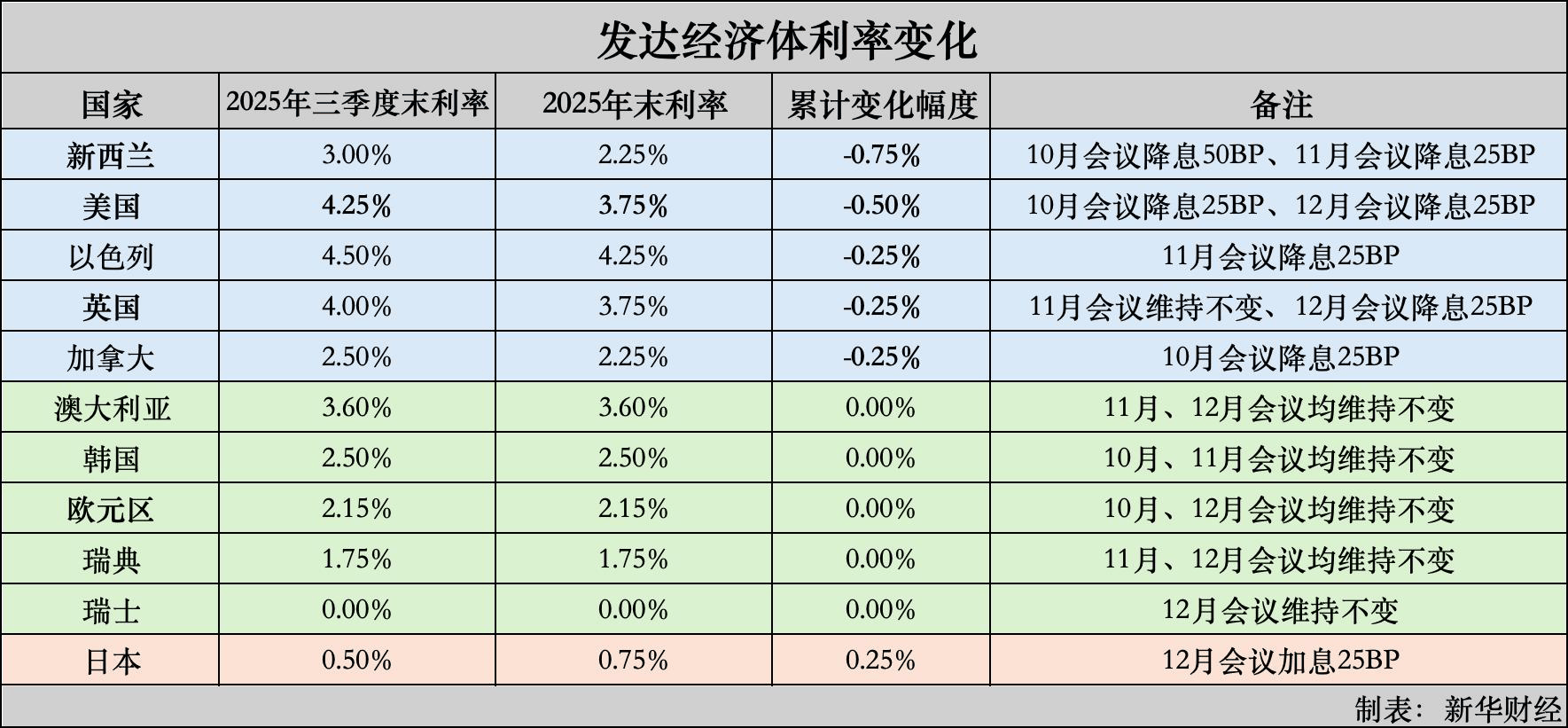
Core Viewpoint - The global monetary policy landscape is increasingly divergent, with major central banks adopting different stances on interest rates as they navigate economic stability, inflation, and employment concerns. The Federal Reserve and New Zealand are expected to implement significant rate cuts, while the Bank of England and the European Central Bank are likely to proceed cautiously or maintain current rates [1][12]. Group 1: Developed Economies Interest Rate Changes - As of the end of 2025, New Zealand's interest rate decreased from 3.00% to 2.25%, a reduction of 0.75% [3] - The U.S. Federal Reserve lowered its rate from 4.25% to 3.75%, a decrease of 0.50% [3] - The Bank of England reduced its rate to 3.75%, marking a cumulative decline of 0.25% [5] - The European Central Bank maintained its rates at 2.15%, showing no change [3][6] - Japan's central bank raised its rate from 0.50% to 0.75%, an increase of 0.25%, becoming the only major central bank to hike rates during this period [2][4] Group 2: Emerging Markets Interest Rate Changes - Turkey's central bank cut its rate from 40.50% to 38.00%, a reduction of 2.50% [8] - Russia's rate decreased from 17.00% to 16.00%, a drop of 1.00% [8] - Mexico's rate was lowered from 7.50% to 7.00%, a decrease of 0.50% [10] - South Africa and India both reduced their rates by 25 basis points, bringing them to 6.75% and 5.25%, respectively [9] - Several emerging market central banks, including Brazil and Indonesia, opted to keep their rates unchanged [10][11] Group 3: Future Monetary Policy Outlook - In the first quarter of 2026, the Federal Reserve may slow its rate-cutting pace after several reductions, influenced by fiscal expansion policies [12][13] - The European Central Bank is expected to maintain a neutral stance, with no immediate plans for rate changes [12][14] - The Bank of England's future rate decisions will be cautious, reflecting internal disagreements on the appropriate level of interest rates [14] - Emerging market central banks are likely to adopt varied strategies based on their unique inflation and growth conditions, with some, like Mexico and Turkey, potentially considering further rate cuts [12][14]
广发证券:美联储短期降息必要性延续低位
Sou Hu Cai Jing· 2026-01-14 23:59
Group 1 - The core viewpoint of the report indicates that the December CPI data, despite fluctuations due to the previous government shutdown, remains moderate in its core readings [1] - The market had anticipated technical disruptions caused by the government shutdown and year-end effects, leading to fluctuations in certain categories such as clothing, entertainment goods, and hotel accommodations, which are viewed as base effect corrections rather than trend changes [1] - In the context of "inflation not derailing + employment not losing momentum," the necessity for short-term interest rate cuts is understood to continue at low levels [1]

1月14日金市早评:黄金冲4600美元震荡 CPI与地缘博弈成焦点
Jin Tou Wang· 2026-01-14 03:21
Group 1 - The US dollar index is trading around 99.240, while spot gold opened at $4585.49 per ounce and is currently trading at approximately $4617.53 per ounce [1] - On the previous trading day, the US dollar index rose by 0.29% to close at 99.186, while spot gold fell by 0.18% to $4594.90 per ounce [1] - Other precious metals showed mixed performance, with spot silver rising by 2.06% to $86.91 per ounce, while platinum and palladium fell by 0.33% to $2329.70 per ounce and 1.32% to $1826.50 per ounce, respectively [1] Group 2 - As of January 13, COMEX gold inventory increased by 4.59 tons to 1128.93 tons, while COMEX silver inventory decreased by 56.41 tons to 13550.91 tons [2] - SPDR gold ETF holdings rose by 3.43 tons to 1074.23 tons, while SLV silver ETF holdings decreased by 26.79 tons to 16321.16 tons [2] - The payment direction for deferred compensation fees indicates that Au(t+d), Ag(t+d), and mAu(t+d) are all in a short-to-long payment structure [2] Group 3 - The US CPI growth remained stable in December, with core CPI slightly below expectations, leading to comments from Trump advocating for significant interest rate cuts [3] - The ADP weekly employment report indicated that private sector employers added an average of 11,750 jobs per week over the four weeks ending December 20, 2025 [4] - The EU is discussing additional sanctions against Iran, with Trump stating that all meetings with Iranian officials have been canceled and that Iran will "pay a heavy price" [4][5]
铂:区间整理,铜:窄幅震荡
Guo Tai Jun An Qi Huo· 2026-01-14 02:01
Group 1: Report Investment Rating - No information provided on the industry investment rating Group 2: Core Viewpoints - Platinum is expected to trade in a range, while palladium is likely to experience narrow - range fluctuations [1] - The trend intensity of platinum is 0, and the trend intensity of palladium is 0, indicating a neutral outlook for both [3] Group 3: Summary by Relevant Catalogs Platinum and Palladium Fundamental Data - **Price**: Platinum futures 2606 closed at 605.05 with a - 2.85% decline; gold - exchange platinum was at 599.38 with a - 2.21% decline; New York platinum main - contract (previous day) was 2338.00 with a - 0.99% decline; London spot platinum (previous day) was 2331.20 with a - 0.76% decline. Palladium futures 2606 closed at 483.25 with a - 4.33% decline; RMB spot palladium was at 447.00 with no change; New York palladium main - contract (previous day) was 1887.00 with a - 1.28% decline; London spot palladium (previous day) was 1831.35 with a - 1.06% decline [1] - **Trading Volume and Open Interest**: Guangdong platinum trading volume was 32,647 kg (down 7907 kg from the previous day), and open interest was 38,440 kg (down 861 kg). NYMEX platinum trading volume was 44,452 kg (up 2211 kg), and open interest was 105,349 kg (up 1149 kg). Guangdong palladium trading volume was 22,262 kg (down 1916 kg), and open interest was 15,204 kg (down 59 kg). NYMEX palladium trading volume was 22,245 kg (up 7340 kg), and open interest was 57,759 kg (up 292 kg) [1] - **ETF Holdings**: Platinum ETF holdings (ounces, previous day) were 3,278,284 (down 4597), and palladium ETF holdings (ounces, previous day) were 1,191,890 (up 10,833) [1] - **Inventory**: NYMEX platinum inventory (ounces, previous day) was 624,345 (down 409), and NYMEX palladium inventory (ounces, previous day) was 210,908 (down 398) [1] - **Price Spreads**: PT9995 to PT2606 spread was - 5.67 (up 4.19 from the previous day); Guangdong platinum 2606 to 2610 spread was - 0.10 (down 1.20); buying Guangdong platinum 2606 and selling 2610 inter - period arbitrage cost was 7.44 (down 0.21). The spread between Guangdong platinum main - contract and London platinum (considering VAT) was 14.40 (down 12.89). The spread between RMB spot palladium price and PD2606 was - 36.25 (up 21.85); Guangdong palladium 2606 to 2610 spread was - 3.45 (up 1.75); buying Guangdong palladium 2606 and selling 2610 inter - period arbitrage cost was 6.00 (down 0.26). The spread between Guangdong palladium main - contract and London palladium (considering VAT) was 19 (down 21.58) [1] - **Exchange Rates**: The US dollar index was 99.18 with a 0.05% increase; the US dollar to RMB (CNY spot) was 6.97 with a - 0.06% decline; the US dollar to offshore RMB (CNH spot) was 6.97 with a - 0.15% decline; the US dollar to RMB (6M forward) was 6.90 with a - 0.06% decline [1] Macro and Industry News - US CPI growth remained stable in December, and core CPI was slightly lower than expected. Trump praised the inflation data and called on Powell to cut interest rates significantly. The Fed's mouthpiece said the December CPI was unlikely to change the current wait - and - see attitude [4] - ADP weekly employment report: In the four weeks ending December 20, 2025, private - sector employers added an average of 11,750 jobs per week [4] - Trump's interview was broadcast this morning, focusing on Iran, the economy, and Powell [4] - Kim Yo - jong responded to South Korea's North Korea policy, saying that the so - called "improving relations" was a delusion [4] - Takaichi Sanae expressed her intention to dissolve the House of Representatives and hold early elections on the 23rd [4] - Fed's Musalem said there were few reasons for further policy easing in the short term and still believed that inflation risks would be more persistent than expected [4] - The US relaxed restrictions on NVIDIA's H200 chip exports to China [4]