
市场预期

Search documents
帮主郑重:美股创了新高,美国政府停摆了?这事没你想的那么慌
Sou Hu Cai Jing· 2025-10-02 00:58
Core Viewpoint - The U.S. stock market has reached historical highs despite the government shutdown, indicating a disconnect between market performance and political events [1][3]. Market Reaction - The Dow Jones and S&P 500 have both hit record highs, with the S&P 500 stabilizing above 6700 points for the first time [1]. - The market's resilience is attributed to expectations that the government shutdown will be short-lived, as historical precedents suggest that prolonged shutdowns can negatively impact the economy and credit ratings [3]. Employment Data - The ADP report indicates a decline in private employment by 32,000 jobs in September, suggesting a softening labor market [3]. - The upcoming non-farm payroll report is critical, as the government shutdown will delay its release, impacting Federal Reserve decision-making [3]. Inflation and Valuation Concerns - Inflation remains a concern, and stock valuations are at high levels, raising questions about future Federal Reserve policy adjustments in the absence of key economic data [3][4]. Long-term Investment Perspective - Investors are advised to focus on long-term trends rather than short-term market fluctuations or political events, as the current market highs are driven by expectations of a quick resolution to the shutdown and stable Federal Reserve policies [4][5].


人民币汇率小幅波动背后:美联储政策与市场预期的角力
Sou Hu Cai Jing· 2025-09-28 18:28
Core Viewpoint - The recent adjustment of the RMB to USD exchange rate reflects underlying market tensions amidst global monetary policy divergence and geopolitical risks, with every small change potentially indicating larger capital flow dynamics and policy interactions [1][2] Exchange Rate Dynamics - On September 26, the RMB to USD central parity rate was reported at 7.1152, a decrease of 34 basis points from the previous trading day [1] - Historical trends indicate that the Federal Reserve's tightening monetary policy has previously exerted significant depreciation pressure on the RMB, with the currency experiencing substantial fluctuations in 2023, including a drop below 7.35, marking a 15-year low [1][3] Market Sentiment and Internal Challenges - The responsibility for exchange rate fluctuations cannot be solely attributed to external factors; internal market expectations and information transmission issues pose significant challenges [2] - Concerns from microeconomic entities highlight the uncertainty surrounding whether recent fluctuations are short-term disturbances or indicative of a trend change, complicating long-term foreign exchange strategy formulation [2] Policy and Market Stability - The People's Bank of China emphasizes the stability of the RMB exchange rate, asserting that the international balance of payments remains fundamentally balanced and cross-border capital flows are orderly [2] - However, reliance on the central parity guidance and counter-cyclical factors for stability may inadvertently weaken the exchange rate's role as an automatic stabilizer in the macroeconomy [2] Historical Lessons and Future Outlook - The lessons from 2023 underscore the importance of effective expectation management and cross-border capital flow regulation, especially as the RMB shows signs of stabilization amid external pressures [3] - The future trajectory of the RMB exchange rate will depend on the interplay of external factors, such as potential Fed rate cuts, and internal economic recovery and structural reforms [4] Broader Currency Valuation Perspective - There is a need to shift focus from the RMB to USD exchange rate to a broader assessment of the RMB's value against a basket of currencies, reflecting its performance in international trade [3] - Experts suggest that a more comprehensive view of the effective exchange rate index could provide a clearer understanding of the RMB's value in the global market [3] Conclusion on Stability and Reform - True stability in the RMB exchange rate hinges on market confidence in China's long-term economic prospects and trust in the exchange rate formation mechanism [4] - Addressing external shocks and enhancing financial reforms are crucial for allowing the exchange rate to serve as an effective tool for reflecting market supply and demand, rather than merely a macroeconomic control instrument [4]
风险月报 | 权益风险评分超过去年高点,情绪与预期出现分歧
中泰证券资管· 2025-09-25 11:30
Core Viewpoint - The overall market sentiment has significantly improved, with the market moving from a "neutral to slightly positive" state to a "significantly positive" range, indicating increased trading activity and investor confidence [4] Market Risk Assessment - The Zhongtai Asset Management risk system score for the stock market is 62.77, an increase from 59.65 last month, surpassing last year's highest score of 61.33 [2] - The valuation of the CSI 300 index has slightly risen to 61.90 from 59.68 last month, marking five consecutive months of upward movement in overall market valuation [2] - The market expectation score has dropped significantly to 50.00 from 60.00 last month, reflecting concerns over macroeconomic data and policy implementation [2] Sector Performance - Among the 28 Shenwan first-level industries, sectors such as steel, electronics, real estate, and defense have valuations above the historical 60th percentile, with real estate driven by fluctuating policy expectations [2] - The agriculture, forestry, animal husbandry, and fishery sector remains below the historical 10th percentile in valuation [2] Economic Indicators - August economic data shows a continued weak trend, with industrial output growth at 5.2% (down from 5.7%), retail sales growth at 3.4% (down from 3.7%), and fixed asset investment growth at 0.5% (down from 1.6%) [8] - The "anti-involution" policy is impacting production and investment, suggesting a potential overhang effect on data [8] Liquidity and Financing - In August, the social financing scale increased by 25,693 billion yuan, a decrease of 4,630 billion yuan year-on-year, while new RMB loans amounted to 5,900 billion yuan, down by 3,100 billion yuan year-on-year [9] - The M1 and M2 money supply growth rates were 6% and 8.8%, respectively, both exceeding market expectations [9] - The bond market remains stable under a loose liquidity environment, with the ten-year government bond yield around 1.8% and the thirty-year yield at 2.2% [9]

黑色建材日报:市场预期转弱,钢价弱势运行-20250924
Hua Tai Qi Huo· 2025-09-24 05:39
Report Summary 1. Investment Ratings - **Steel**: Oscillating weakly [2] - **Iron Ore**: Oscillating [4] - **Coking Coal and Coke**: Oscillating [6] - **Steam Coal**: No strategy suggested [7] 2. Core Views - The market expectation for steel has weakened, leading to a weak performance in steel prices. Extreme weather has hindered logistics and transportation in the south, causing terminal demand to stagnate and speculative demand to decline significantly. The improvement in the supply - demand fundamentals of the steel market before the holiday is limited [1]. - The iron ore market is under cautious observation and is oscillating. This week, the arrival of iron ore has decreased slightly month - on - month, while iron ore demand remains high due to high pig iron production. Attention should be paid to the impact of the change in floating cargo volume on arrival and the pre - holiday restocking rhythm of steel mills [3]. - Coking coal and coke have strong bottom support and are oscillating. The supply - demand structure of coke has tightened, and there is an expectation of price increases from major coke enterprises, but coke inventories have continued to accumulate. The production of coking coal mines is gradually recovering, market sentiment is positive, and demand is considerable. The relatively strong steam coal price and pre - holiday restocking demand support the coking coal price [5][6]. - The pre - holiday restocking of steam coal is basically completed, and the market's price - holding sentiment has declined. The supply of steam coal is sufficient, and the daily consumption of power coal has begun to decline, resulting in a decrease in market demand. In the long - term, the pattern of loose supply remains unchanged, and attention should be paid to the consumption and restocking of non - power coal [7]. 3. Summary by Commodity Steel - **Market Analysis**: Domestic steel market prices have changed from rising to falling, with black futures falling across the board and spot prices weakly correcting. The trading volume has shrunk. The rebar main contract closed at 3155 yuan/ton, and the hot - rolled coil main contract closed at 3340 yuan/ton. The overall spot trading of steel is average, and the national building materials trading volume is 91977 tons, showing a significant decrease compared with the previous day [1]. - **Strategy**: Unilateral trading is expected to be oscillating weakly, and no strategies are suggested for inter - period, inter - commodity, spot - futures, and options trading [2]. Iron Ore - **Market Analysis**: The futures price of iron ore weakened slightly yesterday. The main 2601 contract of iron ore closed at 802.5 yuan/ton, with a decline of 0.74%. The prices of mainstream imported iron ore varieties at Tangshan Port decreased slightly. Traders' enthusiasm for quoting was average, and steel mills' purchases were mainly for rigid demand. The total trading volume of iron ore at major ports across the country was 179.1 million tons, a month - on - month increase of 65.53%. The total trading volume of forward - looking spot iron ore was 227 million tons (18 transactions), a month - on - month increase of 87.6% (including 118 million tons of mine trading volume) [3]. - **Strategy**: Unilateral trading is expected to be oscillating, and no strategies are suggested for inter - period, inter - commodity, spot - futures, and options trading [4]. Coking Coal and Coke - **Market Analysis**: The main futures contracts of coking coal and coke oscillated yesterday. On the spot side, the coal prices in the main production areas generally continued to rise, while the prices of some coal varieties in a few coal mines decreased. The coke market remained stable, and the coke production on the supply side remained stable. The price of imported Mongolian coal continued to rise slightly, with the transaction price of Mongolian No. 5 raw coal rising to around 1000 - 1020 yuan/ton [5]. - **Strategy**: Both coking coal and coke are expected to be oscillating. No strategies are suggested for inter - period, inter - commodity, spot - futures, and options trading [6]. Steam Coal - **Market Analysis**: In the production areas, the coal prices oscillated. The inspection of over - production in the production areas continued to be strict, but the overall impact was limited, and the coal supply was sufficient. Some coal mines had low inventories, and their prices remained stable. At ports, as the pit - mouth coal price continued to rise, buyers' resistance increased, the pre - holiday restocking was basically completed, and market demand declined. In terms of imports, the tender price of imported coal continued to rise, the price of low - calorie domestic coal rebounded, and the price difference between domestic and foreign coal shrank [7]. - **Strategy**: No strategy is suggested [7].
美股盘前纳指期货上涨1.1%,热门中概股普跌,现货黄金小幅上涨
Hua Er Jie Jian Wen· 2025-09-18 09:24
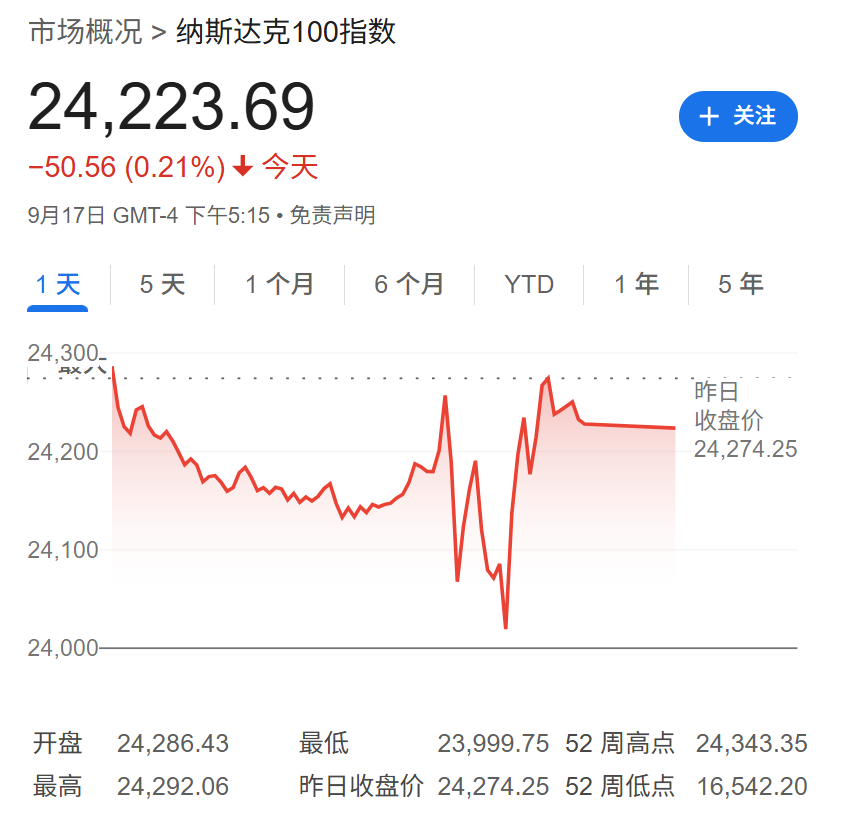
Core Viewpoint - The Federal Reserve's recent interest rate cut, while expected, has led to cautious signals that dampen market optimism for continued easing in the future [5][6]. Market Reactions - The Nasdaq 100 futures rose by 1.1%, reaching an intraday high, while popular Chinese stocks in the U.S. market experienced declines, with JD.com, Pinduoduo, Li Auto, Baidu, and Alibaba down by 1%, Xpeng down by 2%, and Bilibili and NIO down by 3% [2][5]. - European stocks saw gains, with the German DAX index increasing by 1%, the UK FTSE 100 opening up by 0.21%, the French CAC40 rising by 0.41%, and the Euro Stoxx 50 up by 0.64% [5]. Federal Reserve's Policy Signals - The Fed's decision to cut rates by 25 basis points signals a response to a weakening labor market and persistent inflation, indicating a gradual approach rather than a shift to aggressive easing [6]. - The dot plot from Fed officials suggests two more rate cuts this year, but only one by 2026, contrasting with traders' expectations of two to three cuts next year [5]. Economic Indicators - The yield on the 10-year U.S. Treasury bond fell by 2 basis points to 4.057% [5]. - The U.S. dollar index decreased by 0.05% to 96.98, while spot gold rose by 0.15% to 3665.13 [7].
国泰君安期货商品研究晨报-20250917
Guo Tai Jun An Qi Huo· 2025-09-17 05:24
1. Report Industry Investment Ratings No investment ratings for the industry are provided in the report. 2. Core Views of the Report This report provides trend forecasts and analysis of fundamental data for various commodities, including precious metals, base metals, energy, agricultural products, etc. It also presents macro and industry news and calculates the trend strength of each commodity. The overall view is that most commodities will show a trend of range - bound or volatile fluctuations, and some commodities will be affected by factors such as supply - demand relations, macro - economic policies, and international news [2][5]. 3. Summary According to Related Catalogs Precious Metals - **Gold**: Expected to have a downward revision of non - farm employment, with a trend strength of 0, and prices may be affected by the Fed's interest rate decision [2][7]. - **Silver**: Forecasted to break through and move upward, with a trend strength of 0 [2][7]. Base Metals - **Copper**: Before the Fed's decision, prices will be cautious, with a trend strength of 0. The industry has major events such as mergers and production changes [2][12]. - **Zinc**: Will have a range - bound shock, with a trend strength of 0 [2][15]. - **Lead**: Lacks obvious driving forces, and prices will fluctuate, with a trend strength of 0 [2][18]. - **Tin**: Will experience range - bound fluctuations, with a trend strength of 0 [2][21]. - **Aluminum**: Will have a range - bound shock; Alumina will grind the bottom in a shock; Casting aluminum alloy will follow electrolytic aluminum, all with a trend strength of 0 [2][26]. - **Nickel**: The contradiction in the smelting end is not prominent, and attention should be paid to the news - related risks in the ore end, with a trend strength of 0; Stainless steel will have a game between long - and short - term logics, and steel prices may fluctuate, with a trend strength of 0 [2][29]. Energy and Chemicals - **Carbonate Lithium**: Will fluctuate, and the increase in supply restricts the upward space, with a trend strength of 0 [2][36]. - **Industrial Silicon**: The main idea is to short at high prices; Polysilicon requires attention to market information, with a trend strength of 0 for industrial silicon and 1 for polysilicon [2][40]. - **Iron Ore**: Expectations will fluctuate repeatedly, with a wide - range shock, and a trend strength of - 1 [2][43]. - **Rebar and Hot - Rolled Coil**: The anti - involution sentiment is back, and both will have a relatively strong shock, with a trend strength of 1 [2][46][47]. - **Silicon Ferrosilicon and Manganese Ferrosilicon**: Boosted by macro - sentiment, both will have a relatively strong shock, with a trend strength of 1 [2][52]. - **Coke and Coking Coal**: Expectations will fluctuate repeatedly, with a wide - range shock, and a trend strength of 0 [2][55][56]. - **Log**: Will fluctuate repeatedly, with a trend strength of 0 [2][58]. Others - **LPG**: Will have a short - term narrow - range and relatively strong shock [2][50]. - **Propylene**: Will operate weakly at a high level in the short term [2][50]. - **PVC**: Will have a wide - range shock [2][53]. - **Fuel Oil**: Will rebound following crude oil and have a short - term adjustment trend; Low - sulfur fuel oil will continue to rise, and the price difference between high - and low - sulfur in the overseas spot market will rise slightly [2][54]. - **Container Shipping Index (European Line)**: The contract in October will operate under pressure; Contracts in December and February will have a wide - range shock [2][55]. - **Short - Fiber and Bottle Chip**: Will follow cost fluctuations in the short term, with a weak trend [2][58]. - **Offset Printing Paper**: Will fluctuate at a low level [2][59]. - **Pure Benzene**: Will fluctuate in the short term and be weak in the fourth quarter [2][61]. - **Palm Oil**: Supported by US soybean oil, boosted by macro - factors; Soybean oil: US soybeans continue to rise, and attention should be paid to the results of Sino - US negotiations [2][62]. - **Soybean Meal**: Affected by optimistic trade sentiment, will fluctuate at a low level; Soybean: Will fluctuate [2][64]. - **Corn**: Will fluctuate [2][66]. - **Sugar**: Has a weak basis [2][67]. - **Cotton**: The market focuses on the situation of new cotton listing [2][68]. - **Egg**: The peak season for spot goods is coming to an end, and inventory is still high [2][70]. - **Live Pig**: The policy expectations have been implemented, but the weakness of spot goods is hard to change [2][71]. - **Peanut**: Attention should be paid to the listing of new peanuts [2][72].
招银国际:市场已完全反映美联储本周减息25个基点预期
智通财经网· 2025-09-16 03:13
Group 1 - The market has fully priced in the expectation of a 25 basis point rate cut by the Federal Reserve this week [1] - The U.S. Court of Appeals rejected Trump's request to remove Fed Governor Cook, clearing the way for Cook to attend this week's Fed meeting, which may witness internal divisions within the Fed [1] - U.S. Treasury yields have declined, the U.S. dollar index has fallen, and cryptocurrencies have experienced widespread declines, while gold has reached a new high and oil prices have increased [1] Group 2 - The mainland stock market has risen, with Hong Kong's consumer discretionary, energy, and staple consumer sectors leading the gains, while materials, conglomerates, and real estate construction sectors have declined [1] - Biotech, lithium batteries, and smart terminals have performed well, with southbound funds net buying 14.473 billion HKD [1] - In A-shares, electric equipment, media, and agriculture sectors have seen the largest increases, while conglomerates, telecommunications, and defense industries have declined [1] Group 3 - Non-metallic building materials, energy, and iron ore prices have risen, while the yield on RMB government bonds has slightly increased, and the RMB has appreciated slightly [1]
FPG财盛国际:美联储加息 vs 降息:对黄金、股市等影响有多大?
Sou Hu Cai Jing· 2025-09-15 02:37
Core Viewpoint - The Federal Reserve's interest rate decisions significantly impact global financial markets, influencing assets like gold, stocks, and cryptocurrencies [2]. Group 1: Impact of Interest Rate Hikes - When the Federal Reserve raises interest rates, the market immediately feels the tightening effect [4]. - Gold, despite being a "safe-haven asset," loses attractiveness in a high-interest environment due to increased opportunity costs [5]. - Technology stocks are particularly sensitive to interest rates, as rate hikes compress their high valuation logic [5]. - Bitcoin, viewed as a "liquidity darling," tends to weaken during rate hike cycles [5]. Group 2: Impact of Interest Rate Cuts - Conversely, interest rate cuts are perceived as a signal of "releasing liquidity," leading to lower borrowing costs and increased market inflows [5]. - Gold benefits from lower real interest rates, typically resulting in price increases [5]. - Rising interest rates lead to increased borrowing costs, constraining corporate financing and consumer spending [5]. - A stronger dollar results in capital flowing back to the U.S., tightening global liquidity and putting pressure on risk assets like gold, Bitcoin, and U.S. stocks [5]. Group 3: Market Reactions and Expectations - A recovering stock market, especially growth stocks, may experience rapid rebounds during rate cuts [6]. - The cryptocurrency market becomes more active, with high-risk, high-volatility assets regaining popularity [6]. - Market participants often focus more on future interest rate paths rather than just the announced results, leading to preemptive market movements [8]. - The disparity between market expectations and actual outcomes can lead to significant volatility upon data releases [8].

新房在降价促销,可为什么二手房卖不动了,也不降价出售?
Sou Hu Cai Jing· 2025-09-14 16:19
Core Insights - The article highlights the contrasting pricing behaviors between new and second-hand homes in the real estate market, with new homes experiencing significant price reductions while second-hand homes remain relatively stable in price [1][2][3] Market Dynamics - New home prices have decreased by 8% to 15%, while second-hand home prices have only seen a slight decline of 2% to 5% despite a 31% drop in transaction volume for second-hand homes [1][2] - Developers face substantial financial pressure due to high costs associated with land, materials, labor, and interest on loans, leading them to reduce prices to stimulate sales [1][3][6] - In contrast, second-hand homeowners have lower holding costs and are less pressured to sell quickly, allowing them to maintain higher asking prices [2][5] Psychological Factors - The "anchoring effect" influences second-hand homeowners, who are reluctant to sell below their purchase price, often viewing their homes as emotional investments [2][9] - Many second-hand homeowners hold onto the belief that property values will rise again, leading to a reluctance to lower prices [7][12] Information Asymmetry - Developers have access to professional market research, enabling them to adjust strategies quickly, while most second-hand homeowners lack timely market information [3][12] - The speed of information dissemination favors new home price adjustments, while second-hand price changes are often less visible to potential buyers [12][13] Financial Considerations - Developers operate under high leverage and face significant costs if sales are delayed, while second-hand homeowners typically have lower financial burdens, allowing them to wait for better offers [5][6] - The holding costs for developers include various fees and interest, which accumulate rapidly, contrasting with the relatively low costs for second-hand homeowners [9][10] Market Segmentation - The real estate market is characterized by a buyer's market, where buyers have more options, making it crucial for second-hand homeowners to remain competitive in pricing [12] - The disparity in pricing strategies between new and second-hand homes is influenced by differing market conditions across various cities, with first-tier cities showing more resilience in second-hand home prices compared to lower-tier cities [10][12] Long-term Outlook - The sustainability of the current pricing gap between new and second-hand homes is questionable, as market forces will eventually seek equilibrium [12][13] - The article suggests that both developers and second-hand homeowners need to adjust their expectations to align with the evolving real estate landscape [12][13]

美股异动|赛默飞世尔股价攀升背后董事复杂交易初露端倪
Xin Lang Cai Jing· 2025-09-11 22:48
Group 1 - Thermo Fisher Scientific (TMO) experienced a 3.12% increase in stock price on September 11, attracting significant investor interest, especially after Barclays raised the target price to $550 [1] - Recent internal trading activities by executives, including Casper Marc N and Holmes Joseph R, indicate a complex outlook on the company's future, with both buying and selling shares [1] - The company's involvement in providing technical services to Zhejiang University highlights its capabilities in technology development and may pave the way for long-term growth [1] Group 2 - Thermo Fisher Scientific is focused on enhancing market competitiveness through a diversified brand portfolio, including Thermo Scientific and Applied Biosystems, catering to pharmaceutical, environmental, and research sectors [2] - The stock price movements of Thermo Fisher Scientific are influenced by multiple factors, including internal trading, industry expansion, and market expectations [2] - Investors considering engagement with Thermo Fisher Scientific should monitor performance trends and executive trading activities for insights into future developments [2]
