
票息策略

Search documents
信用策略周报20250907:论信用“抗跌性”与“扛跌性”-20250908
Tianfeng Securities· 2025-09-07 23:41
Group 1 - The overall performance of credit bonds has shown structural differentiation, with short-term credit outperforming long-term and ultra-long-term credit [1][8] - The secondary market for credit bonds has seen a decline in trading duration since mid-July, particularly for public credit bonds, indicating a significant pressure on ultra-long credit [2][9] - Credit bonds have demonstrated enhanced "anti-drawdown" and "resilience" characteristics this year, with short-term credit showing independent performance during market adjustments [3][32] Group 2 - The current market sentiment remains cautious, with expectations of limited chances for significant overcorrection or negative feedback from redemptions [4][42] - Selected mid-to-short-term credit assets are recommended for consideration, with a focus on 3-5 year bonds that have adjusted to a favorable risk-return profile [4][42] - Caution is advised for ultra-long credit, as trading profitability is not evident and there is a tendency for increased allocation at high levels [4][42]
华泰固收:点心债供求偏暖,票息为先
Ge Long Hui A P P· 2025-09-06 02:22
Core Viewpoint - The rapid development of dim sum bonds since 2022 is primarily driven by urban investment bonds, with the outstanding dim sum bond scale exceeding 1.5 trillion yuan by early September 2025 [1] Supply Side - The supply of urban investment offshore bonds remains strictly regulated, making significant short-term increases in urban investment dim sum bonds unlikely [1] - High-quality financial/industrial bonds and green bonds are expected to expand under regulatory support [1] Demand Side - The expansion of cross-border investment channels, strong willingness of institutions to invest overseas, and potential appreciation of the renminbi indicate promising incremental demand for dim sum bonds [1] Investment Strategy - It is recommended to focus on coupon strategies for dim sum bond investments, primarily in the short to medium term, while also considering the extension of duration for investment-grade financial/industrial bonds and moderate allocation in short to medium-term urban investment bonds [1]
【财经分析】信用债结构性“跑赢”利率债 短端品种或为阶段“良配”
Xin Hua Cai Jing· 2025-09-03 06:21
Core Viewpoint - Despite the weak sentiment in the bond market influenced by the "stock-bond seesaw" effect, credit bonds are currently outperforming interest rate bonds, with analysts suggesting that institutions can still capture coupon assets and seek capital gains in the short term [1][2][3] Group 1: Credit Bond Performance - In August, credit bonds structurally "outperformed" interest rate bonds, with credit spreads not significantly widening [2] - The economic fundamentals remain weak, as indicated by the manufacturing PMI of 49.4 in August, which is below the growth line [2] - The "stock-bond seesaw" effect has weakened, reducing the negative feedback from a bullish stock market on the bond market [2] Group 2: Funding Support - The funding environment is expected to remain stable, with monetary policy maintaining a supportive tone [3] - The second quarter monetary policy report emphasizes a "moderately loose monetary policy" to adapt to domestic and international economic conditions [3] - There is an increasing expectation of interest rate cuts from the Federal Reserve, which could lead to more trading opportunities in the bond market [3] Group 3: Demand Side Support - As of September 2, the yields on credit bonds in the interbank market have decreased, with the 3-month AAA yield down 1 basis point to 1.59% [3] - Bank wealth management products were the main buyers of credit bonds in August, with net purchases of approximately 180 billion yuan [4] - Insurance companies also significantly increased their purchases of credit bonds, with a net buying scale of 56.2 billion yuan in August [4] Group 4: Investment Strategy - It is recommended to focus on short-duration high-yield bonds, particularly city investment bonds with maturities around 2 years [7] - Institutions are advised to selectively consider mid-to-short duration coupon assets with ratings of AA+ and above [7] - Caution is advised for long-duration credit bonds due to limited buying power in the bond market and the absence of clear stabilization in interest rates [7][8]
量化信用策略:票息策略≠防御空间
SINOLINK SECURITIES· 2025-08-17 12:27
Group 1: Report's Investment Rating - No information provided on the report's industry investment rating Group 2: Core Views - This week, the simulated portfolio's returns turned negative, with the credit - style portfolio's retracement relatively controllable. Among the interest - rate style portfolios, the short - end sinking of urban investment bonds and the sinking strategy of certificates of deposit (CDs) had relatively high weekly return readings, both around - 0.41%. Among the credit - style portfolios, the short - end sinking of urban investment bonds and the sinking strategy of CDs had smaller retracements, with return readings of - 0.16% and - 0.16% respectively [2][15][16]. - Since July, the CD strategy has a higher odds. The average weekly return of the credit - style CD heavy - position portfolio dropped to - 0.17%, a decrease of about 24bp from last week. It is also one of the few strategies with positive cumulative returns in the past three weeks. The corresponding interest - rate style portfolio underperformed the defensive strategy again after two weeks [2][19]. - In terms of return sources, the coupon of the credit - style urban investment bond heavy - position strategy is approaching the annual low and can hardly withstand recent fluctuations. The coupon contributions of the credit - style portfolio this week generally fell within the range of - 25% to - 5%, and capital gains significantly dragged down the comprehensive return [3][27]. - In the past four weeks, except for the short - end sinking of urban investment bonds, the remaining mainstream strategies generally lacked excess returns. From the perspective of strategy terms, short - term strategies significantly outperformed. Short - term CD strategies outperformed the benchmark, and the excess return of urban investment sinking reached the highest since late June [4][31][33]. Group 3: Summary by Relevant Catalogs 1. Portfolio Strategy Return Tracking 1.1 Portfolio Weekly Return Overview - As of August 15, this year, the cumulative returns of the interest - rate style and credit - style portfolios have significantly lagged behind the same period in the past two years. Among the main credit - style portfolios, the cumulative comprehensive returns of the long - term industrial portfolio, the short - end sinking of urban investment bonds, and the duration portfolio led, reaching 1.48%, 1.39%, and 1.22% respectively. The cumulative returns of the credit - style portfolios all exceeded the corresponding interest - rate style portfolios, while the cumulative returns of the interest - rate style portfolios basically fell back to within 1% [10]. - The average weekly return of the credit - style CD heavy - position portfolio dropped to - 0.17%, a decrease of about 24bp from last week. The weekly return of the urban investment bond heavy - position portfolio decreased by 38.6bp to - 0.27% compared with the previous week. The weekly return of the secondary bond heavy - position portfolio decreased by more than 40bp, but its absolute return performance was slightly stronger than that of the interest - rate style portfolio. The average return of the long - term bond heavy - position strategy dropped to - 0.55%, a decrease of about 64bp compared with the previous week [2][19]. 1.2 Portfolio Weekly Return Sources - The coupons of the main strategy portfolios continued to decline. The coupons of the short - end sinking and dumbbell - shaped portfolios of urban investment bonds were around an annualized 1.92% and 1.97% respectively, less than 5bp away from the annual low. The coupon of the secondary bond duration portfolio was still 14bp away from the low point, and the coupon volatility remained high [3][27]. 2. Credit Strategy Excess Return Tracking - In the past four weeks, the cumulative excess returns of the short - end sinking of urban investment bonds, the bullet - shaped portfolio of commercial financial bonds, and the sinking strategy portfolio of secondary bonds reached 16.2bp, 0.9bp, and 0.6bp respectively, while the cumulative readings of the remaining strategy portfolios dropped to the negative range. This week's weak performance widened the gap between the cumulative returns of the heavy - position strategy of Tier 2 and perpetual bonds and the urban investment bond heavy - position strategy, with the cumulative excess return dropping to below - 22bp [4][31]. - From the perspective of strategy terms, short - term strategies significantly outperformed. Short - term CD strategies outperformed the benchmark, and the excess return of urban investment sinking reached the highest since late June. In the medium - and long - term, all strategies showed negative excess returns, except that the excess return of the short - end sinking of urban investment bonds reached 9.7bp. The negative deviations of Tier 2 capital bonds and the bullet - shaped portfolio of commercial financial bonds from the benchmark were within 2bp, also having a certain defensive property [4][33]. Appendix: Simulated Portfolio Allocation Method - The simulated portfolio has some limitations, including the distortion of the portfolio allocation method and errors in the return calculation method. The actual product's bond allocation in terms of grade and term distribution is more complex and may change strategies according to market conditions. The fixed bond ratio in the simulated portfolio may be distorted, and there are some assumptions and simplifications in the calculation method of coupon and capital gains [5][47]
九泰聚鑫混合A,九泰聚鑫混合C: 九泰聚鑫混合型证券投资基金2025年第2季度报告
Zheng Quan Zhi Xing· 2025-07-21 05:10
Core Viewpoint - The report provides an overview of the performance and investment strategy of the Jiutai Juxin Mixed Securities Investment Fund for the second quarter of 2025, highlighting its focus on bond investments and risk management strategies [1][2]. Fund Overview - Fund Name: Jiutai Juxin Mixed [3] - Fund Manager: Jiutai Fund Management Co., Ltd. [4] - Fund Custodian: Huaxia Bank Co., Ltd. [4] - Total Fund Shares at End of Reporting Period: 8,875,114.83 shares [3]. Investment Strategy - The fund employs a combination of qualitative and quantitative research methods to determine the allocation of stocks, bonds, and cash in its investment portfolio [3]. - The investment strategy includes a focus on bond investments, particularly using a "barbell" strategy and coupon strategies to manage duration and enhance returns [8][9]. - The fund emphasizes the importance of duration management and has increased the duration of its bond holdings to enhance yield elasticity [9]. Financial Performance - As of the end of the reporting period, the net asset value (NAV) of Class A shares was 0.9807 yuan, with a net value growth rate of 1.37% [12]. - Class C shares had a NAV of 0.9708 yuan, with a net value growth rate of 1.33% [12]. - The performance benchmark for the same period yielded a return of 1.54% [12]. Asset Allocation - The fund's asset allocation is heavily weighted towards bonds, with 96.32% of total assets in bonds [13]. - The fund did not hold any stocks or equity-related securities during the reporting period [13][14]. Shareholder Information - The total number of shares at the beginning of the reporting period for Class A was 3,706,723.33, and for Class C was 5,618,643.01 [16]. - The total shares at the end of the reporting period for Class A were 3,705,522.14, and for Class C were 5,169,592.69 [16]. Compliance and Governance - The fund management adheres to relevant laws and regulations, ensuring fair trading practices and the protection of shareholder interests [7][8]. - No significant trading anomalies were reported during the period, and the fund maintained compliance with internal trading policies [8].

信用周报:逢高配置高票息-20250712
Huachuang Securities· 2025-07-12 14:37
Group 1: Report Industry Investment Rating - No relevant content provided Group 2: Core Views of the Report - The bond market fluctuated weakly this week due to multiple negative disturbances such as regulatory guidance on rural commercial bank bond investment and the supply of real estate and ultra - long - term bonds. The adjustment range of credit bonds was smaller than that of interest - rate bonds, and the spreads were mostly passively narrowed. Institutions may continue to explore high - coupon individual bonds after the stock - bond seesaw effect, which helps to further narrow the credit spreads. It is advisable to allocate high - coupon varieties on rallies, and pay attention to the right - hand opportunities for long - term credit bonds after the market stabilizes [2][5]. - For institutions with weak liability - side stability, focus on 2 - 3y medium - and low - grade varieties and some 4 - 5y high - coupon, medium - quality individual bonds. For institutions with strong liability - side stability, take advantage of stable liabilities to extend the duration and actively allocate long - term varieties [2][14]. - When considering taking profits on long - term credit bonds, pay attention to three time points: when funds continue to net buy but credit spreads do not further compress significantly; when the net buying power of funds weakens or turns to small net selling; and using 10 - 15BP above the lowest spread last year as a reference line [5][13]. Group 3: Summary According to the Catalog I. Bond Market Review and Credit Strategy Outlook - This week, the equity market sentiment was strong, and the stock - bond seesaw effect continued. The bond market fluctuated weakly. Most credit bond yields rose, and spreads were mostly passively narrowed. The 3y - and - below short - end spreads of most varieties were compressed to an extreme level, while the medium - and long - term varieties still had some room [5][9][12]. - Looking forward, with the current fundamental pattern unchanged significantly and the second - quarter economic data being relatively strong, the risk of a trend reversal in the bond market is controllable. Institutions may continue to explore high - coupon bonds, and if the adjustment continues next week, it may bring better layout opportunities [5][13]. II. Key Policies and Hot Events - Shenzhen Longfor Holdings Co., Ltd. announced adjustments to the principal and interest repayment arrangements of 21 bonds, indicating that the debt restructuring of real - estate enterprises is accelerating and risk clearing is speeding up [2][16]. - Gansu Province established a 10 - billion - yuan provincial emergency working capital pool, with 2 billion yuan from provincial finance and 8 billion yuan from bank supporting financing, to support key enterprises in repaying due debts and effectively alleviate debt risks [2][3][16]. - The central bank and the Hong Kong Monetary Authority announced three opening - up optimization measures at the "Bond Connect Anniversary Forum 2025", which may bring new investment opportunities for Chinese overseas bonds traded in the Hong Kong market [2][3][17]. - Ten science - innovation bond ETFs completed their issuance, raising a total of 28.988 billion yuan, with subscriptions being extremely popular. Attention should be paid to the subsequent scale expansion [3][17]. III. Secondary Market - Credit bond yields generally rose this week, and spreads were mostly passively narrowed. In terms of different varieties: - For urban investment bonds, yields generally rose, and spreads mostly narrowed. Attention can be paid to the income - mining opportunities of high - coupon urban investment bonds within 3y and extend the duration of medium - and high - grade varieties [20]. - For real - estate bonds, low - grade varieties were relatively weak. Currently, real - estate bond yields are still attractive, and attention can be paid to 1 - 2y central and state - owned enterprise real - estate AA and above varieties [21]. - For cyclical bonds, coal and steel bond yields mostly rose, and spreads mostly narrowed. For coal bonds, appropriate credit - risk exposure can be taken for short - end varieties, and the duration of medium - and high - grade varieties can be extended to 3y. For steel bonds, consider short - duration AA + implicit - rated varieties [21]. - For financial bonds, bank perpetual and secondary capital bonds generally underperformed, with yields rising and spreads mostly narrowing. Brokerage sub - bonds and insurance sub - bonds also had yield increases and spread narrowing [22]. IV. Primary Market - This week, the credit bond issuance scale was 287.4 billion yuan, a week - on - week increase of 66.8 billion yuan, and the net financing was 88.3 billion yuan, a week - on - week decrease of 47.8 billion yuan. The urban investment bond issuance scale was 102.3 billion yuan, an increase of 39.9 billion yuan, and the net financing was 26 billion yuan, an increase of 174 billion yuan [6]. V. Trading Liquidity - This week, the trading activity of credit bonds in the inter - bank market decreased, while that in the exchange market increased [6]. VI. Rating Adjustments - This week, 1 entity's rating was downgraded, and 6 entities' ratings were upgraded [6].
7月信用债策略月报:长久期信用债后续如何参与,何时止盈?-20250712
Huachuang Securities· 2025-07-12 07:40
Group 1 - The report indicates that since late May, the long-term credit bond market has seen significant net buying activity, reflecting high market participation enthusiasm [1][9] - The long-term credit bond market began to show independent trends in both last year and this year under extreme conditions of short-term yield compression, leading to a focus on duration for yield [9][12] - The report highlights that the current long-term credit bond market is influenced by the "stock-bond" effect, with institutions being cautious and focusing on profit-taking points [1][9] Group 2 - For the 5-7 year medium-term bonds, institutional net buying has significantly increased since late May, with peak net buying volumes reaching around 3.5 billion [2][14] - In the 7-10 year medium-term bonds, the fluctuation of fund net buying is a crucial factor affecting credit spreads, with insurance companies showing stronger net buying compared to last year [2][17] - For bonds over 10 years, the participation of funds has been limited this year, with the main buying force coming from insurance and other product categories, resulting in weaker effects on credit spread compression [2][18] Group 3 - The report states that the compression of credit spreads has reached an extreme level for short-term bonds (3 years and under), while there is still some room for long-term bonds (5 years and above) [3][23] - The report suggests that if funds continue to buy long-term credit bonds significantly, it could further compress spreads; otherwise, the compression potential may be limited [3][23] - The report identifies three key points for profit-taking in long-term credit bonds, including observing fund buying trends and credit spread movements [3][9] Group 4 - The report recommends that institutions with weaker liability stability should focus on 2-3 year low-grade bonds and 4-5 year high-yield bonds, while those with stronger stability should actively allocate long-term bonds [4][9] - The yield range for 7-year AA+ rated bonds and 10-15 year AA+ rated bonds is noted to be between 2.07% and 2.39%, indicating potential for yield exploration [4][9]
信用债顺势继续挖掘
HTSC· 2025-07-07 11:00
Industry Investment Rating No industry investment rating is provided in the report. Core Viewpoints - In July, the credit bond market may be bullish. Institutions can appropriately extend the duration of their portfolios based on their liability profiles and focus on trading opportunities. The coupon strategy should focus on 3 - 5 year investment opportunities in medium - to high - grade industries, urban investment bonds, and high - quality urban and rural commercial banks. For trading, institutions can moderately participate in the opportunities of Tier 2 and perpetual bonds and long - term general credit bonds, but should leave a larger safety margin and take profits in a timely manner [1][32][33] - The sustainability of the subsequent credit market depends on non - bank allocation power, interest rate disturbances, and the liquidity situation. Credit bond ETFs have become a new highlight, but investors should be cautious not to over - participate at present [10][16][17] Summary by Directory Market Review - From June 27 to July 4, 2025, after the quarter - end, the liquidity situation was loose, the equity market performed well, and the yield of interest rate bonds fluctuated within a narrow range. The market returned to coupon hunting, and the yields of credit bonds declined across the board by about 4BP. The yields of Tier 2 and perpetual bonds generally declined by about 5BP, with the medium - and short - term yields declining more strongly, generally by over 6BP. The buying volume continued to increase, with wealth management products net buying 11.7 billion yuan and funds net buying 55.4 billion yuan. The median spreads of publicly - issued bonds of AAA - rated entities in various industries mostly declined by about 4BP, and the median spreads of urban investment bonds in each province declined across the board, with the spread in Guizhou declining by over 10BP [2][37] Primary Issuance - From June 30 to July 4, 2025, the total issuance of corporate credit bonds was 166.8 billion yuan, a 60% decline from the previous period; the total issuance of financial credit bonds was 61.7 billion yuan, a 9% decline from the previous period. Among corporate credit bonds, urban investment bonds were issued at 56.7 billion yuan, and industrial bonds at 103.2 billion yuan, with a total net financing of 30.6 billion yuan. Urban investment bonds returned to the net repayment range, with a net repayment of 14.2 billion yuan, while industrial bonds had a net financing of 44.1 billion yuan. In terms of financial credit bonds, commercial bank bonds were issued at 22.6 billion yuan, commercial bank subordinated bonds at 36.6 billion yuan, and insurance and securities company bonds at 2.5 billion yuan, with a total net financing of 6.6 billion yuan. In terms of issuance interest rates, the average issuance interest rate of medium - and short - term notes for AAA - rated entities decreased slightly, while that for AA+ - rated entities increased. The average issuance interest rate of corporate bonds increased for all ratings except AAA [3][62] Secondary Trading - Active trading entities are mainly medium - to high - grade, medium - and short - term, and central and state - owned enterprises. For urban investment bonds, active trading entities are divided into two types: mainstream high - grade platforms in economically strong provinces such as Jiangsu and Guangdong, and core platforms in regions with relatively high spreads in large economic provinces such as Shandong, Sichuan, and Henan. For real estate bonds, active trading entities are still mainly AAA - rated, with most trading terms between 1 - 3 years. For private enterprise bonds, active trading entities are also mainly AAA - rated, with most trading terms in the medium - and short - term. In terms of long - term bonds, the proportion of bonds with a remaining term of over 5 years in actively traded urban investment bonds was 2%, a slight decline from the previous week's 4% [4][73]
资金疯狂涌入债券型ETF,规模超百亿的债券ETF达15只
Ge Long Hui· 2025-07-03 06:24
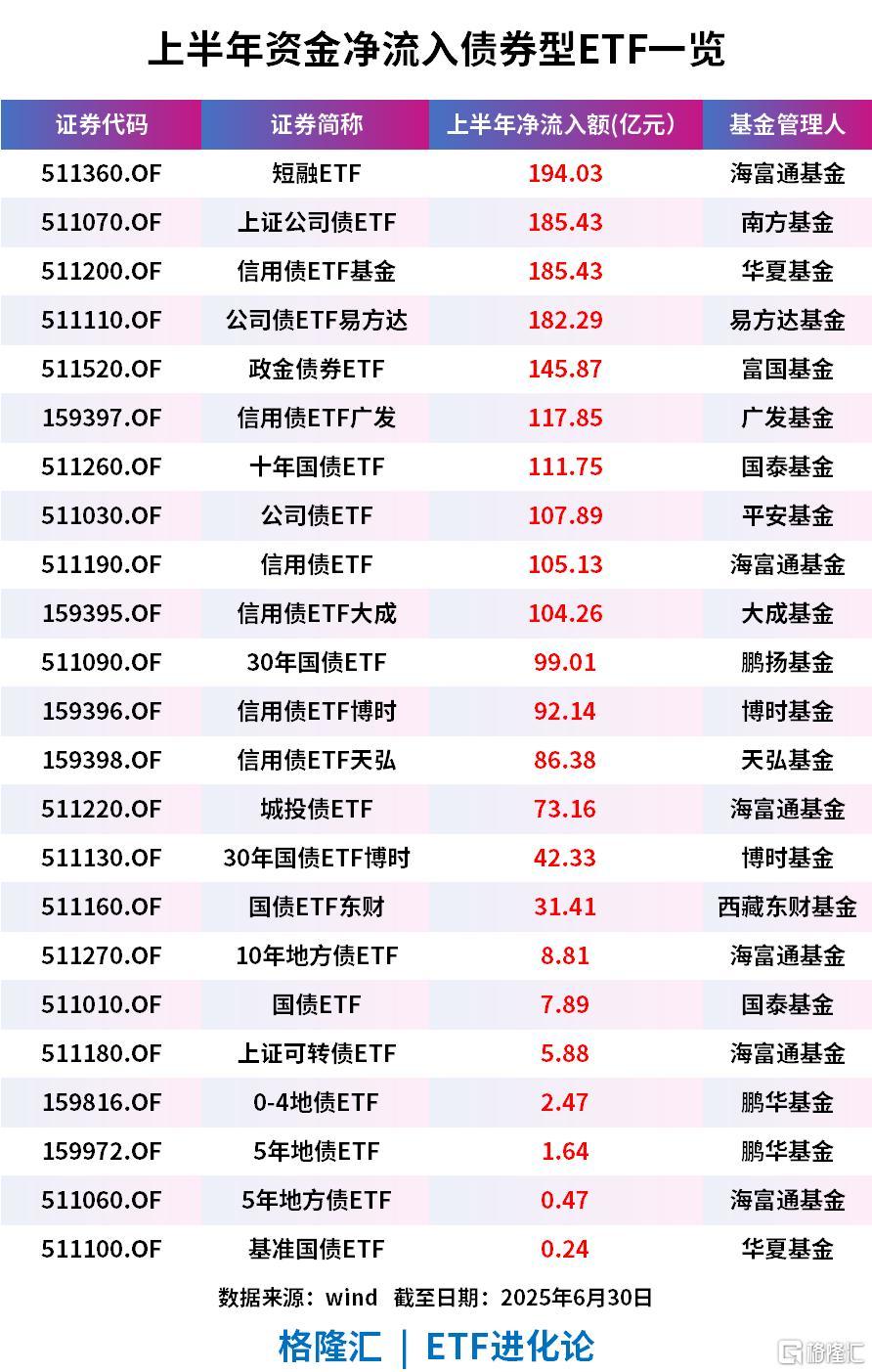
Group 1 - The total scale of ETFs surpassed 4 trillion yuan, reaching 4.31 trillion yuan, representing a growth of 15.57% compared to the end of last year [1] - The largest growth in the first half of the year was seen in bond ETFs, which grew by 120.71% to 383.976 billion yuan [1] - A total of 29 bond ETFs reached a combined scale of 383.976 billion yuan, setting a new historical record [1] Group 2 - Bond ETFs had the highest net inflow in the first half of the year, totaling 175.784 billion yuan [1] - Notable bond ETFs with net inflows exceeding 10 billion yuan include Hai Futong Short-term Bond ETF, Southern Shanghai Stock Company Bond ETF, and others [1] - The top bond ETF by scale is the Government Financial Bond ETF, which reached 52 billion yuan [5][7] Group 3 - There are 15 bond ETFs with a scale exceeding 10 billion yuan, including various types such as policy financial bonds and corporate bonds [5] - The rapid growth of bond ETFs is attributed to factors such as increased market liquidity, lower costs, improved regulatory frameworks, and a shift in investor risk preferences [10] - The credit bond market is experiencing fluctuations in yield, with low-grade credit spreads compressing the most [11] Group 4 - The outlook for the second half of the year suggests that credit bond yields are likely to remain volatile, with potential for credit spreads to widen due to supply-demand mismatches [12][13] - Investment strategies should focus on short to medium-term high-grade credit bonds and consider opportunities in local government bonds [12]

2025信用月报之六:下半年信用债怎么配-20250702
HUAXI Securities· 2025-07-02 13:52
Group 1: Report Summary - Investment Rating: Not provided in the report - Core View: In the second half of 2025, credit bond investment should focus on three elements: the trend of funds and interest rates, the supply - demand pattern of credit bonds, and the cost - effectiveness of different varieties. Interest rates may continue to decline in a volatile manner, making the coupon value of credit bonds prominent, but the valuation volatility may increase. The overall supply of credit bonds may be difficult to expand, and the configuration demand may weaken from August to December. Different investment strategies are recommended for different periods and varieties [1][18] Group 2: 1. Steady Coupon as the Foundation, Grasp the Trading Rhythm 1.1. Short - to Medium - Duration Credit Spread Compression for Coupon Income, Seize Phased Opportunities in Long - Duration Bonds - H1 2025 Review: The credit bond market experienced an increase in yields and a widening of credit spreads from January to mid - March, followed by a rotation of the market to medium - to long - duration and then ultra - long - duration bonds from April to June. The main factors in the first quarter were the tight funds and the change in wealth management scale. In mid - to late March, the bond market recovered, driven by supply shrinkage and the cost - effectiveness of varieties. From April to June, the market was affected by interest rate fluctuations and the shift of the funds' central point [12][13] - June 2025 Highlights: The long - duration credit bond market was activated, mainly due to the compression of short - to medium - duration credit spreads to historical lows and the increased demand from funds, insurance, and other products. The scale of credit bond ETFs increased by 7.7 billion yuan in June, which also drove the demand for some long - duration component bonds [14][16] - H2 2025 Outlook: Interest rates may continue to decline in a volatile manner. The supply of credit bonds may be difficult to expand, with the decrease in urban investment bonds offset by the increase in industrial bonds. The wealth management scale usually increases significantly in July but weakens from August to December. The rectification of wealth management's net - value smoothing methods may suppress the demand for ultra - long - duration and low - rated medium - to long - duration bonds. It is recommended to increase positions in July, take profits in August, and reduce credit bond positions from August to December, switching to inter - bank certificates of deposit and interest - rate bonds [18][19][21] - Variety Cost - Effectiveness: The 10Y high - grade credit bonds have relatively large potential for credit spread compression. As of June 30, the credit spreads of 10Y high - grade medium - term notes are still 8 - 11bp higher than the average. Short - to medium - duration credit spread compression may still be the dominant strategy. Bonds with a yield of 2.0% - 2.2% in the 1 - 3 - year AA and AA(2) categories have high allocation value. High - grade 5 - year bonds can be considered when the credit spread adjusts to the mean + 1 standard deviation [22][30][35] 1.2. Grasp the Trading Rhythm of Bank Capital Bonds 1.2.1. Difficult for Bank Capital Bond Supply to Expand in H2 2025 - H1 2025 Review: The supply of bank capital bonds increased slightly. The net financing of secondary capital bonds increased year - on - year, while that of perpetual bonds decreased. The city commercial banks increased their issuance scale, while the supply from rural commercial banks was weak [39] - H2 2025 Outlook: The demand for new capital bonds from the Big Four banks may decrease after the capital injection in June. Although small and medium - sized banks may increase issuance if the cost is low, the overall net supply is difficult to expand [40] 1.2.2. Narrower Bandwidth for Band - Trading in Bank Capital Bonds, Reverse Trading May Yield Higher Win - Rates - H1 2025 Review: The yields of bank capital bonds showed differentiation. The yields of 1 - 5Y large - bank bonds generally increased, while those of 10Y secondary capital bonds and 1 - 4Y small - and medium - bank bonds mostly decreased. The credit spreads of most varieties compressed, with short - duration and low - grade bonds performing better [44] - H2 2025 Outlook: The bank capital bonds still have trading opportunities following interest - rate bonds, but the credit spread compression space is limited. Reverse trading (increasing positions during adjustments) may have a higher win - rate. The 4 - year and 6 - year bonds have higher riding yields and better holding experiences [50][51] Group 3: 2. Urban Investment Bonds: Negative Net Financing in H1, a Historical First - H1 2025 Supply: The supply of urban investment bonds shrank, with negative net financing for the first time in history. From January to June, the issuance was 2.9464 trillion yuan, a year - on - year decrease of 382.9 billion yuan, and the net financing was - 71.7 billion yuan, a year - on - year decrease of 218.5 billion yuan, mainly due to the tightening of bond - issuing policies [55] - Issuance Characteristics: The overall issuance sentiment was good, with a high proportion of over - subscribed issuances. The proportion of 3 - 5 - year issuances increased, while that of within - 1 - year issuances decreased. The issuance interest rates decreased overall, with greater declines in short - to medium - term bonds [55][56] - Regional Differences: The net financing performance of urban investment bonds varied by region. Most regions had negative net financing, mainly affected by district - level and park - level platforms. Guangdong and Shandong had relatively high positive net financing, while Jiangsu, Hunan, and Chongqing had large negative net financing [58] - Yield and Credit Spread: The yields of urban investment bonds generally decreased in H1, with high - grade long - duration and AA - low - grade bonds performing better. The credit spreads of all maturities and grades narrowed, with low - grade bonds performing more strongly [62][63] - Secondary Market: Since mid - March, the buying interest in the secondary market has been high, with a high proportion of TKN transactions and low - valuation transactions. There was a trend of increasing duration in transactions, and the proportion of AA(2) low - grade transactions remained high [66] Group 4: 3. Industrial Bonds: Supply Increase, Longer Durations in Both Primary and Secondary Markets - H1 2025 Supply: The issuance and net financing of industrial bonds increased year - on - year. From January to June, the issuance was 3.8718 trillion yuan, a year - on - year increase of 309.2 billion yuan, and the net financing was 1.0788 trillion yuan, a year - on - year increase of 40 billion yuan. The new regulations on science and technology innovation bonds contributed to the increase in issuance [18] Group 5: 4. Bank Capital Bonds: Low - Rated Bonds Perform Better, Weak Trading Sentiment - H1 2025 Performance: The yields of bank capital bonds showed differentiation, with short - duration and low - rated bonds performing better. The credit spreads of most varieties compressed, with 1 - 4Y small - and medium - bank capital bonds and 1 - 3Y AA - perpetual bonds having significant spread compression [44] - Trading Rhythm: The trading bandwidth of large - bank long - duration capital bonds has been narrowing, making band - trading more difficult. Reverse trading may be a better strategy. The 4 - year and 6 - year bonds have higher riding yields [48][51]