
美国经济衰退

Search documents
经典重温 | 美元:“巴别塔”的倒塌?(申万宏观·赵伟团队)
申万宏源宏观· 2025-09-25 05:14
Core Viewpoint - The article discusses the unexpected weakening of the US dollar since the implementation of Trump's tariffs on April 2, while the Chinese yuan remains under pressure. It analyzes the reasons behind the dollar's decline and the potential future trends for both the dollar and yuan [1]. Group 1: Recent Weakness of the US Dollar - Since January 10, the US dollar has been continuously weakening, with the dollar index dropping to 99.4 by April 17, a decline of 9.3%. The dollar's performance has shown a clear divergence against developed and emerging market currencies, with declines of 7.6% and 1.4% respectively [2][7]. - Prior to April 7, the primary reason for the dollar's weakness was the rising expectations of a US recession, as indicated by a drop in the Citigroup Economic Surprise Index from 14.5 to -19.5. This led to an increase in market expectations for interest rate cuts, which rose from 1.2 to 4.2 times by April 4, causing a significant drop of 62 basis points in the 10-year US Treasury yield [2][17]. - After April 7, despite a rebound in Treasury yields, the dollar continued to weaken, possibly due to overseas capital fleeing the US. This shift in market sentiment transitioned from "flight to safety" to "flight to non-US" assets [2][28]. Group 2: Future Outlook for the US Dollar - The uncertainty surrounding tariffs and other policies may continue to exert downward pressure on the US economy, potentially leading to further dollar weakness. The tariffs are expected to increase economic and trade uncertainties, impacting corporate activities and consumer confidence [3][39]. - The GTAP model suggests that the tariffs could reduce US GDP by approximately 3 percentage points. Historical patterns indicate that during recessions, the dollar typically strengthens; however, current concerns about US debt sustainability and Trump's isolationist policies may weaken the dollar's safe-haven status [3][52]. - The outflow of funds from US assets could diminish the likelihood of the dollar's typical "smile curve" behavior during a recession, as capital flows towards non-US assets increase [3][52]. Group 3: Implications for the Chinese Yuan - Despite the weakening dollar, the Chinese yuan has also depreciated, primarily due to the direct impact of tariff policies. Since April 2, while the dollar index fell by 4.1%, the onshore yuan depreciated by 0.4%, reaching a new low since the 2015 reform [4][61]. - Looking ahead, the depreciation pressure on the yuan may ease as external shocks diminish. The ongoing US economic downturn and capital outflows from the US could alleviate external pressures on the yuan [4][92]. - The People's Bank of China (PBOC) has tools to counter cyclical behaviors in the market, and the accumulation of approximately $123.9 billion in pending foreign exchange settlements since 2023 may provide a buffer for the yuan's stability [4][77].


中信建投:美国衰退风险,如何评估?
Xin Lang Cai Jing· 2025-09-23 00:02
Group 1 - The core debate in the market revolves around whether the Federal Reserve's interest rate cuts signify a "rate cut trade" indicating a soft landing for the U.S. economy, or a "recession trade" suggesting significant risks for equities [2][3][7] - Current economic indicators in the U.S. are weak but not at recession levels, with key metrics remaining relatively high compared to historical recession periods [8][11][14] - The employment market's traditional signaling of recession risks may be diminishing due to factors such as AI-driven investment and an aging population, which alters the relationship between employment, income, and consumption [17][20] Group 2 - The Federal Reserve's proactive measures have reduced the likelihood of a financial crisis, thereby increasing the difficulty of a recession occurring in the U.S. [4][25] - Historical responses to financial crises, such as the rapid implementation of quantitative easing during the 2019 monetary crisis and the swift actions following the Silicon Valley Bank collapse, illustrate the Fed's commitment to maintaining economic stability [5][25] - The current macroeconomic environment, characterized by weak economic performance but not a recession, is favorable for both U.S. equities and bonds in the medium term [6][26][27]


美国衰退将至?
虎嗅APP· 2025-09-19 00:10
Core Viewpoint - The Federal Reserve's decision to cut interest rates by 25 basis points is seen as a preventive measure to support the economy, but it does not eliminate the risk of recession in the U.S. economy [5][9][10]. Economic Indicators - The U.S. labor market shows signs of weakness, with only 73,000 jobs added in July 2025, below the expected 110,000, and the unemployment rate rising to 4.2% [11]. - In August 2025, non-farm employment increased by only 22,000, with the unemployment rate reaching 4.3%, the highest in nearly four years [11]. - The U.S. Bureau of Labor Statistics revised employment data downward, indicating a reduction of 911,000 jobs, revealing a more fragile labor market than previously thought [11]. Manufacturing Sector - The New York Fed's manufacturing index fell to -8.7 in September 2025, significantly below the forecast of 5.0, indicating a downturn in the manufacturing sector [12]. Trade Policies - Trade protectionism, particularly the tariffs imposed by the Trump administration, is negatively impacting the U.S. economy by increasing costs for consumers and businesses, leading to reduced investment and consumer spending [13][14]. - The tariffs are expected to result in significant job losses and income reductions for American households, with estimates suggesting a potential recession probability increase from 25% to 40% [14]. Market Reactions - Following the Fed's rate cut, various asset classes reacted with volatility, indicating a lack of confidence in the Fed's optimistic forecasts [9][10]. - The demand for safe-haven assets like gold and U.S. Treasuries is expected to rise as investors seek refuge from potential economic downturns [17]. Long-term Implications - The U.S. government's rising debt burden, projected to exceed $37 trillion, poses a risk to the long-term stability of U.S. Treasuries, potentially diminishing their safe-haven status [18]. - The dollar may experience a short-term strengthening due to safe-haven flows, but long-term trends suggest a weakening of the dollar as global trust in U.S. fiscal management declines [19]. Summary of Asset Movements - In the event of a recession or heightened recession expectations, investors typically shift from risk assets to safe-haven assets, leading to a temporary increase in demand for U.S. Treasuries and the dollar, while long-term concerns about debt and creditworthiness may undermine their value [20].

美国衰退将至?
Hu Xiu· 2025-09-18 23:01
Core Viewpoint - The Federal Reserve's decision to cut interest rates by 25 basis points is seen as a preventive measure rather than a response to a strong economy, indicating underlying economic concerns [1][5]. Economic Indicators - The labor market is showing signs of weakness, with only 73,000 jobs added in July, below the expected 110,000, and the unemployment rate rising to 4.2% [6]. - In August, non-farm employment increased by just 22,000, with the unemployment rate climbing to 4.3%, marking a four-year high [6]. - The U.S. Bureau of Labor Statistics revised employment data downward by 911,000 jobs, revealing a more fragile labor market than previously thought [6]. Inflation and Monetary Policy - Inflation remains high, with the August CPI rising 2.9% year-over-year and core CPI at 3.1%, significantly above the Fed's 2% target [3]. - The Fed's decision to lower rates in a high-inflation environment reflects a serious economic downturn, contradicting traditional monetary policy [3][5]. Internal Fed Dynamics - There is significant internal disagreement within the Fed regarding future rate cuts, with some members advocating for no further cuts while others suggest a larger cut of 50 basis points [3][4]. Trade and Economic Policy - Trade protectionism, particularly tariffs imposed by the Trump administration, is negatively impacting the U.S. economy by raising costs for consumers and businesses [7][8]. - The tariffs are expected to lead to a decline in consumer spending and investment, further exacerbating economic slowdown [7][8]. Global Economic Impact - A potential U.S. recession could have global repercussions, particularly for export-driven economies like Germany, Japan, and Mexico, as U.S. demand decreases [9]. - Financial markets may react negatively to U.S. economic downturns, leading to a sell-off of risk assets globally [9]. Safe-Haven Assets - In the event of a recession, gold is likely to see increased demand as a safe-haven asset, while U.S. Treasury bonds may also strengthen in the short term due to their liquidity and perceived safety [11]. - However, long-term concerns about U.S. debt levels and interest burdens may undermine the attractiveness of U.S. Treasuries [12]. Currency Dynamics - The U.S. dollar may experience a short-term strengthening due to safe-haven flows, but long-term trends suggest a weakening dollar as confidence in U.S. fiscal management declines [13].

百利好晚盘分析:多头盛世狂欢 黄金再创新高
Sou Hu Cai Jing· 2025-09-16 10:43
Gold - Gold prices reached a new historical high, with potential to challenge the $3700 level, indicating strong bullish control and suggesting further surprises ahead [1] - Moody's warning about the U.S. economy being on the brink of recession has heightened market concerns, particularly due to a significant drop in housing permits [1] - Analysts suggest that the combination of slowing economic data, ongoing tariff negotiations, and internal conflicts in the U.S. could lead to a recession, which is reflected in the current gold price trends [1] - Technical analysis shows a bullish daily candle for gold, with a return to moving averages and a potential for new highs, while support is noted at $3675 [1] Oil - Oil prices experienced a slight rebound, but the underlying issue remains weak demand against increasing supply, making it difficult for oil prices to perform well [2] - OPEC+ has agreed to gradually increase oil production starting October 2025, marking a shift from maintaining oil prices to competing for market share [2] - The anticipated oversupply in the global oil market could exceed 2 million barrels per day in Q4, supporting a bearish outlook for oil prices despite potential geopolitical risks [2] - Technical indicators show a clear downtrend for oil prices, with resistance noted at $64 [2] U.S. Dollar Index - The U.S. dollar index continues to decline, reaching recent lows, with upcoming interest rate cuts expected to exacerbate this trend [3] - The Congressional Budget Office indicated that tariffs imposed by the Trump administration have raised inflation above initial expectations, complicating the Fed's potential rate cuts [3] - Economic growth forecasts for the U.S. have been downgraded, suggesting a risk of stagflation, which would further challenge the Fed's monetary policy [3] Technical Analysis - The U.S. dollar index shows a series of small bearish candles, facing significant resistance from long-term moving averages, with a potential short-term rebound but overall bearish sentiment [4] - The Nikkei 225 index shows a small bullish candle but indicates overbought conditions, suggesting caution against potential price pullbacks [5] - Copper prices are showing weakness despite a recent bullish candle, with a significant chance of a short-term decline, and resistance is noted at $4.63 [6]

关键衰退指标“亮红灯”,美联储决议日或再被数据催降息!
Jin Shi Shu Ju· 2025-09-16 06:18
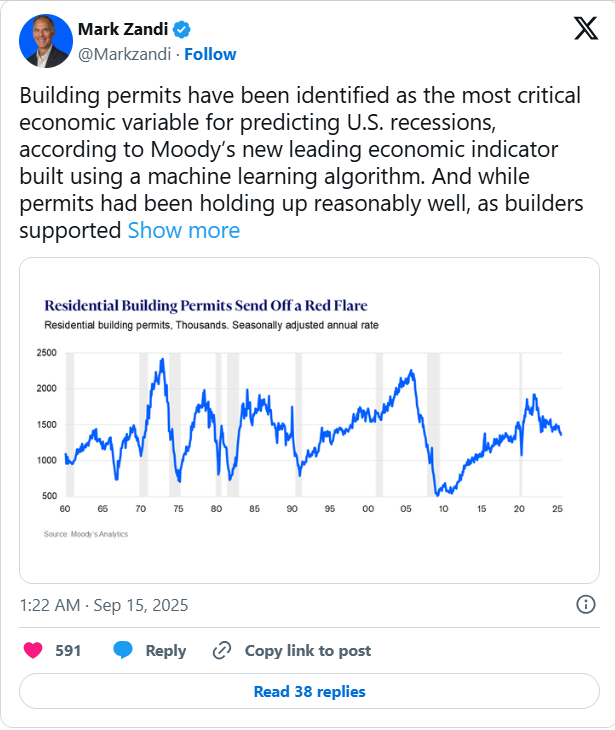
Group 1 - Mark Zandi, chief economist at Moody's, has raised alarms about the high probability of a U.S. recession, now estimated at 48% for the next 12 months [1] - Zandi describes the U.S. economy as being on the "precipice of recession," indicating a critical economic situation [1] - Historical data suggests that a recession probability reaching such a high level has never occurred without leading to an actual recession [1] Group 2 - The decline in residential building permits is highlighted as a significant indicator of potential recession, with current levels nearing those seen during the pandemic [3] - Zandi notes that the upcoming residential building permit data, to be released on September 17, will be crucial for the Federal Reserve's decision on interest rates [3] - Even if the Federal Reserve decides to cut interest rates as expected, Zandi warns that this may not be sufficient to prevent an economic recession [3]
美联储9月降息已无悬念
21世纪经济报道· 2025-09-12 16:06
Group 1: Federal Reserve and Interest Rate Expectations - The upcoming Federal Reserve meeting in September is expected to result in interest rate cuts, with the market pricing in three rate cuts by the end of the year [1][9][11] - The recent increase in initial jobless claims to 263,000, the highest since October 2021, has shifted the Fed's focus towards employment, reinforcing the expectation of rate cuts [1][6] - Despite stable inflation data, the Fed's monetary policy is likely to lean towards supporting employment due to the deteriorating job market [10][11] Group 2: Inflation Trends - The August Consumer Price Index (CPI) showed a month-on-month increase of 0.4% and a year-on-year increase of 2.9%, aligning with market expectations [1][3] - Core CPI, excluding volatile food and energy prices, rose 0.3% month-on-month and 3.1% year-on-year, indicating controlled inflation despite some upward pressures from tariffs [3][4] - Certain categories, such as new and used cars and housing, exhibit price stickiness, suggesting that while inflation is manageable, there are still risks of upward pressure in the medium to long term [4][6] Group 3: Employment Market Dynamics - The U.S. job market is showing signs of cooling, with non-farm payrolls increasing by only 22,000 in August and the unemployment rate rising to 4.3%, the highest in nearly four years [7][10] - The combination of rising inflation and a weakening job market could lead to two scenarios: a soft landing with gradual rate cuts or a hard landing resulting in recession [6][7] - The potential for a "stagflation-like" scenario exists if inflation rises unexpectedly while the economy slows, limiting the Fed's policy options [10][11]

国贸期货日度策略参考-20250912
Guo Mao Qi Huo· 2025-09-12 06:38
Report Summary 1) Report Industry Investment Ratings - **Bullish**: Gold, Aluminum, Polycrystalline Silicon, Stainless Steel, Iron Ore (long - term), Palm Oil (long - term), Rapeseed Oil (long - term), MO1, Calcium Carbide, PG (long - term) [1] - **Bearish**: Lithium Carbonate, Polyvinyl Chloride (PVC) (short - term), Ethylene Glycol, Benzene, Styrene, CP (short - term) [1] - **Neutral**: Copper, Zinc, Nickel, Tin, Silicon, Rebar, Hot - Rolled Coil, Coke, Sugar, Corn (C01), Pulp, Crude Oil, Fuel Oil, BR Rubber, PTA, Short - Fiber, Natural Gas, Propylene, PVC, Container Shipping to Europe [1] 2) Core Views - Short - term stock index futures' discount has widened again, and with liquidity drive, short - term index adjustments may bring long - position layout opportunities [1] - Asset shortage and weak economy are beneficial to bond futures, but the central bank has recently warned of interest - rate risks [1] - The expected Fed rate cut in September supports gold prices, and gold may run strongly at high levels in the short term [1] - Weak US non - farm data has led to recession concerns, but the expected Fed rate cut limits the downside of copper prices [1] - With the approaching consumption peak season and the expected Fed rate cut, aluminum prices are expected to run strongly [1] - The supply and demand fundamentals of various commodities are complex, affected by factors such as production capacity changes, inventory levels, and macro - economic policies [1] 3) Summary by Variety Macro - Financial - **Stock Index Futures**: Short - term adjustments may offer long - position opportunities due to widened discount and liquidity drive [1] - **Treasury Bonds**: Asset shortage and weak economy are favorable, but central bank warns of interest - rate risks [1] - **Gold**: Supported by expected Fed rate cut in September, may run strongly at high levels short - term [1] - **Silver**: May run strongly at high levels short - term, beware of increased volatility [1] Non - Ferrous Metals - **Copper**: Weak US non - farm data pressures prices, but expected Fed rate cut limits downside [1] - **Aluminum**: Expected to run strongly with approaching consumption peak season and expected Fed rate cut [1] - **Alumina**: Weak fundamentals due to increased production and inventory, consider long - position in far - month contracts [1] - **Zinc**: Social inventory increase pressures prices, but LME inventory decline and macro - support limit downside [1] - **Nickel**: Follows macro - trends and may run strongly short - term, mid - long - term surplus pressure exists [1] - **Stainless Steel**: Raw material support strengthens, futures may fluctuate strongly short - term [1] - **Tin**: Overall supported, look for low - long opportunities [1] - **Silicon**: May fluctuate due to supply resumption and potential policy changes [1] - **Polycrystalline Silicon**: Expected to rise due to capacity reduction and low terminal demand [1] - **Lithium Carbonate**: Expected to decline due to expected mine复产 and limited subsequent replenishment space [1] Ferrous Metals - **Rebar**: Valuation returns to neutral, industry drive is unclear, macro - drive is positive [1] - **Hot - Rolled Coil**: Similar to rebar, valuation neutral, industry drive unclear, macro - drive positive [1] - **Iron Ore**: Near - month limited by production restrictions, far - month has upward potential [1] Agricultural Products - **Palm Oil**: Short - term回调 risk, long - term bullish, wait for callback to go long [1] - **Soybean Oil**: Domestic inventory may pressure the market, but bullish in Q4, look for callback to go long [1] - **Rapeseed Oil**: Consider 11 - 1 positive spread strategy due to trade - flow possibilities [1] - **Cotton**: New cotton supply may be tight short - term, acquisition game is a focus [1] - **Sugar**: Expected to fluctuate weakly, short - term downside limited [1] - **Corn**: New crop expected to be abundant, C01 suggest shorting at high prices [1] - **MO1**: In an upward channel, affected by USDA report, short - term fluctuate, buy at low prices [1] - **Pulp**: Consider 11 - 1 positive spread due to price changes and inventory adjustments [1] - **Log**: Fundamentals unchanged, futures may fluctuate weakly [1] Energy and Chemicals - **Crude Oil**: Affected by geopolitical situation, OPEC+ policy, and expected Fed rate cut [1] - **Fuel Oil**: Similar to crude oil, affected by multiple factors [1] - **BR Rubber**: Follow crude oil, pay attention to inventory and device maintenance [1] - **PTA**: Production increases, downstream profit recovers, affected by OPEC+ policy [1] - **Ethylene Glycol**: Expected to decline due to device投产 and increased hedging [1] - **Short - Fiber**: Factory devices resume, market delivery willingness weakens [1] - **Benzene and Styrene**: Supply increases, inventory accumulates, domestic import pressure rises [1] - **Natural Gas**: Limited upside due to weak domestic demand, supported by cost [1] - **Propylene**: Price fluctuates weakly due to macro - environment and demand [1] - **PVC**: Fluctuates due to supply pressure and inventory situation [1] - **Calcium Carbide**: Expected to rise due to approaching peak season and low inventory [1] - **PG**: International oil price supports, but fundamental factors limit upside [1] Others - **Container Shipping to Europe**: Supply exceeds the same - period level, freight rate may decline [1]
降息能救美国经济吗?
2025-09-11 14:33
Summary of Key Points from the Conference Call Industry Overview - The discussion revolves around the current state of the **U.S. economy** and the implications of potential **Federal Reserve interest rate cuts** on economic performance and market dynamics [1][2][4]. Core Insights and Arguments - The U.S. economy is experiencing a **controlled cooling** phase, not yet in recession, with GDP showing fluctuations due to import impacts and base effects [1][2][3]. - **Consumer spending** is slowing under high interest rates and tariff pressures but remains in positive growth territory, indicating resilience despite challenges [1][2]. - **Non-farm employment** is heavily reliant on the public sector, with a slight increase in the unemployment rate and stable wage growth, reflecting a simultaneous contraction in labor supply and demand [1][2]. - **Inflation** has shown a slight uptick after a decline earlier in the year, with tariffs beginning to exert their influence on prices [1][2]. - The market anticipates a **25 basis point rate cut** in September, with a cumulative reduction of **75 basis points** expected by the end of the year, driven by weakening labor demand and stable inflation expectations [4][5][7]. - The potential for **rate cuts** to alleviate recession fears is acknowledged, but the effectiveness may be limited by ongoing tariff impacts and the need for further reductions to offset these effects [5][6]. Additional Important Insights - The **independence of the Federal Reserve** could be compromised by excessive rate cuts, particularly if influenced by political figures, which may hinder long-term credit stability [6]. - The **shift in market focus** post-rate cuts will likely transition from employment metrics to inflation data, with potential implications for bond yields and the dollar [7][9]. - There is a recommendation to **overweight** investments in **Hong Kong and A-shares**, as well as sectors benefiting from liquidity and inflationary trends, such as technology and renewable energy [9]. - The **debt situation** remains a concern, with current rate cuts unlikely to resolve the challenges posed by the expanding U.S. debt [6][9]. This summary encapsulates the critical points discussed in the conference call, providing a comprehensive overview of the current economic landscape and the anticipated actions of the Federal Reserve.
美就业市场疲软加剧经济衰退担忧
Sou Hu Cai Jing· 2025-09-11 00:38
Group 1 - The U.S. Labor Department revised its employment data, indicating a downward adjustment of 911,000 jobs added from April 2024 to March 2025, raising concerns about the economic outlook [1] - The initial report suggested nearly 1.8 million jobs added in the non-farm sector, averaging about 149,000 per month, but the revised data shows a monthly employment growth reduction of 76,000 [1] - Specific sectors such as leisure and hospitality, professional and business services, and retail saw significant job reductions of 176,000, 158,000, and 126,000 respectively [1] Group 2 - Recent non-farm employment data for August showed only a 22,000 increase in jobs, a significant drop from the revised 79,000 in July and below market expectations of 75,000 [2] - The Labor Department also revised June's total employment down by 13,000, marking the first negative figure since December 2020, indicating a slowdown in the job market [2] - Analysts attribute the cooling job market to uncertainties from tariff policies and immigration pressures, which may harm the economy [2] Group 3 - The slowdown in job growth suggests a weakening foundation for income growth among U.S. citizens, raising concerns about consumer confidence and spending [3] - The impact of tariffs is expected to further elevate inflation levels by the end of the year, with a potential increase in recession risks if the job market continues to deteriorate [3] - Balancing monetary policy to stimulate the economy while controlling inflation presents a significant challenge for the U.S. [3]