输入性通胀

Search documents
【财经分析】从“影响有限”到“阴云密布”:美关税放大土耳其汽车产业焦虑
Xin Hua Cai Jing· 2025-10-22 13:44
Core Viewpoint - The U.S. tariff policy has limited short-term impact on Turkey's automotive industry but has heightened potential risks and industry anxiety, leading to increased supply chain costs and inflationary pressures that could weaken export competitiveness and elevate long-term risks [1][4]. Group 1: Current Industry Situation - The automotive sector is Turkey's largest export industry, with exports growing by 6.3% year-on-year to $37.2 billion last year [2]. - The U.S. maintains a 25% special tariff on Turkish automobiles and parts, creating uncertainty that amplifies anxiety across the supply chain [2][4]. - Rising costs are eroding profits, with suppliers facing direct pressure on margins due to increased global costs driven by U.S. tariffs [2]. Group 2: Impact on Exports and Contracts - The rising costs may lead to renegotiation of contracts with European buyers, as the EU is Turkey's largest automotive market [3]. - Exporters may need to manage cash flow more flexibly due to potential adjustments in delivery terms stemming from increased global costs [3]. - Some overseas importers are shifting towards alternative markets like Mexico and Eastern Europe to avoid tariff costs, which could lead to some Turkish suppliers exiting the global value chain [3]. Group 3: Long-term Industry Challenges - The uncertainty from U.S. tariffs is casting a shadow over global trade, potentially leading to order fluctuations and production disruptions [4]. - Input inflation from rising prices of imported components and raw materials is expected to erode consumer purchasing power, contributing to a downward trend in the automotive market [4][5]. - The automotive industry faces dual challenges from EU regulatory changes and U.S. tariffs, with a projected 10% decline in exports this year [6]. - The industry is at a critical turning point, where failure to adapt to opportunities in new energy and smart technology could lead to a rapid loss of existing competitive advantages [6].
多数经济学家预计日央行四季度将加息,日元贬值与通胀压力成关键推力
Sou Hu Cai Jing· 2025-10-22 07:15
Core Viewpoint - A recent survey indicates that the majority of economists expect the Bank of Japan to raise policy interest rates in the fourth quarter, driven primarily by inflationary pressures from the continued depreciation of the yen [1] Group 1: Economic Expectations - 60% of the 35 surveyed economists anticipate that the Bank of Japan will increase interest rates in the current quarter (October to December) [1] - Among the respondents, 46% believe the rate hike will occur in January 2026, 31% expect it in December, and 14% predict it will happen in October [1] - Approximately 96% of economists forecast that by the end of March 2026, the Bank of Japan will raise rates by at least 25 basis points, increasing the short-term policy rate from the current 0.50% to 0.75% [1] Group 2: Political Influence - New Prime Minister Sanna Takashi advocates for active fiscal policies, which may exert influence on the central bank, but the market generally believes this will not significantly delay the normalization of monetary policy [1]
多数经济学家预计日央行四季度将加息 日元贬值与通胀压力成关键推力
Xin Hua Cai Jing· 2025-10-22 06:23
Group 1 - A recent survey indicates that the majority of economists expect the Bank of Japan to raise policy interest rates in the fourth quarter, driven by inflationary pressures from the continued depreciation of the yen [1][2] - Among 35 surveyed economists, 60% anticipate an interest rate hike within this quarter, with 46% predicting it will occur in January 2026, 31% in December, and 14% in October [1] - Approximately 96% of economists forecast that by the end of March 2026, the Bank of Japan will raise rates by at least 25 basis points, increasing the short-term policy rate from the current 0.50% to 0.75% [1] Group 2 - The weak yen is significantly raising import costs, becoming a key consideration for the Bank of Japan's shift towards tightening monetary policy [2] - Although domestic political changes and global economic uncertainties may affect decision-making, Japan's inflation remains above the central bank's 2% target, providing a basis for policy adjustments [2] - Continuous wage growth further supports the rationale for potential policy changes [2]
涨逾4%,集运的利多还能持续多久?
对冲研投· 2025-10-15 11:02
Core Viewpoint - The article discusses three main factors driving the recent increase in shipping rates, including proactive price increases by shipping companies, geopolitical tensions boosting market sentiment, and strikes at key European ports disrupting supply chains [4]. Group 1: Price Increases by Shipping Companies - Major shipping companies such as Mediterranean Shipping Company, Maersk, CMA CGM, and Hapag-Lloyd have announced price increases for November, with rates for a 20-foot container rising to the range of $1,500 to $1,700 and for a 40-foot container to $2,500 to $2,700, reflecting an increase of nearly 30% compared to the end of October [8]. Group 2: Geopolitical Factors - China's response to the U.S. 301 investigation, which includes imposing special port fees on U.S. vessels, has significantly boosted market sentiment. The Chinese Ministry of Transport announced the implementation of these fees starting October 14, while also launching an investigation into the impact on the shipping and shipbuilding industries [10][11]. Group 3: Supply Chain Disruptions - Strikes at key European ports, specifically Rotterdam and Antwerp, have led to cargo delays and operational disruptions, resulting in capacity losses for shipping companies [13]. Group 4: Market Outlook - In the short term, current prices reflect some expectations of price increases, but further upward movement will require new catalysts, with a forecast of wide fluctuations. In the medium to long term, expectations of the Red Sea reopening may suppress the valuation of long-term contracts, maintaining a bearish outlook [5][15]. - The strategy suggests capturing structural opportunities in the market, particularly focusing on the spread between contracts 2512 and 2606 [5].


日本央行加息进程生变
Jing Ji Wang· 2025-10-11 02:06
Core Viewpoint - The recent political shift in Japan, marked by the election of former Economic Security Minister Sanae Takaichi as the leader of the ruling Liberal Democratic Party, has led to a significant depreciation of the Japanese yen against the US dollar and other major currencies, raising concerns about Japan's fiscal outlook and the uncertainty surrounding the Bank of Japan's future interest rate policies [1][2][5]. Currency Movement - On October 6, the yen depreciated by 1.94% against the US dollar, breaking the critical 150 level, and continued to weaken, falling below 151, 152, and 153 in the following days [2]. - The yen reached a low of 153.003 against the dollar on October 8, marking its lowest level since mid-February, with a cumulative decline of over 3.7% since October 2 [2]. - The yen also depreciated against other major currencies, hitting a historic low against the euro at 177.86, the lowest since the euro's inception in 1999 [2]. Economic Policy Implications - Takaichi's economic policies are seen as a continuation of "Abenomics," focusing on aggressive fiscal measures and maintaining a loose monetary policy, which is expected to exert downward pressure on the yen [3][4]. - Analysts suggest that Takaichi's stance against interest rate hikes and her advocacy for active fiscal policies are the primary reasons for the yen's recent depreciation [2][3]. Long-term Outlook - The long-term trajectory of the yen will depend on the implementation and impact of Takaichi's policies, with current market reactions primarily reflecting short-term sentiment [5][8]. - Despite the current downward pressure, the yen is considered significantly undervalued, suggesting limited further depreciation potential even if Takaichi becomes Prime Minister [5][6]. Monetary Policy Considerations - The independence of the Bank of Japan is relatively weaker compared to the Federal Reserve, and Takaichi's election is expected to influence the central bank's policy stance, although the extent of this impact will depend on her execution and authority within the government [8][9]. - Current inflation in Japan is viewed as driven by cost-push factors rather than demand, indicating that premature interest rate hikes could hinder economic recovery [8][9].
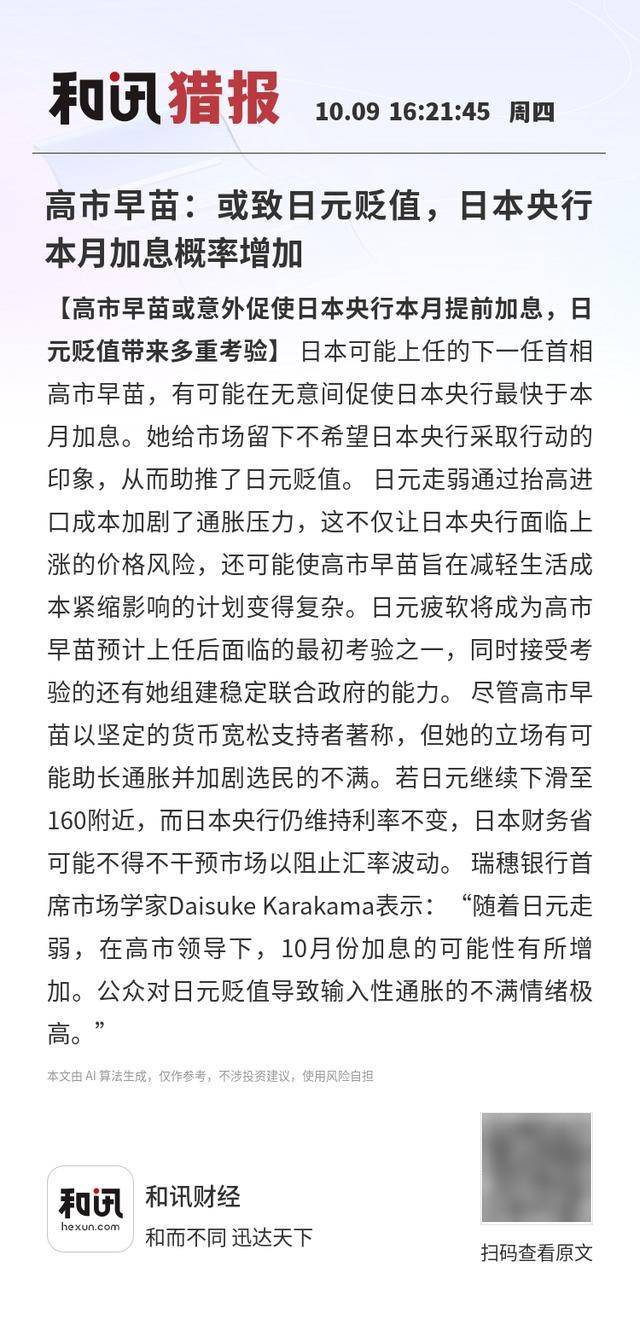
高市早苗:或致日元贬值,日本央行本月加息概率增加
Sou Hu Cai Jing· 2025-10-09 09:28
Group 1 - The potential new Prime Minister of Japan, Sanna Takashi, may inadvertently prompt the Bank of Japan to raise interest rates as early as this month due to her perceived disinterest in the central bank's actions, which has contributed to the depreciation of the yen [1][2] - The weakening yen is increasing import costs, exacerbating inflationary pressures, and complicating Takashi's plans to alleviate the impact of rising living costs [1] - If the yen continues to decline towards 160, and the Bank of Japan maintains interest rates, the Japanese Ministry of Finance may need to intervene in the market to stabilize exchange rate fluctuations [1][2] Group 2 - Daisuke Karakama, chief market economist at Mizuho Bank, indicated that the likelihood of an interest rate hike in October has increased under Takashi's leadership due to public dissatisfaction with the inflation caused by yen depreciation [1][2]
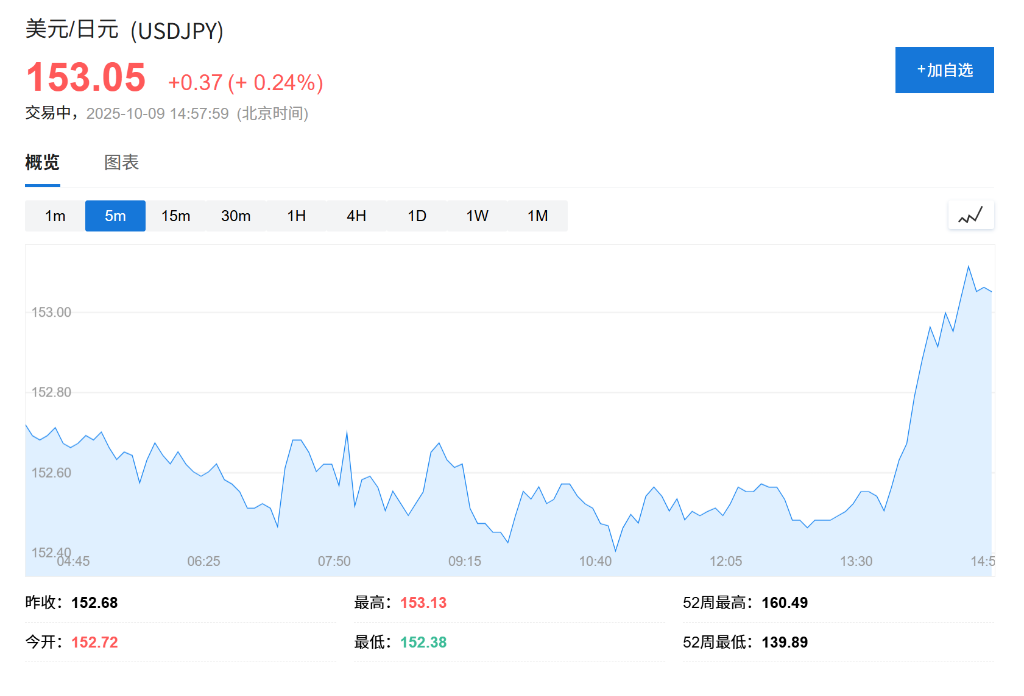
日元汇率跌破153,“新安倍经济学”预期下,美日汇率冲突重燃?
Hua Er Jie Jian Wen· 2025-10-09 07:41
Core Viewpoint - The economic policy stance of Japan's new Prime Minister, Sanae Takaichi, has sparked market expectations for a "new Abenomics," leading to the yen's exchange rate falling below the 153 mark, reigniting disputes over currency policy between the US and Japan [1][3]. Group 1: Currency Exchange Rate Movements - The USD/JPY exchange rate rose to 153, marking a 0.2% increase, the first time since February that it has reached this level, which is considered politically and psychologically sensitive [1]. - The yen's depreciation has been linked to concerns over rising import costs, which could exacerbate household living cost pressures [1][4]. - The yen had previously appreciated about 6% to 147.44 before Takaichi's election, but has since weakened to around 152, narrowing its year-to-date gain to 2.77% [4]. Group 2: Historical Context and Political Implications - The current yen depreciation has revived discussions reminiscent of former President Trump's accusations of Japan "manipulating" its currency for unfair trade advantages [3][5]. - Analysts suggest that Takaichi may adopt a cautious approach to economic policy to avoid straining relations with the US, despite the volatility in the market [3][5]. - Concerns about import inflation are expected to prevent Takaichi from implementing policies that would further weaken the yen, indicating a need for a more realistic policy stance [4][7]. Group 3: Inflation and Economic Policy Challenges - Japan's inflation rate has exceeded the Bank of Japan's 2% target for over three years, with an overall inflation rate of 2.7% reported in August [7]. - Experts believe that interest rate hikes will be necessary to curb inflation, with market pressures likely forcing Takaichi to accept potential rate increases by the Bank of Japan in the near future [7]. - The loss of purchasing power among the public is identified as a primary reason for the ruling party's unpopularity, highlighting the political stakes involved in managing inflation and currency value [7].
输入性通胀不可避免
Hu Xiu· 2025-09-26 00:27
Core Viewpoint - The article discusses the recent surge in copper prices and reflects on the broader implications of monetary policy and commodity price fluctuations, particularly in the context of historical events and economic cycles. Group 1: Commodity Price Trends - The article highlights the cyclical nature of commodity prices, noting that significant drops in prices often begin with gold, which is tied to the dollar's value [3][5][21] - It references the historical context of commodity price movements, including the rise of oil prices post-911 and the subsequent financial crises that have influenced market dynamics [2][10][19] Group 2: Monetary Policy and Economic Impact - The discussion includes the role of the Federal Reserve in managing economic crises through monetary policy, emphasizing that the printing of money does not necessarily lead to inflation if managed correctly [13][22][23] - It points out that the Federal Reserve's actions have historically aimed to prevent asset price collapses, indicating a strategic approach to maintaining economic stability [19][23] Group 3: Geopolitical Considerations - The article suggests that geopolitical events, such as conflicts in the Middle East, have been manipulated to serve financial interests, impacting global commodity prices [7][8][10] - It also mentions the relationship between the U.S. and Russia during periods of high oil prices, indicating how financial incentives can shape international relations [9][10]
美联储降息引发油价危机!中国商品面临巨大冲击,百姓生活何去何从?
Sou Hu Cai Jing· 2025-09-20 22:53
Group 1 - The Federal Reserve's recent 25 basis point interest rate cut has triggered significant market reactions, causing volatility in both U.S. and international markets, including oil and soybean prices [1][4] - The widening interest rate differential between the U.S. and China is attracting international capital, but concerns about imported inflation and the capacity of the Chinese economy to absorb this influx persist [4][5] - Despite the allure of China's interest rates, foreign investors remain cautious due to risks in the real estate market and local government debt, which could deter substantial investments [5][7] Group 2 - China's manufacturing sector shows resilience, with exports of electromechanical products steadily increasing, indicating strong growth potential that appeals to foreign investors [7] - The Chinese government is implementing policies to address real estate issues and local debt, which could enhance investor confidence and stabilize the market [7][10] - Strategic reserves and price control mechanisms are in place to mitigate the impact of rising commodity prices on consumers, ensuring that inflation remains manageable [8][10] Group 3 - The challenges faced by small and medium-sized enterprises (SMEs) in accessing financing are significant, with a preference from banks to lend to larger, more established companies [11][12] - The People's Bank of China is focusing on targeted monetary policy measures, such as lowering the Medium-term Lending Facility (MLF) rate, to provide low-cost funds to SMEs and the manufacturing sector [12] - Overall, China's economic strategy is proactive, leveraging its strong industrial base and market size to navigate global economic challenges effectively [14]

美联储降息,你的钱包是“鼓”还是“瘪”?这几个变化一定要知道
Sou Hu Cai Jing· 2025-09-20 08:05
Group 1: Impact on Housing Market - The Federal Reserve's interest rate cut is expected to reduce mortgage rates in China, benefiting existing homeowners by lowering monthly payments [3] - New homebuyers may also enjoy lower borrowing costs due to a more accommodative monetary environment, leading to decreased home purchase costs [3] Group 2: Investment Market Changes - The decline in interest rates is likely to result in lower yields for fixed-income products such as bank deposits and money market funds, making them less attractive [3][4] - Investors face a dilemma of either accepting lower yields or taking on more risk for higher returns, prompting recommendations for longer investment horizons and diversified asset allocation [4] Group 3: Employment Market Effects - Lower financing costs for businesses may lead to increased investment and hiring, positively impacting the job market, especially in export-related sectors [4] - Growth sectors like technology may also benefit from improved liquidity, potentially expanding their recruitment efforts [4] Group 4: Currency and International Spending - The Fed's rate cut could lead to a depreciation of the dollar, making overseas spending cheaper for consumers, including those studying abroad or shopping online [6] - However, there is a risk of dollar appreciation if the market anticipates overheating in the U.S. economy, suggesting a cautious approach to currency exchange [6] Group 5: Inflation Considerations - While increased liquidity from rate cuts could raise price levels, the current domestic market conditions in China suggest that inflationary pressures remain manageable [8] - The overall price stability is expected to continue, alleviating concerns about significant inflation spikes [8] Group 6: Consumer Strategies - Homeowners should monitor changes in the Loan Prime Rate (LPR) and consider negotiating repayment terms with banks if necessary [10] - Investors are advised to balance risk and return, while job seekers should focus on opportunities in export and growth sectors [10] - Consumers should remain rational in their spending habits and avoid panic buying due to inflation fears [11]