
经济增长

Search documents
【论债务十】政府债务之-财政政策的目的
付鹏的财经世界· 2025-10-30 06:58
Core Views - The effectiveness of monetary and fiscal policies is contingent upon their ability to promote stable economic growth, but they often serve as tools rather than solutions when deep structural contradictions arise in the economy [2][7] - Government debt management is akin to operating a "super company," where the sustainability of debt relies on the expectation of future income, primarily through tax revenues [2][4] Government Debt and Expenditure - Government debt and expenditure must be built on a durable and stable system, which is essential for both corporate prosperity and government sustainability [4] - Fiscal spending should accurately address the core contradictions and pain points of the economy to yield potential economic returns and growth; misallocation of fiscal funds can erode government competitiveness and future revenue-generating capacity [4][8] Monetary and Fiscal Policies - Monetary and fiscal policies are merely means to alleviate pain during economic downturns and to temper overheating during upturns, but they do not resolve core contradictions [7][8] - High interest rates are often employed to control rapid economic expansion rather than directly causing a slowdown in growth; the key variables affecting growth are division, distribution, and leverage [7][8] Debt Sustainability - Low interest rates do not necessarily provide substantial benefits to fiscal debt; if fiscal debt loses market confidence, merely having low rates will not resolve credit crises [8] - The core issue is whether policies can promote sustainable growth, which in turn leads to long-term benefits for government departments and alleviates concerns about debt sustainability [8]


四川迎来近年经济运行最为平稳的一年
Sou Hu Cai Jing· 2025-10-30 04:56
Economic Overview - The top ten provinces and cities in China achieved a GDP of nearly 62 trillion yuan in the first three quarters, accounting for over 61% of the national total, with eight provinces and cities outpacing the national economic growth rate [1][2] - The national GDP grew by 5.2% year-on-year in the first three quarters, an acceleration compared to the previous year [2][3] Provincial Performance - Guangdong and Jiangsu both surpassed 10 trillion yuan in GDP for the first time, with Guangdong reaching 10.5 trillion yuan and Jiangsu close behind at 10.3 trillion yuan [2] - Shandong's GDP was 7.71 trillion yuan, with a year-on-year growth of 5.6%, indicating a strong possibility of joining the "10 trillion club" [2] - Hubei recorded the highest growth among the top ten provinces at 6.0%, while Shanghai improved its growth rate to 5.5% in the third quarter [2][3] Industrial and Consumption Insights - Eight provinces exceeded the national industrial growth rate of 6.2%, with Henan at 8.4% and Shandong and Hunan both at 7.8% [5] - The manufacturing sector is shifting towards high-end, intelligent, and green development, with significant growth in sectors like automotive and electronics in Shandong and robotics in Zhejiang [5][6] - National retail sales of consumer goods grew by 4.5%, with seven of the top ten provinces outperforming this figure, particularly Henan at 6.2% and Sichuan at 5.8% [6] Investment and Trade Dynamics - The first three quarters saw a 4% year-on-year increase in China's goods trade, with the top ten provinces accounting for 75.5% of the total trade volume [8] - Fixed asset investment faced challenges, with a nationwide decline of 0.5%, but Hubei and Shanghai managed to maintain growth rates of 6.5% and 6.0%, respectively [8] Future Outlook - Provinces are urged to capitalize on foreign trade opportunities and address investment shortfalls as they approach year-end targets [7][8] - The fourth quarter is critical for economic performance, with various provinces emphasizing the need for robust economic activities to ensure successful completion of the "14th Five-Year Plan" [9]
西南区域三季报公布 川渝领跑
Sou Hu Cai Jing· 2025-10-29 17:26
Core Insights - The economic growth of the southwestern provinces of China, particularly Guizhou, Yunnan, Sichuan, and Chongqing, has slowed down significantly compared to previous years, with Guizhou's GDP growth falling to 4.9% in the first three quarters of 2023, below the national average of 5.2% [1][2][3] Economic Performance - Guizhou's GDP for the first three quarters of 2023 reached 17,352.04 billion yuan, with a year-on-year growth of 4.9%. The breakdown of GDP growth by sector shows the primary industry grew by 4.3%, the secondary industry by 5.4%, and the tertiary industry by 4.8% [1][2] - Yunnan's GDP growth has also declined, with a growth rate of 4.4% in 2023, falling below the national average [3] - Sichuan and Chongqing have shown some recovery, with projected growth rates of 5.7% for Chongqing and 5.5% for Sichuan in 2024, both exceeding the national average [3] Investment Trends - Investment growth has been a significant factor in the economic slowdown of the southwestern provinces. Guizhou's fixed asset investment growth has drastically decreased, showing negative growth in recent years, with a notable decline of 5.7% in 2023 [4][5] - Yunnan's fixed asset investment has also faced challenges, with a decline of 10.6% in 2023, primarily due to a downturn in real estate development investment [4][5] Industry Challenges - Traditional pillar industries in the region, such as alcohol, coal, electricity, and tobacco, are facing significant challenges. The white liquor industry in Guizhou is undergoing deep adjustments, impacting overall economic performance [5] - In Yunnan, while the growth in traditional industries remains low, the non-ferrous metals industry has shown a notable increase, with a growth rate of 14.6% contributing significantly to industrial growth [5]
武汉2025年前三季度GDP公布
Chang Jiang Ri Bao· 2025-10-29 12:36
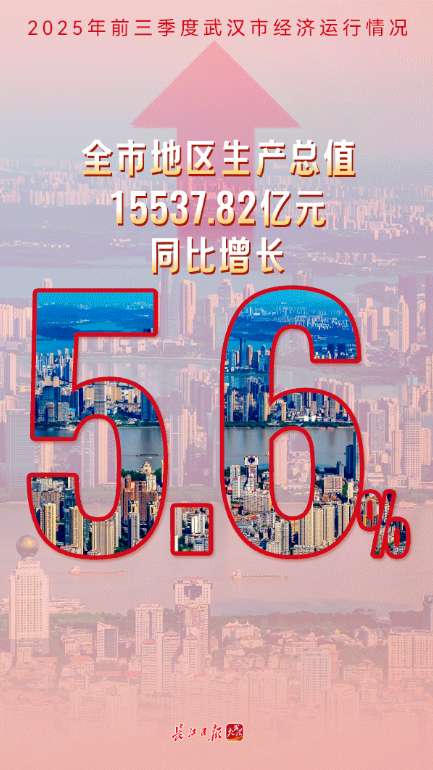
Economic Overview - The GDP of Wuhan for the first three quarters reached 15,537.82 billion yuan, with a year-on-year growth of 5.6% [2] - The primary industry added value was 370.81 billion yuan, growing by 3.7%; the secondary industry added value was 5,068.39 billion yuan, growing by 4.8%; and the tertiary industry added value was 10,098.62 billion yuan, growing by 6.0% [2] Agricultural Sector - The total output value of agriculture, forestry, animal husbandry, and fishery was 608.38 billion yuan, with a year-on-year increase of 3.9% [3] - Major agricultural products showed growth, with summer grain and early rice production totaling 120,500 tons, an increase of 0.6% compared to last year [3] Industrial Sector - The industrial added value for large-scale enterprises grew by 5.4%, accelerating by 0.3 percentage points compared to the first half of the year [4] - High-tech manufacturing saw a significant increase of 16.3%, accounting for 25.2% of the industrial added value [4] Service Sector - The service sector's added value increased by 6.0%, with transportation, warehousing, and postal services growing by 10.8% [6] - The revenue of large-scale service enterprises rose by 11.6% from January to August [6] Investment Trends - Fixed asset investment grew by 2.0%, with industrial investment increasing by 12.0% [7] - High-tech industry investment rose by 2.9%, with high-tech service and manufacturing investments growing by 13.2% and 0.4%, respectively [7] Consumer Market - The total retail sales of consumer goods reached 6,299.74 billion yuan, with a year-on-year growth of 5.5% [8] - The "old-for-new" policy positively impacted retail sales, particularly in home appliances and building materials, which grew by 28.6% and 21.0%, respectively [8] Trade and Finance - The total import and export volume was 3,369.6 billion yuan, with exports growing by 18.1% [9] - By the end of September, the balance of deposits in financial institutions was 42,864.83 billion yuan, reflecting a year-on-year growth of 5.1% [9] Income and Prices - The per capita disposable income reached 46,107 yuan, with urban and rural incomes growing by 4.6% and 5.9%, respectively [11] - The consumer price index increased by 0.3% year-on-year, with food prices decreasing by 0.5% [11] Conclusion - Overall, Wuhan's economy showed stable growth in the first three quarters, with a focus on maintaining progress amid external uncertainties [12]
刚刚,武汉2025年前三季度GDP公布
Chang Jiang Ri Bao· 2025-10-29 08:20
Economic Overview - Wuhan's GDP for the first three quarters of 2025 reached 15,537.82 billion yuan, reflecting a year-on-year growth of 5.6% at constant prices [3] - The primary industry added value was 370.81 billion yuan, growing by 3.7%; the secondary industry added value was 5,068.39 billion yuan, growing by 4.8%; and the tertiary industry added value was 10,098.62 billion yuan, growing by 6.0% [4] Agricultural Sector - The total output value of agriculture, forestry, animal husbandry, and fishery reached 608.38 billion yuan, with a year-on-year growth of 3.9% [11] - Major agricultural products saw production increases, with summer grain and early rice totaling 120,500 tons, up by 0.6% from the previous year [11] Industrial Sector - The industrial added value for large-scale enterprises grew by 5.4%, accelerating by 0.3 percentage points compared to the first half of the year [13] - High-tech manufacturing added value increased by 16.3%, accounting for 25.2% of the total industrial added value [13] - Notable growth was observed in the computer, communication, and other electronic equipment manufacturing sector, which grew by 18.0% [13] Service Sector - The service industry added value increased by 6.0%, with transportation, warehousing, and postal services growing by 10.8% [15] - Revenue from large-scale service enterprises rose by 11.6%, with significant increases in various service sectors [15] Investment Trends - Fixed asset investment grew by 2.0%, with industrial investment increasing by 12.0% and infrastructure investment by 6.2% [17] - High-tech industry investment rose by 2.9%, with high-tech service and manufacturing investments growing by 13.2% and 0.4%, respectively [17] Consumer Market - The total retail sales of consumer goods reached 6,299.74 billion yuan, with a year-on-year growth of 5.5% [19] - The "old for new" policy positively impacted retail sales in home appliances and building materials, with increases of 28.6% and 21.0%, respectively [20] Trade and Finance - The total import and export volume was 3,369.6 billion yuan, growing by 15.8% year-on-year [22] - Financial institutions reported a deposit balance of 42,864.83 billion yuan, with a year-on-year growth of 5.1% [22] Income and Prices - Per capita disposable income reached 46,107 yuan, with urban and rural incomes growing by 4.6% and 5.9%, respectively [24] - The consumer price index rose by 0.3% year-on-year, with various categories showing different price trends [24] Conclusion - Overall, Wuhan's economy showed stable growth in the first three quarters of 2025, with a focus on consolidating the recovery and addressing external uncertainties [25]
理解十五五规划的三个定量指标:——《十五五规划》系列报告三
EBSCN· 2025-10-29 06:45
Group 1 - The "15th Five-Year Plan" proposes three important quantitative indicators for economic development: steady improvement of total factor productivity, significant increase in the consumption rate, and maintaining economic growth within a reasonable range [3][10][15] - Total factor productivity is emphasized as a new indicator to measure economic efficiency and productivity development, with strategies including optimizing traditional industries, supporting emerging industries, and promoting core technology breakthroughs [3][10][11] - The plan aims to increase the resident consumption rate by 3-5 percentage points to 43%-45%, enhancing domestic demand as a key driver of economic growth [15][16][18] Group 2 - The plan outlines a clear blueprint for the next five years, with a focus on high-quality development, technological self-reliance, and comprehensive deepening of reforms [4][5] - It includes twelve key tasks across various sectors such as industry, technology, domestic market, and green development, with a notable shift in priorities compared to previous plans [5][8] - The emphasis on a strong domestic market and the need to break down barriers to create a unified national market is highlighted as essential for enhancing internal circulation [24][25] Group 3 - The plan stresses the implementation of more proactive macroeconomic policies to maintain economic growth within a range of 4.5%-5% [3][26] - It calls for strengthening counter-cyclical and cross-cyclical adjustments in macroeconomic policies, indicating a more aggressive approach compared to previous plans [26][27] - Financial policies are to be aligned with industrial development, emphasizing the importance of direct financing and the use of diverse financial instruments to support economic growth [31][32]
特朗普矛头再指鲍威尔要求美联储降息:不会让美联储因为担心三年后的通胀而加息
Sou Hu Cai Jing· 2025-10-29 06:05
格隆汇10月29日|美国总统特朗普周四对美联储提出批评,再次将矛头指向美联储主席鲍威尔,指责其 在降息问题上行动迟缓。特朗普在韩国的演讲中提到"杰罗姆·'太迟'·鲍威尔",这引发了参加亚太经合 组织峰会的商界高管和领导人的笑声。特朗普补充说:"我们不会让美联储因为担心三年后的通胀而加 息。"此言或许暗示他承认通胀最终可能加速。他预计美国经济将在2026年第一季度实现4%的增长,远 高于路透社调查的经济学家预测中值。因经济学家认为,特朗普政府新实施的进口关税仍将拖累经济增 长。周四的言论突显了特朗普与美联储之间的紧张关系,特朗普抨击鲍威尔没有迅速降息,称美联储落 后于欧洲同行,损害了商业信心。 【免责声明】本文仅代表作者本人观点,与和讯网无关。和讯网站对文中陈述、观点判断保持中立,不 对所包含内容的准确性、可靠性或完整性提供任何明示或暗示的保证。请读者仅作参考,并请自行承担 全部责任。邮箱:news_center@staff.hexun.com ...

财经观察:外资流出170亿美元,印度急于改革
Huan Qiu Shi Bao· 2025-10-28 22:39
Core Insights - Foreign investors have withdrawn over $17 billion from the Indian stock market this year, marking a significant decline compared to a net inflow of $20 billion in 2023, making India the worst-performing market in Asia for foreign portfolio outflows [1][2][3] - The outflow trend is primarily driven by external factors such as the strong dollar and internal issues including high stock market valuations and disappointing corporate earnings growth [3][4] Investment Trends - The report from "Ilara Capital" indicates that the largest withdrawals since July have come from U.S. funds ($1 billion), followed by Luxembourg ($765 million) and Japan ($365 million), reflecting a broader retreat from Indian markets [2] - India's allocation in global emerging market funds has dropped to 16.7%, the lowest since November 2023, while China's allocation has surged to 28.8%, indicating a shift in investor preferences [2] Economic Impact - The outflow of foreign capital is expected to exert downward pressure on the Indian rupee, which has depreciated over 3.7% against the dollar since 2025, and could lead to increased import costs and domestic inflation [4][8] - The Indian stock market's benchmark index, Nifty 50, has underperformed compared to other regional indices for five consecutive months, the longest period since 2013 [4] Regulatory Response - In response to the capital outflow, the Indian Securities and Exchange Board has introduced measures to streamline the investment process for foreign investors, including reducing approval processes and allowing overseas Indians to open investment accounts without being physically present [5][6] - The Reserve Bank of India has implemented 11 reform measures aimed at improving access for foreign investors, with a focus on enhancing the business environment and attracting foreign capital [6][7] Future Outlook - Analysts express skepticism about a short-term reversal of the outflow trend, emphasizing the need for clarity in U.S. trade and immigration policies, stability of the rupee, and evidence of reasonable stock market valuations [4][8] - Despite the challenges, some experts believe that India's macroeconomic fundamentals remain strong, with projected economic growth rates exceeding 6.5% in the coming years [9][10]
(经济观察)“十五五”规划建议清晰勾勒“确定的中国”
Zhong Guo Xin Wen Wang· 2025-10-28 20:39
Economic Growth Certainty - The "15th Five-Year Plan" aims for China's economy to reach approximately 140 trillion RMB by the end of 2025, continuing the momentum from the "14th Five-Year Plan" [2] - The focus remains on high-quality development, emphasizing the importance of the real economy and promoting new growth points such as quantum technology and biomanufacturing [2] - The plan encourages a shift towards an economy driven by domestic demand, consumption, and endogenous growth, with detailed measures across various sectors to ensure sustained economic growth [2] Quality Development Certainty - The plan emphasizes the need for a balance between qualitative improvements and reasonable quantitative growth, with a focus on ensuring that growth translates into tangible benefits for the public [3] - Key goals include significantly enhancing technological self-reliance and advancing the construction of a unified national market, alongside achieving high-quality employment and synchronized growth in residents' income and the economy [3][4] Open Economy Certainty - In response to rising unilateralism and protectionism, the plan advocates for creating a win-win cooperation framework and sharing opportunities with countries worldwide [6] - China's vast market will continue to open up, fostering cross-border trade cooperation and providing significant opportunities for other nations [6] - The plan emphasizes maintaining a multilateral trade system and expanding bilateral investment cooperation, aiming to inject stability into the global economic landscape [6] Reform Deepening Certainty - The plan outlines the goal of achieving breakthroughs in comprehensive reforms during the "15th Five-Year Plan" period, with over 300 important reform measures targeted for completion by 2029 [7][8] - Key reform initiatives include unifying market rules, eliminating local protectionism, and enhancing the market-oriented allocation of resources, reflecting a commitment to overcoming systemic barriers and fostering internal growth [8]
连平:“十五五”财政政策将怎样积极有为
Di Yi Cai Jing· 2025-10-28 13:15
Core Viewpoint - The "15th Five-Year Plan" emphasizes the importance of proactive fiscal policy to support economic growth, with a focus on precision and efficiency in implementation [1][2][8]. Fiscal Policy Support for Economic Development - The necessity for enhanced fiscal policy support during the "15th Five-Year Plan" is highlighted, particularly to maintain an average annual GDP growth rate of at least 4.5% to achieve long-term strategic goals by 2035 [2][3]. - The fiscal policy aims to address challenges such as population decline, economic restructuring, and external pressures by increasing spending and optimizing expenditure [2][3]. Investment in Key Areas - Significant investment is required in critical sectors such as modern industrial systems, technological self-reliance, and green transformation, which necessitates substantial public investment led by fiscal policy [3][4]. - Fiscal funding is essential to fill investment gaps and leverage private capital through risk-sharing mechanisms [3]. Expanding Domestic Demand - The strategy emphasizes expanding domestic demand as a strategic foundation, requiring fiscal measures to enhance consumer confidence and investment willingness [4][5]. - Fiscal policy will focus on optimizing spending and improving social security to stabilize expectations and promote a dynamic balance between supply and demand [4]. Promoting Social Equity - The plan aims to advance common prosperity through fiscal measures that address income distribution and enhance social welfare systems [5][6]. - Fiscal policy will play a crucial role in reducing disparities and ensuring equitable resource allocation [5]. Addressing Uncertainties - The fiscal policy must maintain necessary spending levels to counteract increasing uncertainties and risks, including economic downturns and external shocks [6][7]. - A proactive fiscal approach is essential to provide a stable foundation for economic and social development during the "15th Five-Year Plan" [6][7]. Focus Areas for Fiscal Policy - The fiscal policy will maintain a proactive stance, with an expected deficit rate of 3.8% to 4.0%, potentially rising to over 4.2% during significant shocks [8][9]. - Annual issuance of long-term special bonds is projected at around 1.5 trillion yuan, targeting key areas such as technological innovation and social welfare [9][10]. Deepening Fiscal and Tax Reforms - The plan includes reforms to enhance fiscal sustainability and clarify the fiscal relationship between central and local governments [10][11]. - Measures will be taken to improve local tax systems and reduce reliance on land finance, while also addressing local government debt issues [10][11]. Managing Local Government Debt - The strategy outlines a phased approach to resolving existing local government debt, with an annual issuance of special bonds estimated between 4.5 trillion to 5 trillion yuan [11]. - Efforts will focus on categorizing and managing debt risks while enhancing local fiscal capabilities [11].