
财政政策

Search documents
外资机构看好2026年中国股票表现
Zhong Guo Jing Ying Bao· 2025-11-25 02:56
Global Economic Outlook - The International Monetary Fund (IMF) projects a global economic growth of 3.2% in 2025, up by 0.2 percentage points from previous forecasts, and a growth of 3.1% in 2026, unchanged from July predictions [1] - Chief Economist at ICBC International, Cheng Shi, indicates that the global economy is entering a phase characterized by fiscal dominance amid multiple uncertainties [1] Fiscal Policy and Monetary Policy - Cheng Shi notes that major economies are increasing fiscal expansion to counteract downward pressures, as monetary policy transmission efficiency is limited due to high debt levels [1] - The anticipated monetary policy landscape for 2026 suggests that most major central banks will adopt a wait-and-see approach, with the European Central Bank pausing activities and the Bank of England nearing the end of rate cuts [2] U.S. Economic Projections - U.S. investment and consumption are expected to slow down, with GDP growth projected at around 1.8% and inflation at approximately 2.9% in 2026 [2] - The Federal Reserve is expected to lower interest rates to a neutral level of 3% to 3.25% [2] Investment Outlook - Barclays forecasts that U.S. tech stocks will continue to lead the market in 2026, driven by sustained growth in AI-related capital expenditures and robust performance in cloud services and digital advertising [2] - Chinese stocks are also viewed positively, with expectations of strong performance in 2025 and a low valuation compared to other major markets [3] Market Dynamics in China - The Hang Seng Index has shown significant gains, with a rise of over 30% since 2025, and the Hang Seng Tech Index increasing by over 50% [3] - Analysts believe that the current A-share market has room for upward movement, supported by substantial household savings in China [3][4]
华泰证券今日早参-20251125
HTSC· 2025-11-25 02:32
Group 1: Market Overview - The overall market experienced a pullback last week, but funding pressure is expected to improve marginally due to a rebound in private equity registrations and public fund launches, with private fund registrations rising to 337, exceeding 300 for two consecutive weeks [2][3] - The peak of A-share unlock market value has passed, and the net reduction in industrial capital has shown a marginal decline, indicating a reduction in funding supply pressure [2] Group 2: Fixed Income Analysis - In the construction industry, the supply and demand remain weak, with new home transactions showing a decline while second-hand home transactions have slightly increased [2] - The industrial sector shows strong freight volume performance, but production rates are mixed, with some sectors like coking and independent refineries seeing an increase, while the chemical and automotive sectors remain weak [2] Group 3: Energy Sector Insights - In the global gas turbine market, new orders increased by 95% year-on-year to 24GW in Q3 2025, driven by various factors including energy policy shifts and AI power demand [5] - The high demand for gas turbines is expected to boost exports for domestic component manufacturers, with companies like Yingliu and Haomai Technology positioned to benefit [5] Group 4: Fiscal Policy Outlook - The fiscal policy in 2026 is expected to be more proactive, with a projected fiscal deficit rate of around 4% and an increase in special bond quotas to approximately 5 trillion yuan to support debt resolution and other initiatives [6][7] - The upcoming Central Economic Work Conference will serve as a key observation point for policy reserves and future deployments [6] Group 5: Company-Specific Analysis - Kangnuo Ya-B (2162 HK) is highlighted for its potential in the global autoimmune pipeline, with a market cap increase of over 75% recently, and promising early clinical data for its CM512 product [9] - Black Sesame Intelligence (2533 HK) is recognized for its advancements in the robotics sector with the launch of the SesameX multi-dimensional intelligent computing platform, indicating strong growth potential [10]
固收-年末“最后一跌”,或可配置
2025-11-25 01:19
Summary of Conference Call Notes Industry Overview - The current market presents a favorable configuration window, with the 10-year government bond yield rising to approximately 1.83%, which is considered a safe protection point. Attention should be paid to the buying levels of rural financial institutions at year-end, as this will determine whether a wave of configuration will start [1][3][4]. Key Points and Arguments - **Fiscal Policy Outlook for 2026**: The fiscal policy is expected to maintain a positive tone, with a deficit rate around 4%. The government bond issuance is projected to be approximately 5 trillion RMB, with total government funding needs increasing by about 1.3 trillion RMB compared to this year [1][5]. - **Government Support**: The fiscal support from government departments is anticipated to rise from about 68% in 2025 to 70.5% in 2026, indicating an upward trend despite a slowdown in growth [1][9]. - **Bond Issuance Plans**: The issuance of ordinary government bonds is expected to reach 7.1 trillion RMB in 2026, with local debt totaling around 7.5 trillion RMB. The financing pace in the first quarter is expected to be rapid, necessitating attention to supply pressure [1][10]. - **Investment Strategies**: Recommended strategies include focusing on 7-10 year government bonds and 3-5 year varieties, as well as 10-year government bonds, which are seen as having good cost-performance ratios. Specific recommended products include short-term 3-5 year government bonds and 30-year old government bonds [1][6]. - **Market Conditions**: The current market has a high win rate but limited odds, suggesting a gradual accumulation strategy for next year's coupon income. Monitoring the buying behavior of rural financial institutions is crucial for timely adjustments to investment strategies [1][7][8]. Additional Important Insights - **Credit Market Performance**: The credit bond market is currently weak, but liquidity in credit bond ETFs is good, with opportunities in 4-5 year and long-term credit bonds. The final version of the fund fee rate regulations should also be monitored [2][15][16]. - **Future Credit Market Trends**: The credit market may enter a year-end configuration period from late November to early December, with a focus on institutional allocation behavior changes. The current environment is seen as a good window for accumulating coupon assets [17]. - **Local Government Debt**: Recent developments indicate a significant reduction in hidden debts in Jilin Province, with a nearly 90% decrease in stock hidden debt and over 70% reduction in financing platforms. This aligns with market expectations and suggests potential regional development opportunities [20]. This summary encapsulates the key insights and projections from the conference call, providing a comprehensive overview of the current state and future outlook of the bond and credit markets.
中国投资年会视频集锦:共议全球经济和市场下的中国机遇
野村集团· 2025-11-24 10:06
Core Viewpoint - The 17th Nomura China Investment Conference highlighted a shift in investor sentiment, with a focus on the resilience of the Chinese economy amidst global challenges and the significant role of AI in future growth [3][4]. Group 1: Market Dynamics - The global stock market is experiencing a robust recovery, driven by the technology sector, with China emerging as a key player [3]. - Despite concerns over US-China trade uncertainties, investments in AI are expected to propel future growth, with China playing a crucial role [4]. Group 2: Economic Outlook - China's economic growth is projected to slow to 4% in the coming quarters, with the government expected to implement measures to support growth [6]. - Long-term growth targets set by the government aim for 4.2% over the next decade, which poses significant challenges given the anticipated decline in export growth from an average of 8% to 3% [6]. Group 3: AI and Technology - Strong investments from major cloud service providers and AI clients are anticipated to drive robust growth in the global AI value chain over the next one to two years [7]. - China is building a self-sufficient AI supply chain, bolstered by domestic infrastructure such as chips and servers, and possesses strong advantages in algorithms and data [7]. Group 4: Monetary and Fiscal Policy - The market's focus is expected to shift towards fiscal stimulus policies, inflation trends, and support for the real estate market [8]. - Expectations for monetary easing, including interest rate cuts and liquidity injections, are likely to persist, indicating potential downward pressure on 2-3 year interest rates [9].


2026年展望系列三:政府债供给压力持续
China Post Securities· 2025-11-24 06:30
Group 1: Report Overview - The report is a fixed - income report released on November 24, 2025, written by analyst Liang Weichao and research assistant Wang Yi [1][2] Group 2: 2025 Government Bond Supply Review - In 2025, the deficit - to - GDP ratio was increased to 4%, resulting in a significant increase in government bond supply. As of the end of November, the cumulative government bond issuance was about 24.08 trillion yuan, with a net financing of about 13.23 trillion yuan. It is estimated that the full - year issuance will reach 26.31 trillion yuan, with a net financing of 13.85 trillion yuan [3][11][12] - The issuance of government bonds in 2025 was generally fast. The issuance of national debt from January to November was at a relatively fast pace compared to the same period in the past five years. The issuance of local government bonds was more balanced, and the progress accelerated again in the fourth quarter [12] Group 3: 2026 Government Bond Supply Outlook 3.1 Fiscal Policy and Overall Supply - In 2026, the fiscal policy will remain proactive, with a stable total bond - issuance volume and a focus on quality and efficiency improvement. The deficit - to - GDP ratio is expected to remain at around 4%, the deficit scale is about 5.95 trillion yuan, and the special bond quota is expected to increase to 4.8 trillion yuan. The scale of ultra - long - term special treasury bonds is expected to increase to about 1.8 trillion yuan, and the annual debt - resolution arrangement is expected to remain at 2 trillion yuan. The estimated general deficit scale in 2026 is about 14.55 trillion yuan, corresponding to a general deficit - to - GDP ratio of about 9.8% [4][14] - The total government bond supply in 2026 is about 25 trillion yuan, and the net financing target is 14.42 trillion yuan, remaining at a historically high level but with limited impact [5] 3.2 National Debt - The total national debt issuance in 2026 is expected to be 13.9 trillion yuan, a decrease from the previous year due to reduced maturity pressure. The net financing target is about 6.9 trillion yuan, a slight increase from 2025. The maturity pressure is expected to be about 7 trillion yuan [4][17][18] - The issuance progress of national debt in 2026 is expected to be more gradual than in 2025. The supply shock in the first quarter will ease year - on - year. The net financing peak may be concentrated in the third and fourth quarters [20] 3.3 Local Government Bonds - The total issuance of local government bonds in 2026 is expected to be 11.12 trillion yuan, slightly higher than the previous year. The new local government bond scale is expected to be about 5.72 trillion yuan. The ordinary refinancing bond issuance is expected to be 3.12 trillion yuan, and the special refinancing bond issuance is expected to be 2.29 trillion yuan [23] - June and August 2026 are the peak repayment months for local government bonds. The issuance rhythm may be more front - loaded, with supply peaks in the first and second quarters [24][27] Group 4: Policy Coordination and Uncertainties - In 2026, the coordination between fiscal and monetary policies will be more effective. The central bank will continue to release medium - and long - term liquidity to ease the supply shock, and the fiscal side will pay more attention to structural investment and debt - resolution rhythm [5] - Uncertainties in government bond supply in 2026 mainly include the demand for special treasury bonds and new arrangements after the debt - resolution quota is used up. The special treasury bonds may have new uses, and the debt - resolution pressure in some local areas remains high, especially the problem of enterprise accounts receivable [32]
宏观金融类:文字早评2025/11/24星期一-20251124
Wu Kuang Qi Huo· 2025-11-24 02:26
1. Report Industry Investment Ratings There is no information provided regarding the report's industry investment ratings. 2. Core Views of the Report - The stock market has a certain degree of short - term uncertainty due to previous rises and overseas market adjustments, but the medium - to - long - term strategy is to go long on dips [4]. - The bond market is expected to oscillate and recover in the fourth quarter, with attention to the stock - bond seesaw effect and the increasing allocation power [8]. - For precious metals, it is recommended to hold a bottom position and wait and see, with the Fed's easing policy expected to further drive prices in December [10]. - Most non - ferrous metals are expected to be in a state of shock in the short term, with different support and pressure factors [13][15][18]. - The steel market is expected to be weakly volatile in the short term, but demand may improve with policy implementation [36]. - The energy and chemical market shows different trends, with some products recommended for long - term strategies and others for short - term caution [56][58][60]. - The agricultural product market also has various trends, such as short - term weak operation for some and shock - based operation for others [81][86]. 3. Summary by Related Catalogs Macro - financial Category Stock Index - **Market Information**: The US government may allow NVIDIA to sell H200 chips to China; the SASAC held a central enterprise specialization integration promotion meeting; Changxin Storage released new DDR5 products; a Goldman Sachs partner said the US stock market may continue to sell off [2]. - **Strategy View**: After previous rises and influenced by overseas market adjustments, the short - term index is uncertain, but the medium - to - long - term strategy is to go long on dips [4]. Treasury Bond - **Market Information**: The main contracts of TL, T, and TF decreased on Friday, while TS remained unchanged. The Bank of Japan may raise interest rates, and the US PMI data showed mixed results. The central bank conducted a net injection of 1622 billion yuan [5]. - **Strategy View**: The bond market is expected to oscillate and recover in the fourth quarter, with attention to the stock - bond seesaw effect and the increasing allocation power [8]. Precious Metals - **Market Information**: Gold prices rose slightly, and silver prices fell. The US 10 - year Treasury yield and the US dollar index were reported. Fed officials' "dovish" remarks supported precious metal prices [9]. - **Strategy View**: It is recommended to hold a bottom position and wait and see, with the Fed's easing policy expected to further drive prices in December [10]. Non - ferrous Metals Category Copper - **Market Information**: The copper price rebounded after a decline, with LME copper inventory decreasing and domestic spot premiums rising [12]. - **Strategy View**: The copper price is expected to be in a state of shock in the short term, with strong support at the bottom [13]. Aluminum - **Market Information**: The aluminum price rebounded after a decline, with domestic and overseas inventory changes and improved downstream procurement sentiment [14]. - **Strategy View**: The aluminum price is expected to strengthen after an oscillatory adjustment, with strong support [15]. Zinc - **Market Information**: The zinc price rose slightly, with changes in inventory and basis [16]. - **Strategy View**: The zinc price is expected to be weakly volatile in the short term, with the zinc industry still in an over - supply cycle [18]. Lead - **Market Information**: The lead price fell, with changes in inventory and basis [19]. - **Strategy View**: The lead price is expected to be weakly volatile in the short term, with relatively loose supply [19]. Nickel - **Market Information**: The nickel price continued to fall, with changes in spot premiums and cost [20]. - **Strategy View**: The nickel price is expected to be under pressure in the short term, and it is recommended to wait and see [21][22]. Tin - **Market Information**: The tin price fell slightly, with changes in supply, demand, and inventory. The safety situation in the DRC may affect tin mines [23]. - **Strategy View**: The tin price is expected to oscillate in the short term, and it is recommended to wait and see [24]. Carbonate Lithium - **Market Information**: The carbonate lithium price fell, with changes in spot and futures prices [25]. - **Strategy View**: It is recommended to pay attention to potential disturbances and the reference range of the main contract [26]. Alumina - **Market Information**: The alumina price fell, with changes in inventory and basis [28]. - **Strategy View**: It is recommended to wait and see in the short term, with attention to supply - side policies [29]. Stainless Steel - **Market Information**: The stainless steel price rose slightly, with changes in inventory and cost [30]. - **Strategy View**: The stainless steel price is expected to continue to decline weakly, with an over - supply situation [30]. Cast Aluminum Alloy - **Market Information**: The cast aluminum alloy price fell, with changes in inventory and basis [31]. - **Strategy View**: The price is expected to be in a state of shock in the short term [33]. Black Building Materials Category Steel - **Market Information**: The steel price rose slightly, with changes in inventory and basis [35]. - **Strategy View**: The steel price is expected to be weakly volatile in the short term, but demand may improve with policy implementation [36]. Iron Ore - **Market Information**: The iron ore price fell slightly, with changes in inventory and basis [37]. - **Strategy View**: The iron ore price is expected to oscillate within a range, with strong supply and stable demand [38][39]. Glass and Soda Ash - **Market Information**: The glass price fell, and the soda ash price fell. There were changes in inventory and basis [40][41]. - **Strategy View**: The glass price is expected to oscillate at the bottom, and the soda ash price is expected to be weakly volatile [40][41]. Manganese Silicon and Ferrosilicon - **Market Information**: The manganese silicon price fell, and the ferrosilicon price rose slightly. There were changes in inventory and basis [42]. - **Strategy View**: It is recommended to pay attention to the inflection point of market sentiment and price, and to look for opportunities to rebound [44][45]. Industrial Silicon and Polysilicon - **Market Information**: The industrial silicon price fell, and the polysilicon price rose slightly. There were changes in inventory and basis [46][49]. - **Strategy View**: The industrial silicon price is expected to oscillate, and the polysilicon price is expected to oscillate within a wide range [48][50]. Energy and Chemical Category Rubber - **Market Information**: The rubber price oscillated and adjusted, with changes in tire factory start - up rates and inventory [52][54]. - **Strategy View**: It is recommended to have a bullish strategy with stop - loss settings and partial hedging [56]. Crude Oil - **Market Information**: The crude oil price fell, and there were changes in refined oil prices and inventory [57]. - **Strategy View**: It is recommended to wait and see in the short term and test OPEC's export price - support willingness [58]. Methanol - **Market Information**: The methanol price fell, with changes in inventory and basis [59]. - **Strategy View**: The methanol price is expected to continue to decline weakly, with high inventory pressure [60]. Urea - **Market Information**: The urea price rose slightly, with changes in inventory and basis [61]. - **Strategy View**: The urea price is expected to oscillate at the bottom, and it is recommended to go long at low prices [61]. Pure Benzene and Styrene - **Market Information**: The pure benzene price was unchanged, and the styrene price rose. There were changes in inventory and basis [62]. - **Strategy View**: The styrene price may stop falling in stages, with cost and demand factors [63]. PVC - **Market Information**: The PVC price was unchanged, with changes in inventory and basis [64]. - **Strategy View**: The PVC price is expected to be weak, and it is recommended to go short in the medium term [66]. Ethylene Glycol - **Market Information**: The ethylene glycol price fell, with changes in inventory and basis [67]. - **Strategy View**: The ethylene glycol price is expected to be weak, and it is recommended to go short in the medium term [68]. PTA - **Market Information**: The PTA price fell, with changes in inventory and basis [69]. - **Strategy View**: The PTA price is expected to be affected by supply, demand, and valuation factors [71]. Para - Xylene - **Market Information**: The para - xylene price fell, with changes in inventory and basis [72]. - **Strategy View**: The para - xylene price is expected to have a risk of valuation correction, with high supply and low demand [73]. Polyethylene (PE) - **Market Information**: The PE price fell, with changes in inventory and basis [74]. - **Strategy View**: The PE price is expected to oscillate at a low level, with cost and demand factors [75]. Polypropylene (PP) - **Market Information**: The PP price fell, with changes in inventory and basis [77]. - **Strategy View**: The PP price is expected to be affected by cost and demand factors, and may be supported in the first quarter of next year [78]. Agricultural Products Category Pig - **Market Information**: The pig price fluctuated, with normal supply and limited demand [80]. - **Strategy View**: It is recommended to go short on the near - month contract or do reverse spreads [81]. Egg - **Market Information**: The egg price was stable with partial increases, with reduced inventory pressure and increased replenishment willingness [82]. - **Strategy View**: The egg price is expected to oscillate in the short term, and it is recommended to go short after a rebound in the medium term [83][84]. Soybean Meal and Rapeseed Meal - **Market Information**: The soybean meal price was stable, with changes in import cost, inventory, and demand [85]. - **Strategy View**: The soybean meal price is expected to oscillate, with cost support and pressure on crushing margins [86]. Edible Oils - **Market Information**: The edible oil price fell, with weak palm oil export data and high supply [87]. - **Strategy View**: The palm oil price is recommended to be viewed with an oscillatory perspective, and turn to a bullish strategy if production decreases [88][89]. Sugar - **Market Information**: The sugar price fell, with an expected global surplus in the 2025/26 season and increased imports [90][91]. - **Strategy View**: It is recommended to wait for a rebound and then go short [91]. Cotton - **Market Information**: The cotton price oscillated narrowly, with changes in production, inventory, and demand [92][93]. - **Strategy View**: The cotton price is expected to oscillate in the short term, with no strong driving force [94].
多地积极部署2026年专项债券项目储备工作
Zheng Quan Ri Bao· 2025-11-23 17:09
Core Viewpoint - The Chinese government is intensifying its fiscal policy efforts as the year-end approaches, with a focus on advancing the planning and issuance of special bonds for 2026 to support key projects and economic recovery [1][2][3] Group 1: Fiscal Policy and Special Bonds - The Ministry of Finance plans to continue issuing new local government debt limits for 2026 to ensure funding for major projects and bolster economic recovery [1] - Various regions, such as Hubei and Jiangxi, have initiated the planning and review of special bond projects for 2026, focusing on areas like education, healthcare, and urban infrastructure [1][2] - As of November 23, the total issuance of new special bonds this year has reached approximately 42,315 billion yuan, achieving 96% of the annual target of 44,000 billion yuan [2] Group 2: Importance of Project Planning - Experts emphasize the necessity of early planning for special bond investment projects, particularly those aimed at urban renewal and improving living conditions, to ensure a stable economic outlook and high-quality development [2] - The proactive approach of local governments in preparing for 2026 special bond projects reflects a strong commitment to stabilizing investment and expanding domestic demand [2][3] - The successful issuance of special bonds this year has played a crucial role in stabilizing the macro economy and enhancing public welfare, laying a solid foundation for future fiscal policy continuity [3]
国泰海通:预计2026年狭义财政赤字率仍需突破4%,新增地方专项债或在4.6万亿左右
Sou Hu Cai Jing· 2025-11-23 06:25
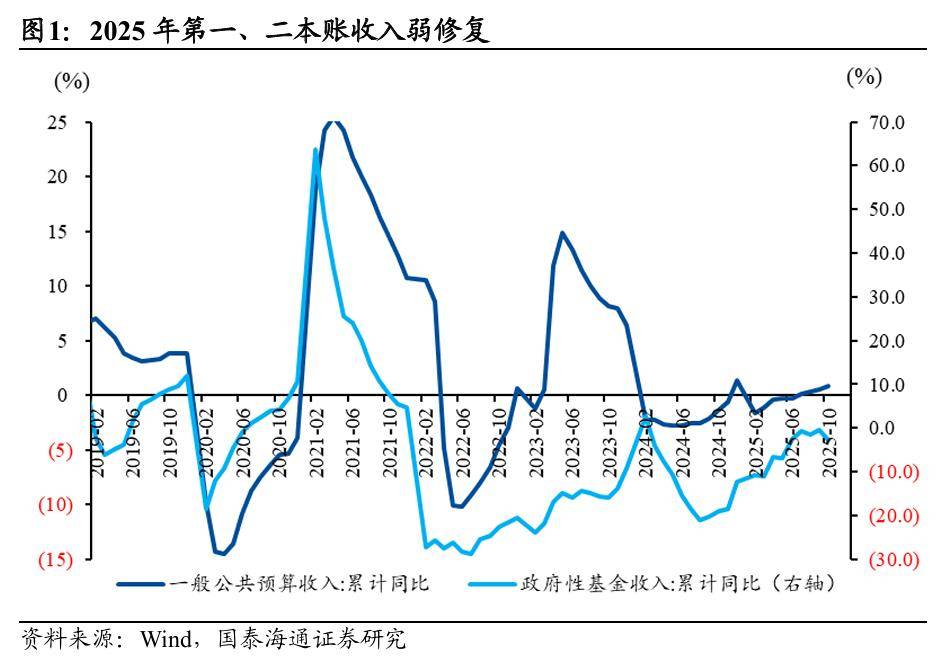
Core Viewpoint - The fiscal policy for 2026 will focus on promoting stable growth, improving people's livelihoods, and managing risks under the "15th Five-Year Plan," with a projected narrow fiscal deficit rate exceeding 4% and new local special bonds around 4.6 trillion yuan [1][5][43]. Group 1: Fiscal Policy Characteristics - The core feature of China's fiscal policy in 2025 is a shift towards a "people-oriented" expenditure structure, which is reflected in the resilience of consumption and the decline in infrastructure investment since July [1][5]. - On the revenue side, there is a weak recovery in the two accounts, with tight constraints still present. The income from individual income tax and securities transactions has improved, while land transfer income has seen a narrowing decline [5][11]. - On the expenditure side, there is a moderate expansion in total fiscal spending, with a structural shift towards social welfare. The central government's financial support is increasing, but the alignment of financial resources and responsibilities still needs optimization [1][11][15]. Group 2: Key Tasks for 2026 - The fiscal policy for 2026 will focus on three key tasks: promoting the synergy between social welfare and consumption incentives, addressing the slowdown in external demand, and resolving funding constraints for infrastructure investment [1][21][22]. - Policies such as trade-in programs and childbirth subsidies are expected to continue and be enhanced, with a focus on service consumption, projecting a retail sales growth rate of around 4.5% [2][25]. Group 3: Infrastructure Investment and Debt Management - For infrastructure investment and debt management, it is essential to clarify the scale and path of debt management funding, with an estimated need for around 3 trillion yuan in special bonds for debt management and clearing overdue accounts in 2026 [3][29]. - The pressure of interest payments after debt replacement is expected to be manageable due to a low-interest environment, which will help offset the visible interest payment pressure [3][37]. - The growth rate of infrastructure investment is projected to be around 3.5% in 2026, influenced by the constraints of debt management and the pursuit of effective investment [3][41]. Group 4: Fiscal Data Projections for 2026 - The growth rate of broad fiscal spending is expected to be around 4.6%, with a narrow fiscal deficit rate still needing to exceed 4%, and new local special bonds projected at approximately 4.6 trillion yuan [5][43][49]. - The general public budget revenue growth rate is estimated at about 1%, while government fund revenue is expected to decline by around 5% [43][46].

国债期货周报:基本面偏弱运行,债市窄幅震荡-20251121
Rui Da Qi Huo· 2025-11-21 10:38
Report Industry Investment Rating - Not provided in the document Core Viewpoints - The economic growth in October continued the slowdown trend in the third quarter, with some economic indicators significantly affected by the external environment. The 500 billion new policy - based financial instruments have been fully deployed by the end of October, which may effectively boost investment growth in the fourth quarter, and it is expected that the annual economic growth target of 5% can be achieved without worry [104]. - The overall fundamental data in October was weak, with indicators such as exports, social financing, and social retail showing varying degrees of decline. The inflation level rebounded slightly, but its sustainability remains to be observed. It is expected that the economy will continue a weak recovery trend in the fourth quarter, supporting the bond market. The central bank will maintain a moderately loose policy tone, and the space for further monetary easing this year is limited. In the short term, interest rates may fluctuate within a narrow range [105]. Summary by Directory 1. Market Review - **Weekly Data**: The 30 - year TL2512 contract fell 0.51%, the 10 - year T2512 contract rose 0.01%, the 5 - year TF2512 contract fell 0.02%, and the 2 - year TS2512 contract rose 0.01%. The trading volume of the TS, TF, T, and TL main contracts increased, while the open interest decreased [13][30]. - **Treasury Bond Futures Market Review**: The 30 - year main contract fell 0.51%, the 10 - year main contract rose 0.01%, the 5 - year main contract fell 0.02%, and the 2 - year main contract rose 0.01% [16][22]. 2. News Review and Analysis - **Key News Review**: From January to October this year, the national fiscal revenue was 18.65 trillion yuan, a year - on - year increase of 0.8%. In October, the national fiscal revenue was 2.26 trillion yuan, a year - on - year increase of 3.2%. From January to October, the national fiscal expenditure was 22.58 trillion yuan, a year - on - year increase of 2%. In October, the bank settlement and sales surplus was 177 billion US dollars, and the cross - border capital inflow increased. The new LPR remained stable for the sixth consecutive month, and there is still a possibility of a decline in the future. The yield of Japan's newly issued 10 - year treasury bonds reached a new high since June 2008. The Fed's decision - making on interest rate cuts in October was highly controversial. The number of non - farm payrolls in the US in September increased significantly, but the unemployment rate rose to a new high since October 2021 [33][34][35]. 3. Chart Analysis - **Spread Changes** - **Treasury Yield Spread**: The spread between the 10 - year and 5 - year treasury yields narrowed, and the spread between the 10 - year and 1 - year treasury yields widened [41]. - **Main Contract Spread**: The spread between the 2 - year and 5 - year main contracts narrowed, and the spread between the 5 - year and 10 - year main contracts widened [50]. - **Treasury Bond Futures Near - Far Month Spread**: The inter - period spreads of the 10 - year, 30 - year, 5 - year, and 2 - year contracts all narrowed [54][61]. - **Treasury Bond Futures Main Position Changes**: The net short positions of the top 20 positions in the T treasury bond futures main contract increased slightly [67]. - **Interest Rate Changes** - **Shibor and Treasury Yields**: Overnight and 1 - week interest rates decreased, while 2 - week and 1 - month Shibor rates increased. The weighted average DR007 rate fell to around 1.44%. The yields of treasury bonds fluctuated within a narrow range, with the 10 - year and 30 - year yields rising by about 0.6bp and 0.9bp to 1.81% and 2.16% respectively [71]. - **China - US Treasury Yield Spread**: The spreads between the 10 - year and 30 - year China - US treasury yields both narrowed slightly [78]. - **Central Bank Open Market Operations**: The central bank conducted 1.676 trillion yuan in reverse repurchases, with 1.122 trillion yuan in reverse repurchases maturing and 120 billion yuan in treasury cash deposits maturing, resulting in a net injection of 434 billion yuan. The weighted average DR007 rate fell to around 1.44% [81]. - **Bond Issuance and Maturity**: This week, the total bond issuance was 1.203854 trillion yuan, and the total repayment was 1.263495 trillion yuan, with a net financing of - 59.641 billion yuan [87]. - **Market Sentiment** - The central parity rate of the RMB against the US dollar was 7.0875, with a cumulative depreciation of 50 basis points this week. The spread between the offshore and onshore RMB widened [90]. - The yield of the 10 - year US treasury bond decreased, and the VIX index increased significantly [96]. - The yield of the 10 - year treasury bond in China increased, and the A - share risk premium increased slightly [101]. 4. Market Outlook and Strategy - **Domestic**: In October, economic indicators such as social retail, industrial added value, and fixed - asset investment showed a slowdown. Social financing and credit decreased slightly year - on - year, and the support of government bonds for social financing continued to weaken. The export growth rate turned negative. The 500 billion new policy - based financial instruments have been fully deployed, which may boost investment in the fourth quarter, and the annual economic growth target of 5% is expected to be achieved [104]. - **Overseas**: The US government shutdown ended, and a large amount of economic data will be released. The non - farm payrolls in September increased significantly, but the unemployment rate rose. The Fed's decision - making on interest rate cuts was controversial, and the expectation of an interest rate cut in December decreased significantly [104].
普徕仕:美联储政策走向不明引发市场担忧 维持偏高配置中国股票
Zhi Tong Cai Jing· 2025-11-21 06:21
Core Viewpoint - The investment outlook for Asian investors is cautious due to economic uncertainty and fluctuating market expectations regarding interest rate cuts by the Federal Reserve [1] Group 1: Economic Outlook - The Federal Reserve's policy direction is unclear, with increasing concerns about its impact on the market [1] - Discrepancies among Federal Open Market Committee members highlight the uncertainty in economic forecasts, with some advocating for a more aggressive 50 basis point cut while others oppose any cuts [1] - Fed Chair Powell warned that a rate cut in December is not guaranteed, contributing to market anxiety [1] Group 2: Market Performance - U.S. equities have rebounded nearly 40% from their "liberation day" lows but have recently become more volatile [1] - Concerns are growing over high valuations, skepticism regarding AI spending, and issues related to AI infrastructure debt financing [1] - Factors such as a recent government shutdown, weakening private sector employment data, declining consumer confidence, and unclear Fed policy are deepening market worries [1] Group 3: Corporate Earnings and Investment Strategy - Corporate earnings remain strong, and M&A activity is on the rise, supported by fiscal and monetary policy [2] - AI spending is identified as a key driver of economic growth, corporate earnings, and market performance, offsetting weaknesses in real estate, manufacturing, and the job market [2] - The company maintains a neutral stance on risk assets while closely monitoring economic sector disparities [2] Group 4: Stock Market Preferences - The company holds a neutral position on U.S. equities across market capitalizations, noting that while large caps may benefit from AI optimism, small caps present attractive valuations and could benefit from lower interest rates and increased M&A/IPO activity [2] - A higher allocation to Chinese stocks is maintained, with technology expected to be a key growth driver for China [2] - The company is underweight on U.S. long-term Treasuries due to potential upward pressure on yields from U.S. government financing needs [2]