物理AI

Search documents
港股汽车芯片IPO迎来清华系夫妻档,年出货3700万片,奇瑞上汽北汽共同押注
3 6 Ke· 2025-12-04 10:15
Core Viewpoint - Xihua Technology has submitted its IPO application to the Hong Kong Stock Exchange with a valuation of 2.844 billion RMB, marking it as the first player in the automotive MCU sector closely related to smart vehicles and physical AI to reach this milestone [2][3]. Financial Performance - Xihua Technology's revenue from 2022 onwards shows a compound annual growth rate (CAGR) of 67.8%, with the first three quarters of 2025 already matching the total revenue for 2024, indicating rapid business expansion [6]. - Despite this growth, the company's gross margin remains low, reflecting its status in the "startup" phase compared to other fabless semiconductor companies [6][10]. Supply Chain and Cost Structure - The company faces challenges due to a highly concentrated supply chain, with the top five suppliers accounting for over 80% of procurement, leading to weak bargaining power against rising costs in wafer foundry and packaging testing [8]. - The revenue from the rapidly developing smart sensing control chips (TMCU) surged by 521% in the first nine months of 2025, but the gross margin for this segment is only 9.2%, further dragging down overall profitability [8]. Research and Development - Xihua Technology invests approximately 100 million RMB annually in R&D, which constitutes over 35% of its revenue, significantly higher than the industry average [10]. - However, the return on R&D investment is low, with only 12 patents produced from an investment of 86.83 million RMB in 2024, resulting in an average cost of 7.23 million RMB per patent, which is above the industry average of 3 million RMB [10]. Profitability and Cash Flow - Since its inception, Xihua Technology has not achieved profitability, accumulating a net loss of over 420 million RMB, with negative operating cash flow indicating a lack of self-sustaining financial capability [11][13]. - As of September 2025, the company had cash and equivalents of 605 million RMB, a 60.8% increase from the end of 2024, primarily due to new bank loans, leading to a total debt of 1.023 billion RMB and a debt-to-asset ratio of 50.9% [13]. Product Focus - The company specializes in Scaler chips, which are image/video processing chips that ensure compatibility between different devices' image formats [14][16]. - Xihua Technology's innovative ASIC architecture for Scaler chips offers higher performance, lower power consumption, and better cost efficiency compared to traditional FPGA solutions, positioning it as a leader in the ASIC Scaler segment [17]. Market Position and Growth Drivers - The Scaler market is experiencing continuous growth, driven by the demand for compatibility in smartphone repairs and the increasing prevalence of multi-screen interactions in smart vehicles [17]. - Xihua Technology's product offerings also include TMCU, which is a vehicle-grade microcontroller with advanced touch capabilities, applicable in various automotive functions [18][22]. Company Background - Founded by Chen Xi in 2018, Xihua Technology has undergone multiple funding rounds, attracting significant investments from various venture capital and industry players, including SAIC and BAIC [25][26]. - The company has a clear shareholder structure, with the founder and co-founder holding over 65% of the shares, indicating stable control conducive to long-term strategic planning [28].


快讯|清华大学成立具身智能与机器人研究院,特朗普政府年底成立机器人工作组,领益智造:人形机器人组装突破5000台
机器人大讲堂· 2025-12-04 06:40
Group 1 - Tsinghua University has established the Institute of Embodied Intelligence and Robotics, focusing on original innovation in "robust bodies + intelligent brains" technology [1][3] - The institute aims to leverage resources from Beijing's industrial ecosystem to create a full-chain transformation hub for technology research and application [1][3] Group 2 - Cao Cao Mobility and Yujian Technology have signed a strategic cooperation agreement to enhance automation and intelligence in Robotaxi operations, introducing the first "green intelligent passage island" in Hangzhou [4][6] - Yujian's humanoid robot Atom will serve as an "intelligent employee," validating applications in AI-guided interaction and unmanned operations [4][6] Group 3 - Lingyi Zhizao has completed the assembly of over 5,000 humanoid robots this year, collaborating with over 20 domestic companies and making progress with several North American AI/robotics clients [7][9] Group 4 - The Trump administration is increasing support for the robotics industry, planning to issue an executive order next year and establish a robotics task force by the end of the year [11][13] - This initiative has led to a significant rise in U.S. robotics stocks, with iRobot seeing a nearly 74% increase in share price [11][13] - The global robotics investment landscape is active, with projections indicating a funding scale of $2.3 billion by 2025 and a humanoid robot market size of $38 billion by 2035 [11][13] Group 5 - Fanuc, a leading global industrial robot manufacturer, has announced a strategic partnership with NVIDIA to integrate AI capabilities into factory robots, enabling them to understand human language commands [14][16] - This collaboration aims to accelerate the transition from traditional automation to intelligent systems, addressing challenges such as complex settings and talent shortages in the industry [14][16]



财报季变局:“蔚小理”三强分化,新势力赛道重新洗牌
Xin Lang Cai Jing· 2025-12-04 04:16
Core Insights - The recent Q3 2025 financial reports from Chinese automakers highlight the competitive landscape and strategic shifts within the industry, particularly among the leading new energy vehicle (NEV) companies NIO, Xpeng, and Li Auto [1][4] Financial Performance - Xpeng Motors reported a record revenue of 20.38 billion yuan, a year-on-year increase of 101.8%, and achieved a gross margin of 20.1%, surpassing NIO's 13.9% and Li Auto's 16.3% [2][3] - NIO's Q3 revenue reached 21.79 billion yuan, up 16.7% year-on-year, with a gross margin of 13.9%, but still faced a net loss of 3.48 billion yuan, the highest among the three [2][3] - Li Auto generated 27.4 billion yuan in revenue, a decline of 36.2% year-on-year, and reported a net loss of 624 million yuan, ending its streak of 11 consecutive profitable quarters [2][3] Strategic Adjustments - NIO is shifting its focus to core automotive operations, reducing investments in non-core businesses, and controlling sales and management expenses [4][5] - Xpeng is pursuing a strategy of "technology integration into the market," expanding into the range-extended vehicle market while maintaining its focus on smart driving [5] - Li Auto is transitioning from a "family-oriented" brand to an "AI-focused" strategy, aiming to build an "embodied intelligence" ecosystem [5] Competitive Landscape - The competition among NEV companies remains intense, with no clear leader emerging in profitability, as companies continue to vie for market share through cost-effectiveness and technological advancements [3][6] - New entrants like Leap Motor and Xiaomi are gaining traction, further intensifying the competitive environment [6] - The industry is evolving from a focus on product features to a comprehensive assessment of product definition, cost control, and brand strategy [6] Future Outlook - The immediate focus for NIO and Xpeng is achieving stable profitability, while Li Auto aims to recover from the MEGA recall incident and ramp up production of its electric models [7] - Long-term success will depend on technological advancements and the ability to adapt to global markets, with companies like Xpeng and NIO already expanding their international presence [7][8] - The NEV sector is entering a new phase of consolidation, where the ability to deliver on profitability promises and navigate technological changes will be crucial for survival [8]


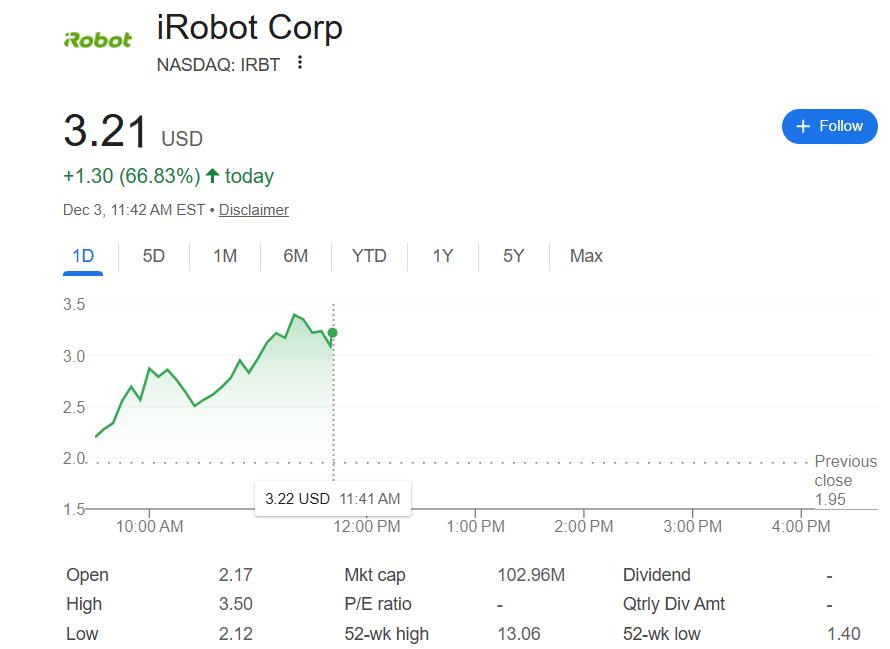
特朗普政府All in!据称考虑明年发机器人行政令,iRobot盘中飙涨近80%
Hua Er Jie Jian Wen· 2025-12-03 17:28
Core Viewpoint - The Trump administration is actively promoting the robotics industry, indicating a strategic shift towards robotics as a key area for competition with other major economies, following the focus on artificial intelligence (AI) [1][4]. Group 1: Government Support and Initiatives - U.S. Secretary of Commerce, Gina Raimondo, has been meeting with robotics CEOs to express full support for the industry's development, with plans for an executive order on robotics next year [1][3]. - The U.S. Department of Transportation is preparing to announce the establishment of a robotics task force, highlighting growing congressional interest in the robotics sector [4]. - The commitment to robotics is seen as essential for bringing critical manufacturing back to the U.S., following a previous AI acceleration plan [3][4]. Group 2: Investment and Market Potential - Significant investment is anticipated in the robotics sector, with projections indicating that funding could reach $2.3 billion by 2025, doubling from the previous year [5]. - Goldman Sachs estimates that the global humanoid robotics market could reach $38 billion by 2035, showcasing the potential for growth in this industry [5]. Group 3: Industry Perspectives and Challenges - The robotics industry is advocating for government tax incentives and federal funding to help integrate advanced automation technologies and strengthen supply chains [6]. - Apptronik, a humanoid robotics startup, emphasizes the need for a national robotics strategy to maintain competitiveness in this emerging sector [6]. Group 4: Technological Integration and Future Outlook - Major tech companies are investing in "physical AI," which encompasses robotics and autonomous driving technologies, indicating a broader trend in the industry [7]. - SoftBank's CEO, Masayoshi Son, has expressed the belief that physical AI will significantly impact global GDP, suggesting a transformative potential for the economy [8]. Group 5: Economic Implications - Tesla CEO Elon Musk argues that AI-driven robots are the only viable solution to address the U.S. debt crisis, emphasizing their potential to enhance productivity and output [9]. - Musk predicts that advancements in AI and robotics could lead to deflation, as production increases outpace monetary supply growth [9][10].




技术、生态与品牌的全面换道,中国造车新势力正迈入“物理 AI”时代
Guan Cha Zhe Wang· 2025-12-03 13:13
Core Insights - The article discusses the emerging trend of "Physical AI" in the Chinese smart electric vehicle industry, highlighting how companies like Xpeng and Li Auto are shifting their focus from hardware and software competition to a more integrated approach that combines AI with physical interactions [1][4][16]. Group 1: Industry Trends - The Chinese smart electric vehicle industry is transitioning from "technical configuration competition" to "cross-terminal intelligent platform competition" [1]. - The rapid development of sectors such as wearable devices, smart electric vehicles, low-altitude economy, and robotics is providing a fertile ground for the implementation of "Physical AI" [4][6]. - In 2024, China's total vehicle production and sales are expected to reach historical highs, with new energy vehicles achieving over 12.88 million units, marking a year-on-year growth of over 30% [4]. Group 2: Company Strategies - Li Auto's "Livis" strategy aims to create a system brand and OS that integrates various physical endpoints, enhancing user experience through a "memory and action" framework [7][9]. - Xpeng is focusing on expanding its AI capabilities to include more physical forms, aiming to make vehicles an integral part of users' lives [11]. - Both companies are leveraging their growing user bases and data pools to commercialize "Physical AI," with Li Auto targeting nearly 500,000 annual deliveries in 2024 [4][11]. Group 3: Market Opportunities - The wearable device market in China is projected to exceed 61 million units in 2024, positioning the country as a global leader [6]. - The low-altitude economy market is expected to reach 1.5 trillion RMB by 2025, while the robotics market is forecasted to surpass 150 billion RMB in the same year [6]. - The integration of "Physical AI" across various sectors is seen as a realistic and promising entry point for automotive companies [6][15]. Group 4: Challenges and Future Outlook - The implementation of "Physical AI" will face challenges such as regulatory issues, user adoption, and the need for high investment [16]. - The competition in the smart electric vehicle sector is evolving towards a higher dimension of "AI-ification" of the physical world, moving beyond traditional automotive performance comparisons [16][17]. - The future winners in this space may not be the companies with the best hardware, but those that can create a unified AI experience in people's lives [17].

赛道分化加剧,2026年人工智能最强风口来袭
3 6 Ke· 2025-12-03 08:57
Core Insights - The article emphasizes that 2026 will be a pivotal year for artificial intelligence (AI), marking a shift from "AI+" to "AI native," where AI fundamentally redefines system architectures and operational logic [1][3]. Group 1: AI Native Revolution - AI native signifies a complete redesign of systems with AI as the core logic and capability, leading to a comprehensive transformation across technology architecture, business processes, organizational roles, and value creation methods [3][4]. - The transition from "AI+" to "AI native" is not merely an enhancement but a fundamental restructuring that makes intelligence an inherent attribute of applications rather than an added feature [3][4]. - Key characteristics of a true AI native system include natural language interaction, autonomous learning and adaptation, and the ability to complete tasks independently based on large language models and knowledge bases [4][5]. Group 2: Development Trends and Tools - The rise of low-code/no-code platforms allows individuals without programming skills to create custom AI tools, fostering a surge in "one-person company" models [8]. - Major companies like Microsoft and ByteDance are embedding AI agents into office suites, creating end-to-end workflows that enhance productivity [8]. - The development of AI native applications requires a productized approach to various tools, such as platforms for deploying large models and automated fine-tuning tools, which are essential for widespread adoption [8]. Group 3: Physical AI Integration - By 2026, AI will extend beyond screens into physical environments like cities, factories, hospitals, and homes, marking the era of Physical AI [10][11]. - Physical AI is characterized by its ability to connect digital and physical worlds, enabling actions based on real-time data and physical interactions [10][11]. - The evolution of AI has progressed through three stages: perceptual AI, generative AI, and now Physical AI, which can reason, plan, and act like humans [10][11]. Group 4: World Models and Their Impact - World models are becoming crucial for AI's integration into the real world, allowing AI to shift from data-driven to rule-driven approaches, enabling predictive decision-making [19][21]. - These models enhance generalization capabilities, allowing AI to apply learned knowledge to new, unseen scenarios, which is vital for applications like autonomous driving [22][23]. - The development of world models involves understanding physical laws and simulating environments, which can significantly improve the performance of AI systems in complex real-world situations [24][25]. Group 5: Multimodal AI Capabilities - The emergence of multimodal large models (MLLMs) will redefine industries by enabling AI to process and integrate various data types, such as text, images, and audio [15][17]. - MLLMs will enhance cross-modal understanding and generation, allowing for more sophisticated content creation and problem-solving capabilities [15][16]. - By 2026, MLLMs are expected to drive significant advancements across various sectors, including cultural heritage preservation, security, and intelligent driving [17][18].

NVIDIA开源 Alpamayo-R1:让车真正“理解”驾驶
3 6 Ke· 2025-12-03 04:27
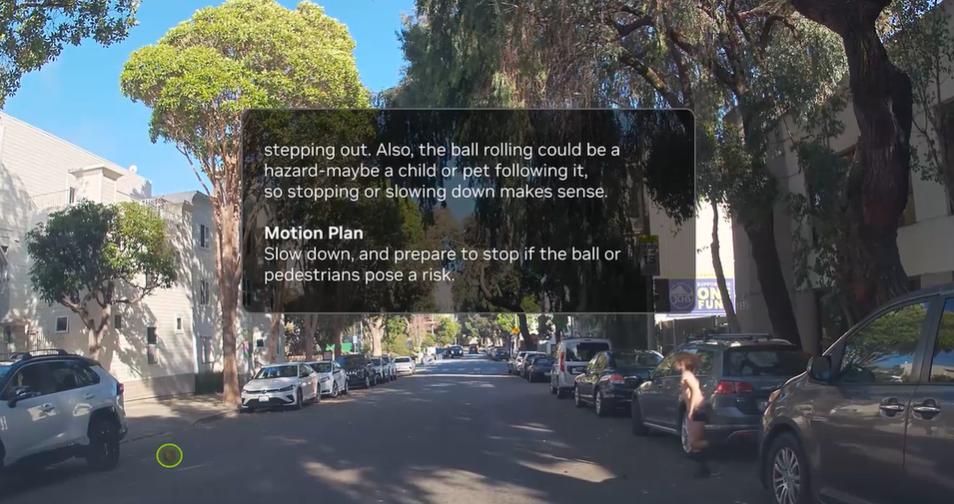
Core Insights - NVIDIA announced the launch of Alpamayo-R1, the world's first open-source Vision-Language-Action Model specifically designed for autonomous driving research, marking a shift from perception-driven systems to semantic understanding and common-sense reasoning [1][12] Group 1: Model Features - Alpamayo-R1 is built on the Cosmos-Reason architecture, introducing a "Chain-of-Thought" mechanism that allows the model to break down complex driving tasks into interpretable reasoning steps [4] - The model enhances robustness in operational design domain (ODD) boundary conditions, particularly addressing long-tail challenges faced by Level 4 autonomous driving [4][6] - Unlike traditional end-to-end models that map images directly to control signals, Alpamayo-R1 enables vehicles to "understand why" certain actions are taken, mimicking human-like multi-step reasoning in complex scenarios [6] Group 2: Open Source and Development Tools - NVIDIA has open-sourced the Alpamayo-R1 model weights and released the Cosmos Cookbook, a comprehensive AI development toolkit for autonomous driving [7] - The toolkit includes high-quality data construction standards, synthetic data generation pipelines, lightweight deployment solutions, and safety assessment benchmarks [7] Group 3: Collaborative Driving Systems - NVIDIA, in collaboration with Carnegie Mellon University, introduced the V2V-GoT system, the first framework applying Graph-of-Thought reasoning for multi-vehicle collaborative autonomous driving [9] - This system significantly reduces intersection collision rates from 2.85% to 1.83% and accurately predicts surrounding vehicles' movements within three seconds [9] Group 4: Synthetic Data Generation - The performance of Alpamayo-R1 is supported by NVIDIA's advanced synthetic data generation capabilities, utilizing the Cosmos world model trained on 20,000 hours of real driving footage [11] - This synthetic data addresses the scarcity of real-world long-tail distributions and supports closed-loop adversarial training for emergency response capability testing [11] Group 5: Strategic Implications - The release of Alpamayo-R1 represents a significant step in NVIDIA's "physical AI" strategy, moving beyond a perception-planning-control pipeline to create embodied agents that understand physical laws and social norms [12] - The open-source strategy is expected to accelerate global research and development in the next generation of autonomous driving technologies [13]
基于“车路云一体化”数据 奔驰联合苏州汤元等启动世界模型开发应用
Xin Hua Cai Jing· 2025-12-02 13:19
具体来看,梅赛德斯-奔驰以智能驾驶更稳健、更安全的行为决策为目标牵引,提出世界模型的目标方 向和应用场景;清华大学-梅赛德斯奔驰可持续交通研究院提供技术路线、方法论与科学验证;先导 (苏州)数字产业投资有限公司依托苏州的网联化道路、路侧基础设施、运营的苏州市智能网联云控平 台、智能网联可信数据空间和其他相关城市资源,提供高质量的智能网联交通数据,支持在真实环境中 开展验证与示范;汤元科技提供真实道路场景的重建能力,为模型训练提供高质量、带有4D数据结构 的数据基础,构建物理AI。据介绍,汤元科技将在此次合作中承担核心技术研发工作,包括物理世界 的全要素重建、数据生成和闭环仿真等工作。 新华财经北京12月2日电新华财经上海12月2日电(记者王鹤)记者从12月1日举办的第七届全球智能驾 驶大会上获悉,梅赛德斯-奔驰(中国)投资有限公司、清华大学-梅赛德斯奔驰可持续交通研究院、苏 州汤元科技有限公司以及先导(苏州)数字产业投资有限公司四方将共同启动"基于'车路云一体化'数 据的世界模型联合开发与应用"合作计划。 四家合作方共同表示,世界模型被视为物理AI在智能驾驶领域实现跃升的关键基础设施。通过学习来 自真实物理世 ...
发那科与英伟达将合作让机器人理解人类语言
日经中文网· 2025-12-02 08:00
AI当场分析传感器收集的数据并反映在现实动作中的"物理AI"正在普及,机器人有望理解周 围环境,自主行动或进行细致的工作,发那科与英伟达将在这一领域展开合作…… 世界最大的工业机器人企业发那科12月1日宣布,将与美国半导体巨头英伟达展开合作。将在 工厂用机器人上搭载人工智能(AI),使机器人可以在理解人类语言的基础上工作。在AI自主 控制机器人和机械的"物理AI"迅速改变竞争环境的情况下,发那科与AI半导体的王者联手, 争取从防御转为攻势。 发那科1日在东京都内召开的技术发布会上宣布了上述消息。借助英伟达的嵌入式计算系统, 机器人可以理解人类的指示,做出适当的动作。将在虚拟空间中的工厂推进AI学习,使"聪明 的机器人"能够更快地部署到现实工厂。 将支持开源,使全球的开发人员能够开发和使用驱动机器人的程序。发那科社长兼首席执行 官(CEO)山口贤治表示,"将(在机器人上)搭载全世界的智慧"。 在物理AI方面,软银集团(SBG)10月宣布,以53.75亿美元收购瑞士工业巨头ABB的机器 人业务。软银集团会长兼社长孙正义表示,"将(超越人类智能的)超级人工智能(ASI)与 机器人技术相结合,不断实现开创人类未来的划 ...

蔚小理
数说新能源· 2025-12-02 07:10
Delivery Volume - Xiaopeng Motors achieved the highest delivery volume in Q3 2025, reaching 116,007 units, a year-on-year increase of 149.3% [2] - Li Auto delivered 93,211 units, but this represents a decrease of 39.0% year-on-year [2] - NIO delivered 87,701 units, marking a year-on-year increase of 40.8% [2] Revenue and Gross Margin - Li Auto led in total revenue with 273.65 billion RMB, although this is a decrease of 36.2% compared to the same period in 2024 [3] - Xiaopeng Motors reported the highest gross margin at 20.1%, an increase of 4.8 percentage points from 15.3% in 2024 [3] - Li Auto's gross margin was 16.3%, impacted by the estimated costs related to the Li MEGA recall; excluding this, the Q3 gross margin would be 20.4% [3] - NIO's gross margin reached 13.9%, the highest level in the past three years [3] Expense Spending - R&D expenses were highest for Li Auto at 29.74 billion RMB, a year-on-year increase of 15.0% due to new model projects and technology-related costs [4] - NIO and Xiaopeng had similar R&D expenses of 23.91 billion RMB and 24.29 billion RMB, respectively, with NIO's R&D expenses decreasing quarter-on-quarter due to organizational optimization [4] - NIO's SG&A expenses were the highest at 41.85 billion RMB, a 5.5% increase from the previous quarter, primarily due to increased sales and marketing activities related to new product launches [4] Net Profit - All three companies reported net losses in Q3 2025, with NIO's loss being the largest at 34.80 billion RMB [5] - Li Auto reported a net loss of 6.24 billion RMB [5] - Xiaopeng Motors had a net loss of 3.81 billion RMB [5] Long-term Strategic Outlook - NIO's long-term strategy focuses on accelerating growth and multi-brand synergy, with a strong emphasis on operational efficiency and positive cash flow [6] - Li Auto emphasizes product innovation, technological leadership, and sustainable growth, with confidence in achieving long-term strategic goals [7] - Xiaopeng Motors aims to become a global embodied intelligence company, focusing on the commercialization of AI and building a robust product technology ecosystem [8]