货币政策

Search documents
春节假期持仓报告
Yin He Qi Huo· 2026-02-12 07:58
1. Report Industry Investment Rating No relevant content provided. 2. Core Views of the Report - The stock index is expected to continue its slow - bull market. Factors such as policy support, stable market funds, and improving economic data create favorable conditions for the market. After the Spring Festival, the market is likely to perform well, especially for small - and medium - cap stocks and the ChiNext and STAR Market indices [11][12]. - The sentiment in the bond market may turn cautious after the Spring Festival. Although the central bank's monetary policy remains moderately loose, factors such as the approaching important meetings and the possible reversal of some investors' behaviors may lead to a more cautious attitude [14]. - In the agricultural and sideline products sector, different products have different trends. For example, soybean meal is expected to gradually reduce inventory, while the price of live pigs is likely to remain low. Corn and starch are expected to fluctuate at high levels, and the price of sugar is expected to be weak [18][22][25]. - In the ferrous metals sector, steel prices may face pressure after the Spring Festival. The supply - demand structure of steel is weakening, and factors such as iron - water production, inventory accumulation, and coal mine resumption need to be monitored. The coking coal and coke market is affected by factors such as coal mine shutdowns and international coal market changes, with prices showing wide - range fluctuations. Iron ore prices are expected to be weak due to the weakening fundamentals [42][44][47]. - In the non - ferrous metals sector, precious metals such as gold and silver are expected to maintain a cautious and optimistic trend. Copper prices are expected to be in a high - level consolidation in the short term but have a long - term upward trend. Aluminum prices are expected to fluctuate in the short term and may rise if the Mozal aluminum plant's production reduction plan is implemented [52][56][58]. - In the shipping innovation sector, the container shipping market has a weakening price increase expectation in March and will enter the off - season after the Spring Festival. Attention should be paid to factors such as shipping capacity deployment, geopolitical situations, and the implementation of price increase announcements [83]. - In the energy and chemical sector, crude oil prices are mainly driven by geopolitical factors in the short term, with a wide - range fluctuation. LPG prices are supported by high international costs in the short term but are restricted by weak domestic supply and demand in the long term. Other chemical products such as asphalt, natural gas, and fuel oil also have their own supply - demand and price characteristics [88][90][96]. 3. Summary by Directory 3.1 Macro Finance 3.1.1 Stock Index - **Analysis**: Policy guidance consolidates the stable and positive trend. Market risk appetite has decreased, and the enthusiasm for A - share investment has cooled, laying the foundation for a slow - bull market. Economic data is improving, which is beneficial to the performance of listed companies. After the Spring Festival, the market is likely to perform well, especially for small - and medium - cap stocks and the ChiNext and STAR Market indices. The futures market has already reduced positions in advance, and if the market improves after the Spring Festival, the basis discount may further narrow [12]. - **Trading Strategy**: Unilateral trading should be to go long on dips; for arbitrage, consider the spot - futures arbitrage of IM/IC long 2609 + short ETF; for options, use the bull spread strategy [13]. 3.1.2 Treasury Bonds - **Analysis**: The central bank's monetary policy remains moderately loose. Although inflation indicators are recovering, the impact on the bond market is limited. The market risk appetite has stabilized, but the bond market sentiment is still affected by the Spring Festival holiday. In the short term, the probability of a policy interest rate cut is low, and the bond market sentiment may turn cautious after the Spring Festival [14]. - **Trading Strategy**: Unilateral trading should be to try to short TS contracts on rallies; for arbitrage, pay attention to the phased long - T - contract inter - delivery spread trading [15]. 3.2 Agricultural and Sideline Products 3.2.1 Soybean Meal - **Analysis**: The international soybean market is strong, but the upside space is limited. The domestic soybean supply is sufficient, and the soybean meal inventory is expected to gradually decrease [18][19]. - **Trading Strategy**: It is recommended to wait and see for unilateral trading and arbitrage; for options, use the short strangle strategy [20]. 3.2.2 Live Pigs - **Analysis**: The supply pressure of live pigs is obvious, and the price is at a low level. The futures price mainly follows the spot price, and the downward space is limited [22]. - **Trading Strategy**: It is recommended to wait and see for unilateral trading and arbitrage; for options, use the short strangle strategy [23]. 3.2.3 Corn - **Analysis**: The US corn production is stable, and the import profit is high. After the Spring Festival, the supply of corn in Northeast China will increase, and the price may decline slightly. The starch price is expected to be relatively strong [25]. - **Trading Strategy**: For unilateral trading, try to buy US corn 03 below 420 cents/bu and short 03 corn on rallies; for arbitrage, widen the spread between 05 corn and starch on dips; for options, use the bear put spread strategy for 03 corn [26]. 3.2.4 Peanuts - **Analysis**: The peanut price is stable before the Spring Festival, and the 05 contract is expected to oscillate at the bottom [27]. - **Trading Strategy**: For unilateral trading, take a short - long position on dips for the 05 contract; for arbitrage, wait and see; for options, try to sell the pk603 - C - 8200 option [28]. 3.2.5 Sugar - **Analysis**: The international sugar price is expected to be weak, and the domestic sugar price is likely to follow the weak trend [29]. - **Trading Strategy**: For unilateral trading, use the high - short and low - cover strategy for the domestic Zhengzhou sugar 5 - month contract; for arbitrage, wait and see; for options, sell call options [30]. 3.2.6 Cotton - **Analysis**: The cotton price is supported, and the Zhengzhou cotton is expected to oscillate slightly stronger in the short term [31]. - **Trading Strategy**: For unilateral trading, the US cotton is expected to oscillate in a range, and the Zhengzhou cotton is expected to be slightly stronger. It is recommended to hold a light position during the Spring Festival; for arbitrage and options, wait and see [32]. 3.2.7 Eggs - **Analysis**: The egg demand is average, and the price is stable with a slight decline. It is recommended to short the 6 - month contract on rallies [33]. - **Trading Strategy**: For unilateral trading, short the 6 - month contract on rallies; for arbitrage and options, wait and see [34]. 3.2.8 Apples - **Analysis**: The apple inventory is low, and the cost of warehouse receipts is high. The price of the 5 - month contract is expected to be strong in the short term [35]. - **Trading Strategy**: For unilateral trading, go long on the 5 - month contract on dips and short the 10 - month contract on rallies; for arbitrage, go long on the 5 - month contract and short the 10 - month contract; for options, wait and see [36]. 3.2.9 Oils and Fats - **Analysis**: The palm oil inventory in Malaysia is at a high level, but the total inventory of Malaysia and Indonesia is not loose. The US biodiesel demand is expected to be good, which is beneficial to soybean oil. The domestic soybean oil inventory is gradually decreasing, and the supply is generally sufficient. The policy of Canadian rapeseed is uncertain, and the domestic rapeseed oil inventory is slightly decreasing [37]. - **Trading Strategy**: For unilateral trading, hold a light position during the holiday; for arbitrage, conduct P59 and Y59 reverse arbitrage; for options, wait and see [38]. 3.3 Ferrous Metals 3.3.1 Steel - **Analysis**: After the Spring Festival, steel mills may resume production, and the steel supply will increase. The demand is in the off - season, and the inventory is accumulating. The supply - demand structure is weakening, and the steel price may face pressure. However, the steel price valuation is low, and the decline is limited [42]. - **Trading Strategy**: For unilateral trading, the price is expected to be weak and oscillating; for arbitrage, short the hot - rolled coil - rebar spread and the rebar - coking coal ratio on rallies; for options, wait and see [43]. 3.3.2 Coking Coal and Coke - **Analysis**: Coal mines are on holiday during the Spring Festival, and the supply is reduced. The impact of the Spring Festival holiday on the Mongolian coal port is limited. The domestic coal market is affected by international and domestic factors, and the price is expected to fluctuate widely. The coking coal valuation is not high, and it is recommended to go long on dips [44][45]. - **Trading Strategy**: For unilateral trading, conduct band trading; for arbitrage, wait and see; for options, sell out - of - the - money put options [46]. 3.3.3 Iron Ore - **Analysis**: The iron ore supply is increasing, and the demand is weak. The fundamentals are weakening, and the price is expected to be weak after the Spring Festival [47]. - **Trading Strategy**: For unilateral trading, hold a small number of short positions; for arbitrage, wait and see; for options, sell out - of - the - money call options [48]. 3.3.4 Ferroalloys - **Analysis**: The supply and demand of ferrosilicon and ferromanganese are relatively stable, and the cost support is strong. It is recommended to take partial profit on long positions before the long holiday [49]. - **Trading Strategy**: For unilateral trading, take partial profit on long positions before the long holiday and go long on dips after the holiday; for arbitrage, wait and see; for options, sell put options [50]. 3.4 Non - Ferrous Metals 3.4.1 Gold and Silver - **Analysis**: The gold and silver market has stabilized and recovered after the adjustment. The trading mainline is expected to return to factors such as great - power games and the US interest - rate cycle. It is recommended to control risks during the holiday [52]. - **Trading Strategy**: For unilateral trading, conservative investors can exit long positions on rallies, and aggressive investors can hold long positions based on the 20 - day moving average with a light position. It is recommended to hold an empty position for silver; for arbitrage, wait and see; for options, switch futures long positions to buy out - of - the - money call options for gold, and use the bull call spread strategy for silver [53]. 3.4.2 Platinum and Palladium - **Analysis**: The non - farm payroll data is contradictory, and the asset volatility is high. Platinum is in a tight - balance pattern, and palladium is in a supply - surplus pattern. Platinum has a stronger upward driving force [54]. - **Trading Strategy**: For unilateral trading, be cautiously bullish and buy on dips; for arbitrage, go long on platinum and short on palladium; for options, wait and see [55]. 3.4.3 Copper - **Analysis**: The copper price has fluctuated sharply recently. After the adjustment, the fundamentals are healthier, and the long - term upward trend remains unchanged. It is recommended to control positions during the Spring Festival [56]. - **Trading Strategy**: For unilateral trading, the price is in a high - level consolidation, and it is recommended to control positions; for arbitrage, wait and see; for options, sell out - of - the - money put options [57]. 3.4.4 Aluminum - **Analysis**: The macro - economic expectations are volatile. If the Mozal aluminum plant reduces production as planned, the aluminum price will be strong; otherwise, the upward momentum will be weakened. The domestic inventory is accumulating, which suppresses the price [58]. - **Trading Strategy**: In the short term, the Shanghai aluminum is expected to oscillate between 22,800 - 24,200 yuan. In the long term, if the production - reduction plan is implemented, be bullish on dips; pay attention to the implementation of the production - reduction plan [59]. 3.4.5 Alumina - **Analysis**: The alumina supply is uncertain during the holiday. If the production reduction continues, the futures price may fluctuate; otherwise, it will be under pressure [60]. - **Trading Strategy**: In the short term, the main contract is expected to oscillate between 2,780 - 2,880 yuan. It is recommended to be cautious. If there are expectations for policies, buy a small number of call options. In the long term, be bearish on rallies in the surplus pattern; if the supply - demand situation improves, the price may rebound [61]. 3.4.6 Zinc - **Analysis**: The zinc concentrate supply shortage is expected to ease. The refined zinc production is expected to decrease. The downstream demand is affected by the Spring Festival holiday. It is recommended to control positions and hedge inventory [62]. - **Trading Strategy**: For unilateral trading, control positions and hold a light position during the holiday; for arbitrage, buy LME and sell SHFE; for options, buy one - times out - of - the - money put options and two - times out - of - the - money call options [63]. 3.4.7 Lead - **Analysis**: The lead concentrate supply is in short supply, and the production of primary lead is profitable, but the production increase is limited. The production of recycled lead is affected by losses and holidays. The downstream demand is weak. It is recommended to wait and see and control positions [66]. - **Trading Strategy**: For unilateral trading, wait and see; for arbitrage, wait and see; for options, sell out - of - the - money put options [66]. 3.4.8 Nickel - **Analysis**: Geopolitical conflicts and inflation expectations drive the inflow of funds into the non - ferrous metal sector. The nickel supply is expected to be in surplus without quota restrictions, but there may be a shortage if the quota is limited. The nickel price is supported by cost and strategic demand. It is recommended to hold a light long position during the holiday [67][68]. - **Trading Strategy**: For unilateral trading, hold a light long position based on the 5 - day moving average; for arbitrage, wait and see; for options, sell the put option of the NI2604 contract with an exercise price of 134,000 [68]. 3.4.9 Stainless Steel - **Analysis**: The stainless - steel cost is rising, and the inventory is increasing. The price is affected by nickel and the macro - economic environment. It is recommended to hold a light long position during the holiday [69]. - **Trading Strategy**: For unilateral trading, hold a light long position based on the 5 - day moving average; for arbitrage, wait and see [70]. 3.4.10 Polysilicon - **Analysis**: The polysilicon spot price is under pressure, and the market is in a state of disorderly fluctuation before the Spring Festival. After the Spring Festival, if the price drops to the previous low, it can be considered to go long or buy call options [71]. - **Trading Strategy**: For unilateral trading, wait and see and look for a good safety margin; for arbitrage, there is no opportunity; for options, buy call options when appropriate [72]. 3.4.11 Industrial Silicon - **Analysis**: The industrial - silicon production is reducing, and the basis is high. The futures price is expected to oscillate between 8,200 - 9,100 yuan. It is recommended to wait for the price to stabilize [73]. - **Trading Strategy**: For unilateral trading, wait for the price to stabilize; for arbitrage, there is no opportunity; for options, there is no opportunity [73]. 3.4.12 Lithium Carbonate - **Analysis**: The lithium - carbonate demand is improving, and the supply will increase in March, resulting in inventory accumulation. However, the market tolerance for inventory is high, and the industry trend is positive. It is recommended to hold a light long position during the holiday [74]. - **Trading Strategy**: For unilateral trading, hold a light long position based on the 5 - day moving average; for arbitrage, wait and see; for options, sell the put option of the lc2605 contract with an exercise price of 140,000 [75]. 3.4.13 Tin - **Analysis**: The tin price is relatively resilient. The tin - ore import is stable, and the production is expected to change slightly. The inventory is decreasing, and the demand is recovering marginally. It is recommended to control positions before the holiday [77][78]. - **Trading Strategy**: For unilateral trading, control positions before the holiday; for arbitrage, wait and see; for options, wait and see [79]. 3.5 Shipping Innovation 3.5.1 Container Shipping - **Analysis**: The price increase expectation in March is weakening, and the market will enter the off - season after the Spring Festival. The freight rate is under pressure, and the supply and demand are affected by factors such as shipping capacity deployment and geopolitical situations [83]. - **Trading Strategy**: For unilateral trading, wait and see before the holiday; for arbitrage, conduct 6 - 10 positive arbitrage rolling operations [84].
Fed governor says he sees inflation coming down ‘DRAMATICALLY' in 2026
Youtube· 2026-02-12 07:15
Economic Outlook - The recent jobs numbers indicate a strong economy with an unemployment rate of 4.3%, suggesting that interest rates may not need to be lowered immediately [1][24] - Economic growth is a key factor in monetary policy, and while current growth is solid, inflation is expected to decrease significantly this year due to various factors [2][3] Inflation Dynamics - Factors contributing to a decrease in inflation include changes in how shelter inflation is measured and policies that enhance supply-side economics, which are disinflationary [4][6] - Deregulation efforts are projected to reduce inflation by approximately 0.5 percentage points annually in the coming years, as they allow the economy to produce more efficiently [5][6] Supply-Side Economics - Increasing the supply side of the economy can lead to lower prices, as producing more goods and services typically drives prices down [12][19] - The current economic model used by the Federal Reserve does not adequately account for the relationship between supply-side improvements and inflation reduction [10][11] Employment and Construction - The construction sector has shown significant growth, adding 33,000 jobs, which is indicative of increased factory building and production capacity [8][19] - More factories and increased production are expected to lead to a decrease in prices for goods, contributing to lower inflation rates [9][19] Regulatory Impact - The importance of regulations on the supply side of the economy is often underestimated, yet they play a crucial role in determining productivity and industrial mix [18] - Overregulation can push industries overseas, negatively impacting the domestic economy's productivity profile [18]


澳洲联储主席警告:通胀高企不可接受 必要时将再次加息
智通财经网· 2026-02-12 06:43
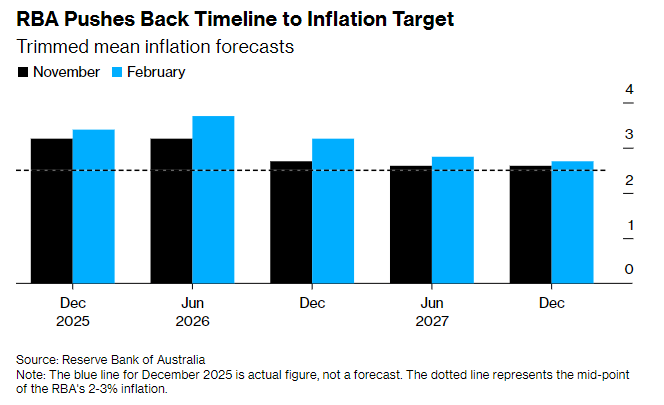
Core Viewpoint - The Reserve Bank of Australia (RBA) is prepared to raise interest rates again if inflation remains stubbornly high, with a cautious approach to further tightening of monetary policy emphasized by Governor Michele Bullock [1][4]. Group 1: Inflation and Monetary Policy - The RBA has become the first major central bank to raise interest rates this year, with expectations of at least one more increase in the coming months as inflation is projected to exceed the target range of 2%-3% [1][4]. - Bullock stated that an inflation rate above 3% is unacceptable, aligning with Deputy Governor Andrew Hagger's warning about the current high inflation levels being a significant challenge for the monetary policy committee [1][4]. - The next RBA meeting is scheduled for mid-March, where decision-makers will review employment and inflation data, along with GDP data for Q4 2025, which is expected to show a resilient Australian economy [4]. Group 2: Economic Challenges - The RBA's recent rate hike marks a sharp policy shift from six months ago when the bank was cutting rates, highlighting structural economic challenges faced by Australia, particularly low productivity growth [4]. - Bullock indicated that without improvements in productivity, maintaining a growth rate above 2% without triggering inflation will be difficult [4]. Group 3: Labor Market and Employment - Despite ongoing inflation control challenges, the unemployment rate remains historically low at 4.1% as of December, with the estimated non-accelerating inflation rate of unemployment (NAIRU) at 4.6% [5]. - Assistant Governor Sarah Hunter emphasized the importance of evaluating economic capacity pressures and labor market conditions to determine whether the recent inflation rise is temporary or a trend [5]. Group 4: Government Spending and Political Sensitivity - Bullock expressed frustration during the hearing regarding media criticism of the RBA's reluctance to attribute government spending to inflationary pressures, highlighting the political sensitivity surrounding fiscal policy [5][6]. - While acknowledging the impact of government spending on the economy, Bullock avoided direct criticism of fiscal policy, stating that public consumption increases total demand but is viewed as a "given condition" by the RBA [5].
1月非农超预期,国债期货大多收涨
Hua Tai Qi Huo· 2026-02-12 05:01
国债期货日报 | 2026-02-12 1月非农超预期,国债期货大多收涨 市场分析 宏观面:(1)宏观政策: 12月8日政治局会议明确实施更加积极的财政政策和适度宽松的货币政策,释放宽货币 信号;中央经济工作会议提出,2026年财政政策方面继续实施更加积极的财政政策,货币方面继续实施适度宽松 的货币政策,灵活高效运用降准、降息及结构性政策工具,为"十五五"良好开局提供稳定的宏观政策环境;2026 年1月19日起,下调再贷款、再贴现等一篮子利率0.25个百分点,同时今年还存在继续降准降息的空间。(2)通胀: 1月CPI同比上升0.2%。 财政:(3)财政:2025年全年财政收支整体未达预期,收入受税收走弱与非税高基数拖累,全年一般公共预算收 入同比下降1.7%;支出节奏前置,年末力度减弱,全年完成度偏低。结构上呈现分化特征,民生支出总体稳定, 基建类支出占比下降,土地财政收入持续疲软。展望2026年,财政政策预计延续积极,强调"总量增加、结构更优", 支出力度有望加强,节奏继续前置,对稳增长形成支撑。(4)金融:2025年前12个月份社会融资规模增量累计为 35.6万亿元,比去年同期3.34万亿:12月末,M2 ...
特朗普罕见认错,转头被曝出有大动作,不到24小时,俄外长开炮
Sou Hu Cai Jing· 2026-02-12 03:16
Group 1 - Trump admitted to a significant mistake in selecting the Federal Reserve Chairman, acknowledging that he chose Jerome Powell over his preferred candidate, Kevin Warsh, due to pressure from the Treasury Secretary [3][5] - The admission appears to be politically motivated, aimed at paving the way for Warsh's nomination as the next Federal Reserve Chairman, as Trump seeks to gain Senate support and appease voters dissatisfied with Powell [5][7] - Trump's upcoming plan to overturn the Obama-era climate regulation, which is foundational for federal oversight of greenhouse gas emissions, could lead to a significant regression in U.S. climate policy and impact global climate governance [7][9] Group 2 - The 2009 climate regulation was established to address the dangers of greenhouse gas emissions and has broad implications for industries worth trillions of dollars [7] - Despite Trump's efforts to deregulate the fossil fuel industry, some groups within that sector are hesitant to support the repeal of the regulation, fearing increased state-level oversight could complicate their operations [9] - Trump's actions and statements reflect a broader pattern of U.S. foreign policy that has been criticized for failing to uphold commitments and exacerbating global instability, as highlighted by Russian Foreign Minister Lavrov [11][16]
多位美联储官员释放鹰派信号暂缓降息 美国通胀今年或维持3% 施密德对AI降通胀存疑
Sou Hu Cai Jing· 2026-02-12 02:35
本周,多位美联储官员密集释放鹰派政策信号,明确暂缓降息计划,将政策重心放在维持当前利率水 平、抑制通胀反弹上。 堪萨斯城联储主席杰夫·施密德强调,鉴于经济增长依然强劲且通胀未达目标,美联储应维持紧缩货币 政策,将利率维持在略具限制性的区间内,过早或进一步降息可能导致高通胀持续更长时间。他指出, 当前利率本应对经济活动形成一定约束,但实际抑制效果并不明显,经济多数领域呈现需求超过供给的 状态,尚未看到足够多的经济降温迹象。 施密德表示,当前接近3%的通胀率显示强劲需求增速超过供给改善速度,近期生产率提升或源于劳动 力市场低招聘率、低解雇率、低离职率的低流动性特征,而非技术进步。他对依靠人工智能立即解决通 胀问题持怀疑态度,承认相关因素有望促成非通胀的供给驱动型增长周期,但强调尚未进入该阶段,主 张维持高利率抑制支出和投资。施密德并非今年联邦公开市场委员会票委。 施密德的表态与特朗普总统提名的下一任美联储主席沃什的观点形成鲜明对比。沃什认为,人工智能将 大幅提升生产力,可在不引发通胀的前提下降低借贷成本。 克利夫兰联储主席贝丝·哈马克表示,当前货币政策处于适宜观望的良好位置,预计美联储在相当长一 段时间内按兵不动 ...
有色金属日报-20260212
Wu Kuang Qi Huo· 2026-02-12 01:21
1. Report Industry Investment Rating There is no information about the industry investment rating in the provided content. 2. Core Viewpoints of the Report - Copper: The US plans to promote the commercial reserve of critical mineral resources, and China is expected to strengthen copper reserves. The US economic data is relatively volatile, and the manufacturing sentiment is strong, providing support on the sentiment side. The copper ore supply remains tight, while the domestic refined copper supply maintains high growth, with relatively abundant short - term supply. It is expected that copper prices will mainly fluctuate. [4] - Aluminum: Domestic aluminum ingot and aluminum rod inventories continue to accumulate, and downstream demand is weak in the off - season. The LME aluminum inventory remains at a relatively low level, and the US aluminum spot premium remains high, so there is still strong support for aluminum prices. It is expected that aluminum prices will be in a range - bound pattern. [7] - Lead: The visible inventory of lead ore has a slight decline but is still higher than the same period in previous years, and the lead concentrate processing fee remains at a low level. The waste battery inventory continues to rise, higher than that in 2025. Near the Spring Festival, the smelter's operating rate declines seasonally. The lead ingot social inventory continues to accumulate, and the domestic industry situation is weak. Whether the lead price can stabilize needs to be observed based on the restocking willingness of downstream battery enterprises after the Spring Festival. [10] - Zinc: The accumulation of visible zinc ore inventory slows down, and the zinc concentrate TC stops falling and stabilizes. The domestic zinc ingot social inventory begins to accumulate. The downstream enterprise operations are mediocre, and the finished - product inventories of die - casting zinc alloy and zinc oxide enterprises rise rapidly. The domestic zinc industry performs weakly. However, short - term funds are greatly affected by macro - sentiment disturbances. Near the Spring Festival holiday, there is still a risk of abnormal movements in non - ferrous metals during the festival. The strong US PMI boosts the market's expectation of consumption recovery, which may drive zinc prices to rise with the non - ferrous metal sector. [12] - Tin: After the secondary decline of precious metal prices, there are signs of stabilization, and tin prices may rebound. Although tin prices still maintain an upward trend in the medium - to - long term, in the short term, with the marginal relaxation of tin ingot supply and demand and the recent steady increase in inventory, there is also pressure for a significant increase. It is expected that tin prices will mainly operate in a wide - range oscillation. [14] - Nickel: After the secondary decline of precious metals and risk assets, they stabilize, and there is a short - term rebound demand. However, nickel still faces fundamental pressure, and it is expected that nickel prices will mainly fluctuate in a wide range. The approved nickel ore production quota is close to market expectations, and it is expected to have limited impact on nickel prices. [16] - Lithium Carbonate: In January, the year - on - year growth rates of domestic power and energy - storage battery production and sales were 55.9% and 85.1% respectively, and the lithium demand expectation is strong. After the Spring Festival, the production schedule growth rate of the material side is considerable. At the same time, there are frequent disturbances on the supply side. Although the substantial impact is limited, it is easy to ignite market sentiment under the inventory decline trend. In the future, the game between upstream hoarding and downstream restocking will affect the direction of lithium prices. [19] - Alumina: There is a strike in a mine in the Boké region of Guinea. It is necessary to observe whether the impact of the strike expands. Currently, production and shipping are normal. The over - capacity pattern in the alumina smelting end is difficult to change in the short term, and the inventory accumulation trend continues. Although there are more capacity overhauls recently, the overall output is still at a high level. It is recommended to wait and see in the short term. [22] - Stainless Steel: From the supply side, although the raw material supply has recovered, under the influence of the steel mill's price - limit policy, the shipment rhythm of agents generally slows down. On the demand side, restricted by the pre - Spring Festival seasonal off - season, the overall market purchasing willingness is not strong, and the acceptance of high - priced resources is limited. Traders mostly choose to actively ship, reduce inventory, and mainly execute previous orders, with a weak willingness to actively restock. Steel mills will have collective production cuts in February, and the market generally believes that the subsequent supply will gradually tighten, and the short - term supply pressure is relatively controllable. Overall, the stainless - steel fundamentals still have support, and the strategy of buying on dips remains unchanged. [25] - Cast Aluminum Alloy: The cost - side price of cast aluminum alloy rebounds. Although the demand is relatively average, under the background of continuous supply - side disturbances and seasonal tightness of raw material supply, the short - term price still has support. [28] 3. Summary According to Relevant Catalogs Copper - **Market Information**: The US employment data was better than expected. Overnight, US stocks rose first and then fell, and copper prices rose. The LME copper 3M closed up 1.06% to $13,239 per ton, and the Shanghai copper main contract closed at 102,190 yuan per ton. The LME copper inventory increased by 3,000 to 192,100 tons, with the increase coming from Asian warehouses. The cancelled warrant ratio increased, and Cash/3M remained at a discount. The domestic SHFE daily warehouse receipts increased by 13,000 to 179,000 tons. The Shanghai spot market turned to a discount of 50 yuan per ton to the futures, and the market trading remained dull. The Guangdong spot market was at a discount of 60 yuan per ton to the futures, and the holders of goods held firm on the basis price quotes, with dull trading. The Shanghai copper spot import loss was about 700 yuan per ton, and the refined - scrap copper price difference was 3,110 yuan per ton, expanding compared with the previous period. [3] - **Strategy Viewpoint**: It is expected that copper prices will mainly fluctuate. The reference range for the Shanghai copper main contract today is 101,000 - 104,000 yuan per ton; the reference range for the LME copper 3M is 13,100 - 13,400 US dollars per ton. [4] Aluminum - **Market Information**: The situation between the US and Iran is still uncertain. Crude oil prices rose first and then fell, and aluminum prices rebounded. The LME aluminum closed up 0.39% to $3,117 per ton, and the Shanghai aluminum main contract closed at 23,555 yuan per ton. The position of the Shanghai aluminum weighted contract increased slightly to 663,000 lots, and the futures warehouse receipts increased by 1,000 to 168,000 tons. The domestic three - place aluminum ingot inventory increased month - on - month, and the aluminum rod inventory also increased. The aluminum rod processing fee continued to rebound, and the spot trading remained dull. The East China electrolytic aluminum spot was at a discount of 190 yuan per ton to the futures, and the spot trading volume gradually declined. The LME aluminum ingot inventory decreased by 1,000 to 486,000 tons, the cancelled warrant ratio declined, and Cash/3M remained at a discount. [6] - **Strategy Viewpoint**: It is expected that aluminum prices will be in a range - bound pattern. The reference range for the Shanghai aluminum main contract today is 23,300 - 23,800 yuan per ton; the reference range for the LME aluminum 3M is 3,090 - 3,160 US dollars per ton. [7] Lead - **Market Information**: On Wednesday, the Shanghai lead index closed up 0.39% to 16,753 yuan per ton, with a total unilateral trading position of 124,100 lots. As of 15:00 on Wednesday, the LME lead 3S rose 8 to $1,978 per ton compared with the previous day, with a total position of 178,100 lots. The average price of SMM1 lead ingots was 16,575 yuan per ton, the average price of recycled refined lead was 16,550 yuan per ton, the refined - scrap price difference was 25 yuan per ton, and the average price of waste electric vehicle batteries was 9,875 yuan per ton. The SHFE lead ingot futures inventory was 46,500 tons, the domestic primary basis was - 35 yuan per ton, and the spread between the continuous contract and the first - consecutive contract was - 90 yuan per ton. The LME lead ingot inventory was 232,800 tons, and the LME lead ingot cancelled warrants were 15,900 tons. The foreign cash - 3S contract basis was - 50.95 US dollars per ton, and the 3 - 15 spread was - 126.6 US dollars per ton. After excluding the exchange rate, the disk Shanghai - London price ratio was 1.227, and the lead ingot import profit and loss was 306.79 yuan per ton. According to Steel Union data, the social inventory of lead ingots in major domestic markets on February 9 was 49,900 tons, an increase of 4,000 tons compared with February 5. [9] - **Strategy Viewpoint**: Whether the lead price can stabilize needs to be observed based on the restocking willingness of downstream battery enterprises after the Spring Festival. [10] Zinc - **Market Information**: On Wednesday, the Shanghai zinc index closed up 0.57% to 24,634 yuan per ton, with a total unilateral trading position of 193,200 lots. As of 15:00 on Wednesday, the LME zinc 3S rose 50 to $3,416.5 per ton compared with the previous day, with a total position of 230,700 lots. The average price of SMM0 zinc ingots was 24,460 yuan per ton, the Shanghai basis was - 30 yuan per ton, the Tianjin basis was - 80 yuan per ton, the Guangdong basis was - 50 yuan per ton, and the Shanghai - Guangdong spread was 20 yuan per ton. The SHFE zinc ingot futures inventory was 42,300 tons, the domestic Shanghai - area basis was - 30 yuan per ton, and the spread between the continuous contract and the first - consecutive contract was - 50 yuan per ton. The LME zinc ingot inventory was 106,800 tons, and the LME zinc ingot cancelled warrants were 11,800 tons. The foreign cash - 3S contract basis was - 19.55 US dollars per ton, and the 3 - 15 spread was 71.21 US dollars per ton. After excluding the exchange rate, the disk Shanghai - London price ratio was 1.046, and the zinc ingot import profit and loss was - 3,392.57 yuan per ton. According to Steel Union data, the social inventory of zinc ingots in major domestic markets on February 9 was 128,100 tons, an increase of 9,800 tons compared with February 5. [11] - **Strategy Viewpoint**: The strong US PMI boosts the market's expectation of consumption recovery, which may drive zinc prices to rise with the non - ferrous metal sector. [12] Tin - **Market Information**: On February 11, tin prices fluctuated and rose. The Shanghai tin main contract closed at 394,700 yuan per ton, up 3.32% from the previous day. On the supply side, the operating rate of smelters in Yunnan last week remained stable at a high level, and the refined tin output in Jiangxi was still low due to the shortage of scrap tin raw materials. However, after the two regions recovered from maintenance, the upward momentum was insufficient. There were both constraints on the scrap side and high - price waiting - and - seeing by downstream, and the short - term supply was difficult to increase significantly. On the demand side, although the price decline released some rigid procurement demand and the spot trading recovered slightly, the overall price was still at a high level, and the downstream's willingness to restock before the festival was still not obvious, mostly holding a cautious wait - and - see attitude. Coupled with the cost pressure on the terminal industry brought by the overall rise of the metal sector, the upward transmission speed of demand was slow, and the actual support for the现货 market was limited. [13] - **Strategy Viewpoint**: It is expected that tin prices will mainly operate in a wide - range oscillation. It is recommended to wait and see. The reference operating range for the domestic main contract is 350,000 - 410,000 yuan per ton, and the reference operating range for overseas LME tin is 46,000 - 50,000 US dollars per ton. [14] Nickel - **Market Information**: On February 11, nickel prices rose significantly. The Shanghai nickel main contract closed at 139,360 yuan per ton, up 4.51% from the previous day. In the spot market, the premiums and discounts of various brands remained stable. The average premium of Russian nickel spot to the near - month contract was 50 yuan per ton, unchanged from the previous day, and the average premium of Jinchuan nickel spot was 9,500 yuan per ton, unchanged from the previous day. On the cost side, nickel ore prices remained stable. The ex - factory price of 1.6% - grade Indonesian domestic red - soil nickel ore was reported at $61.42 per wet ton, unchanged from the previous day, and the ex - factory price of 1.2% - grade Indonesian domestic red - soil nickel ore was reported at $25 per wet ton, unchanged from the previous day. In terms of nickel iron, prices fluctuated upward. The average price of 10 - 12% high - nickel pig iron was reported at 1,047.5 yuan per nickel point, up 7.5 yuan per nickel point from the previous day. [15] - **Strategy Viewpoint**: It is expected that nickel prices will mainly fluctuate in a wide range. The approved nickel ore production quota is close to market expectations, and it is expected to have limited impact on nickel prices. The reference range for Shanghai nickel prices is 120,000 - 150,000 yuan per ton, and the reference range for the LME nickel 3M contract is 16,000 - 18,000 US dollars per ton. [16] Lithium Carbonate - **Market Information**: The evening quotation of the Wukuang Steel Union lithium carbonate spot index (MMLC) was 139,123 yuan, up 1.99% from the previous working day. Among them, the MMLC battery - grade lithium carbonate was quoted at 135,500 - 143,600 yuan, with the average price up 2,750 yuan (+2.01%) from the previous working day, and the industrial - grade lithium carbonate was quoted at 132,500 - 140,500 yuan, with the average price up 1.87% from the previous day. The closing price of the LC2605 contract was 150,260 yuan, up 9.41% from the previous closing price. The average premium and discount of battery - grade lithium carbonate in the trading market was - 1,200 yuan. [18] - **Strategy Viewpoint**: The future game between upstream hoarding and downstream restocking will affect the direction of lithium prices. The reference operating range for the Guangzhou Futures Exchange lithium carbonate 2605 contract today is 138,000 - 156,000 yuan per ton. [19] Alumina - **Market Information**: On February 11, 2026, as of 15:00, the alumina index rose 0.28% intraday to 2,845 yuan per ton, with a total unilateral trading position of 457,800 lots, a decrease of 10,400 lots from the previous trading day. In terms of the basis, the Shandong spot price remained at 2,555 yuan per ton, at a discount of 287 yuan per ton to the main contract. Overseas, the MYSTEEL Australian FOB price remained at $304 per ton, and the import profit and loss was reported at - 65 yuan per ton. In terms of futures inventory, the futures warehouse receipts on Wednesday were reported at 262,700 tons, an increase of 11,700 tons from the previous trading day. At the mine end, the Guinea CIF price remained at $61 per ton, and the Australian CIF price remained at $58 per ton. [21] - **Strategy Viewpoint**: It is recommended to wait and see in the short term. The reference operating range for the domestic main contract AO2605 is 2,750 - 3,000 yuan per ton. It is necessary to focus on domestic supply contraction policies, Guinea ore policies, and the Fed's monetary policy. [22] Stainless Steel - **Market Information**: At 15:00 on Wednesday, the stainless - steel main contract closed at 14,040 yuan per ton, up 2.18% (+300) on the day, with a unilateral position of 205,500 lots, a decrease of 5,669 lots from the previous trading day.
建信期货国债日报-20260212
Jian Xin Qi Huo· 2026-02-12 01:21
1. Report Information - Report Name: Treasury Bond Daily - Date: February 12, 2026 - Research Team: Macro - Financial Team - Researchers: He Zhuoqiao, Huang Wenxin, Nie Jiayi [3] 2. Investment Rating - No investment rating information is provided in the report. 3. Core Viewpoints - The current situation of the bond market is a mix of long and short factors, and it is expected to continue to fluctuate within a range in February. Before the Spring Festival, the market environment is relatively warm, and after the festival, the supply pressure will increase. Long - term bonds may be more favorable. In the last trading week before the festival, trading is expected to decline, and short - term bonds should have stronger support [11][12] 4. Summary by Directory 4.1 Market Review and Operation Suggestions - **Market Performance**: The money market remained in a tight balance, but institutional allocation demand continued to improve. Coupled with the increasing risk - aversion sentiment approaching the long holiday, treasury bond futures closed slightly higher across the board. The yields of major term interest - bearing bonds in the inter - bank market showed a pattern of short - term increase and long - term decrease, with the decline of long - term active bonds around 1bp. The inter - bank money market tightened, with a net reverse - repurchase injection of 403.5 billion yuan in the open market. The overnight DR rate in the inter - bank deposit market fluctuated narrowly around 1.37%, the 7 - day fund rate dropped about 1.9bp to around 1.54%, and the 1 - year AAA certificate of deposit rate fluctuated narrowly around 1.6% [8][9][10] - **Conclusion**: Although the current fundamentals are weak, the expected market easing is not strong. The large supply pressure of local bonds in the first quarter is a concern, but the current yield level of 10 - year treasury bonds around 1.8% does not price in the possible future easing. With the support of allocation demand at the beginning of the year and the central bank's positive attitude towards protecting the money market, the upward space of interest rates should be limited [11][12] 4.2 Industry News - The People's Bank of China released the "China Monetary Policy Implementation Report for the Fourth Quarter of 2025" on February 10, stating that it will continue to implement a moderately loose monetary policy and introduce three ways of coordination between monetary and fiscal policies [13] - Japanese Prime Minister Takamachi Sanae expressed her willingness to have dialogue with China, but the Chinese Foreign Ministry spokesman responded that such a "dialogue" with confrontation actions was unacceptable [13] - US President Trump said he was considering sending another aircraft carrier strike group to the Middle East in case the negotiation with Iran fails. The second round of US - Iran talks is expected to be held next week [14] - During the "good start" deposit - attracting competition of banks before the Spring Festival, small and medium - sized banks mainly attract customers by raising the interest rates of specific deposit products, and large banks use methods such as giving points and reward rebates. The due deposit funds are likely to circulate within the banking system and flow more into low - risk assets [14] 4.3 Data Overview - **Treasury Bond Futures Market**: The report provides data on the trading of various treasury bond futures contracts on February 11, including pre - settlement price, opening price, closing price, settlement price, price change, price change rate, trading volume, open interest, and change in open interest. It also mentions the inter - period spread and inter - variety spread of the main treasury bond futures contracts [6] - **Money Market**: Relevant data on the money market are presented, such as the SHIBOR term structure change, SHIBOR trend, inter - bank pledged repurchase weighted interest rate change, and inter - bank deposit pledged repurchase interest rate change [29][33] - **Derivatives Market**: The Shibor3M interest rate swap fixing curve (mean) and FR007 interest rate swap fixing curve (mean) are provided [35]
【环球财经】市场消化非农就业数据 纽约股市三大股指11日下跌
Sou Hu Cai Jing· 2026-02-12 00:10
Group 1 - The core point of the article highlights the mixed performance of the New York stock market following the release of January's non-farm employment data, with all three major indices closing lower despite initial gains [1] - The Dow Jones Industrial Average closed at 50,121.4 points, down 66.74 points or 0.13%, while the S&P 500 and Nasdaq Composite also experienced slight declines [1] - The S&P 500 index saw eight sectors rise and three fall, with the energy and consumer staples sectors leading gains at 2.59% and 1.40%, respectively, while the financial and communication services sectors led losses at 1.49% and 1.31% [1] Group 2 - The U.S. Labor Department reported that 130,000 non-farm jobs were added in January, significantly exceeding the market consensus of 70,000 and the previous month's 50,000 [1] - The unemployment rate decreased to 4.3% from 4.4% in the previous month, indicating a slight improvement in the labor market [1] - Economists noted that the strong job growth was primarily driven by the healthcare and social assistance sectors, suggesting a stabilization in the job market [2] Group 3 - Market analysts expressed cautious optimism regarding the employment data, with some indicating that while the job market is moving in the right direction, it still faces significant challenges [2][3] - The FedWatch Tool indicated a 94.1% probability that the Federal Reserve would maintain interest rates at the next policy meeting in March, a notable increase from the previous day's 79.9% [3] - The report is expected to influence the Federal Reserve's decision-making regarding interest rates, as it reflects stronger economic growth and improvements in the labor market [3]
特朗普“认错”背后藏玄机!还有多少人会买他的账
Sou Hu Cai Jing· 2026-02-11 23:01
Core Viewpoint - Trump's recent comments about appointing Jerome Powell as the Federal Reserve Chairman being a "big mistake" appear to be a strategic move to influence future Federal Reserve appointments rather than a genuine reflection on past decisions [1][3] Group 1: Trump's Relationship with Powell - Trump's attitude towards Powell has been inconsistent, oscillating between harsh criticism and reluctant support, which has led the market and public to see through his tactics [3] - He has previously labeled Powell as a "big loser" and threatened to dismiss him, only to later state he had no intention of doing so [3] Group 2: Political Implications - Trump's actions are seen as a direct challenge to the independence of the Federal Reserve, which is expected to base its monetary policy on economic data rather than political agendas [3] - The current maneuvering is perceived as an attempt to ensure that the Federal Reserve aligns with his demands for interest rate cuts, prioritizing political interests over economic principles [3]