
贸易战

Search documents
中国驻美大使呼吁美方回归理性,停止极限施压
Xin Hua Cai Jing· 2025-10-15 06:26
Core Points - The Chinese Ambassador to the U.S., Xie Feng, emphasized the need for rationality from the U.S. side, urging an end to extreme pressure and advocating for dialogue to resolve mutual concerns, rather than escalating trade tensions [1] - Xie Feng stated that trade wars and tariff battles yield no winners, highlighting that both sides suffer and that mutual respect and cooperation are the only viable paths to resolve disputes [1] - The ambassador called for adherence to principles of mutual respect, peaceful coexistence, and win-win cooperation, acknowledging the historical and cultural differences between China and the U.S. while stressing the importance of not allowing biases to dictate decisions [1] Industry and Company Insights - Xie Feng urged for collective efforts to enhance China-U.S. exchanges and cooperation, noting that the relationship requires both top-down strategic guidance and grassroots support [2] - The U.S.-China National Council has played a significant role over the past 60 years as a bridge for civil exchanges and cooperation, contributing to the improvement and development of China-U.S. relations [2] - The business community is identified as a stabilizing force in China-U.S. relations, promoting pragmatic cooperation and cultural exchanges, with many U.S. companies choosing to grow alongside China [2]
谢锋大使在美中关系全国委员会年度颁奖晚宴上的致辞
Bei Jing Ri Bao Ke Hu Duan· 2025-10-15 06:19
Core Points - The speech emphasizes the importance of stable and healthy U.S.-China relations, which are crucial for the well-being of both nations and the world [2][3][4] - The speaker highlights the negative impact of trade wars and tariffs, asserting that there are no winners in such conflicts and calling for dialogue and mutual respect to resolve differences [2][3] - The need for cooperation in various global challenges is stressed, with an invitation for the U.S. to participate in China's initiatives for global development and governance [3][5] Group 1 - The U.S.-China relationship is described as the most significant bilateral relationship today, affecting not only the two countries but also the global future [2] - Recent trade discussions have led to positive consensus, but U.S. actions, such as export controls and tariffs, threaten to escalate tensions [2][4] - The speaker urges the U.S. to return to rationality and stop extreme pressure tactics, advocating for dialogue based on mutual respect [2][3] Group 2 - The speech acknowledges historical and cultural differences between the U.S. and China but emphasizes the importance of respecting each other's core interests [4] - The Taiwan issue is identified as a critical point of contention that must be handled with care to maintain the political foundation of U.S.-China relations [4] - The speaker calls for a collaborative approach to address global challenges, highlighting the potential for cooperation in areas like drug trafficking, climate change, and public health [3][5] Group 3 - The role of the business community in stabilizing U.S.-China relations is recognized, with examples of successful partnerships, such as Pfizer's long-term commitment to the Chinese market [5] - The upcoming Chinese Communist Party meeting is expected to outline the "15th Five-Year Plan," which will present significant opportunities for international collaboration [5] - The speaker encourages American friends to visit China and experience its realities, promoting people-to-people connections as a foundation for stronger ties [5][6]

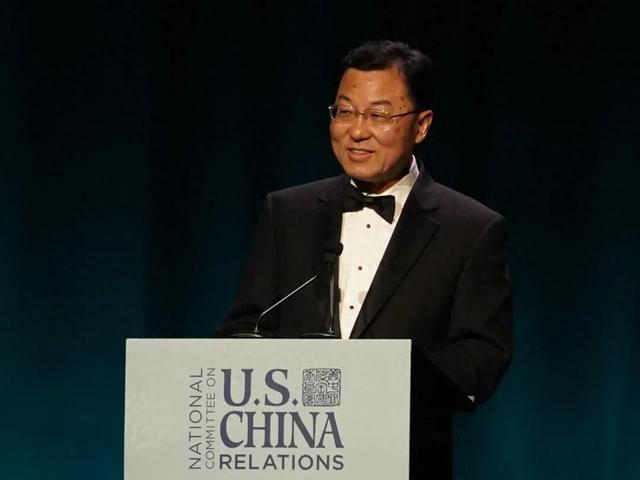
中国驻美大使呼吁美方回归理性 停止极限施压
Xin Hua Wang· 2025-10-15 06:15
Group 1 - The core message emphasizes the need for the U.S. to return to rationality and stop extreme pressure, advocating for dialogue to resolve concerns based on mutual respect and equal consultation [1][2] - The speaker highlights that trade wars and tariff battles yield no winners, and both sides should learn from past experiences that such conflicts only lead to mutual harm [1] - The importance of maintaining a direction of mutual respect, peaceful coexistence, and win-win cooperation is stressed, acknowledging the historical and cultural differences between China and the U.S. [1] Group 2 - The call for collective action to enhance U.S.-China exchanges and cooperation is made, emphasizing the need for both top-down strategic guidance and bottom-up support [2] - The role of the U.S.-China National Council as a bridge for civil exchanges over the past 60 years is recognized, highlighting its contributions to improving bilateral relations [2] - The business community is identified as a stabilizing force in U.S.-China relations, promoting practical cooperation and cultural exchanges [2]
中国驻美大使谢锋:关税战、贸易战打不得 不会有赢家
Zheng Quan Shi Bao Wang· 2025-10-15 06:03
Core Viewpoint - The trade and tariff wars between China and the U.S. are detrimental, with no winners emerging from such conflicts, as emphasized by China's Ambassador to the U.S., Xie Feng [1] Summary by Relevant Sections Trade Relations - Over the past five months, China and the U.S. economic teams have held four meetings, reaching positive consensus to stabilize bilateral economic relations, providing relief to both nations and the global community [1] - Despite these discussions, the U.S. has continued to impose restrictions on Chinese entities, including adding multiple Chinese firms to export control lists shortly after the Madrid talks [1] Economic Impact - The U.S. has implemented measures that significantly harm China's legitimate rights and interests, disrupting international trade and maritime order, and threatening the stability of global supply chains [1] - Following threats from the U.S. to increase tariffs on China, U.S. stock and currency markets reacted negatively, causing global market panic and casting a shadow over the world economy [1] Call for Dialogue - The experience from both sides indicates that trade wars lead to mutual losses, and the only viable solution to disputes is through equality, respect, and reciprocity [1] - China expresses a willingness to avoid conflict but will not tolerate damage to its rights or the disruption of international trade rules, urging the U.S. to return to rationality and resolve issues through dialogue based on mutual respect and equal negotiation [1]
FICC日报:贸易事件波动大,盘面调整-20251015
Hua Tai Qi Huo· 2025-10-15 05:08
1. Report Industry Investment Rating No relevant information provided. 2. Core Viewpoints - Trade events are volatile, with China taking a strong stance in the trade war, leading to a change from morning's volume - shrinking decline to afternoon's volume - expanding decline in the market. The market shows a defensive trend, with high - priced stocks falling and low - priced leading stocks rising. Hot sectors are in adjustment, and cyclical sectors are expected to stabilize and rebound. The strategy of earning basis spread can be gradually implemented [1][2][3] 3. Summary by Directory Market Analysis - **Trade Situation**: Domestically, the Premier emphasized the need to implement counter - cyclical regulation, expand domestic demand, and improve the industrial ecosystem. Internationally, the US implemented final measures for a 301 investigation on China's maritime, logistics, and shipbuilding sectors, and China countered by banning transactions with 5 US - related subsidiaries of Hanwha Ocean Co., Ltd. The Chinese Ministry of Commerce urged the US to correct its wrong practices [1] - **Index Adjustment**: In the spot market, A - share indexes declined, with the Shanghai Composite Index down 0.62% to 3865.23 points and the ChiNext Index down 3.99%. Banking, coal, and food and beverage sectors led the gains, while communication, electronics, non - ferrous metals, and computer sectors led the losses. The trading volume of the Shanghai and Shenzhen stock markets was about 2.6 trillion yuan. Overseas, Powell hinted at a possible halt in balance - sheet shrinkage and a potential 25 - basis - point interest rate cut this month. US stock indexes closed mixed, with the Dow Jones Industrial Average up 0.44% to 46270.46 points [2] - **Futures Market**: In the futures market, the basis of IF, IH, and IM rebounded. The trading volume and open interest of stock index futures increased simultaneously [2] Strategy - Due to China's strong stance in the trade war, the market showed a defensive trend. High - priced stocks continued to fall, low - priced leading stocks rebounded, and cyclical sectors are expected to stabilize. The strategy of earning basis spread can be gradually implemented [3] Macro - economic Charts - The report includes charts showing the relationship between the US dollar index and A - share trends, US Treasury yields and A - share trends, RMB exchange rates and A - share trends, and US Treasury yields and A - share style trends [6][10][12] Spot Market Tracking Charts - **Stock Index Performance**: On October 14, 2025, the Shanghai Composite Index closed at 3865.23, down 0.62%; the Shenzhen Component Index closed at 12895.11, down 2.54%; the ChiNext Index closed at 2955.98, down 3.99%. Other major indexes also showed varying degrees of decline [14] - **Market Volume and Margin Trading**: Charts show the trading volume of the Shanghai and Shenzhen stock markets and the margin trading balance [14] Futures Market Tracking Charts - **Trading Volume and Open Interest**: The trading volume and open interest of IF, IH, IC, and IM all increased. For example, the trading volume of IF was 188092, an increase of 19813, and the open interest was 284388, an increase of 1029 [17] - **Basis**: The basis of IF, IH, and IM rebounded. For instance, the basis of IF's current - month contract was 1.34, an increase of 9.72 [38] - **Inter - delivery Spread**: The report provides data on the inter - delivery spread of stock index futures, including the spread between different contract months such as the next - month and current - month, and the next - season and current - month [47][48]
大越期货原油早报-20251015
Da Yue Qi Huo· 2025-10-15 03:25
Report Industry Investment Rating - Not provided in the content Core View - Overnight crude oil continued to trade weakly. Sino-US trade disputes showed no sign of abating, pressuring oil prices. IEA and OPEC released monthly reports expressing varying degrees of risk of crude oil surplus, further suppressing oil prices. Domestic crude oil has reached its lowest level this year, and there is still a risk of decline without geopolitical positives. Short-term trading is expected in the range of 440 - 450, and long-term investment should be on the sidelines [3] Summary by Directory 1. Daily Prompt - **Fundamentals**: Whether the US will impose a 100% tariff on Chinese exports on November 1st or earlier depends on China's attitude. IEA predicts a surplus of up to 4 million barrels per day in the world oil market next year, while OPEC+ report is less pessimistic, stating that the supply gap will narrow in 2026 [3] - **Basis**: On October 14th, the spot price of Oman crude oil was $64.25 per barrel, and that of Qatar Marine crude oil was $62.91 per barrel, with a basis of $19.58 per barrel, indicating a spot premium over futures [3] - **Inventory**: US API crude oil inventory increased by 2.78 million barrels in the week ending October 3rd, and EIA inventory increased by 3.715 million barrels. Cushing area inventory decreased by 763,000 barrels. As of October 14th, Shanghai crude oil futures inventory remained unchanged at 5.401 million barrels [3] - **Disk**: The 20-day moving average is downward, and the price is below the average [3] - **Main Position**: As of September 23rd, the main position of WTI crude oil was long, with an increase in long positions. As of October 7th, the main position of Brent crude oil was long, with a decrease in long positions [3] - **Expectation**: Short-term trading in the range of 440 - 450, long-term on the sidelines [3] 2. Recent News - **Trade Tensions**: US threats to impose a 100% tariff on Chinese exports may not materialize. Trump expects to reach an agreement with China, and market analysts believe the threat may be more bluster than action [5] - **Oil Price Drop**: Oil prices fell to a five-month low on Tuesday. IEA reported a "large surplus" in crude oil supply, with an expected daily surplus of 3.2 million barrels from this month to June 2026. Despite OPEC+ announcing a small increase in production in November, IEA's prediction reignited concerns about supply surplus [5] 3. Long and Short Concerns - **Likely to Rise**: Threats to refineries and oil fields from the Russia-Ukraine conflict; Trump's tariff threat subsiding [6] - **Likely to Fall**: Easing of the Middle East situation; US government shutdown risk; OPEC+ considering further production increases [6] - **Market Driver**: Short-term weakening of geopolitical conflicts, long-term risk of increased supply [6] 4. Fundamental Data - **Futures Quotes**: Brent crude oil settled at $62.39, down $0.93 or -1.47%; WTI crude oil settled at $58.70, down $0.79 or -1.33%; SC crude oil settled at 451.8 yuan, up 0.30 yuan or 0.07%; Oman crude oil settled at $62.74, down $1.16 or -1.82% [7] - **Spot Quotes**: UK Brent Dtd was at $62.82, down $1.53 or -2.38%; WTI was at $58.70, down $0.79 or -1.33%; Oman crude oil was at $63.26, down $0.99 or -1.54%; Shengli crude oil was at $60.60, down $1.73 or -2.78%; Dubai crude oil was at $63.64, down $1.41 or -2.17% [9] - **Inventory Data**: API and EIA inventory data showed an increase in US crude oil inventory, while Cushing area inventory decreased [3][10][14] 5. Position Data - **WTI Crude Oil**: As of September 23rd, the net long position increased by 4,249 [17] - **Brent Crude Oil**: As of October 7th, the net long position decreased by 61,713 [19]
美欧新关税围剿,家具跨境将错失年底消费旺季?
3 6 Ke· 2025-10-15 02:49
Core Viewpoint - The ongoing "tariff war" is expected to be a significant variable in the fourth quarter of this year, with potential impacts on global trade dynamics and consumer behavior [1]. Group 1: U.S. Tariff Actions - Starting from October 14, the U.S. will impose tariffs ranging from 10% to 25% on imported softwood lumber, upholstered wooden furniture, and finished cabinets/vanities [2]. - Specific tariff rates include 10% on softwood lumber and 10%-25% on upholstered wooden furniture and cabinets, with some rates set to increase in 2026 [2]. - President Trump announced plans to impose an additional 100% tariff on Chinese goods starting November 1, citing China's export controls on rare earths as the reason [2]. Group 2: China’s Response - China has expressed its willingness to engage in dialogue while also indicating readiness to respond to U.S. tariff threats, emphasizing that negotiations should not occur alongside new restrictions [3]. Group 3: EU Tariff Actions - The European Union will impose anti-dumping duties of nearly 90% on hardwood plywood from China starting December 7, 2025, with specific rates for different suppliers [5]. Group 4: Market Reactions and Economic Impact - U.S. stock markets reacted negatively to the tariff news, raising concerns about the impact on global supply chains [7]. - In contrast, the A-share market showed resilience despite initial declines, with China's total trade value reaching 33.61 trillion yuan, a 4% year-on-year increase [7]. - According to Goldman Sachs, U.S. consumers will bear over 55% of the costs associated with the tariffs, while U.S. businesses will absorb 22% [7]. Group 5: Industry-Specific Impacts - The furniture industry is expected to face similar challenges as retailers prepare for the holiday season, with reports indicating a 40% reduction in orders for Halloween costumes due to tariffs [8]. - The shipping market is experiencing price fluctuations, with container shipping rates from Shanghai to the U.S. West Coast showing slight increases, and plans for further rate hikes are in place [9][10].
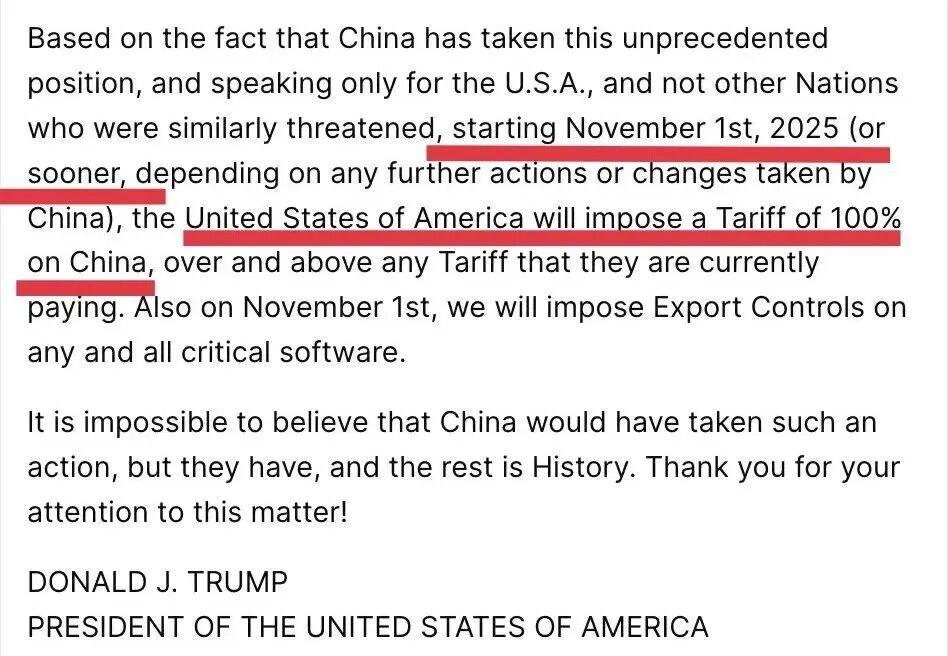
贸易专题分析报告:四月不重演
SINOLINK SECURITIES· 2025-10-15 02:44
Group 1: Current Trade Situation - The likelihood of an escalation in the tariff war is low, as the Trump administration prioritizes reaching a deal rather than unnecessary escalation[1] - The market has developed a "TACO" learning effect, reducing panic compared to the initial trade friction in April[1] - The focus of the current trade friction is on supply chain security, with both sides preparing for negotiations using both incentives and countermeasures[3] Group 2: Recent Developments - On October 10, Trump announced a 100% tariff on all products from China starting November 1, in response to China's export controls on rare earth minerals[3] - The U.S. Bureau of Industry and Security (BIS) introduced the "50% rule," extending export control restrictions to non-U.S. subsidiaries with 50% or more ownership by listed entities[4] - China's countermeasures include strict export controls on rare earth elements, requiring licenses for products containing even 0.1% of Chinese-produced rare earths[4] Group 3: Economic Indicators - China's exports grew by 8.3% year-on-year in September, surpassing the Bloomberg median forecast of 6.6%[8] - The U.S. economy's growth in the first half of 2025 was entirely attributed to private investment in information processing and software, which grew at an annualized rate of 28.3%[20] - The AI investment boom has significantly impacted the U.S. economy, with software investment growth reaching 198% in the second quarter[20] Group 4: Risks and Market Sentiment - Risks include potential unexpected escalation of trade tensions, a possible AI bubble burst leading to systemic financial risks, and Trump's emotional decision-making influenced by domestic political pressures[2][27] - The current market atmosphere is significantly calmer compared to April, with reduced correlation between market movements and trade tensions[19] - Future market focus will shift back to fundamentals, policy changes, external liquidity, regulatory attitudes, and technology narratives[19]
富格林:警戒黑幕筑造可信安全环境
Sou Hu Cai Jing· 2025-10-15 02:25
Group 1 - Spot gold reached a record high of $4180 per ounce before a sharp decline, dropping nearly $90 from the peak, but ultimately closed up 0.77% at $4142.15 per ounce, marking the third consecutive day of gains [1] - Federal Reserve Chair Powell indicated that market liquidity is tightening and that the balance sheet reduction may be nearing its end in the coming months; he noted that while recent economic activity data has exceeded expectations, it has not yet translated into a recovery in hiring, raising concerns about employment market risks [1] - Fed's Bowman continues to expect two more rate cuts by the end of this year [1] Group 2 - The IEA maintained its forecast for global oil demand growth at 699,000 barrels per day for 2026, while predicting a record supply surplus next year [1] - The IMF has raised its global growth forecast for 2025, citing that trade wars may hinder global output [1]
申银万国期货:贸易战与降息预期共振 黄金“避风港”地位空前稳固
Jin Tou Wang· 2025-10-15 02:17
路透社指出,投资者正将黄金作为"政策不确定性与利率见顶后的主要对冲工具"。 美国银行、法国兴 业银行及渣打银行均上调了金价中长期预期,认为黄金有望在2026年前后冲击5000美元/盎司。 【机构观点】 【宏观消息】 来自东西方经济体的黄金需求罕见同步,正推动贵金属进入潜在重估阶段。美国当前36万亿美元国债 中,黄金储备价值仅占约2%,而20世纪70年代这一比例为17%,40年代接近40%。"若重新回到历史水 平,金价可能被动对应至每盎司2.5万至5.5万美元。"这并非具体目标价,而是展示黄金"被低估的结构 性程度"。 【黄金期货行情表现】 10月14日,沪金主力暂报938.98元/克,涨幅达2.70%,今日沪金主力开盘价929.50元/克,截至目前最高 958.10元/克,最低929.14元/克。 随着对贸易战再度升温的担忧,黄金再度从中收益。对年内两次降息的押注也愈发强烈。节日期间黄金 已经展现其强势,美联储谨慎表态、美元走强、远好于预期的9月非农等传统利空因素未对黄金形成打 压,美国政府"停摆"持续发酵。体现在美国财政赤字、债务状况持续恶化,全球对抗加剧,对当前金融 体系不信任度上升背景下,黄金成为终极安 ...