
以旧换新

Search documents
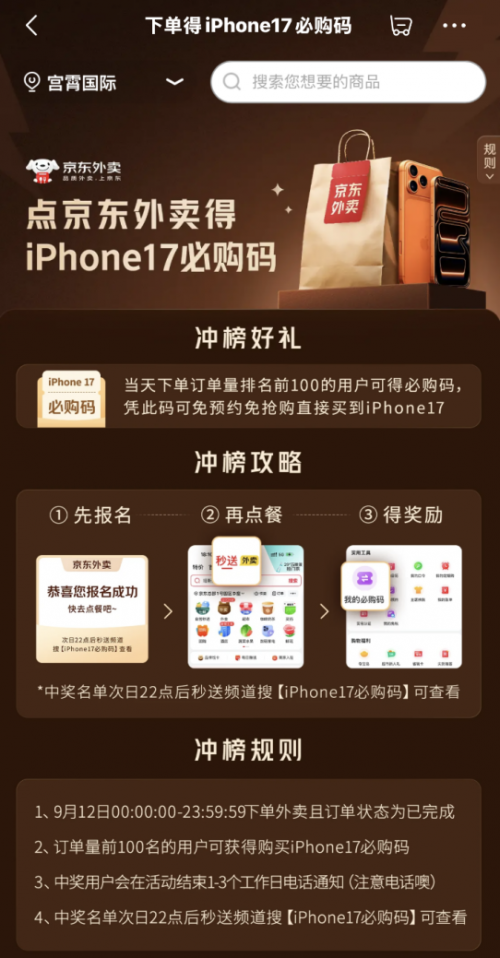
iPhone 17今晚8点开启预购 来点京东外卖有机会得必购码
Sou Hu Wang· 2025-09-12 09:18
Group 1 - Apple officially launched the iPhone 17 series, including iPhone 17, iPhone 17 Air, iPhone 17 Pro, and iPhone 17 Pro Max, with pre-orders starting on September 12 and official sales on September 19 [1] - JD.com is offering a special promotion where the top 100 users who place orders on September 12 can receive a purchase code to skip the reservation process for the iPhone 17 [1] - JD.com has invested 1 billion yuan to subsidize users for upgrading to the iPhone 17, with trade-in subsidies up to 2,100 yuan and additional discounts for specific models [3] Group 2 - Customers purchasing the iPhone 17 through JD.com can enjoy multiple benefits, including up to 85% off on iCloud and AppleCare, and up to 90% off on App Store recharge cards [4] - JD.com offers minute-level delivery for Apple products, allowing customers to quickly obtain the new iPhone 17 series from nearly 10,000 authorized stores nationwide [6] - The promotion encourages users to search for "Apple New Product Benefits" on the JD.com app to access various subsidies and fast delivery options [6]


家电ETF(159996)持续吸金,近5日净流入超2.3亿元,机构:行业整体供需态势向好
Mei Ri Jing Ji Xin Wen· 2025-09-12 07:04
Group 1 - The core viewpoint is that the white goods industry is expected to achieve double growth in revenue and profit in the first half of 2025, driven by the domestic "trade-in" policy and strong performance in emerging overseas markets [1] - Despite facing tariff pressures, companies are enhancing profitability through cost reduction and efficiency improvements, with overall gross margins remaining stable and profit improvements mainly coming from optimized sales expense ratios [1] - The domestic market shows limited effects from policy preemption, while a new round of quota-based national subsidies is expected to continue driving demand; in the export market, expectations of interest rate cuts in the U.S. may boost demand in the real estate chain, and growth momentum in emerging markets remains strong [1] Group 2 - The home appliance ETF (159996) tracks the home appliance index (930697), which selects listed companies involved in the manufacturing and sales of traditional and smart home appliances like refrigerators, air conditioners, and washing machines, reflecting the overall performance of related listed companies [1] - This index is characterized by prominent consumer attributes and relatively weak industry cyclicality [1] - Investors without stock accounts may consider the Guotai CSI All-Share Home Appliance ETF Connect A (008713) and Guotai CSI All-Share Home Appliance ETF Connect C (008714) [1]
中信期货晨报:商品期货多数上涨,中小盘股指涨幅较好-20250912
Zhong Xin Qi Huo· 2025-09-12 05:11
1. Report Industry Investment Rating - No relevant content provided. 2. Core Viewpoints of the Report - The report notes that most commodity futures rose, and small - and mid - cap stock index futures had good gains. In the overseas market, the US labor market shows a clear slowdown trend, and the weak non - farm data increases the probability of a September interest rate cut. In the domestic market, the PPI is expected to see a slight increase in the central value, while the CPI may be slightly lower than the first - half level. Short - term domestic assets present mainly structural opportunities, with a higher probability of incremental policies in the fourth quarter. Overseas, the situation is generally favorable for gold. Long - term US fundamentals are fair, and a weak US dollar pattern continues [6]. 3. Summary by Related Catalogs 3.1 Market Performance - **Stock Index Futures**: The CSI 300 futures closed at 4562, up 2.92% daily, 2.37% weekly, 1.24% monthly, 17.40% quarterly, and 16.35% year - to - date. The SSE 50 futures closed at 2990.2, up 1.78% daily, 1.68% weekly, 0.34% monthly, 11.20% quarterly, and 11.66% year - to - date. The CSI 500 futures closed at 7124.6, up 3.81% daily, 3.28% weekly, 1.83% monthly, 21.52% quarterly, and 25.11% year - to - date. The CSI 1000 futures closed at 7387.8, up 3.31% daily, 2.24% weekly, 0.29% monthly, 20.15% quarterly, and 26.32% year - to - date [3]. - **Treasury Bond Futures**: The 2 - year Treasury bond futures closed at 102.41, up 0.06% daily, 0.02% weekly, - 0.01% monthly, - 0.22% quarterly, and - 0.55% year - to - date. The 5 - year Treasury bond futures closed at 105.59, up 0.16% daily, 0.00% weekly, 0.07% monthly, - 0.63% quarterly, and - 0.89% year - to - date. The 10 - year Treasury bond futures closed at 107.58, up 0.08% daily, - 0.34% weekly, - 0.21% monthly, - 1.24% quarterly, and - 1.23% year - to - date. The 30 - year Treasury bond futures closed at 114.74, down 0.02% daily, - 1.38% weekly, - 1.55% monthly, - 4.61% quarterly, and - 3.44% year - to - date [3]. - **Foreign Exchange**: The US dollar index was at 97.8433, unchanged daily, up 0.11% weekly, unchanged monthly, up 1.11% quarterly, and down 9.81% year - to - date. The euro - US dollar exchange rate was 1.1695, with 0 pips change daily, - 24 pips weekly, 9 pips monthly, - 93 pips quarterly, and 1342 pips year - to - date. The US dollar - yen exchange rate was 147.46, with 0 pips change daily, up 0.03% weekly, up 0.28% monthly, up 2.40% quarterly, and down 6.20% year - to - date [3]. - **Overseas Commodities**: NYMEX WTI crude oil was at $63.75, up 1.56% daily, 2.87% weekly, - 0.41% monthly, - 1.88% quarterly, and - 11.30% year - to - date. ICE Brent crude oil was at $67.6, up 1.61% daily, 2.94% weekly, 0.21% monthly, 1.46% quarterly, and - 9.66% year - to - date. COMEX gold was at $3680.4, up 0.45% daily, 1.12% weekly, 4.67% monthly, 11.02% quarterly, and 39.45% year - to - date [3]. 3.2 Macro Situation - **Overseas Macro**: The US released August non - farm data, with only 22,000 new jobs, lower than the previous value and expectations. The labor market's downward risk has increased, and wage growth has slowed. The number of initial and continued unemployment claims shows that the labor market slowdown is becoming more obvious [6]. - **Domestic Macro**: In August, the PPI rebounded from - 3.6% to - 2.9% year - on - year, while the CPI dropped from 0% to - 0.4% year - on - year. The tail - wagging effect had a large impact, and food prices dragged down the CPI. The PPI's month - on - month rebound to 0 and the core CPI's rise to 0.9% indicate that domestic policies are starting to take effect. The PPI central value is expected to rise slightly, and the CPI may be slightly lower than the first - half level [6]. 3.3 Asset Views - **Short - term**: Domestic assets mainly present structural opportunities. The market sentiment has cooled down after important domestic events this week. In the overseas market, the weak US non - farm data increases the probability of a September interest rate cut, which is favorable for gold. - **Long - term**: The US fundamentals are fair, and interest rate cuts are expected to boost the fundamentals. The weak US dollar pattern continues, and investors should be vigilant about volatility spikes and focus on non - US dollar assets [6]. 3.4 Viewpoint Highlights - **Financial Sector**: Stock index futures should adopt a dumbbell structure to deal with market differences; stock index options should continue the hedging and defensive strategy; the stock - bond seesaw may continue in the short term for Treasury bond futures. All are expected to be in a volatile state [7]. - **Precious Metals**: Driven by dovish expectations, the prices of gold and silver are expected to rise in a volatile manner, as the probability of a September interest rate cut in the US increases, and the risk of the Fed's loss of independence expands [7]. - **Shipping Sector**: For the container shipping to Europe route, attention should be paid to the game between peak - season expectations and price - increase implementation. Steel and iron ore are expected to be volatile, with the impact of production restrictions on steel weakening and iron ore showing an unexpected decline in molten iron production and a slight increase in port inventories [7]. - **Black Building Materials**: Despite the "anti - involution" impact, the prices of varieties in this sector are still supported during the peak season. However, most varieties are expected to be in a volatile state, such as coke starting the first - round price cut after the end of military parade - related production restrictions, and the supply of coking coal significantly decreasing [7]. - **Non - ferrous Metals and New Materials**: Affected by the better - than - expected July China's import and export data, non - ferrous metals were initially boosted. However, most varieties are expected to be volatile, with some facing downward pressure, such as copper due to the rising risk of overseas recession [7]. - **Energy and Chemicals**: The supply - demand situation of crude oil has weakened significantly, and coking coal's decline has dragged down the chemical industry. Most varieties in this sector are expected to be volatile, with some facing downward pressure, such as PP due to the increasing pressure of new production capacity [9]. - **Agricultural Sector**: The agricultural market is in a narrow - range volatile state, waiting for the results of field inspections. Most agricultural products are expected to be volatile, such as livestock products facing a supply - demand imbalance and rubber facing pressure from previous highs [9].
金融期货早评-20250912
Nan Hua Qi Huo· 2025-09-12 03:31
Report Industry Investment Ratings No relevant content provided. Core Views of the Report Macro and Financial Futures - The implementation of domestic service - consumption stimulus policies may form a synergistic effect with commodity - consumption boosting measures to support the growth of total retail sales of consumer goods, but the actual effect needs further observation. Overseas, the CPI data rebounded in August, and the weakening of the US employment market has increased the market's bet on the Fed's interest rate cut. The Fed's interest rate dot - plot will be the focus of the market [1]. - The US dollar index is in a volatile range. The US dollar - RMB exchange rate is likely to fluctuate between 7.10 - 7.16 this week. Export enterprises are advised to lock in forward exchange settlement in batches at the upper edge of the exchange - rate range, and import enterprises can adopt a rolling foreign - exchange purchase strategy near the 7.10 mark [2][3]. Stock Index - The sentiment and capital situation of the stock index have improved, and it is expected to be strong in the short term. However, if the stock index continues to rise rapidly, there will be a need for adjustment due to over - heated sentiment [4]. Treasury Bonds - The bond market rebounded due to rumors of the central bank restarting bond purchases. The central bank's attitude needs to be closely watched, and it is recommended to wait and see for the time being [4][5]. Shipping - The new weekly opening quotes of Maersk are lower than the previous values, and CMA CGM and Evergreen have also followed up and lowered their quotes for European routes, which is likely to drive down the futures price valuation. It is recommended to operate with a quick - in - and - quick - out strategy [8]. Commodities Precious Metals - Precious metals are in a high - level shock. In the medium and long term, they may be bullish. In the short term, gold and silver are in a high - level consolidation. It is advisable to maintain the idea of buying on dips [9][11]. Copper - US inflation - related data are lower than expected, which increases the expectation of interest rate cuts and causes the copper price to strengthen slightly. It is recommended to sell out - of - the - money put options [12]. Aluminum Industry Chain - For aluminum, the macro environment is favorable, and the short - term trend is expected to be strong, but investors should be cautious about chasing high prices. For alumina, the supply is in excess, and the price is expected to be weak. For cast aluminum alloy, the cost provides support, and it is advisable to consider arbitrage operations [13][14][15]. Zinc - In the short term, the zinc price is in a bottom - strengthening shock. It is advisable to continue to observe the LME inventory approaching the extreme value or sell out - of - the - money put options [16]. Nickel and Stainless Steel - They maintain a shock trend, with limited downward space [17][18]. Tin - Affected by US PPI data, the tin price has risen slightly. It is recommended to sell out - of - the - money put options [19]. Lithium Carbonate - The "Golden September and Silver October" downstream peak - season demand provides support for the lithium - carbonate price, and short - term supply - side disturbances do not change the fundamental support logic [20][21]. Industrial Silicon and Polysilicon - In the short term, the Inner Mongolia meeting has a positive impact on sentiment. In the long term, the industry is under structural pressure. The polysilicon market is affected by news and policy expectations, and investors are advised to be cautious [22][23]. Lead - The lead price is in a narrow - range shock. It is advisable to consider selling out - of - the - money call options or using a double - selling strategy [24]. Black Metals Rebar and Hot - Rolled Coil - The supply of crude steel has recovered, but the overall supply of the five major steel products has decreased. The steel inventory pressure is large, and the steel price is expected to continue to fluctuate weakly [26][27]. Iron Ore - The iron - ore price is difficult to rise unilaterally. It is recommended to take profit on long positions [28]. Coking Coal and Coke - A second - round price cut is expected. The coal - coke market is expected to maintain a wide - range shock pattern in the short term [29]. Ferrosilicon and Silicomanganese - Their trends mainly follow the coking - coal price. It is recommended to lightly try long positions on the main contracts, but beware of the risk of a sharp fall after a rise [30][31]. Energy and Chemicals Crude Oil - Production increase dominates the oil - price trend. It is recommended to short on rallies [33]. LPG - It maintains a shock trend. The domestic supply is controllable, and the demand is slightly weakened [34][35]. PTA - PX - The industrial profit is under pressure, but the support is strengthening. It is recommended to expand the processing margin below 260 and try to lay out long positions on TA01 below 4650 [35][38]. MEG - Bottle Chip - There is a pre - expected inventory build - up. It is recommended to wait and see and look for opportunities to short on rallies [39][40]. PP - The cost provides support, and it is expected to be stronger than PE in the short term [41][43]. PE - The current driving force is weak. It is expected to be in a shock pattern, and further demand increase signals need to be awaited [44][45]. Pure Benzene and Styrene - They follow the cost - end fluctuations. Pure benzene is expected to be weak in the short term, and styrene is in a shock state and it is advisable to wait and see [45][47]. Fuel Oil - It follows the cost fluctuations. It is recommended to wait to short the cracking spread [46][47]. Low - Sulfur Fuel Oil - It is recommended to wait to go long on the cracking spread [48]. Asphalt - The demand is affected by rainfall, but the inventory is improving. It is advisable to try long positions after the crude - oil price stabilizes [49][50]. Rubber and 20 - Number Rubber - The downstream operating rate has increased, and the domestic demand is resilient. It is recommended to consider short - term long positions [50][52]. Glass, Soda Ash, and Caustic Soda Soda Ash - The supply is expected to remain high in the medium and long term. The supply - demand pattern is one of strong supply and weak demand, and attention should be paid to cost and supply expectations [53]. Glass - The supply is expected to be stable or slightly increase. The market is in a weak - balance to weak - surplus state. Attention should be paid to supply, cost, and demand factors [54]. Caustic Soda - The near - end spot price is strong, and the inventory is decreasing. Attention should be paid to the spot rhythm, peak - season performance, and downstream stocking enthusiasm [55][56]. Pulp - The fundamental improvement is not obvious. It is recommended to wait and see and not chase short positions [56][57]. Logs - There are no new factors, and it is in a shock state. It is advisable to wait and see [57]. Summaries According to the Catalog Financial Futures - **Macro**: Domestic service - consumption stimulus policies are expected to be introduced, and overseas, the US employment market is weakening, increasing the expectation of Fed interest rate cuts [1]. - **RMB Exchange Rate**: The US dollar - RMB exchange rate is expected to fluctuate between 7.10 - 7.16 this week. Different strategies are recommended for export and import enterprises [2][3]. - **Stock Index**: The sentiment and capital situation have improved, and it is expected to be strong in the short term, but there is a risk of adjustment [4]. - **Treasury Bonds**: The bond market rebounded, and the central bank's attitude is the focus. It is recommended to wait and see [4][5]. Shipping - Maersk's new quotes and the follow - up actions of other shipping companies drive down the futures price valuation. A quick - in - and - quick - out strategy is recommended [8]. Commodities Precious Metals - The inflation data are in line with expectations, and the employment market is cooling. Precious metals are in a high - level shock, and a long - on - dips strategy is recommended [9][11]. Copper - US inflation data increase the expectation of interest rate cuts, and the copper price strengthens slightly. Selling out - of - the - money put options is recommended [12]. Aluminum Industry Chain - For aluminum, the macro and fundamental factors are favorable, but investors should be cautious. For alumina, the supply is excessive. For cast aluminum alloy, the cost provides support [13][14][15]. Zinc - The supply is in excess, and the demand is average. The short - term trend is a bottom - strengthening shock [16]. Nickel and Stainless Steel - They maintain a shock trend, with limited downward space [17][18]. Tin - Affected by US PPI data, the tin price rises slightly. Selling out - of - the money put options is recommended [19]. Lithium Carbonate - The downstream peak - season demand supports the price, and short - term supply disturbances do not change the fundamentals [20][21]. Industrial Silicon and Polysilicon - The short - term sentiment is supported, but the long - term industry is under structural pressure. The polysilicon market is affected by news and policies [22][23]. Lead - The lead price is in a narrow - range shock. It is advisable to consider option - selling strategies [24]. Black Metals Rebar and Hot - Rolled Coil - The crude - steel supply has recovered, but the overall supply of the five major steel products has decreased, and the inventory pressure is large [26][27]. Iron Ore - The price is difficult to rise unilaterally due to weak demand. Taking profit on long positions is recommended [28]. Coking Coal and Coke - A second - round price cut is expected, and the market is in a wide - range shock in the short term [29]. Ferrosilicon and Silicomanganese - Their trends follow coking coal. Lightly trying long positions is recommended, but beware of risks [30][31]. Energy and Chemicals Crude Oil - Production increase leads to a decline in oil prices. A short - on - rallies strategy is recommended [33]. LPG - It maintains a shock trend, with controllable supply and slightly weakened demand [34][35]. PTA - PX - The industrial profit is under pressure, but the support is strengthening. Processing - margin expansion and long - position layout strategies are recommended [35][38]. MEG - Bottle Chip - There is a pre - expected inventory build - up. It is recommended to wait and look for short - on - rallies opportunities [39][40]. PP - The cost provides support, and it is expected to be stronger than PE in the short term [41][43]. PE - The current driving force is weak, and it is in a shock pattern, awaiting demand increase signals [44][45]. Pure Benzene and Styrene - They follow cost fluctuations. Pure benzene is expected to be weak, and styrene is in a shock state [45][47]. Fuel Oil - It follows cost fluctuations. Waiting to short the cracking spread is recommended [46][47]. Low - Sulfur Fuel Oil - Waiting to go long on the cracking spread is recommended [48]. Asphalt - The demand is affected by rainfall, and the inventory is improving. Trying long positions after crude - oil price stabilization is advisable [49][50]. Rubber and 20 - Number Rubber - The downstream operating rate has increased, and the domestic demand is resilient. Short - term long positions can be considered [50][52]. Glass, Soda Ash, and Caustic Soda Soda Ash - The supply is expected to remain high, and the supply - demand pattern is one of strong supply and weak demand [53]. Glass - The supply is stable or slightly increasing, and the market is in a weak - balance to weak - surplus state [54]. Caustic Soda - The near - end spot is strong, and the inventory is decreasing. Spot rhythm and demand need to be watched [55][56]. Pulp and Logs Pulp - The fundamental improvement is not obvious. It is recommended to wait and not chase short positions [56][57]. Logs - There are no new factors, and it is in a shock state. It is advisable to wait and see [57].
价格分化?不慌!8月数据透露修复到了关键节点
Jing Ji Guan Cha Wang· 2025-09-10 15:22
Core Insights - The price data for August 2025 shows a divergence between CPI and PPI, indicating a gradual recovery from low levels [1][2][5] - CPI decreased by 0.4% year-on-year, while PPI fell by 2.9% year-on-year, with both indices remaining stable month-on-month [1][4] CPI Analysis - The CPI decline is characterized by a 0.3% decrease in urban areas and a 0.6% decrease in rural areas, with food prices dropping by 4.3% and non-food prices rising by 0.5% [2][3] - Core CPI, excluding food, increased by 0.9% year-on-year, marking a continuous rise for four months, driven by policies like "old-for-new" subsidies and rising international gold prices [2][3] PPI Analysis - The PPI's year-on-year decline of 2.9% shows a narrowing of the drop by 0.7 percentage points compared to the previous month, with industrial producer purchase prices down by 4.0% year-on-year [4][7] - The recovery of PPI is contingent on sustained "de-involution" policies and timely demand-side stimulus [4][6] Consumer Demand and Price Recovery - Consumer demand is at a critical recovery stage, with expectations of a gradual CPI increase as counter-cyclical policies take effect [5][6] - The improvement in consumer goods prices is attributed to the implementation of consumption promotion policies and the gradual restart of "old-for-new" programs [3][5] Sector-Specific Price Movements - Certain sectors, such as coal and steel, have seen price increases due to improved market competition and demand, with coal processing prices rising by 9.7% in August [6][7] - High-tech product demand is also contributing to price increases in related industries, with integrated circuit packaging prices up by 1.1% year-on-year [6][7]

iPhone17超“燃”发布 苏宁易购加码2200元换新补贴
Zhong Jin Zai Xian· 2025-09-10 09:48
Core Points - Apple launched its latest flagship products including the iPhone 17 series, Apple Watch Series 11/Ultra 3/SE 3, and AirPods Pro 3 during the "Supercharged" event on September 10, with pre-orders starting on September 12 and global sales commencing on September 19 [1] Product Details - The iPhone 17 series consists of four models: iPhone 17, iPhone 17 Air, iPhone 17 Pro, and iPhone 17 Pro Max, with starting prices of 5999 yuan, 7999 yuan, 8999 yuan, and 9999 yuan respectively. The new Air model features a 6.5-inch screen and a thickness of 5.6mm, making it the thinnest iPhone to date [1] - The iPhone 17 standard model is equipped with the A19 chip and introduces 120Hz ProMotion adaptive refresh rate technology. The other three models utilize the A19 Pro chip, with graphics processing speed improved by up to 30% and CPU performance enhanced by 40% compared to the previous A18 Pro, ensuring smooth performance in high-load gaming and multitasking scenarios [2] Promotional Activities - Suning.com has initiated a trade-in program for the iPhone, offering up to 2200 yuan in subsidies and limited-time 24-month interest-free installment plans [1] - Suning's offline stores and app have opened reservations, and users upgrading to the Suning Bee Card can access priority purchasing channels and receive a service package valued at 1099 yuan, which includes exclusive services like 365-day exchange without repair, free battery replacement, and free screen replacement [4]


博西家电胡博瀚:深耕渠道,寻求中国顶奢电器市场增量
2 1 Shi Ji Jing Ji Bao Dao· 2025-09-10 08:04
Core Insights - The luxury home appliance market in China is gaining attention, particularly with the recent launch of GAGGENAU's new flagship series after 20 years, indicating a strategic shift in response to market trends [1][5] Market Dynamics - The "trade-in" policy and market cycles are driving product upgrades in the Chinese home appliance market, with GAGGENAU focusing on high-end appliances where the connection to "trade-in" is less direct [2][3] - The overall slowdown in the real estate market is impacting the home appliance industry, prompting GAGGENAU to explore new sales channels for stable growth [2][3] Retail Strategy - GAGGENAU has opened more retail stores, including the largest flagship store in Shanghai and a new store in Beijing, aiming to create more consumer touchpoints and enhance brand experience [3][4] - Collaborations with cabinet makers and designers are being strengthened to better reach target consumers who prioritize overall home design [3][4] Consumer Trends - High-net-worth consumers are increasingly focused on how products integrate into overall home aesthetics and are looking for kitchens to serve as social spaces [4][5] - There is a growing demand for personalized consultation experiences, with GAGGENAU offering luxury-level services post-purchase, including home styling and cooking classes [5] Product Strategy - GAGGENAU's new product line reflects a minimalist design philosophy, adhering to Bauhaus aesthetics, which aligns with the brand's positioning as a global luxury appliance brand [5][6] - The new products incorporate digital and smart technologies to enhance user experience in cooking and baking [6]
国联民生证券25H1家电行业财报综述:白电内销景气向上 清洁龙头高增
Zhi Tong Cai Jing· 2025-09-10 07:14
Group 1: Overall Industry Performance - The home appliance sector's revenue in Q2 2025 increased by 4.78% year-on-year to 431.5 billion yuan, with net profit attributable to shareholders rising by 3.38% to 38.1 billion yuan, indicating steady growth [1] - The "trade-in for new" policy is driving domestic demand, with the white goods segment showing an upward trend in domestic sales [1] Group 2: White Goods Sector - The white goods segment's revenue in Q2 2025 grew by 4.64% year-on-year to 303.2 billion yuan, supported by favorable domestic policies and increased demand for air conditioning due to high temperatures [2] - The net profit attributable to shareholders in the white goods sector increased by 6.08% year-on-year to 30.6 billion yuan, with a significant improvement in operating cash flow, which rose by 48.18% [2] Group 3: Black Goods Sector - The black goods segment's revenue in Q2 2025 rose by 5.81% year-on-year to 50.8 billion yuan, with improvements in product structure and a relatively stable cost environment for LCD TV panels [3] - However, the net profit attributable to shareholders in the black goods sector decreased by 1.04% year-on-year to 1.033 billion yuan, reflecting a divergence in financial performance among leading brands [3] Group 4: Kitchen Appliances Sector - The kitchen appliances segment experienced a revenue decline of 6.95% year-on-year to 12.4 billion yuan, primarily due to sluggish real estate conditions and increased difficulty in claiming subsidies [4] - The net profit attributable to shareholders in the kitchen appliances sector fell by 16.75% year-on-year to 1.96 billion yuan, indicating a decline in profitability [4] Group 5: Smart Home Sector - The smart home segment saw a significant revenue increase of 32.09% year-on-year to 12.564 billion yuan, driven by domestic promotions and overseas market growth [5] - However, the net profit attributable to shareholders in the smart home sector decreased by 12.95% year-on-year to 1.026 billion yuan due to increased marketing expenditures [5] Group 6: Traditional Small Appliances Sector - The traditional small appliances segment's revenue declined by 0.69% year-on-year to 23.1 billion yuan, with some companies experiencing negative growth due to changes in tariff policies and weakened external demand [6] - The net profit attributable to shareholders in this sector fell by 12.44% year-on-year to 1.344 billion yuan, reflecting pressure on profitability [6]

2025H1家电行业财报综述:稳中有进
Guolian Minsheng Securities· 2025-09-10 07:13
Investment Rating - The report maintains an "Outperform" rating for the home appliance industry [8][15]. Core Insights - The home appliance sector shows steady growth, with white goods domestic sales improving and external tariff impacts becoming evident. Leading brands demonstrate resilience, while cleaning product leaders experience high growth. Increased marketing expenses in discretionary categories have led to a slight decline in profitability. Future outlook suggests that trade-in programs will support domestic demand, and leading brands along with emerging categories will contribute to revenue growth, indicating investment value [4][15]. Summary by Sections Overall Performance - In Q2 2025, the home appliance sector's revenue increased by 4.78% year-on-year to 431.5 billion yuan, with a net profit attributable to shareholders rising by 3.38% to 38.1 billion yuan. The first half of 2025 saw revenue growth of 8.59% to 842.6 billion yuan and net profit growth of 11.23% to 71.2 billion yuan. The cost environment improved due to a decline in raw material prices and shipping costs [19][29]. White Goods - The white goods segment's revenue grew by 4.64% year-on-year to 303.2 billion yuan in Q2 2025, with net profit increasing by 6.08% to 30.6 billion yuan. Domestic demand is supported by favorable policies and high temperatures driving air conditioning needs. However, external sales showed weakness due to tariff impacts [10][20]. Black Goods - The black goods segment reported a revenue increase of 5.81% year-on-year to 50.8 billion yuan, but net profit decreased by 1.04% to 1.0 billion yuan. The segment faced challenges from fluctuating U.S. tariff policies and varying performance between self-owned brands and OEMs [11][29]. Kitchen Appliances - Kitchen appliance revenue declined by 6.95% year-on-year to 12.4 billion yuan, with net profit down by 16.75% to 1.96 billion yuan. The decline is attributed to sluggish real estate conditions and increased difficulty in subsidy applications [12][19]. Smart Home - The smart home segment experienced a significant revenue increase of 32.09% year-on-year to 12.6 billion yuan, although net profit fell by 12.95% to 1.0 billion yuan due to increased marketing expenditures [13][19]. Traditional Small Appliances - Revenue for traditional small appliances decreased by 0.69% year-on-year to 23.1 billion yuan, with net profit down by 12.44% to 1.3 billion yuan. The segment faced challenges from changing tariff policies and reduced external demand [14][19]. Upstream Performance - The upstream sector saw a revenue increase of 5.07% year-on-year to 29.5 billion yuan, with net profit rising by 12.56% to 2.2 billion yuan. The upstream segment's profitability improved due to better cost management [19][25].



渤海证券研究所晨会纪要(2025.09.08)-20250908
BOHAI SECURITIES· 2025-09-08 03:02
Macro and Strategy Research - The U.S. economy is experiencing a shift in the balance of risks between inflation and employment, with a potential monetary policy shift expected in September. The focus is on August's non-farm payroll and inflation data, as well as adjustments to the annual non-farm benchmark [2] - In Europe, economic expectations are improving, and stable inflation allows the European Central Bank (ECB) to maintain current policy rates. ECB President Lagarde indicated that trade negotiations are not posing significant threats to monetary policy [2] Domestic Economy - Domestic economic growth slowed in July due to extreme weather and policy expectations, characterized by strong external demand and weak internal demand. Future external demand growth is expected to be supported by a weakening U.S. demand and a reshaped long-term trade landscape [3] - The domestic policy environment emphasizes stabilizing market expectations and strengthening the domestic circulation, with structural monetary policies focusing on inclusive finance and technological innovation [3][4] Fixed Income Research - In August, the central bank injected a net liquidity of 386.5 billion yuan, maintaining low funding prices. The issuance of interest rate bonds decreased to 3 trillion yuan, with net financing increasing to 1.7 trillion yuan [6][7] - The bond market is expected to face pressure from external demand uncertainties and "anti-involution" measures, with a focus on the stability of the funding environment in September [8] Industry Research - The medical insurance payment management method was introduced in August, and the 11th batch of centralized procurement is progressing. The medical care CPI in July was 100.5, with a year-on-year increase of 0.5% [9][10] - The pharmaceutical manufacturing industry reported a cumulative revenue of 1,401.07 billion yuan from January to July, a year-on-year decrease of 1.7%, while cumulative profits fell by 2.6% [10] - The upcoming World Lung Cancer Conference (WCLC) is expected to provide opportunities for innovation in the pharmaceutical and medical device sectors, with a focus on companies benefiting from optimized procurement rules and the recovery of domestic demand [10]