
PPI

Search documents
“反内卷”行动下,CPI和PPI为何走势分化?
Xin Lang Cai Jing· 2025-09-11 09:37
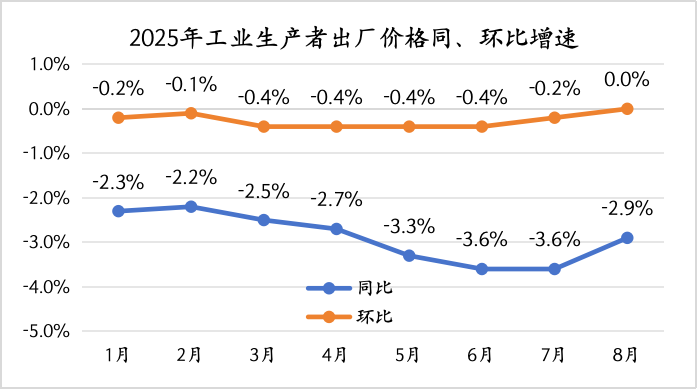
记者 王珍 8月,我国物价走势呈现 "一升一降" 的分化特征:工业品出厂价格指数(PPI)迎来积极变化,同比降 幅自3月以来首次收窄,环比今年以来首次止跌,但居民消费价格指数(CPI)同比由平转负、环比涨 幅收窄。 分析师认为,PPI跌幅收窄很大程度上得益于"反内卷"政策的催化,在遏制无序竞争、推进产能治理的 作用下,煤炭、钢铁等上游原材料价格改善明显。 对于PPI和CPI走势分化,东北证券资深宏观分析师张超越对智通财经指出,PPI向CPI的传导本身并不 会一蹴而就。一方面,在成本价格稍有抬升,但总需求相对平稳阶段,企业为了维护市场份额,通常不 会贸然提价并将成本完全转移给消费者,供应链会率先消化上游的部分价格涨幅。 "另一方面,房租,旅游、医疗、教育等服务类项目在CPI中权重占比较高,而这些项目与民生相关,价 格通常较为稳定,故CPI通胀对PPI通胀的弹性本身就不会很高。"张超越说。 财信金控首席经济学家伍超明对智通财经表示,本轮"反内卷"对CPI的推升作用或明显弱于2015-16年供 给侧结构性改革时期。一是,本轮反内卷更加注重通过法治化、市场化方式优化市场秩序,相关行业产 能去化幅度和节奏相对偏弱偏慢; ...

2025年8月物价点评:物价总体延续低位运行
Hua Yuan Zheng Quan· 2025-09-11 08:32
Group 1: Report Industry Investment Rating - No information about the industry investment rating is provided in the report. Group 2: Report's Core View - In August, the price index was under marginal pressure, with both CPI and PPI year-on-year in the negative range. The year-on-year decline of CPI was 0.4%, and the month-on-month was flat. The year-on-year decline of PPI narrowed to 2.9%, and the month-on-month turned from decline to flat [1]. - The year-on-year pressure on CPI and flat month-on-month may be affected by the seasonal weakness of food prices and high base. In the future, food prices in September may continue to be under pressure due to high base, while service prices may continue to recover in the second half of the year [1]. - The year-on-year decline of PPI narrowed for the first time in six months. The month-on-month turn to flat was mainly affected by policy-driven supply-demand improvement and imported factors. In the future, the prices of production materials in September may continue to pick up, while the stabilization of living materials may depend on the repair of food PPI [1]. - The downward pressure on the economy may increase in the second half of the year. In August, the year-on-year growth rate of prices was lower than expected, and the manufacturing PMI continued to be below the boom-bust line, indicating growth pressure. Consumption and exports may face certain pressure in the second half of the year [1]. - The short-term bond market may be suppressed by sentiment, and the bond market is bullish in September. It is believed that the downward pressure on the economy may increase in the second half of the year, the capital side will continue to be loose, the central bank may restart Treasury bond purchases, and the self-operated allocation demand of banks will support the decline of bond market interest rates [1]. Group 3: Summary by Related Content CPI Situation - In August 2025, CPI year-on-year decreased by 0.4%, month-on-month was flat, both down 0.4 percentage points from the previous month. The year-on-year increase of core CPI continued to expand to 0.9% for the fourth consecutive month, reflecting the improvement trend of domestic demand [1]. - The year-on-year decline of CPI food prices has been negative for seven consecutive months. In August 2025, it decreased by 4.3% year-on-year, with the decline expanding by 2.7 percentage points from the previous month. Food and tobacco had a drag of about -0.74 percentage points on CPI year-on-year. Non-food prices increased by 0.5% year-on-year, with the increase expanding for three consecutive months, mainly driven by industrial consumer goods and service items [1]. - Looking forward, food prices in September may continue to be under pressure due to high base. With relevant policies, service prices may continue to recover in the second half of the year [1]. PPI Situation - In August 2025, the year-on-year decline of PPI narrowed to 2.9%, the first narrowing since February this year, up 0.7 percentage points from the previous month, and the month-on-month turned from decline to flat, up 0.2 percentage points from the previous month, ending the continuous decline for eight months [1]. - From the sub-items, the year-on-year decline of production materials narrowed, up 1.1 percentage points from July to -3.2%, and the year-on-year decline of living materials slightly expanded, down 0.1 percentage points from July to -1.7% [1]. - The month-on-month turn to flat of PPI was mainly affected by policy-driven supply-demand improvement and imported factors. In the future, the prices of production materials in September may continue to pick up, while the stabilization of living materials may depend on the repair of food PPI [1]. Economic and Bond Market Situation - In August, the year-on-year growth rate of prices was lower than expected, and the manufacturing PMI continued to be below the boom-bust line, indicating growth pressure. Consumption and exports may face certain pressure in the second half of the year [1]. - The short-term bond market may be suppressed by sentiment, and the bond market is bullish in September. It is expected that the 10Y Treasury bond yield will be between 1.6% - 1.8% in the second half of the year, and will return to around 1.65% in the next six months [1].
8月通胀数据点评:PPI拐点不等于利率的拐点
Great Wall Securities· 2025-09-11 07:36
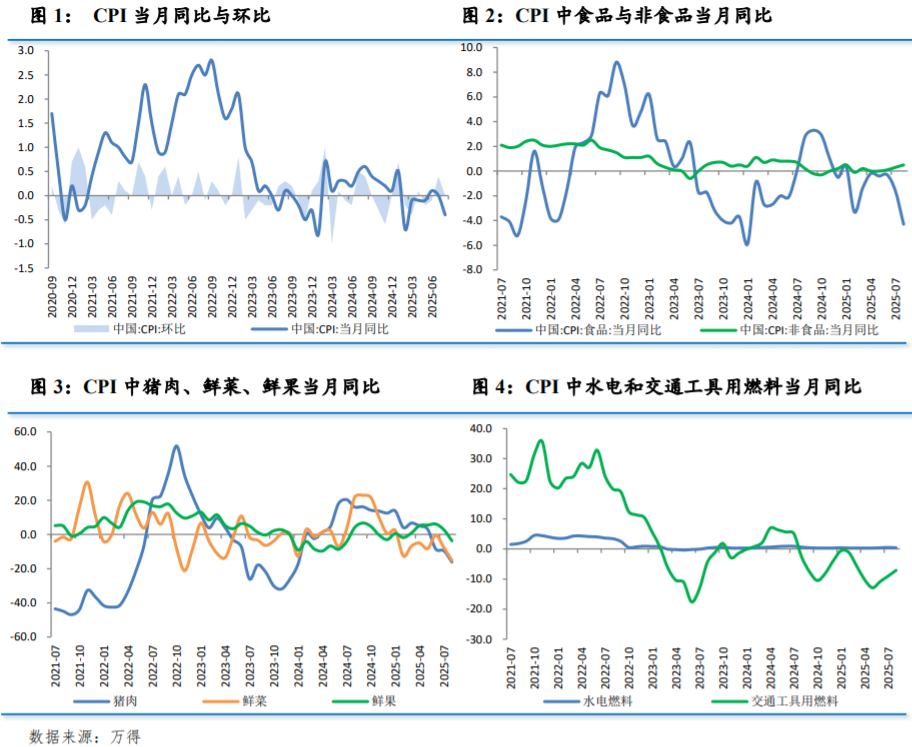
Group 1: Inflation Data Analysis - In August 2025, the Consumer Price Index (CPI) decreased by 0.4% year-on-year, marking a return to negative growth after two months[6] - Food prices fell by 4.3% year-on-year, with significant declines in pork (16.1%), fresh vegetables (15.2%), and eggs (14.2%) contributing to a downward pressure on CPI[6] - Non-food prices increased by 0.5% year-on-year, partially offsetting the decline in food prices[6] - The core CPI, excluding food and energy, rose by 0.9% year-on-year, indicating potential effectiveness of domestic demand policies[6] Group 2: PPI and Economic Outlook - The Producer Price Index (PPI) decreased by 2.9% year-on-year in August, but the decline narrowed by 0.7 percentage points compared to the previous month, suggesting a potential turning point[11] - The PPI's month-on-month change improved from a decline of 0.2% to flat, ending an eight-month downward trend[12] - The improvement in PPI is attributed to the effectiveness of supply-side reforms, particularly in coal and new energy vehicle sectors[11] - Current PPI conditions support a downward trend in interest rates rather than an upward shift, indicating a need for continued policy efforts to stabilize economic recovery[1]
8月通胀数据点评:核心CPI持续改善,PPI边际好转
Mai Gao Zheng Quan· 2025-09-11 07:34
Group 1: CPI Analysis - In August, the CPI recorded a year-on-year decrease of -0.4%, influenced by a high comparison base from the previous year and lower food price increases than seasonal levels[1] - The core CPI, excluding food and energy, rose by 0.9%, marking a two-and-a-half-year high, indicating structural inflation despite overall CPI decline[1][15] - Food prices significantly dragged down the CPI, with an annual decline of 4.3%, contributing approximately 0.51 percentage points to the overall CPI drop[1][14] Group 2: PPI Insights - The PPI fell by 2.9% year-on-year in August, an improvement from July's -3.6%, signaling a potential easing of industrial deflation pressures[2][18] - Month-on-month, the PPI remained flat, ending an eight-month downward trend, with some industrial prices showing signs of recovery due to improved supply-demand dynamics[2][18] - The coal processing price increased by 9.7%, while domestic oil extraction prices decreased by 1.4%, reflecting mixed trends across different sectors[2][21] Group 3: Economic Outlook - Future PPI declines are expected to narrow due to low base effects and ongoing "anti-involution" policies aimed at optimizing market competition[2][22] - The recovery of the real estate market remains slow, posing risks to demand for industrial products and potentially affecting PPI recovery[2][22] - Overall, PPI recovery will depend on domestic demand restoration and changes in the international economic environment[2][22]
债券研究:反内卷政策显现,支撑核心CPI增速继续改善
Bank of China Securities· 2025-09-11 07:26
Index Performance - The HSI closed at 26,200, up 1.0% in one day and 30.6% year-to-date [1] - The HSCEI closed at 9,328, up 0.9% in one day and 28.0% year-to-date [1] - The HSCCI closed at 4,377, up 0.6% in one day and 15.8% year-to-date [1] - The MSCI HK closed at 13,646, up 1.2% in one day and 29.2% year-to-date [1] - The MSCI CHINA closed at 86, up 0.6% in one day and 33.1% year-to-date [1] - The FTSE CHINA A50 closed at 14,844, up 0.5% in one day and 9.9% year-to-date [1] - The CSI 300 closed at 4,445, up 0.2% in one day and 13.0% year-to-date [1] - The TWSE closed at 25,193, up 1.4% in one day and 9.4% year-to-date [1] - The SENSEX closed at 81,101, up 0.4% in one day and 3.8% year-to-date [1] - The NIKKEI 225 closed at 43,838, up 0.9% in one day and 9.9% year-to-date [1] - The KOSPI closed at 3,315, up 1.7% in one day and 38.1% year-to-date [1] - The ASX 200 closed at 8,805, down 0.2% in one day and up 6.4% year-to-date [1] - The DJIA closed at 45,491, down 0.5% in one day and up 6.9% year-to-date [1] - The S&P 500 closed at 6,532, up 0.3% in one day and 11.1% year-to-date [1] - The FTSE 100 closed at 9,225, down 0.2% in one day and up 12.9% year-to-date [1] Commodity Price Performance - Brent Crude closed at US$68/bbl, up 1.8% in one day and down 6.2% year-to-date [2] - Gold closed at US$3,641/oz, up 0.4% in one day and 38.7% year-to-date [2] - Copper closed at US$9,914/t, unchanged in one day and up 13.1% year-to-date [2] - Aluminum closed at US$2,626/t, up 0.2% in one day and 3.9% year-to-date [2] - Nickel closed at US$14,917/t, down 0.8% in one day and 1.3% year-to-date [2] - CH domestic steel rebar 25 closed at RMB3,244/t, unchanged in one day and down 9.1% year-to-date [2] - CH domestic high speed wire closed at RMB3,614/t, down 0.1% in one day and 5.1% year-to-date [2] - CH domestic hot rolled steel closed at RMB3,420/t, down 0.1% in one day and 1.5% year-to-date [2] - CH domestic cold rolled steel closed at RMB3,914/t, unchanged in one day and down 6.7% year-to-date [2] - The BDI index closed at 2,019, unchanged in one day and up 102.5% year-to-date [2] Key Macro and Earnings Releases - US Initial Jobless Claims were 237.0k, higher than the consensus of 235.0k [3] - US Continuing Jobless Claims were 1,940.0k, lower than the consensus of 1,950.0k [3] - US CPI urban consumers MoM was 0.2%, lower than the consensus of 0.3% [3] - US CPI urban consumers YoY was 2.7%, lower than the consensus of 2.9% [3] - US CPI urban consumers was 323.0, lower than the consensus of 323.9 [3] - The Univ. of Michigan Sentiment was 58.2, higher than the consensus of 58.0 [3] - US Treasury Federal Budget Deb was -$291.1 billion, better than the consensus of -$340.0 billion [3] - FOF Federal Reserve US Household was -1,594.6% [3] - US Empire State Manufacturing was 11.9, higher than the consensus of 4.9 [3] - US Import Price Index Chg was 0.4% [3] - US Import Price Index YoY was -0.2% [3] - US capacity utilization was 77.5%, higher than the consensus of 77.4% [3] - US Industrial Production MoM was -0.1%, lower than the consensus of 0.0% [3] - US Industrial Production Indus MoM was 0.0% [3] - US Manufacturing & Trade Inven Mon was 0.2%, in line with the consensus [3] - Adjusted Retail & Food Service Mon was 0.5%, higher than the consensus of 0.3% [3] - Adjusted Retail Sales Less Auto MoM was 0.2%, lower than the consensus of 0.5% [3] Key BOCI Events - Zhou Liu Fu (Tencent Meeting at 10:30am) 6168.HK on 11 Sep [4] - BOCI Online Expert Seminar - Innovative Drug Lecture - Targeting the New Future Series IX: WCLC Innovative Drug Data Interpretation (Tencent Meeting at 4:30pm) on 11 Sep [4] - BOCI Online Expert Seminar - Domestic Server Industry Landscape and Outlook (Tencent Meeting at 4:30pm) on 11 Sep [4] - BOCI Online Expert Seminar - Overseas Hard Tech Seminar: Focus on AI ASIC Chip Thermal Design (Tencent Meeting at 3:30pm) on 11 Sep [4] - Raphael Chen - Internet Sector Marketing (1x1) in HK on 11 - 12 Sep [4] - Tony Fei - Power Sector Marketing (1x1) in SH on 15 - 16 Sep [4] - Raphael Chen - Media Sector Marketing (1x1) in SH on 18 - 19 Sep [4] - Luk Fook (Tencent Meeting at 11am) 0590.HK on 25 Sep [4] - Fortior Tech 峰岹科技 (1x1, Group Lunch) 1304.HK/688279.CH on 26 Sep [4] China Economy - In August, CPI edged down 0.4% YoY after being unchanged in July, while core CPI grew 0.9% YoY, up 0.1ppt from July [5][7] - The "industrial anti-involution" policy further took effect in August, improving the prices of durable goods CPI and some raw material PPI growth [5][7] - PPI dropped 2.9% YoY in August after falling 3.6% YoY in July, and the growth trend of both CPI and PPI is expected to gradually pick up amid the low base last year, narrowing the decline of GDP deflator [6][7] Hello Group Inc - The company's rating is HOLD, with a target price of US$8.30 and a current price of US$7.88 [8] - In 2Q25, the topline was -3% YoY, meeting BOCIe. Excluding non-recurring RMB548m accrual withholding tax, adj. NPM was 17.2%, beating consensus [8] - ROI remains the top assessment benchmark for operating domestic core Momo, Tantan and overseas businesses in 2H25. The company is expected to dynamically increase the revenue sharing ratio for core Momo in 2H25 to offset the negative impact of strict tax scrutiny [9][10] - The company will implement a more prudent model for its overseas expansion in 2H25 [9][10]

X @Ash Crypto
Ash Crypto· 2025-09-11 06:41
REMINDER 🚨🇺🇸 US CPI DATA WILL BE RELEASED TODAY AT 8:30AM ET.EXPECTATIONS: 2.9%● IF CPI < 2.9%, BITCOIN AND ALTS WILL EXPLODE● IF CPI = 2.9%, THE MARKET COULD EXPERIENCE A CORRECTION AS LAST MONTH'S CPI WAS 2.7%● IF CPI > 2.9%, THIS WILL BE REALLY BAD FOR MARKETS.YESTERDAY, PPI DATA CAME WAY LOWER THAN EXPECTED AND SOMETHING SIMILAR AGAIN COULD RESULT IN 50BPS CUT THIS MONTH. ...
煤价带动8月PPI环比企稳
Huafu Securities· 2025-09-11 05:24
Investment Rating - The industry rating is "Strongly Outperforming the Market," indicating that the overall return of the industry is expected to exceed the market benchmark index by more than 5% over the next 6 months [15]. Core Insights - The August PPI data shows a year-on-year decline of 2.9%, with a narrowing of the decline by 0.7 percentage points compared to the previous month, marking the first narrowing since March 2025. Month-on-month, the PPI remained flat after a previous decline of 0.2% [3][4]. - The main contributors to the PPI stabilization in August were the coal mining and washing industry, black metal mining, and black metal smelting and rolling processing industries, with month-on-month increases of 2.8%, 2.1%, and 1.9% respectively. This indicates a strong correlation between coal prices and PPI [5][6]. - The narrowing of the year-on-year decline in PPI is attributed to the continuous optimization of domestic market competition, which has led to a reduction in price declines across several industries, including coal processing and black metal smelting [5][6]. Summary by Sections PPI Data Analysis - In August 2025, the year-on-year PPI decline was -2.9%, with a month-on-month change from a decline of 0.2% to flat [3][4]. - The average PPI from January to August 2025 was -2.9%, while the average purchase price index was -3.3% [3]. Coal Price Impact - The improvement in coal prices has been a significant factor in stabilizing the PPI in August, reflecting the immediate effects of policies aimed at curbing overproduction [5][6]. - The report anticipates that the positive contributions to PPI from coal prices may gradually manifest around February to March 2026 [6]. Investment Opportunities - The report suggests several dimensions for capturing investment opportunities in coal: 1. Companies with excellent resource endowments and stable operating performance, such as China Shenhua, China Coal Energy, and Shaanxi Coal Industry [7]. 2. Companies with production growth potential benefiting from the bottoming of coal prices, including Yanzhou Coal Mining, Huayang Co., Guanghui Energy, Jinkong Coal Industry, and Gansu Energy [7]. 3. Companies with globally scarce resources benefiting from long-cycle supply tightness, such as Huaibei Mining, Pingmei Shenma, Shanxi Coking Coal, Lu'an Environmental Energy, and Shanmei International [7]. 4. Companies with coal-electricity integration models that stabilize cyclical fluctuations, including Shaanxi Energy, Xinji Energy, and Huaihe Energy [7].
2025年8月物价数据点评:物价数据步入改善过程
Ping An Securities· 2025-09-11 04:48
Group 1: CPI Analysis - In August 2025, the CPI year-on-year decreased by 0.4%, while the PPI year-on-year decreased by 2.9%[2] - The core CPI, excluding food and energy, increased by 0.9%, marking a continuous expansion for four months[3] - The food component of CPI fell by 4.3%, contributing approximately 0.51 percentage points to the overall CPI decline[3] Group 2: PPI Insights - The year-on-year decline in PPI narrowed by 0.7 percentage points, the first contraction since March 2025[3] - PPI remained flat month-on-month after a decline of 0.2% in the previous month, indicating a potential stabilization[3] - The prices of production materials increased by 0.3% month-on-month, while living materials saw a slight recovery[3] Group 3: Market Outlook - The overall price data indicates an improvement, with core CPI steadily rising and PPI showing signs of stabilization[3] - The supply pressure from pork prices is expected to persist into the first quarter of next year, impacting CPI[3] - Continued improvement in price data may influence asset reallocation strategies in equity and bond markets[3]
温彬:反内卷政策显效,物价有望低位温和回升
Di Yi Cai Jing· 2025-09-11 03:05
Core Insights - The article highlights the gradual improvement in supply-demand relationships due to policies aimed at expanding domestic demand, countering excessive competition, and developing new growth drivers [1][2]. CPI Analysis - In August, the Consumer Price Index (CPI) showed a flat month-on-month change and a year-on-year decline of 0.4%, influenced by falling food and energy prices [4]. - Food prices were weaker than seasonal trends, with a month-on-month increase of 0.5%, below the historical average of 1.5%. Pork prices fell by 0.5%, while egg prices rose by 1.5%, both lower than historical averages [4]. - Energy prices decreased due to lower international oil prices, with transportation fuel prices down by 0.9% month-on-month and 7.1% year-on-year [4]. - Core CPI improved, remaining flat month-on-month and increasing by 0.9% year-on-year, marking the fourth consecutive month of growth [4]. PPI Analysis - The Producer Price Index (PPI) showed signs of recovery, with a month-on-month change from a decline of 0.2% to flat, and a year-on-year decline of 2.9%, narrowing by 0.7 percentage points [12]. - Prices for production materials improved, with a month-on-month increase of 0.1% and a year-on-year decline of 3.2%, also narrowing by 1.1 percentage points [12]. - Specific industries saw price increases, such as coal processing prices rising by 9.7% month-on-month, indicating a positive trend in domestic market competition [13]. Future Outlook - The outlook suggests a moderate recovery in prices, driven by the continued effects of domestic demand expansion policies and improved market competition [14]. - CPI is expected to reflect a trend of "food and energy prices declining while core inflation rises," with seasonal factors likely to support a decrease in food prices [15]. - PPI may enter a recovery phase, supported by ongoing policy measures against excessive competition and improvements in export structures [15].
8月通胀数据点评:CPI同比继续走低
Great Wall Securities· 2025-09-11 02:57
Group 1: CPI Analysis - In August 2025, the CPI year-on-year decreased to -0.4%, down from 0.0% in the previous month, while the month-on-month change remained flat at 0.0%[1] - The core CPI year-on-year rose to 0.9%, an increase of 0.1 percentage points from the previous month, marking four consecutive months of acceleration[2] - The average month-on-month CPI for August 2023-2024 was 0.35%, significantly lower than historical averages[2] Group 2: PPI Insights - The PPI year-on-year decreased by 2.9%, but the decline was less severe than the previous month's drop of 3.6%[1] - The month-on-month PPI change turned flat, ending an eight-month downward trend, indicating a positive effect from anti-involution policies[2] - The improvement in PPI is contingent on the recovery of domestic demand and international commodity price trends[3] Group 3: Market Dynamics - The weak CPI performance in August was primarily due to food and energy price pressures, while the core CPI showed improvement driven by policy-induced consumer activity[3] - The narrowing decline in PPI and the stabilization of key industrial product prices, such as coal and steel, suggest early signs of stabilization in production[3] - Risks include potential underperformance of domestic macroeconomic policies, unexpected changes in interest rates, and concentrated credit events[3]