
制造业PMI

Search documents
瑞达期货铝类产业日报-20250506
Rui Da Qi Huo· 2025-05-06 10:50
Group 1: Report Summary - The report is an aluminum industry daily report dated May 6, 2025, written by Wang Fuhui [1][2] Group 2: Investment Rating - No investment rating is provided in the report Group 3: Core Views - The alumina main contract oscillates weakly, with increasing open interest, spot premium, and strengthening basis. Its fundamentals may be in a stage of slightly shrinking supply and stable - to - increasing demand. It is recommended to trade with a light position with a weak - oscillation strategy [2] - The Shanghai aluminum main contract oscillates weakly, with decreasing open interest, spot premium, and weakening basis. The electrolytic aluminum market is entering a stage of synchronous growth in supply and demand and benign inventory digestion. It is recommended to trade with a light position with an oscillation strategy [2] Group 4: Market Data Summary Futures Market - The closing price of the Shanghai aluminum main contract is 19,785 yuan/ton, down 125 yuan; the closing price of the alumina futures main contract is 2,675 yuan/ton, down 54 yuan [2] - The LME aluminum three - month quote is 2,431.50 US dollars/ton, up 15.50 US dollars; the LME aluminum inventory is 411,575 tons, down 2,000 tons [2] Spot Market - The Shanghai Non - ferrous A00 aluminum price is 19,850 yuan/ton; the Yangtze River Non - ferrous Market AOO aluminum price is 20,090 yuan/ton, down 270 yuan [2] Upstream Situation - The alumina production is 747.52 million tons, down 3.23 million tons; the demand for alumina (electrolytic aluminum part) is 723.72 million tons, up 76.70 million tons [2] Industry Situation - The total production capacity of electrolytic aluminum is 4,517.20 million tons, unchanged; the production of aluminum products is 598.17 million tons, down 12.49 million tons [2] Downstream and Application - The production of automobiles is 3.0446 million vehicles, down 0.454 million vehicles; the export volume of unwrought aluminum and aluminum products is 51 million tons, up 14 million tons [2] Option Situation - The 20 - day historical volatility of Shanghai aluminum is 18.20%, up 0.05%; the 40 - day historical volatility of Shanghai aluminum is 14.36%, up 0.06% [2] Group 5: Industry News - In April, the US employment growth was strong, with the unemployment rate remaining stable. The non - farm payrolls increased by 177,000, higher than the expected 130,000, and the unemployment rate remained at 4.2% [2] - The Ministry of Finance plans to increase the deficit rate to 4% this year, with a deficit scale of 5.66 trillion yuan [2] - The eurozone's April manufacturing PMI was 49, higher than the expected 48.7 [2] - The "May Day" holiday saw a consumer boom in the "trade - in" policy. New energy vehicle sales in April were strong, with significant year - on - year growth for many brands [2] - In April, the manufacturing PMI was 49.0%, down 1.5 percentage points from the previous month, but high - tech manufacturing and related industries continued to expand [2]
美元失宠?
Jin Rong Jie· 2025-05-06 08:07
美国供应管理协会(ISM)最新公布的服务业PMI(采购经理指数)出乎意料上升,从3月时的九个月 低位50.8点,上升至4月份的51.6点,远超市场预期的50.6点。该指数读数在50点以上,反映经济活动扩 张,反之则意味着经济活动收缩。 4月份的服务业PMI达到51.6点的水平,着实让市场喜出望外,美股三大指数原本低开低走,在公布服 务业PMI后反弹,但是回味过后,投资者的忧虑并没有消散,美股收盘前续跌。以反映科技股表现的纳 斯达克指数(IXIC.US)为例,低开后持续上下波动,午后公布服务业PMI后一度走高,但是尾盘急速 走低,收盘跌133.49点,或0.74%,报17,844.24点。 这项数据有何问题? 本周中后期美联储议息,市场普遍预期将维持利率不变,这或也是关税阴霾下,市场对于美联储最后一 次把握比较大的预测,即便如此,利率仍走高,反映资金需要更高的风险收益补偿。 美元指数再跌破100 从服务业PMI的细分领域来看,新订单和存货指数均表现良好,分别达到52.3点和53.4点,显示出增长 加快的信号,同时商业活动仍处于扩张区间,为53.7点。但值得注意的是,服务业就业继续处于收缩水 平,报49点,而价格 ...
宝城期货国债期货早报-20250506
Bao Cheng Qi Huo· 2025-05-06 03:34
| 品种 | 短期 | 中期 | 日内 | 观点参考 | 核心逻辑概要 | | --- | --- | --- | --- | --- | --- | | TL2506 | 震荡 | 震荡 | 震荡偏强 | 区间震荡 | 制造业 PMI 走弱,降息预期升温 | 备注: 1.有夜盘的品种以夜盘收盘价为起始价格,无夜盘的品种以昨日收盘价为起始价格,当日日盘收盘 价为终点价格,计算涨跌幅度。 2.跌幅大于 1%为下跌,跌幅 0~1%为震荡偏弱,涨幅 0~1%为震荡偏强,涨幅大于 1%为上涨。 3.震荡偏强/偏弱只针对日内观点,短期和中期不做区分。 ◼ 主要品种价格行情驱动逻辑—金融期货股指板块 投资咨询业务资格:证监许可【2011】1778 号 宝城期货国债期货早报(2025 年 5 月 6 日) ◼ 品种观点参考—金融期货股指板块 时间周期说明:短期为一周以内、中期为两周至一月 品种:TL、T、TF、TS 日内观点:震荡偏强 中期观点:震荡 参考观点:区间震荡 核心逻辑:上周三国债期货继续窄幅震荡整理。上周三统计局公布了 4 月制造业 PMI 数据为 49.0%, 比上月下降 1.5 个百分点,回落至收缩区间。这 ...
公司债ETF(511030) 近1月日均成交17.48亿元,国债ETF5至10年(511020)规模创近3月新高,机构:预计债市二季度呈现震荡局面
Sou Hu Cai Jing· 2025-05-06 02:48
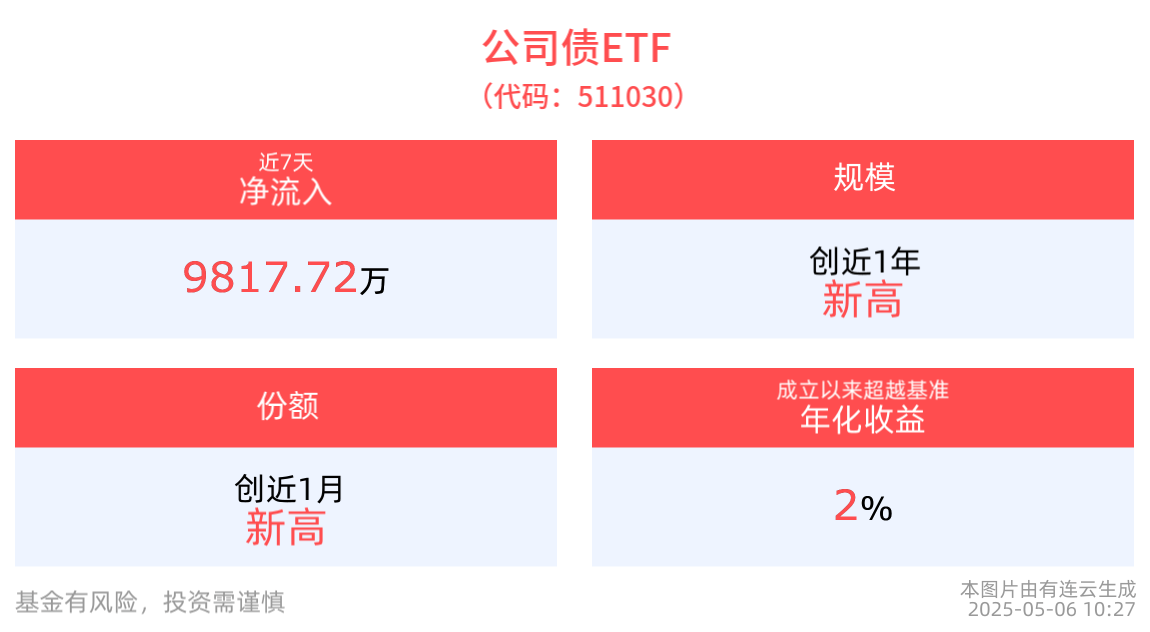
截至2025年5月6日 10:27,公司债ETF(511030)多空胶着,最新报价105.51元。拉长时间看,截至2025年4月30日,公司债ETF近半年累计上涨1.16%。 流动性方面,公司债ETF盘中换手0.33%,成交4435.83万元。拉长时间看,截至4月30日,公司债ETF近1月日均成交17.48亿元。 规模方面,公司债ETF最新规模达133.53亿元,创近1年新高。 份额方面,公司债ETF最新份额达1.27亿份,创近1月新高。 消息面上,4月制造业PMI降至49.0%,为2021年以来四月份的第二低。4月制造业PMI容易季节性回落,今年4月制造业PMI环比降幅明显好于2022年4月及 2020年2月,反映美国高关税对中国经济的影响程度可能明显好于疫情。 机构认为,未来债市需要关注中美关税谈判的进展。倘若未来半年中美达成协议将关税降至年初水平,年内10Y国债收益率高点仍可能到1.9%,2025年经济 仍有望企稳。由于关税谈判艰难,短期或难谈成,我们预计债市二季度震荡。 浙商证券认为近期债市调整仍将持续,但鉴于基本面无明确利空,货币宽松基调不变,建议按利率底部区间震荡思路交易。 流动性方面,国债ETF ...

人民币、港币汇率大幅走强!恒生科指领涨……假期重要消息还有这些
证券时报· 2025-05-05 12:27
Group 1 - The "Private Economy Promotion Law" was passed, marking the first foundational law specifically for the development of the private economy in China, effective from May 20, 2025. It addresses key concerns such as "fair competition," "investment and financing promotion," "technological innovation," "business regulation," "service guarantee," and "rights protection" for private enterprises [1] Group 2 - The Ministry of Commerce noted that the U.S. has expressed willingness to negotiate on tariff issues, and China is currently evaluating this situation [2] Group 3 - A new proactive fiscal policy is set to be introduced in 2024, including a one-time increase of 6 trillion yuan in local special bond limits to replace hidden debts, issuance of special government bonds to support state-owned banks, and measures to stabilize the real estate market [3] Group 4 - In April, the manufacturing PMI fell to 49.0%, a decrease of 1.5 percentage points from the previous month, while the non-manufacturing PMI remained in the expansion zone at 50.4% [4] Group 5 - The U.S. President announced a 100% tariff on all films produced abroad entering the U.S., indicating a significant trade policy shift [5] Group 6 - U.S. non-farm payrolls increased by 177,000 in April, exceeding market expectations, while the unemployment rate remained stable at 4.2%. This led to a decrease in market expectations for a rate cut by the Federal Reserve [6] Group 7 - Global risk assets saw a comprehensive rise, with the Hang Seng Tech Index leading with a 3.1% increase, indicating a recovery trend in Chinese assets [7] Group 8 - The Hong Kong Monetary Authority intervened by purchasing 46.539 billion HKD in U.S. dollars to maintain the currency peg, marking its first intervention in five years [8] Group 9 - The Hong Kong Monetary Authority attributed the recent strength of the Hong Kong dollar to increased demand related to stock investments and the appreciation of several regional currencies against the U.S. dollar [9] Group 10 - Berkshire Hathaway's annual shareholder meeting addressed trade policies and investment strategies, emphasizing the importance of global trade [10] Group 11 - New energy vehicle companies reported significant growth in April deliveries, with XPeng Motors seeing a 273% year-on-year increase [11] Group 12 - Travel booking platform Fliggy reported an over 80% increase in customized travel bookings for the May Day holiday, indicating a shift towards more personalized travel experiences [12] Group 13 - OPEC+ announced an increase in production by 411,000 barrels per day starting in June, reflecting a response to current market conditions [13] Group 14 - Upcoming new stock offerings include three companies, with specific details on their subscription codes [14] Group 15 - CITIC Securities indicated that risk appetite is expected to rise in May, focusing on themes related to technology and consumption [15] Group 16 - Zhongtai Securities highlighted that opportunities in May will be more pronounced in technology, consumption, and certain cyclical sectors, suggesting a focus on improving performance and policy support [16]

海外研究|关税扰动对全球宏观经济影响已初见端倪(2025年4月)
中信证券研究· 2025-05-05 07:59
Core Viewpoint - The global manufacturing PMI index for April 2025 shows a slight decline to 49.8, indicating economic uncertainty due to tariff disruptions, with varying performances across regions [1][2]. Regional Analysis Asia - Economic performance in Asia remains mixed, with Japan and India showing marginal improvements in manufacturing PMI, while China's and South Korea's indices fell to 49 and 47.5 respectively. India's PMI rose to 58.2, and Japan's to 48.7 [3]. Europe - Most European countries saw marginal improvements in manufacturing PMI, yet they remain in contraction territory. Germany's PMI increased to 48.4, above previous values and expectations. The Eurozone's GDP growth rate for Q1 2025 has rebounded above zero, but tariff impacts continue to pose risks [3]. Americas - North American economies are experiencing a slight downturn, with Mexico and Canada's manufacturing PMIs dropping to 44.8 and 45.3 respectively, influenced by U.S. trade policies and declining output [3]. U.S. Economic Indicators - The U.S. ISM manufacturing PMI fell by 0.3 points to 48.7, continuing a downward trend from the previous quarter. Key characteristics include a decline in supply and demand, rising inflation, a cooling job market, and significant drops in export orders [4]. Export Trends - China's overall export growth is expected to face pressure in Q2 2025. In March, South Korea's export growth improved to 3.7%, while China's export growth surged to 12.4%, driven by low base effects and strong performance in semiconductor and machinery sectors. However, most goods are anticipated to be negatively impacted by trade frictions [5].
中采PMI|外贸压力进入验证期(2025年4月)
中信证券研究· 2025-05-05 07:59
Core Viewpoint - The manufacturing PMI in April 2025 has declined compared to the previous month and the past five-year average, indicating a weakening manufacturing sector under external pressures, particularly from trade tensions with the US [1][3][4] Manufacturing PMI Analysis - The manufacturing PMI for April 2025 is reported at 49.0%, down 1.5 percentage points from the previous month and 1.3 percentage points lower than the five-year average, reflecting a decrease in manufacturing activity due to external trade pressures [2][3] - The production index within the manufacturing PMI is at 49.8%, which is 2.4 percentage points lower than the five-year average, indicating a decline in production levels [4] - The new export orders index is at 44.7%, significantly lower than the five-year average by 4.8 percentage points, primarily due to reduced exports to the US [4][5] Sector Performance - Among 15 major manufacturing sectors, only 5 have PMIs above the threshold, with 4 sectors showing a month-on-month increase, including non-ferrous metal smelting and processing, which rose by 9.1 percentage points [5] - The gap between PMIs of large, medium, and small enterprises is narrowing, with large enterprises experiencing a more significant decline [5] Non-Manufacturing PMI Insights - The non-manufacturing PMI for April 2025 is at 50.4%, which is 3.6 percentage points lower than the five-year average, indicating weaker domestic demand [6] - The service sector PMI is at 50.1%, and the construction sector PMI is at 51.9%, both reflecting a decline compared to historical averages [6] Policy Response - The Central Political Bureau meeting in April outlined measures to stabilize the economy, including accelerating existing policy implementation, introducing new policies, and preparing contingency plans [7] - Specific actions include expediting the issuance of local government bonds and establishing new financial tools to support infrastructure and industrial investments [7] Market Outlook - Economic fundamentals are expected to support the bond market, with anticipated monetary easing leading to a potential decline in interest rates for medium and long-term bonds [8]
5月5日电,越南4月标普全球越南制造业PMI为45.6,前值50.5。
news flash· 2025-05-05 00:31
智通财经5月5日电,越南4月标普全球越南制造业PMI为45.6,前值50.5。 ...
民营经济促进法本月施行,美国调整汽车关税政策丨一周热点回顾
Di Yi Cai Jing· 2025-05-03 02:38
Group 1: Private Economy Promotion Law - The Private Economy Promotion Law, effective from May 20, is China's first foundational law specifically addressing the development of the private economy, consisting of 9 chapters and 78 articles [2] - The law emphasizes the equal legal status of the private economy and aims to promote its healthy development, ensuring fair competition and improved investment and financing environments [2][3] - It addresses key concerns of private enterprises by establishing systems for fair competition, innovation support, and legal protections [2][3] Group 2: Market Access Barrier Cleanup - The National Development and Reform Commission, along with the Ministry of Commerce and the State Administration for Market Regulation, initiated a campaign to clear market access barriers, aiming to create a unified national market [4] - The focus is on rectifying unreasonable regulations and practices that violate market access requirements, including local regulations that hinder competition [4][5] - This six-month action is part of implementing a new negative list for market access, promoting a stable and transparent environment for private enterprises [4][5] Group 3: Employment and Economic Stability Measures - The National Development and Reform Commission announced five measures to stabilize employment and the economy, including support for employment, foreign trade stability, and effective investment expansion [6][7] - These measures are designed to enhance policy implementation efficiency and ensure that benefits reach businesses and the public [6][7] - The focus is on actionable policies that can support economic recovery and maintain social stability amid external challenges [6][7] Group 4: Manufacturing PMI Decline - The manufacturing Purchasing Managers' Index (PMI) fell to 49.0% in April, indicating a contraction after two months of expansion, with significant declines in new orders and export orders [8] - The decline is attributed to seasonal factors and a slowdown in external demand due to changing trade environments [8] - Analysts suggest that proactive macroeconomic policies are needed to bolster investment and consumer spending to stabilize the economy [8] Group 5: U.S. Economic Performance - The U.S. GDP contracted by 0.3% in the first quarter, marking the worst quarterly performance since 2022, primarily due to increased imports and reduced government spending [9] - This contraction has raised concerns about the impact of tariff policies on business and consumer confidence, leading to downward revisions of economic forecasts [9] - The economic downturn poses challenges for the current U.S. administration, affecting its credibility and public support [9] Group 6: U.S.-Ukraine Mineral Agreement - The U.S. and Ukraine signed an agreement to establish a joint investment fund, with both countries holding equal shares and management rights [10][11] - The agreement allows Ukraine to retain ownership and control over its mineral resources, addressing a key concern for Ukraine [11] - While the agreement does not explicitly mention U.S. security guarantees, it signals continued military support for Ukraine amid ongoing conflict [11] Group 7: U.S. Auto Tariff Policy Adjustments - The U.S. government announced adjustments to auto tariffs, including exemptions for imported auto parts and a small rebate for domestic manufacturers [12] - These changes come in response to widespread opposition to previous tariff policies, which could negatively impact consumer interests [12] - Despite these adjustments, uncertainties surrounding tariff policies continue to pose challenges for the automotive industry and consumer sentiment [12]