
反内卷

Search documents
渤海证券研究所晨会纪要(2026.01.28)-20260128
BOHAI SECURITIES· 2026-01-28 00:29
Macro and Strategy Research - The profit growth of industrial enterprises in 2025 is supported by new momentum and anti-involution policies, with a marginal increase in profit growth rate by 0.5 percentage points to 0.6% year-on-year [2][3] - In December 2025, the profit of industrial enterprises increased by 5.3% year-on-year, reversing from negative to positive with an 18.4 percentage point recovery [3] - The industrial added value in December 2025 grew by 5.2% year-on-year, driven by resilient exports and high-tech industries [3] - The revenue profit margin for industrial enterprises in 2025 was 5.31%, a year-on-year decrease of 1.5%, but the decline was less severe than in the previous months [3] - Among 41 industrial sectors, 16 sectors achieved positive profit growth in 2025, with notable growth in black metal smelting, non-ferrous metal mining, and high-tech manufacturing [4] - The end of three consecutive years of negative profit growth for industrial enterprises is attributed to support from new momentum sectors and the implementation of anti-involution policies [4] Fixed Income Research - The issuance scale of credit bonds increased, with corporate bonds remaining stable and other types of bonds seeing growth [6][8] - Credit bond yields generally declined, with credit spreads for medium and short-term notes narrowing [8] - The overall market sentiment remains optimistic, with a focus on adjusting strategies in response to market fluctuations and maintaining a cautious approach to ticket strategies [8] Fund Research - The number of equity funds increased to 7,583 by the end of Q4 2025, with a total scale of 94,572.12 billion, a decrease of 277.04 billion from the previous quarter [11] - Active equity funds saw a slight decrease in positions, with a notable decline in mixed and flexible allocation funds [11][12] - The allocation in the main board decreased significantly, while the allocation in the Sci-Tech Innovation Board and Growth Enterprise Market increased [12] - The top five industries with increased holdings included non-ferrous metals and communications, while electronics and biomedicine saw a decrease [12] Industry Research - The geopolitical situation has led to strong performance in gold prices, with expectations for continued upward pressure due to uncertainties [14][15] - The steel industry is expected to see improved profitability due to steady growth policies and demand in shipbuilding and construction [15] - The copper industry is anticipated to maintain a favorable outlook, supported by supply constraints and demand from key sectors like electric power and new energy vehicles [16] - The aluminum sector is expected to benefit from improved supply dynamics and demand from the new energy vehicle sector [16] - The rare earth industry is projected to see a revaluation of related companies due to China's export control upgrades and strategic importance [17]
盘点2025年汽车产业政策新风向:从追求“规模速度”到比拼“质量效益”
Zhong Guo Qing Nian Bao· 2026-01-27 22:48
Core Insights - The Chinese automotive industry achieved significant milestones in 2025, with total vehicle production and sales showing steady growth, and new energy vehicle sales surpassing 10 million units for the first time, achieving a market penetration rate of over 50% [2][10] - A comprehensive set of policies was implemented to guide and correct the industry, with over 30 key standards and regulatory policies released by relevant departments, averaging more than 2.5 per month [2] Group 1: Market Competition and Regulation - The year 2025 marked a shift from "price wars" to "value wars," with a strong emphasis on curbing "involution" in the automotive sector through regulatory measures [3][4] - Key regulations included a "60-day payment cycle" for suppliers and a "price behavior compliance guideline" aimed at restoring order in the market and protecting supplier rights [3][4] - Major automakers like SAIC, BYD, and Geely adopted the 60-day payment cycle, which is seen as a move towards healthier industry ecology and stable cash flow for suppliers [3][4] Group 2: Safety and Technological Standards - Policies focused on safety in both intelligent connected vehicles and new energy vehicles were intensified, establishing a robust safety regulatory framework [5][6] - In the intelligent connected vehicle sector, new mandatory standards were introduced to ensure safety and prevent exaggerated claims about advanced driving capabilities [5] - The new national standards for electric vehicle batteries introduced stringent safety requirements, including tests for fire resistance and crash safety, which are considered the strictest in history [6] Group 3: Future Policy Directions - The continuity and foresight of policies in 2026 are expected to reinforce the stability of the automotive industry, with high standards established in 2025 set to be fully implemented [7] - Future competition will focus on the resilience and collaboration of the entire supply chain, emphasizing technological research, high-end manufacturing, and global operations [7] - Policies will increasingly support the development of cutting-edge technologies like L3-level autonomous driving and solid-state batteries, while promoting collaboration across the supply chain [7][10] Group 4: Global Expansion and Innovation - The push for "going global" is shifting from product export to "industry chain export" and "standard export," with a focus on building a complete ecosystem for Chinese automakers in international markets [9][10] - Companies like Leap Motor and Chery are rapidly expanding globally, utilizing diverse strategies to enhance their market presence and competitiveness [9][10] - The policies are driving innovation across the supply chain, with companies like Xinwangda developing advanced battery technologies to meet stringent safety and performance standards [8][9]


工业利润三年跌势扭转 今年稳增长行动思路明确
Sou Hu Cai Jing· 2026-01-27 16:39
Core Viewpoint - In 2025, China's industrial profits showed a positive growth of 0.6%, reversing a three-year decline, with significant contributions from equipment manufacturing and high-tech industries, indicating an improvement in the structure of traditional industries and overall industrial economic quality [1][2][6]. Group 1: Industrial Profit Growth - In 2025, the total profit of industrial enterprises above designated size reached 73,982 billion yuan, marking a 0.6% increase from the previous year [1]. - December 2025 saw a monthly profit increase of 5.3%, recovering from a 13.1% decline in November, indicating a significant rebound [2]. - The profit growth trend for industrial enterprises is expected to continue into 2026, supported by government policies aimed at stabilizing industrial economic growth [1][6]. Group 2: Cost and Revenue Analysis - In 2025, the cost per 100 yuan of revenue for industrial enterprises was 85.31 yuan, an increase of 0.16 yuan year-on-year, while expenses per 100 yuan of revenue decreased to 8.62 yuan, down 0.02 yuan [3]. - The average collection period for accounts receivable decreased to 67.9 days by the end of December 2025, reflecting improved cash flow management [3]. Group 3: Profit Structure Improvement - In 2025, profits from small and medium-sized enterprises, as well as foreign-invested enterprises, turned positive, growing by 1.4% and 4.2% respectively [4]. - The manufacturing sector saw a profit increase of 5.0%, with equipment manufacturing and high-tech manufacturing being the main drivers of profit growth [4][5]. - High-tech manufacturing profits rose by 13.3%, significantly outpacing the overall industrial profit growth, with specific sectors like smart electronics and semiconductors experiencing substantial profit increases [5]. Group 4: Future Outlook - The industrial sector is expected to maintain a recovery trend in 2026, driven by stable domestic consumption, recovering investment, and improved export quality [6][8]. - The Ministry of Industry and Information Technology has prioritized consolidating the positive momentum of industrial economic growth for 2026, focusing on stabilizing key industries and regions [8].
中国工业利润三年跌势扭转,今年稳增长行动思路明确
Di Yi Cai Jing· 2026-01-27 15:59
Core Insights - The overall profit of industrial enterprises above designated size in China reached 73,982 billion yuan in 2025, marking a 0.6% increase from the previous year, reversing a three-year decline trend [1][2] - The equipment manufacturing industry accounted for 39.8% of total industrial profits, with a significant profit increase of 7.7% [5] - The high-tech manufacturing sector saw a profit growth of 13.3%, with smart consumer devices manufacturing profits soaring by 48% [5] Industrial Profit Growth - In December 2025, profits for industrial enterprises increased by 5.3% compared to the previous month, marking a recovery from a 13.1% decline in November [1][2] - The profit growth trajectory for 2025 was characterized by a "low first half, high second half" pattern, with fluctuations influenced by policy effects and market conditions [2] Cost and Expense Analysis - The cost per 100 yuan of revenue for industrial enterprises was 85.31 yuan, an increase of 0.16 yuan year-on-year, while expenses decreased to 8.62 yuan [3] - The average accounts receivable collection period improved to 67.9 days, down by 2.5 days from the previous value, indicating better cash flow management [3] Profit Structure Improvement - Small and medium-sized enterprises, as well as foreign-invested enterprises, saw profit growth of 1.4% and 4.2% respectively, reversing previous declines [4] - Manufacturing profits grew by 5.0%, with notable increases in the electricity and gas supply sectors [4] Sector-Specific Performance - The equipment manufacturing sector was the strongest contributor to overall industrial profit growth, adding 2.8 percentage points to the total [5] - The semiconductor industry experienced remarkable profit increases, with integrated circuit manufacturing profits rising by 172.6% [5] Future Outlook - Industrial profits are expected to continue recovering in 2026, supported by stable domestic consumption and improved investment conditions [6][10] - The government plans to focus on stabilizing growth in key industries and regions, enhancing the competitive environment for enterprises [9]
2025年工业企业利润数据点评:同比转正,新旧分化
GF SECURITIES· 2026-01-27 15:35
Revenue Trends - In 2025, the revenue of industrial enterprises above designated size increased by 1.1% year-on-year, slightly lower than the 2.1% growth in 2024 and consistent with 2023, remaining in the low range of 1%-3% for three consecutive years[3]. - December 2025 saw a 3.2% year-on-year decline in revenue, marking three consecutive months of negative growth[3]. - The nominal GDP growth for the secondary industry in Q4 2025 was 1.28%, down from 1.45% in Q3, while the tertiary industry maintained a growth rate of 5.7%[3]. Profit Trends - The profit of industrial enterprises above designated size in 2025 increased by 0.6% year-on-year, ending three years of consecutive negative growth from 2022 to 2024, which recorded -4.0%, -2.3%, and -3.3% respectively[4]. - December 2025 profits showed a significant improvement with a 5.3% year-on-year increase, contrasting sharply with the negative growth seen in the previous months[4]. - The profit margin for 2025 was 5.31%, a slight decrease of 0.03 percentage points year-on-year, indicating a stabilization in profit rates[4]. Sector Performance - High-growth sectors in 2025 included high-tech manufacturing, non-ferrous metals, and public utilities, with specific industries like smart drones and semiconductors showing profit growth rates of 102.0% and 172.6% respectively[8]. - The mining sector experienced a profit decline of 26.2% in 2025, continuing a trend of negative growth from previous years[8]. - The profit share of high-tech manufacturing and non-ferrous metals reached a historical high of 44.6% in 2025, while traditional high-energy-consuming industries dropped to 18.3%[12]. Inventory and Debt - By the end of 2025, the nominal inventory of industrial enterprises grew by 3.9% year-on-year, with a sales-to-inventory ratio of 0.49 in December, indicating a slower inventory reduction compared to the previous year[13]. - The asset-liability ratio for industrial enterprises was 57.6% at the end of 2025, reflecting a decrease in debt growth to a historical low of 4.2% year-on-year[13].
【广发宏观王丹】同比转正,新旧分化:2025年工业企业利润数据点评
郭磊宏观茶座· 2026-01-27 15:18
广发证券 资深宏观分析师 王丹 bjwangdan@ gf.com.cn 广发宏观郭磊团队 摘要 第一, 2025 年规上工业企业营业收入同比增长 1.1% ,略低于 2024 年的 2.1% ,持平于 2023 年,营收同比连续 3 年在 1%-3% 的低位区间内徘 徊。边际变化看, 12 月单月营收同比下降 3.2% ,连续 3 个月同比为负。从四季度名义 GDP 来看,也是三产企稳、二产放缓。 第二, 利润趋势上好于营收。 2025 年全年规上工业企业利润同比增长 0.6% , 2022-2024 年同比分别为 -4.0% 、 -2.3% 、 -3.3% ;企业利润同 比结束连续 3 年负增长、实现小幅转正。边际变化看, 12 月利润同比增长 5.3% ,较 10-11 月的同比下降明显改善,也显著好于营收表现。 第三, 利润率趋稳是支撑 2025 年企业盈利同比转正的关键。从"量、价、利润率"三因素看, 2025 年呈现"量强 + 价跌"的特征;利润率是支撑利润同 比转正的关键, 2025 年营收利润率 5.31% ,同比微降 0.03 个点,较 2024 年的同比下降 0.3 个点明显收窄。我们理解 ...

多数光伏企业2025年延续亏损状态,部分企业锚定2026年业绩扭亏
第一财经· 2026-01-27 12:49
Core Viewpoint - The photovoltaic (PV) industry in A-shares is facing significant losses, with many leading companies projecting substantial pre-loss figures for 2025 due to a challenging operating environment and supply-demand imbalances [2][3]. Group 1: Financial Performance and Projections - Major PV companies are expected to report significant pre-loss figures for 2025, including Tongwei Co. with a projected loss of 9 to 10 billion yuan, LONGi Green Energy with 6 to 6.5 billion yuan, and JinkoSolar with 5.9 to 6.9 billion yuan [2]. - The overall operating environment remains difficult, with many companies experiencing nine consecutive quarters of losses since Q4 2023, driven by price declines and insufficient end-demand [3]. Group 2: Industry Dynamics - The PV module prices are under pressure due to "involutionary competition" and a lack of terminal demand, with market transaction prices around 0.6 yuan per watt expected in mid-2025 [3]. - The industry is witnessing a supply surplus, with production rates declining across various segments, while core material prices, such as silver, continue to rise [3]. Group 3: Recovery Efforts and Future Goals - Some companies are beginning to emerge from the loss cycle, with LONGi Green Energy projecting a maximum reduction in losses of 30.38% and Aiko Solar up to 77.44% compared to 2024 [4]. - The China Photovoltaic Industry Association noted a 16.9% year-on-year decline in revenue for the main industry chain in the first three quarters of 2025, but an improvement in gross margins to 3.64% [4]. - Several leading PV companies have set profit targets for 2026, with Trina Solar aiming for a net profit of no less than 200 million yuan and LONGi Green Energy targeting positive net profits in subsequent years [5].







瑞银关于A股十问十答:估值还有空间!
Datayes· 2026-01-27 12:09
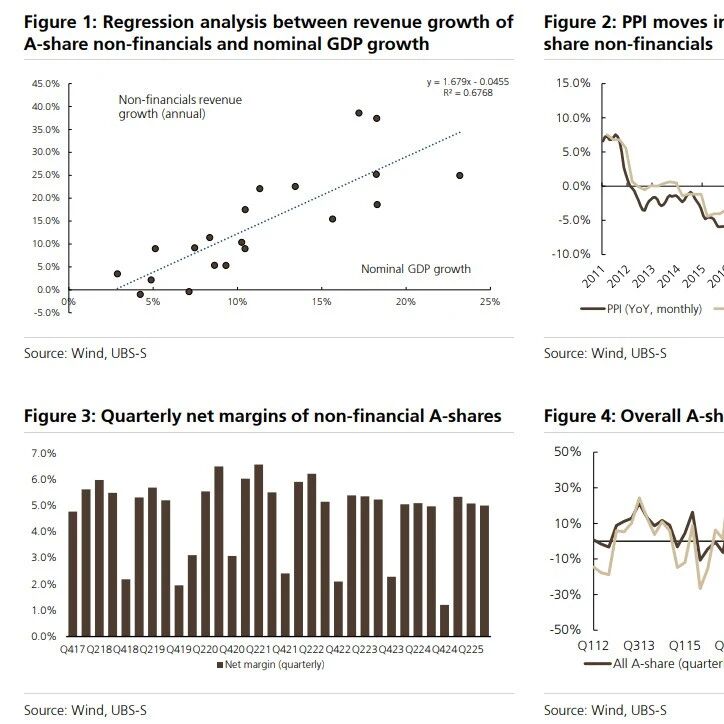
Group 1 - The overall A-share profit growth is expected to accelerate from 6% in 2025 to 8% in 2026, primarily driven by the non-financial sector [1] - The revenue growth of non-financial A-shares is closely related to China's nominal GDP growth and PPI inflation, with a projected nominal GDP growth of 4.3% in 2026 [1] - The net profit margin (NPM) of non-financial A-shares has rebounded in the first nine months of 2025, reversing a long-term downward trend since 2021 [1] Group 2 - The financial sector's profit growth is expected to remain stable, supported by solid asset quality in the banking sector and improved market sentiment [2] - The cumulative profit growth of industrial enterprises in China was only 0.1% in the first eleven months of 2025, but certain sectors like computer and electronic equipment manufacturing saw a 15% profit increase [2] - Investors should pay attention to potential revisions in profit growth expectations around April 2026, as historical data shows discrepancies in profit growth forecasts during that period [2] Group 3 - The current rolling P/E ratio of the Wind All A-share index has risen above the historical average, leading some investors to worry about overvaluation [13] - Despite concerns, the equity risk premium in the A-share market remains above historical averages, indicating potential for further revaluation [13][16] - Factors such as clearer fiscal support, accelerating profit growth, and increased household savings reallocating to stocks are expected to drive A-share growth in 2026 [16] Group 4 - The Chinese central bank plans to moderately expand the deficit and maintain stable credit pulses, which is expected to support A-share revaluation [17] - The anticipated reduction in policy rates and reserve requirement ratios by the central bank may further enhance liquidity in the market [17] - A moderate expansion in P/E ratios is expected as profit growth accelerates, with historical data showing a correlation between profit growth and P/E ratios [21] Group 5 - The ongoing market capitalization management reforms are changing investor perceptions, leading to increased focus on shareholder returns [27] - A-share cash dividends reached 2.06 trillion yuan in 2025, marking a significant increase, while stock buybacks have also risen [27] Group 6 - Daily trading volume in A-shares has significantly increased in 2026, driven by improved investor risk appetite, with average daily turnover reaching 3.03 trillion yuan [28] - Regulatory measures have been implemented to cool down excessive trading activity, with daily turnover ratios fluctuating [28][33] - The financing balance in A-shares reached a historical high of 2.7 trillion yuan, indicating increased leverage in the market [33] Group 7 - The trend of reallocating household savings towards stocks is evident, with a significant portion of household deposits still available for investment in A-shares [40] - Despite a recent uptick in the stock market, the influx of household funds into the market has not yet reached overheating levels [42][46] - The potential for further inflows into A-shares exists as investors may gradually shift from fixed-income products to equity investments [49] Group 8 - The issuance of active funds has been slow, but the performance of equity funds has improved, potentially leading to increased inflows as market conditions stabilize [53] - The ETF market has seen rapid growth, with A-share holdings in ETFs surpassing those in active equity funds for the first time [58] Group 9 - The "anti-involution" policies are expected to improve supply-demand dynamics and support price recovery, enhancing corporate profitability [64] - The narrowing and eventual recovery of PPI is crucial for the revenue growth of non-financial A-shares, which may lead to stock price revaluation [65] Group 10 - The growth style is expected to outperform the value style in the mid-term, with cyclical stocks likely to perform better than defensive stocks [66] - Tactical preferences lean towards sectors benefiting from innovation, ample liquidity, and narrowing PPI, such as electronics, telecommunications, and chemicals [66] Group 11 - Despite recent declines in financing balances and market turnover, the technology sector's fundamentals remain strong, with expectations for continued growth in 2026 [75] - Metrics for assessing trading congestion in technology stocks include the proportion of trading volume and financing balances relative to market capitalization [78]
化工板块深度回调,锂电领跌!化工ETF(516020)盘中跌超2%,资金逆市狂买!
Xin Lang Cai Jing· 2026-01-27 12:00
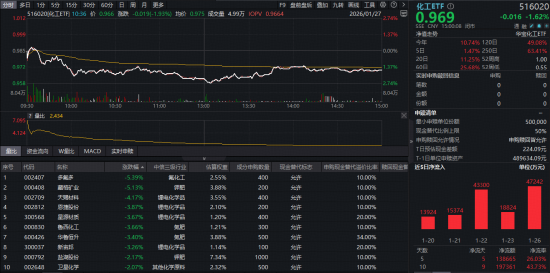
Group 1 - The chemical sector experienced a significant pullback on January 27, with the chemical ETF (516020) opening weak and closing down 1.62%, having dropped over 2% at one point during the day [1][8] - Key stocks in the sector, including fluorine chemicals, lithium batteries, and nitrogen fertilizers, saw notable declines, with companies like Multi-Fluorine and Cangge Mining dropping over 5%, and Tianqi Lithium down 4.17% [1][8] - Despite the recent downturn, the chemical sector has been favored by investors, with the chemical ETF (516020) seeing net subscriptions exceeding 1.3 billion yuan in the past five days and nearly 2 billion yuan in the past ten days [3][10] Group 2 - On January 27, lithium carbonate futures continued their downward trend, with the main contract dropping over 7%, attributed to previous over-expectations and regulatory tightening [10][11] - Analysts suggest that while there are risks in the supply chain, including domestic compliance issues and geopolitical factors affecting overseas supply, the long-term price trend for lithium carbonate may still be upward [10][11] - The overall performance of the chemical sector reflects market expectations for future growth, with no significant changes in fundamentals, and any short-term adjustments are seen as part of a longer bullish trend [11] Group 3 - Looking ahead, China Galaxy Securities indicates that the chemical industry is facing negative growth in capital expenditure since 2024, which will gradually reduce existing capacity [4][11] - The demand side is expected to grow, supported by the "14th Five-Year Plan" emphasizing domestic demand expansion, alongside the transition to new growth drivers and the onset of a U.S. interest rate cut cycle [4][11] - The combination of supply-side resistance and new demand drivers is anticipated to accelerate the cyclical reversal in the chemical industry, with recommendations to focus on cyclical investment opportunities [4][11]





ETF基金周报:沪深300ETF资金合计净流出超2000亿-20260127
Dongguan Securities· 2026-01-27 11:16
Group 1 - The report highlights that geopolitical events have impacted market sentiment, leading to a general decline in equity markets globally, while safe-haven assets like COMEX gold have shown strength, surpassing $5000 per ounce as of January 26, 2026 [10][11] - In the domestic market, the bond market has shown signs of recovery, while the equity market is experiencing a "rational cooling" trend, with broad index performance diverging [10][11] - All types of ETFs, except for cross-border ETFs, recorded positive average weekly returns, with commodity ETFs, stock ETFs, and bond ETFs rising by 6.82%, 1.37%, and 0.25% respectively [10][11] Group 2 - The report indicates that significant capital outflows are occurring in broad-based ETFs, with a net outflow of 333.06 billion yuan this week, particularly from ETFs tracking the CSI 300, which saw a net outflow of 237.34 billion yuan [11][12] - Conversely, thematic ETFs, particularly in sectors like fine chemicals, electric grid equipment, and semiconductors, continue to attract capital, with the fine chemicals index ETF seeing a net inflow of 17.27 billion yuan year-to-date, the highest among all thematic indices [18][19] Group 3 - The report notes that convertible bond ETFs have seen an average weekly increase of 2.64%, with the sentiment in the bond market significantly improving, particularly for interest rate bonds, which outperformed credit bonds [20][21] - However, credit bond ETFs experienced substantial net outflows exceeding 10 billion yuan this week, likely due to capital returning after the end-of-year rush for Sci-Tech bond ETFs [20][22] Group 4 - The analysis of leveraged financing indicates a slight increase in leverage across ETFs, with significant net buy amounts concentrated in indices related to electric grid equipment, gold, and satellite industries [24][25] - The report emphasizes the investment opportunities in the electric grid equipment sector, driven by a projected 40% increase in fixed asset investment by the State Grid during the 2026-2030 period [24][25]