实际利率

Search documents
美初请数据创三年新低 获利了结施压白银
Jin Tou Wang· 2025-12-05 02:38
Group 1 - The core viewpoint of the articles indicates that silver prices are experiencing fluctuations, with a recent slight increase observed, while market sentiment remains sensitive to strong U.S. economic data and Federal Reserve officials' comments [1][2] - Silver prices reached a peak of $57.27 per ounce and a low of $56.85 per ounce, with a current price of $57.22 per ounce, reflecting a 0.22% increase [1] - The recent sell-off in silver was attributed to profit-taking after a significant price surge to record highs, leading to a 2.32% drop to $57.09 per ounce [1] Group 2 - The U.S. Labor Department reported that initial jobless claims unexpectedly fell to 191,000, the lowest level in over three years, significantly below the economists' expectation of 220,000, indicating a decrease of 27,000 claims [2] - The unadjusted claims dropped nearly 50,000 to 197,221, exceeding model expectations, particularly in states like California, Texas, and New York [2] - Continuing claims also decreased by 4,000 to 1.939 million, suggesting that the labor market is maintaining stability and not facing stagnation risks [2]
通胀预期创21年新高 日元贬值风险持续累积
Zhi Tong Cai Jing· 2025-12-04 04:20
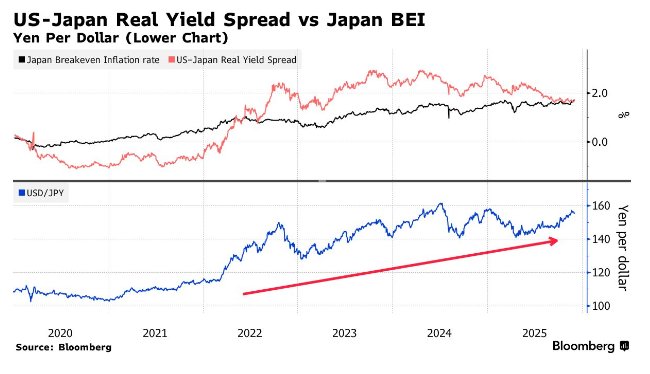
日本央行如果上调政策利率,将推高名义国债收益率,这通常有利于日元。然而,如果消费物价持续大 幅上涨,日元购买力将被侵蚀,此举的提振效果也会大打折扣。本季度日元对美元汇率已下跌超 4.5%,截至发稿,美元兑日元汇率报155.51。 鉴于日本市场对通胀上升的押注,经通胀调整后的国债收益率受到抑制,进而削弱了其对日元的支撑能 力。 衡量市场对未来价格涨幅预期的重要指标——10年期盈亏平衡通胀率——本周飙升至2004年有记录以来 的最高水平。尽管日本央行行长植田和男近日强烈暗示,央行可能在本月晚些时候的会议上收紧货币政 策以抑制通胀,但该指标周一早间触及约1.74%的高位,此后一直维持在1.7%以上。 "随着通胀预期升温,日本央行的加息举措不会带来实际利率的上升,因此难以成为支撑日元的因 素,"SMBC Nikko Securities首席外汇和外国债券策略师Makoto Noji表示。 10年期盈亏平衡通胀率反映的是名义国债收益率与相同期限通胀挂钩债券收益率之间的差值。目前10年 期国债收益率减去该盈亏平衡通胀率后,实际收益率仅约0.2%。植田和男曾表示,当前实际利率处于 低位,即使未来加息,货币政策仍将保持宽松。 ...

日元抛售还会加速?
日经中文网· 2025-12-03 02:59
日本银行总裁植田和男在12月1日的演讲中强烈暗示12月18~19日的金融政策决定会议可能 加息,但日元汇率却反应迟钝,汇率为1美元兑155.5日元至155.9日元,反而进一步走 弱…… 在日本银行(央行)加息概率急剧上升的情况下,日元买盘却缺乏势头。市场预期的12月加 息概率已上升至80%,但与加息概率为30%左右的11月中旬相比,日元汇率水平基本持平。 政策利率上限是否为1%?市场看清日本银行加息"极限",这一局面与投机资金大举抛售日元 的2024年夏季十分相似。 "将对是否加息做出恰当判断",日本银行总裁植田和男在12月1日的演讲中如此表示,强烈暗 示12月18~19日的金融政策决定会议可能加息。受这番言论的推动,日本银行加息概率急剧 上升,隔夜指数掉期利率(OIS)市场预期的12月加息概率在1日下午达到80%。 尽管如此,日元汇率却反应迟钝。11月18日的加息概率为近期最低的28%,当天的汇率在1 美元兑155日元关口附近,而12月2日的汇率为1美元兑155.5日元至155.9日元,日元反而进 一步走弱。 三井住友银行市场营业部外汇交易组组长纳谷巧指出:"市场猜测,即便加息一次,后续也很 难再加息,这样 ...
美联储降息预期动摇 黄金多头拥挤风险凸显
Jin Tou Wang· 2025-12-03 02:16
摘要今日周三(12月3日)亚盘时段,国际黄金目前交投于4220美元附近,截至发稿,国际黄金最新报 4214.60美元/盎司,涨幅0.22%,最高上探至4220.90美元/盎司,最低触及4201.67美元/盎司。目前来 看,国际黄金短线偏向看涨走势。 今日周三(12月3日)亚盘时段,国际黄金目前交投于4220美元附近,截至发稿,国际黄金最新报4214.60 美元/盎司,涨幅0.22%,最高上探至4220.90美元/盎司,最低触及4201.67美元/盎司。目前来看,国际黄 金短线偏向震荡走势。 【要闻速递】 当前市场对12月降息的预期已从87%回落至55%,美联储内部意见分歧明显加剧,包括波士顿联储主席 在内的6位地区联储行长公开反对降息,这使黄金短线承压。 分析指出,若美联储后续释放鹰派信号,美元指数有望反弹,从而直接压制以美元计价的黄金;同时, 实际利率(名义利率减通胀)上升将增加持有无息黄金的机会成本,资金或转向美债等生息资产。 不过,市场分析师认为价格回调并未动摇整体看涨预期。Zaner Metals副总裁彼得.格兰特表示,此次回 落仅是短期获利了结,核心驱动力——美联储降息预期依然稳固,他依旧看好金价在 ...
日本央行行长:如果经济展望实现,将加息
Hua Er Jie Jian Wen· 2025-12-01 01:14
Core Viewpoint - The Governor of the Bank of Japan, Kazuo Ueda, stated that real interest rates are very low, and even if the policy interest rate is raised, the overall environment will remain accommodative [1] Group 1: Economic Indicators - The USD/JPY exchange rate declined following Ueda's remarks [1] - The yield on Japan's 10-year government bonds increased by 4 basis points to 1.84%, marking the highest level since June 2008 [1] - The Tokyo Stock Exchange index saw an expanded increase of 1% [1]
贵属策略报:?价强势整理,市场静待政策催化
Zhong Xin Qi Huo· 2025-11-28 01:09
Group 1: Report Industry Investment Rating - No relevant content Group 2: Core Viewpoints of the Report - Gold is trading steadily above $4150, with the core driver being the strong consolidation pattern before the December policy path is finalized. The overall situation is in a "strong consolidation - waiting for a catalyst" phase [1]. - The continuous strengthening of the expectation of interest rate cuts within the year is the core factor for gold to maintain a narrow - range consolidation above $4150. Although the initial jobless claims and durable goods orders in the US are generally strong, they do not change the market's judgment on the December interest rate cut. The weak rebound of the US dollar and the low - level long - term US Treasury yields keep the downward trend of real interest rates stable, providing a clearer medium - term support for gold. In the context of thin holiday liquidity, the market shows the characteristics of "weak pullback and strong support" [3]. - If the December FOMC meeting continues the loose path, the gold price is expected to further break through $4200 and approach the previous high range again [3]. Group 3: Summaries According to Relevant Catalogs 1. Key Information - Multiple US policymakers pointed out in public speeches that the slowdown in employment and the decline in inflation will continue to affect the policy direction, and they did not rule out the possibility of further interest rate cuts in December [2]. - European economic officials said that the eurozone needs to speed up internal capital expenditure and industrial chain adjustment to reduce its structural dependence on external demand, and the EU is studying a new round of industrial and trade coordination plan [2]. - Ukraine and Russia have carried out multiple rounds of communication on border security and infrastructure protection, and Russia reiterated the need to establish a verifiable mechanism for security arrangements to promote subsequent discussions [2]. - As of the week ended November 22, the number of initial jobless claims in the US dropped to 216,000, the lowest since April this year; the number of continued claims was 1.96 million; the four - week average of initial claims dropped to 223,800 [2]. - In September, non - defense capital goods orders excluding aircraft increased by 0.9%, orders excluding transportation equipment increased by 0.6%, and orders excluding defense increased by 0.1%. The overall durable goods orders in September increased by 0.5%, with the previous value revised up to 3%, and multiple manufacturing sub - items continued to show signs of recovery [2]. 2. Price Logic - Gold maintains a narrow - range consolidation above $4150, mainly due to the continuous strengthening of the expectation of interest rate cuts within the year. The strength of initial jobless claims and durable goods orders does not change the market's judgment on the December interest rate cut. The weak rebound of the US dollar and the low - level long - term US Treasury yields keep the downward trend of real interest rates stable, providing a clearer medium - term support for gold. In the context of thin holiday liquidity, the market shows the characteristics of "weak pullback and strong support" [3]. - The stable ETF holdings and continuous central bank gold purchases form a solid bottom for the price. Although there is still short - term technical overbought pressure, the trend momentum is gradually accumulating [3]. 3. Outlook - The weekly range for London gold is maintained at [4030 - 4200], and for London silver at [50 - 55] [4]. 4. Commodity Index - The comprehensive index includes special indices and sector indices. Among the special indices, the commodity index is 2241.06, up 0.12%; the commodity 20 index is 2543.53, up 0.04%; the industrial products index is 2200.67, up 0.03%; the PPI commodity index is 1336.40, down 0.13% [46]. - For the precious metals index on November 26, 2025, the current value is 3370.94, with a daily increase of 0.25%, a 5 - day increase of 1.28%, a 1 - month increase of 4.87%, and a year - to - date increase of 52.36% [47].
黄金狂飙6年涨219%!4380美元历史峰值后,还能继续冲高吗?
Sou Hu Cai Jing· 2025-11-20 07:54
6年狂飙219%:黄金为何"停不下来"? 2025年的黄金市场,用"疯狂"二字形容毫不为过:伦敦现货金价年内飙涨超50%,10月冲上4380美元/盎司的历史峰值,截至11月19日仍稳居4100美元上 方,创下1979年以来最强年度表现。更令人惊叹的是,自2019年启动第三轮上涨周期以来,黄金已连续6年走强,累计涨幅达219%,成为全球资产中"最 亮的星"。然而,站在历史高位,一个关键问题萦绕在投资者心头:黄金的上涨势头还能持续吗?地缘政治、央行购金、实际利率三大变量,将如何左右 未来走势? 3. 实际利率:金价的"隐形推手" 黄金与实际利率呈负相关关系:实际利率越低,持有黄金的机会成本越低,金价越易上涨;反之则承压。2024年,美联储开启降息周期,实际利率下 行,成为金价上涨的重要推手。然而,未来利率路径存在不确定性:若美联储因通胀反弹而暂停降息,甚至重启加息,实际利率可能上行,对金价构成 压制。 未来展望:黄金还能"飞"多高? 黄金的这轮上涨,堪称"教科书级"的慢牛行情。2019年,全球贸易摩擦升级、美联储开启降息周期,黄金从1200美元/盎司起步,开启第一波攻势;2020 年疫情冲击下,全球经济停摆,黄金 ...
三轮黄金上涨周期复盘,黄金如何定价?
Hua Er Jie Jian Wen· 2025-11-19 13:56
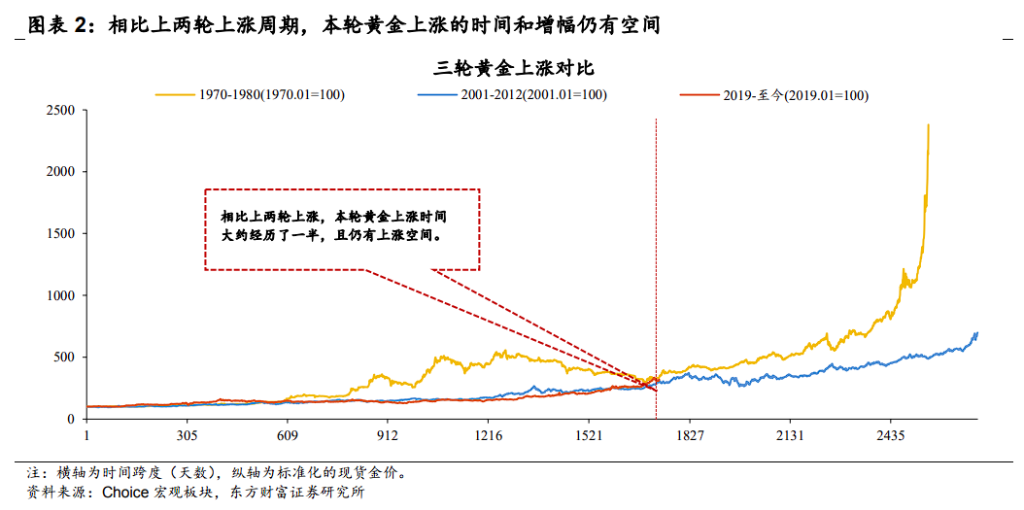
Core Viewpoint - The current gold price uptrend, which began in 2019, has lasted for six years with a cumulative increase of 219%, raising market concerns about future price movements [1][2]. Group 1: Historical Context - Gold has experienced three major uptrends since 1968, with the first from 1970 to 1980 (highest increase of 2323%) and the second from 2001 to 2012 (highest increase of 599%) [2]. - The current uptrend, starting in 2019, has shown a cumulative increase of 219% over six years, which is shorter in duration compared to previous cycles [3]. Group 2: Monetary Attributes - The dollar has depreciated nearly 100% against gold since 1970, with a 35% decline in 2025 alone, driven by increasing fiscal deficits and monetary supply [9]. - The relationship between the dollar index and gold prices has been negative, with the dollar index dropping nearly 10 percentage points since 2025, benefiting gold prices [9]. - Economic and political uncertainties have increased the U.S. economic policy uncertainty index significantly since early 2025, impacting the dollar's credibility [11]. Group 3: Commodity Attributes - Central bank gold purchases have surged from 255 tons in 2020 to 1089 tons in 2024, with an average annual growth rate of 44%, increasing their share of total demand from 5% to 22% [15]. - Jewelry demand has decreased from approximately 50% before 2020 to 32% in the first three quarters of 2025, indicating a shift in demand dynamics [15]. - Global gold reserves have increased significantly, with European countries showing high reserve ratios, contributing to upward pressure on gold prices [15]. Group 4: Financial Attributes - The traditional negative correlation between real interest rates and gold prices has weakened since 2021, as high inflation distorts real interest rates and enhances gold's anti-inflation properties [22]. - Real interest rates have increased by 213% during the current cycle, contrasting with previous cycles where they remained near zero or negative [38]. - The ratio of the S&P 500 to gold prices is approaching historical averages, suggesting that gold may be fully valued relative to equities, yet still has room for growth compared to previous cycles [22]. Group 5: Key Variables for Future Price Movements - The report identifies three critical variables that will influence future gold prices: geopolitical risks, growth in gold reserves, and changes in real interest rates [25][32]. - The geopolitical risk index has risen by 72% since 2019, reflecting heightened global tensions due to events like the COVID-19 pandemic and the Russia-Ukraine conflict [28][31]. - Global gold reserves have increased by 167% during the current cycle, a significant rise compared to previous periods, indicating a strategic shift among central banks [35].
国海良时期货:黄金期货短期回调 中期避险需求仍在
Jin Tou Wang· 2025-11-19 09:32
Macro News - The Shanghai gold futures price is reported at 937.00 CNY per gram, with an increase of 1.09%. The opening price was 922.54 CNY per gram, with a daily high of 938.32 CNY and a low of 922.54 CNY [1] - Liu Jinsong, Director of the Asian Department of the Ministry of Foreign Affairs, expressed dissatisfaction with the results of consultations with Japan's Foreign Ministry, indicating a serious atmosphere during the meeting [1] - U.S. President Trump stated he has narrowed down candidates for the next Federal Reserve Chair, including current Fed governors and executives from BlackRock [1] Institutional Insights - Today's gold price closed at 4080.47 USD, with an intraday fluctuation of -105.53 USD. The 10-year TIPS real interest rate rose by 0.02% to 4.14%, which has a weak impact on gold [1] - The nominal interest rate changed by 0.03, and the dollar index changed by 0.1115, indicating a short-term strong pressure on gold prices. Since Q3, there has been a divergence between nominal interest rates and the dollar index, leading to a neutral outlook for gold prices [1] - As of the end of October, global gold ETF holdings stood at 3892.6 tons, which is relatively high for the year, indicating a positive performance in terms of capital [1] - Key macro events to watch include U.S. housing starts and building permits for October. Strong housing starts may suggest a robust economy, leading to upward pressure on nominal interest rates and gold prices. Conversely, weak data could support a decline in real interest rates, benefiting gold [1] - Concerns about data delays following the U.S. government shutdown continue to exist, amplifying demand for gold as a safe haven [1]
今日黄金多少钱一克?11月13日黄金价格又跌价
Sou Hu Cai Jing· 2025-11-15 14:17
Core Insights - On November 13, 2025, global financial markets focused on precious metals, with international spot gold prices experiencing notable fluctuations, reaching $4,129.2 per ounce [1] - The domestic gold market also showed complex dynamics, with real-time prices providing investors with immediate market references [2] Domestic Precious Metals Market - The domestic gold price was reported at 946.3 RMB per gram, while silver, platinum, and palladium prices were 11.6 RMB, 365.7 RMB, and 332.6 RMB per gram respectively [2] - Various jewelry brands offered different retail prices for gold, with notable examples including Chow Tai Fook at 1,313 RMB per gram for gold jewelry and 642 RMB for platinum [5] Gold Price Trends - The Shanghai Gold Exchange reported a gold price of 942.19 RMB per gram, down 4.31 RMB from the previous trading day, reflecting a decline of 0.455% [6] - The price fluctuated during the day, reaching a high of 949.22 RMB and a low of 938.16 RMB [6] Financial Institutions' Gold Bar Pricing - Different financial institutions offered varying prices for their gold bars, with prices ranging from 936.1 RMB to 976 RMB per gram [7] - For instance, the Agricultural Bank's gold bar was priced at 945.2 RMB per gram, while the higher-priced option from Qianjiaxin was 1,072 RMB per gram [7] Investment Logic Behind Gold Price Movements - Recent adjustments in international gold prices followed a significant prior increase, with London spot gold prices dipping below $4,000 per ounce [8] - Factors influencing this trend included a strengthening dollar, high interest rates, and a shift in global investor risk appetite [8][9] Dollar and Interest Rate Impact - A strong dollar typically pressures gold prices, while a weak dollar supports them; recent Federal Reserve actions have contributed to a stronger dollar [9] - High yields on 10-year U.S. Treasury bonds, currently above 4.1%, have led investors to reassess the opportunity cost of holding gold [9] Evolving Investor Sentiment - The allure of gold as a safe-haven asset has diminished as geopolitical and financial risks have eased, prompting a shift of funds towards equities, bonds, and cryptocurrencies [10] - The adjustment in gold prices reflects a rebalancing of market investment logic rather than panic selling or a decline in gold's intrinsic value [10]