开源模型

Search documents
Llama 4被图灵奖得主曝作弊刷榜,Meta开源AI帝国一夜倾覆
Tai Mei Ti A P P· 2026-01-11 11:49
Core Viewpoint - Meta's Llama 4 has been accused of manipulating benchmark results, leading to a significant decline in reputation and internal turmoil within the company [1][4][21]. Group 1: Internal Management and Team Dynamics - Yann LeCun, Meta's former chief scientist, confirmed that the team altered benchmark results to maintain rankings, indicating a lack of integrity in the development process [1][4]. - The departure of key figures like LeCun and the firing of the FAIR team highlight internal management chaos and a failure to align on technical direction [2][8]. - The new leadership, particularly Alexandr Wang, is criticized for lacking experience and understanding of research, which has contributed to the company's struggles [6][8]. Group 2: Shift in Strategic Direction - Meta is abandoning its open-source strategy in favor of a closed-source model named "Avocado," which is seen as a desperate attempt to catch up in the AI race [21][22]. - The company is integrating technologies from competitors like Google and OpenAI, indicating a shift from innovation to imitation [21][22]. - The failure of Llama 4 is attributed to a strategic misjudgment by Meta's leadership, who prioritized productization over foundational AI capabilities [13][21]. Group 3: Future Prospects - The success of the upcoming Avocado model is critical for Meta's future in AI; failure could result in a permanent loss of its competitive edge [22]. - The company's current trajectory reflects a transition from an idealistic open-source pioneer to a pragmatic follower, raising concerns about its long-term viability in the AI sector [21][22].


2025,AI行业发生了什么?
Jing Ji Guan Cha Bao· 2026-01-10 09:01
Core Insights - The AI industry experienced significant milestones in 2025, marked by technological innovations, business model transformations, and global regulatory dynamics [2] Group 1: Multi-Modal Integration - AI models have advanced rapidly in text and reasoning but lagged in multi-modal capabilities, limiting their effectiveness [4] - Developers are shifting from "assembled" models to "native multi-modal" models that can process text, images, audio, and video simultaneously [5] - The development of multi-modal models is becoming a primary focus for leading AI companies, enhancing their ability to perform real-world tasks [5][6] Group 2: Embodied Intelligence - The focus of embodied AI has shifted from experimental demonstrations to market-ready solutions, with companies announcing mass production of robots [8] - The cost of humanoid robots has significantly decreased, making them more accessible for commercial use [9] - The rise of embodied intelligence is driven by advancements in multi-modal AI and increasing labor costs, leading to greater demand for robotic solutions [9] Group 3: Computing Power Competition - The competition for computing power has evolved from a focus on acquiring GPUs to a more complex, efficiency-driven battle [10] - Companies are now prioritizing how to effectively utilize limited computing resources rather than just increasing their total computing power [10] - Some developers are moving towards self-developed chips to reduce reliance on dominant suppliers like NVIDIA [10] Group 4: Paradigm Controversy - There is a growing debate in the theoretical community regarding the "scale law" that has traditionally guided AI development [12] - Some experts argue that simply increasing model size does not lead to general intelligence, suggesting a need for new training paradigms and reasoning mechanisms [13] - Despite differing opinions, both sides recognize the need for a reevaluation of existing paradigms to find better development paths [13] Group 5: Rise of Agents - The emergence of AI agents, capable of executing complex tasks autonomously, signifies a shift in human-computer interaction from function-driven to task-driven systems [14][15] - This transition is expected to reshape organizational structures and business models, focusing on task completion rather than capability provision [15] Group 6: Open Source Renaissance - Open-source models have become a foundational infrastructure for global innovation, increasingly rivaling closed-source systems in performance and adoption [16] - The rise of open-source is attributed to changing AI innovation logic, where community collaboration and rapid customization are prioritized [17] Group 7: Business Innovation - The AI industry is moving towards clearer business paths, with different players finding monetization strategies that align with their capabilities [18] - The concept of "Outcome-as-a-Service" is gaining traction, shifting the focus from selling functionalities to delivering task completion [19] Group 8: Regulatory Dynamics - AI governance has become a critical area of focus, balancing innovation with regulatory frameworks to avoid stifling technological development [20] - Different regions are adopting varied approaches to governance, reflecting their priorities and institutional frameworks [21][22] Group 9: International Competition - The competition in AI has escalated from corporate to national levels, with countries vying for leadership in defining technological paths and standards [23] - The U.S. maintains a strong position in core technologies, while China focuses on optimizing existing frameworks for scalable applications [23][24] Group 10: Youth Leadership - A trend of young scientists gaining significant influence in AI companies is emerging, reflecting a shift in the industry's leadership dynamics [25][26] - This generational change is seen as essential for navigating the evolving landscape of AI, where innovative problem definition and evaluation are crucial [26]
别再相信AI恋人了,它们连自己都养不活
Ge Long Hui· 2026-01-09 17:24
Core Viewpoint - Minimax's initial public offering (IPO) on January 9, 2026, saw its market capitalization exceed HKD 100 billion, driven by significant revenue growth, but underlying issues regarding growth quality, business model sustainability, and industry competition warrant scrutiny [1][7]. Revenue Performance - In the first three quarters of 2025, Minimax reported revenue of USD 53.437 million, a year-on-year increase of over 170%, with overseas market revenue accounting for 73.1% [1]. - The company's revenue growth is heavily influenced by marketing expenditures, which reached USD 86.695 million in 2024, representing 284.9% of its revenue [7]. Business Model Analysis - Minimax's revenue structure is characterized by a dominance of consumer (C-end) income, which constitutes over 71% of total revenue, primarily from two products: Talkie (35.1% of revenue) and Hai Luo AI (32.6% of revenue) [2]. - The C-end products face significant user retention challenges, with a reported drop in monthly active users by 60% in Q4 2025 [3]. Competitive Landscape - The AI video generation sector, where Hai Luo AI operates, is experiencing intense competition, with competitors like Runway and Pika Labs gaining market share [4]. - Minimax's B-end platform, while covering over 100 countries, lacks the scale and ecosystem influence of industry leaders, limiting its competitive edge [5]. Valuation Concerns - The market's enthusiasm for Minimax's IPO is seen as a reflection of an AI valuation bubble, with its growth driven more by marketing than by sustainable demand [7]. - The company has accumulated a net loss of USD 1.25 billion from 2022 to Q3 2025, with a research and development expense ratio of 337.4% [8]. Regulatory and Compliance Risks - Minimax's overseas revenue is concentrated in markets with stringent AI regulations, such as Singapore and the U.S., which could pose compliance risks [8]. - The company faces potential legal challenges related to copyright issues, with lawsuits from major studios claiming unauthorized use of copyrighted materials [15]. Strategic Recommendations - The analysis suggests that Minimax's approach may not be replicable for other Chinese AI companies, emphasizing the need for a shift towards sustainable business practices and localized operations [18][19]. - Companies are encouraged to focus on vertical B-end markets with strong demand and payment capabilities, rather than relying on consumer-driven growth [21].
周鸿祎预言2026年将迈入“百亿智能体时代” AI竞争焦点从参数转向落地
Zhong Guo Jing Ying Bao· 2026-01-09 09:16
Core Insights - The year 2026 is predicted to be defined as the "Year of Hundred Billion Intelligent Agents," with a shift in AI competition focus from "parameter comparison" to "practical application" [1] - AI industry dynamics will fundamentally change, with a move towards "reasoning applications" that directly employ AI to solve real-world problems, leading to a significant increase in demand for computing power [1][2] - The chip market is expected to transition from a single-dominant player (NVIDIA) to a dual-track model, emphasizing both training and diverse reasoning capabilities [1] Infrastructure and Market Dynamics - The demand for reasoning tasks is projected to grow by "hundred-fold" in the short term, surpassing the scale and growth of training computing power [1] - The energy supply will become the core bottleneck, leading to an escalation in global technological competition characterized as an "energy war" [1] - China's early advantage is highlighted through the "East Data West Calculation" national project and its green power capabilities [2] Model Evolution and Open Source - The evolution of AI models is expected to transition from "static tools" to "continuously evolving systems," with a new paradigm of "general foundation + industry specialization + reasoning evolution" [2] - Chinese open-source models, such as DeepSeek and Tongyi Qianwen, are becoming central to the global AI ecosystem, creating a "siphoning effect" on global intellectual resources [2] - The shift towards open-source AI is democratizing technology, particularly benefiting countries involved in the "Belt and Road" initiative [2] Social Integration and Workforce Changes - By 2026, AI is anticipated to develop mature long-term memory capabilities, evolving into a personal "second brain" and becoming an extension of human consciousness [2] - The integration of "silicon-based digital employees" into the workforce will lead to a mixed team of carbon-based and silicon-based entities, resulting in a flatter organizational structure [2] - Companies that can effectively translate industry know-how into AI-learnable knowledge will establish a significant competitive moat [2] Economic and Security Implications - The integration of hundred billion intelligent agents into the economy will rewrite business rules and security boundaries, marking a third leap in human commerce towards an "automated economy among intelligent agents" [3] - AI will replace apps as the core service entry point, necessitating the establishment of silicon-based regulatory frameworks, including identity verification and blockchain contracts [3] - AI security will transition from an elective concern to a critical priority, requiring the development of fully traceable systems and maintaining human oversight in key decision points [3]

英伟达新一代Rubin平台 欲重构AI与世界的联结
Zhong Guo Jing Ying Bao· 2026-01-09 02:08
Core Insights - The main focus of the article is on NVIDIA's introduction of the Vera Rubin AI computing platform at CES 2026, highlighting its transition from a chip manufacturer to an AI infrastructure company [2][9]. Group 1: Rubin Platform Overview - The Rubin platform is NVIDIA's first AI platform that integrates six chips, including Vera CPU and Rubin GPU, and has fully entered production [4][5]. - The Rubin GPU shows significant performance improvements over the previous Blackwell GPU, with NVFP4 inference performance increasing to 50 PFLOPS (5 times), training performance to 35 PFLOPS (3.5 times), and HBM4 memory bandwidth to 22TB/s (2.8 times) [5]. - The design of the Vera Rubin NVL72 system allows for faster assembly of computing nodes, reducing assembly time from 2 hours to 5 minutes, while the system operates at 100% liquid cooling [7]. Group 2: AI Infrastructure and Storage Solutions - The introduction of the BlueField-4 DPU supports a new AI storage infrastructure, addressing the growing memory requirements for complex AI tasks [6]. - NVIDIA aims to become a major player in the storage market, not by building storage systems but through partnerships with companies like HP and Dell [6]. Group 3: Open Source Models and AI Applications - Open source models are gaining traction, with 25% of tokens generated from these models, and NVIDIA is leading the open source model ecosystem [2][8]. - The company has expanded its open source model ecosystem across six domains, including biomedical AI and robotics, showcasing the rapid advancement of open source models [8][10]. - The concept of "Physical AI" is emphasized, with NVIDIA's Cosmos model enabling AI to understand physical laws and perform reasoning tasks [9][10].

a16z 创始人:AI 价格打下来了,机会才刚开始
3 6 Ke· 2026-01-09 01:17
Core Insights - The core argument presented is that AI is transitioning from a luxury to a necessity, with costs plummeting dramatically, making it more accessible for businesses and consumers alike [1][4][39]. Cost Structure - AI unit costs are decreasing at a rate faster than Moore's Law, with significant drops in the cost of tokens for large models over the past year [4][10]. - The lifespan of GPUs has increased from 3 years to over 7 years, allowing for more efficient use of hardware [5]. - Companies can now run AI on a single card or server for double the time, significantly reducing the cost per call [6][7]. Revenue Growth - Despite falling costs, revenue for AI companies is soaring, with growth rates surpassing previous technology cycles [8][10]. - Consumers are increasingly willing to pay higher subscription fees for AI services, with premium plans priced between $200 to $300 per month gaining traction [9][10]. Market Dynamics - The focus is shifting from who has the strongest AI to who can make affordable AI a standard process [3]. - The AI industry is expected to evolve into a pyramid structure, with a few supermodels at the top and numerous smaller models at the bottom, similar to the evolution of the computer industry [18][19]. Application Development - Companies are moving from merely integrating existing models to developing and fine-tuning their own models, enhancing functionality and cost-effectiveness [20][22]. - The pricing strategy for AI applications is shifting from cost-based to value-based, allowing for higher pricing based on the results delivered [26][28]. Competitive Landscape - The speed of innovation in AI is accelerating, with new entrants quickly catching up to established players due to open-source models and reduced costs [30][32]. - The competitive environment is characterized by uncertainty, where existing companies must make strategic choices to maintain their advantages [33][34]. Conclusion - The AI industry is at a pivotal moment where affordability is becoming more critical than capability, leading to a redefined competitive landscape [39][40].



黄仁勋CES最新演讲:这,是所有人的机会
Sou Hu Cai Jing· 2026-01-08 23:23
Core Insights - AI is transitioning from being a tool to becoming an integral part of all software applications, indicating a significant shift in how technology is utilized in various industries [3][4] - The concept of "double relocation" in AI signifies that it is moving from traditional applications to a new paradigm that includes both physical and digital environments [2][4] - The emergence of open-source models is democratizing AI, allowing a wider range of participants, including startups and researchers, to engage in AI development [5][8] Group 1: AI's Evolution - AI is no longer just a tool but is becoming foundational to all software, indicating a shift in application development [3] - The technology stack for software development is being completely overhauled, moving from CPU-based programming to GPU-based training, which allows for more dynamic and context-aware applications [4] - The modernization of approximately $10 trillion worth of computing infrastructure is underway to accommodate this new AI-driven approach, with significant venture capital flowing into this transformation [4] Group 2: Open-Source Models - The introduction of open-source models, such as DeepSeek R1, has sparked widespread interest and participation in AI development across various sectors [6][8] - The rapid growth in the download of open-source models indicates a global enthusiasm for AI, with contributions from startups, large companies, and academic institutions [8][9] - Open-source initiatives are seen as crucial for building trust among developers and fostering innovation in the AI space [9] Group 3: Physical AI - AI is evolving from being a digital assistant to a physical worker, capable of understanding and interacting with the real world [10][11] - The development of "physical AI" involves training AI to comprehend physical laws and realities, which is essential for applications like autonomous driving and robotics [11][12] - NVIDIA's Cosmos platform is designed to generate synthetic data for training AI in real-world scenarios, enhancing its ability to perform tasks in various environments [13][14] Group 4: Computational Power Upgrade - The introduction of the Rubin platform aims to address the challenges of computational power and cost associated with AI, significantly improving training efficiency and reducing operational costs [20][22] - Key advantages of the Rubin platform include a fourfold increase in training speed, a tenfold reduction in token costs, and a sixteenfold increase in context memory, enabling more complex tasks without loss of information [23][25][26] - The platform is designed to enhance energy efficiency, allowing for greater computational output with lower energy consumption, which is critical for the sustainability of AI operations [28][35] Group 5: Industry Insights - NVIDIA's CEO emphasizes the importance of competition, particularly from Chinese AI chip companies, as a driving force for innovation and improvement within the company [30][32] - The advice for robotics startups includes focusing on either broad technologies applicable across various sectors or specializing in specific verticals to create competitive advantages [33][34] - The energy demands of AI operations are acknowledged, with a focus on improving energy efficiency to ensure sustainable growth in the industry [35][36]
开源“裸考”真实世界,国产具身智能基座模型拿下全球第二!
量子位· 2026-01-08 11:07
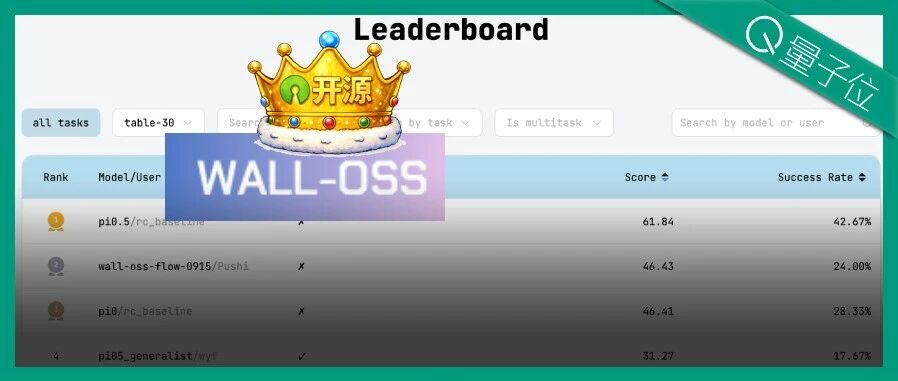
嘻疯 发自 凹非寺 量子位 | 公众号 QbitAI 国产具身智能基座模型,再次突破! RoboChallenge真机评测榜单上,来自 自变 量机器人的 端到端具身智能基础模型WALL-OSS ,以46.43分的成绩,超越美国具身智能明星 公司Physical Intelligence的pi0 (π0) , 总分 排名 全球第二 。 | | Beta | Home | Challenges | Runs | Leaderboard | News | Community | Eval Your Policy | Log In | | --- | --- | --- | --- | --- | --- | --- | --- | --- | --- | | | | | | Leaderboard | | | | | | | all tasks | table-30 > | Search by tag v | | Search by task v | | Is multitask > | | Search by model or user | Q | | Rank | Model/User | | Is multi ...
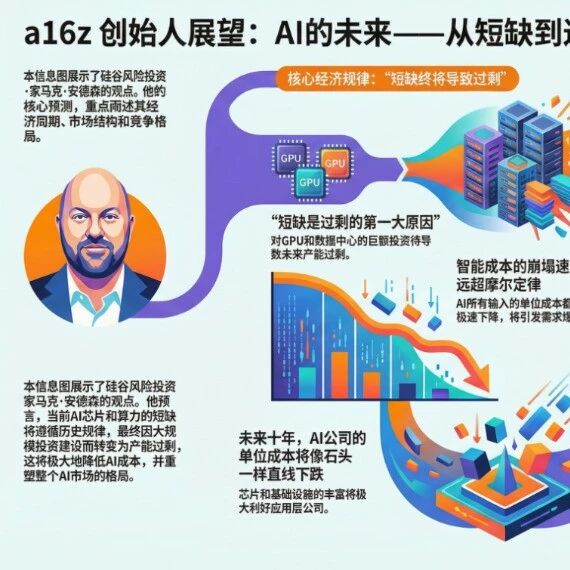
“短缺终将导致过剩”!a16z安德森2026年展望:AI芯片将迎来产能爆发与价格崩塌
硬AI· 2026-01-08 04:24
Core Insights - AI represents a technological revolution larger than the internet, comparable to electricity and microprocessors, and is still in its early stages [2][3][11] - The cost of AI is decreasing at a rate faster than Moore's Law, leading to explosive demand growth [4][41] - Historical patterns suggest that shortages in GPU and data center capacity will eventually lead to oversupply, further driving down AI costs [5][12][41] Group 1: AI Market Dynamics - The future AI market structure will resemble the computer industry, with a few "god-level models" at the top and numerous low-cost "small models" proliferating at the edges [6][19] - The competition between the US and China is intensifying, with Chinese companies like DeepSeek and Kimi making significant strides in open-source strategies and chip development [6][15][59] - AI applications are shifting from "pay-per-token" models to "value-based pricing," allowing startups to integrate and build their own models rather than merely acting as wrappers [7][17] Group 2: Public Perception and Regulatory Landscape - Public sentiment towards AI is mixed, with fears of job displacement coexisting with rapid adoption of AI technologies [8] - The EU's regulatory approach, focusing on leading in regulation rather than innovation, is hindering local AI development [8][60] - The US regulatory environment is shifting towards supporting innovation, with less interest in imposing strict regulations that could hinder competitiveness against China [14][64] Group 3: Economic Implications - The rapid decline in AI input costs is expected to create significant demand elasticity, leading to unprecedented growth in AI applications [41][42] - The economic landscape for AI companies is promising, with many experiencing unprecedented revenue growth as they effectively monetize their offerings [32][39] - The ongoing construction of data centers and GPU production is projected to lead to a significant reduction in AI operational costs over the next decade [41][50]
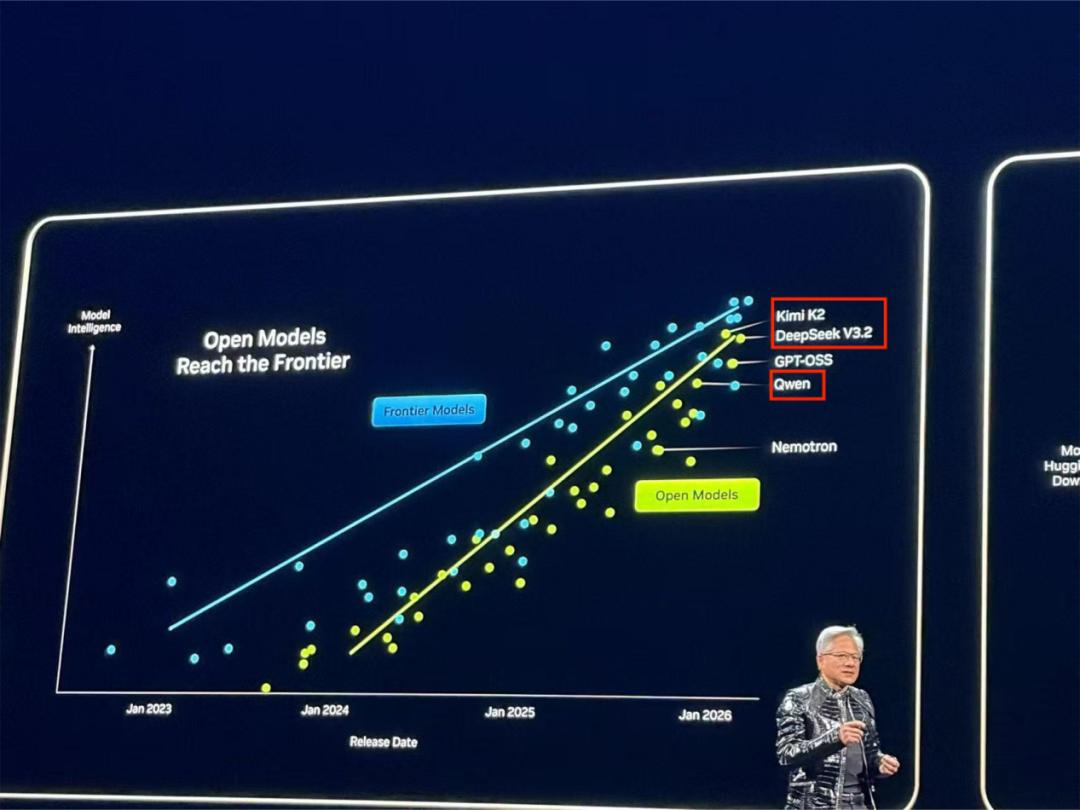
黄仁勋2026第一场演讲,点赞中国3个大模型
3 6 Ke· 2026-01-07 03:24
Core Insights - NVIDIA's CEO Jensen Huang emphasized the shift towards physical AI during his keynote at CES, moving away from consumer graphics cards to focus on advancements in AI technology [1][2] Group 1: AI Industry Developments - Huang highlighted the significant impact of open-source models on the AI industry, stating that they have become a catalyst for global innovation [2] - The emergence of the DeepSeek R1 model has notably accelerated industry transformation, surprising many in the field [2] - Open-source models are rapidly approaching top-tier performance, with a current gap of about six months compared to proprietary models, which is gradually narrowing [4] Group 2: NVIDIA's Innovations - NVIDIA introduced a comprehensive open-source model matrix covering six key areas, including agent AI, physical AI, autonomous driving, and robotics [5] - Huang defined physical AI as the fourth stage of AI development, capable of understanding physical causality in the real world, marking a transition from digital to physical applications [8] - The company launched the Alpamayo model, the world's first open-source autonomous driving inference model, which competes directly with Tesla's Full Self-Driving (FSD) technology [8] Group 3: Technical Advancements - The new Vera Rubin architecture was unveiled, named after astronomer Vera Rubin, and is designed to overcome limitations posed by the slowing of Moore's Law [11][13] - Rubin architecture features six chips working collaboratively, achieving a performance of 50 PFLOPS for inference tasks, which is five times that of the previous Blackwell architecture [13] - The cost of inference using Rubin has decreased by ten times, allowing for faster training and lower latency in decision-making processes [15] Group 4: Future Outlook - Huang expressed confidence that a significant portion of vehicles will be highly autonomous within the next decade [9] - The convergence of open-source model advancements, breakthroughs in physical AI, and the introduction of the Rubin architecture is expected to reshape industries and daily life [17]