收益率曲线陡峭化

Search documents
降息预期退潮,美国长期国债“失宠”
Hua Er Jie Jian Wen· 2025-06-16 12:56
Group 1 - The market is experiencing a "flight" from long-term U.S. Treasuries as expectations for aggressive rate cuts by the Federal Reserve diminish, with the 30-year Treasury yield approaching 5% [1] - Recent weak consumer and producer price data have revived rate cut expectations, with futures indicating a higher probability of cuts starting in September [1] - Concerns over fiscal policy, particularly the potential impact of Trump's "Big Beautiful Plan," which could increase the deficit by $2.4 trillion over the next decade, are contributing to a steepening yield curve [2] Group 2 - The trend of steepening yield curves is expected to continue, driven by a preference for short-term bonds while reducing exposure to long-term bonds due to uncertainties in fiscal expansion and potential inflation risks from tariff policies [3] - Investors are closely monitoring the Federal Reserve's latest economic forecasts, which suggest a policy rate of 3.75%-4.00% by the end of 2025, indicating a cautious outlook on long-term Treasuries [3]
华泰固收|周度债市讨论会
2025-06-09 15:30
Summary of Key Points from Conference Call Industry Overview - The discussion primarily revolves around the bond market in China, with a focus on the impact of U.S.-China tariff issues, domestic economic conditions, and central bank policies [1][2][4][5]. Core Insights and Arguments 1. **Tariff Impact**: The long-standing U.S.-China tariff issues are not expected to be the primary drivers of the bond market in the short term, as the market has largely absorbed these impacts [1][4]. 2. **Domestic Economic Weakness**: The domestic economic fundamentals are weak, with limited external demand support, declining real estate sales, and soft consumer spending, which collectively provide some support for the bond market [1][5]. 3. **Central Bank Policies**: The central bank's proactive measures, such as announcing reverse repurchase operations, indicate a protective stance towards the liquidity environment, reducing concerns about significant funding disruptions at the end of the half-year [1][8][10]. 4. **Banking Behavior**: Large banks are increasing their allocation to short-term bonds and realizing gains, driven by liquidity management and policy expectations. This behavior may lead to a decline in short-term interest rates while limiting the downward space for long-term rates [1][10]. 5. **Fiscal Policy**: Fiscal spending is strong, particularly in social welfare projects, but the revenue side remains weak, which could constrain future spending if the trend continues [1][17][22]. Additional Important Insights 1. **Market Sentiment**: The bond market sentiment is relatively optimistic regarding government bond yields, but reactions to tariff negotiations have become muted as the market understands the underlying logic of these issues [4]. 2. **Credit Market Dynamics**: The credit bond market is experiencing a decline in default rates, but liquidity disturbances due to interest rate fluctuations and uncertainties remain a concern [3][27]. 3. **Investment Opportunities**: There are emerging investment opportunities in private debt and asset-backed securities (ABS), particularly in sectors supported by policy incentives [12][37]. 4. **Economic Structure Changes**: The economic structure is showing significant divergence, with high-value-added industries demonstrating resilience, while traditional infrastructure sectors are lagging [24][25]. 5. **Future Outlook**: The bond market outlook remains favorable in the medium to long term, with attention needed on real estate trends and their effects on consumption and employment [26][28]. Conclusion The bond market is currently influenced by a mix of domestic economic challenges, central bank interventions, and evolving fiscal policies. Investors should remain vigilant regarding market dynamics, particularly in credit markets and emerging investment opportunities in private debt and ABS.
美国这场220亿“借钱大戏”,突然成了本周最大悬念
Jin Shi Shu Ju· 2025-06-09 03:02
Core Viewpoint - Global investor aversion to long-term government bonds is turning the upcoming U.S. Treasury auction into a highly anticipated event on Wall Street, particularly focusing on the sale of $22 billion in 30-year bonds, which will serve as a gauge for market appetite amid declining demand for such securities [1][2] Group 1: Market Sentiment and Auction Details - The upcoming auction results will be closely monitored as they will reflect market sentiment, with the 30-year U.S. Treasury bonds currently viewed as undesirable by investors [1][2] - Key metrics such as the auction "tail" (the difference between final yield and pre-issue trading levels) and the bid-to-cover ratio will provide insights into market demand [2] - The participation of foreign investors will also be a focal point, as poor auction results could indicate deeper issues in market confidence [2] Group 2: Yield Trends and Economic Implications - Long-term bond yields have recently surged due to rising concerns over debt spirals and worsening fiscal deficits, with the 30-year yield reaching a near 20-year high of 5.15% before settling at 4.94% [1][3] - The increase in yields signifies heightened financing pressures as the U.S. government continues to expand its borrowing amid uncontrolled spending [1][4] - The yield curve is steepening, with the 10-year term premium indicator rising to nearly 0.75 percentage points, reflecting increased compensation demanded by investors for long-term borrowing [4] Group 3: Political and Economic Factors - Long-term yields are increasingly influenced by political factors rather than monetary policy, leading to a disconnect from fundamental economic indicators [3][4] - The potential for a tax on foreign investors, as proposed in the Trump administration's tax reform, raises concerns about foreign investment in U.S. Treasuries, despite clarifications that it would not apply to bond investments [4] - Upcoming economic data releases, including inflation metrics, are expected to further impact the yield curve, with a likely outcome of continued steepening [4]
非农数据重磅来袭:债市押注9月降息概率达90% 美联储政策转向关键信号待揭晓
智通财经网· 2025-06-06 03:00
市场预计,周五公布的5月非农就业人数将增加12.5万,低于前值17.7万;失业率预计维持在4.2%不变。 Brandywine Global Investment Management投资组合经理杰克·麦金太尔(Jack McIntyre)对债券持看涨立 场,他表示,"经济正偏向温和疲软,若做空债券,而周五数据疲软,就可能面临风险。强劲的数据尚 可解释为噪音,而不是将疲软的数据视为异常。" 政策敏感的两年期国债收益率稳定在3.91%,本周累计上行约2个基点。10年期国债收益率周四一度跌 至4.31%,但欧洲国债抛售潮推动其回升至4.39%,周五亚洲时段基本持稳于该水平。 债券交易员一直押注短期债券表现将优于长期债券(即收益率曲线陡峭化),其逻辑在于:美联储最终将 降息压低短期收益率,而特朗普的减税计划可能恶化财政赤字,推高长期借贷成本。 智通财经APP获悉,债券交易员将仔细剖析5月就业报告,从中捕捉劳动力市场疲软的迹象,以判断美 联储降息的时机。周四,美国周度初请失业金人数意外跃升至8个月高点,推动美债收益率短暂跌至近 一个月最低水平,交易员据此几乎完全定价了9月降息的预期(此前预期为10月)。尽管交易员仍预 ...
日债拍卖三度遇冷,瑞银喊话:根本没人买,别发了!
Jin Shi Shu Ju· 2025-06-05 10:00
Group 1 - A senior investment manager suggests Japan should stop issuing bonds with maturities over 30 years to alleviate volatility in the government bond market [1] - The yield on 40-year Japanese government bonds surged to 3.675%, the highest since its introduction in 2007, prompting a call for the Ministry of Finance to cease long-term bond issuance [1] - Domestic demand for long-term bonds is declining due to an aging population, with life insurance companies and pension funds no longer needing to allocate to bonds with maturities exceeding 30 years [1] Group 2 - The recent surge in bond yields has led the Ministry of Finance to seek feedback from market participants regarding potential adjustments to its issuance strategy [2] - It is anticipated that the Bank of Japan should follow up on its January rate hike in the upcoming July monetary policy meeting, signaling a potential for semi-annual rate increases to stabilize market expectations [2] - The current bond portfolio of the Bank of Japan is heavily concentrated in 5-10 year bonds, and a shift towards longer maturities could enhance demand for ultra-long-term bonds [2] Group 3 - During the recent spike in bond yields, tactical purchases of ultra-long-term bonds were made, but significant accumulation will depend on clear signals from the Japanese government regarding market normalization [3]

英国央行行长贝利收益率曲线的明显陡峭化并非由量化紧缩引起,但仍需考虑量化紧缩与此现象的相互影响。
news flash· 2025-06-03 11:00
英国央行行长贝利收益率曲线的明显陡峭化并非由量化紧缩引起,但仍需考虑量化紧缩与此现象的相互 影响。 ...
“能做空就做空”,30年期美债惨成弃儿,明星机构唯恐避之不及
华尔街见闻· 2025-06-03 03:12
Core Viewpoint - The article discusses the shift in investment strategies among major financial institutions, led by DoubleLine Capital, towards short-term bonds due to concerns over the expanding U.S. federal budget deficit and debt burden, while long-term U.S. Treasury bonds are being avoided due to rising yield risks [1][2][5]. Group 1: Investment Strategies - DoubleLine Capital and other institutions are avoiding long-term U.S. Treasury bonds, opting instead for short-term bonds which present lower interest rate risks and decent yields [1]. - The investment strategy includes "steepening" trades, focusing on bonds in the mid-yield curve rather than long-term bonds [4]. - PIMCO has maintained a cautious stance on 30-year bonds since late last year, favoring bonds in the 5 to 10-year range [11][12]. Group 2: Market Trends - The 30-year U.S. Treasury bond has shown particularly weak performance this year, with yields rising while shorter-term bonds (2-year, 5-year, and 10-year) have seen declining yields [2]. - The yield on the 30-year bond reached 5.15%, close to its highest point since 2007, with a yield spread between the 30-year and 5-year bonds exceeding 1 percentage point for the first time since 2021 [9]. - Recent auction results indicate a preference for shorter-term bonds, with 2-year, 5-year, and 7-year bonds performing well, while the 30-year bond auction slightly underperformed expectations [13]. Group 3: Government Debt Issuance - Discussions about potentially reducing or pausing the issuance of 30-year bonds have emerged, which is unusual given the Treasury's efforts to maintain a stable debt issuance plan [5][6]. - The U.S. Treasury has committed to maintaining its auction scale, including long-term bonds, despite market pressures [7]. - The upcoming auction of 30-year bonds on June 12 is viewed as a critical test for market demand [7]. Group 4: Economic Concerns - Concerns over inflation due to tariff policies and the potential for increased government borrowing to cover deficits have contributed to the negative sentiment surrounding long-term bonds [8]. - The Congressional Budget Office projects that by 2035, the U.S. debt-to-GDP ratio could rise to 118%, surpassing historical highs, which raises further concerns about long-term bond investments [13].


美债长端收益率逼5%拉响警报 交易员押注美债将进一步下跌
智通财经网· 2025-05-29 01:14
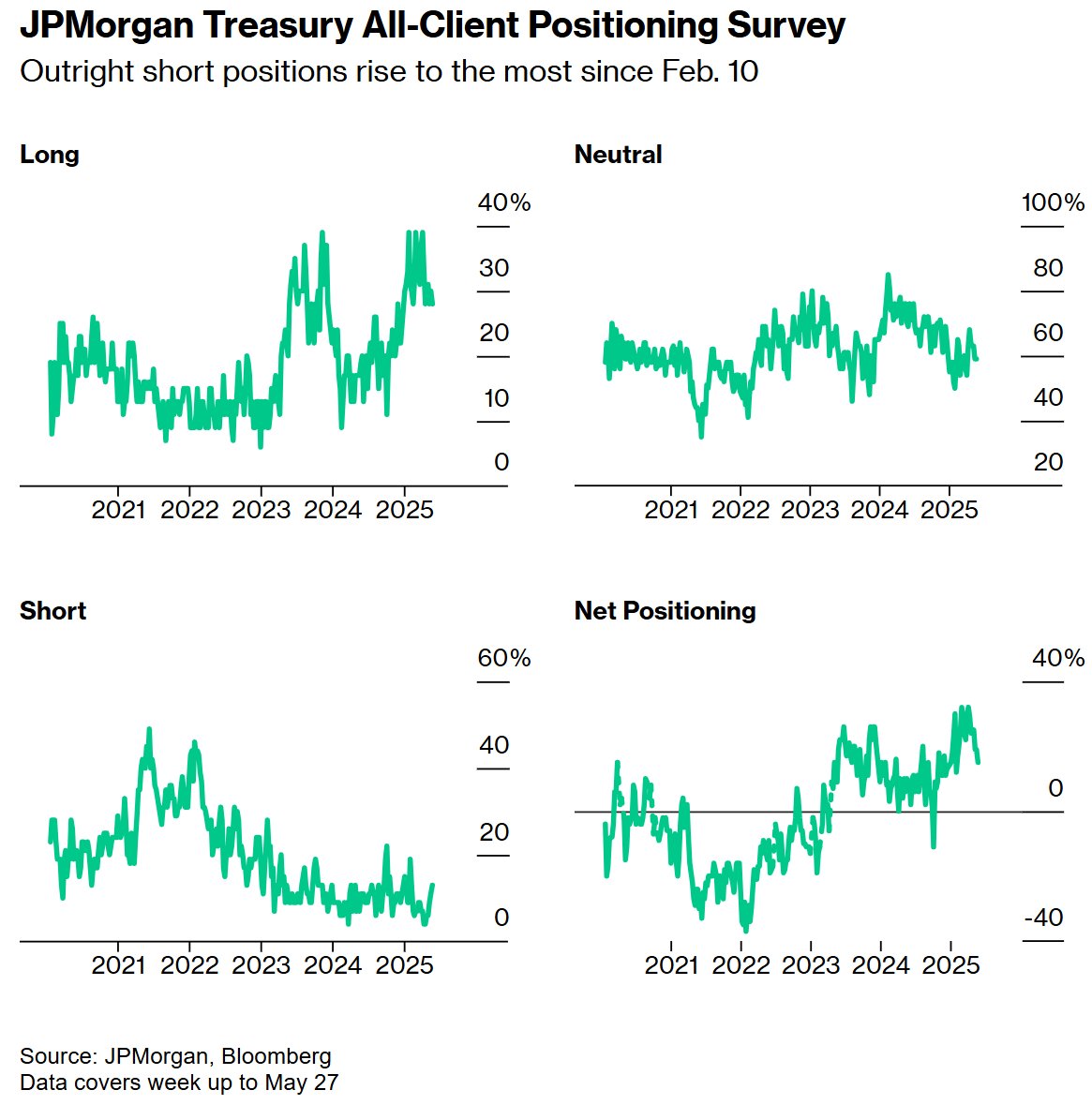
Group 1 - Long-term U.S. Treasury bonds are experiencing a significant decline, causing traders to feel uneasy as yields hover around the critical psychological threshold of 5% [1] - A recent survey by JPMorgan indicates that investor expectations for further selling are worsening, with net short positions across all client categories reaching the highest level since mid-February [1] - The current yield on the 30-year Treasury bond is approximately 4.97%, having peaked at 5.15% last week, marking the highest level since October 2023 [1] Group 2 - There is a global steepening of the yield curve, with increasing supply and decreasing demand for long-term securities, putting pressure on the long end of the curve [2] - Recent auctions for five-year and two-year Treasury bonds have shown strong demand, highlighting the disparity in investor interest between short-term and long-term bonds [2] - As of the week ending May 27, investor direct short positions increased by 2 percentage points, reaching the highest level since February 10 [2] Group 3 - SOFR options have seen significant activity, particularly for options with a strike price of 94.875, driven by inflows including a large buyer of a specific put spread [5] - The strike price of 95.75 remains the second most active despite a large amount of clearing, with 95.625 being the most significant strike price across various option expirations [7] - Traders are paying higher premiums to hedge against the risk of long bond contract sell-offs, with the inclination for put options in long-term bond contracts reaching the highest level in about a month [10] Group 4 - Asset management companies have been actively reducing leverage in U.S. Treasury futures, closing approximately 168,000 contracts of 10-year Treasury futures equivalents in the latest week [13] - The de-risking is most pronounced in futures for bonds with maturities over 10 years, with a significant amount of long positions being closed [13]
日本超长期国债止跌,但真正的考验在本周三
Hua Er Jie Jian Wen· 2025-05-26 05:57
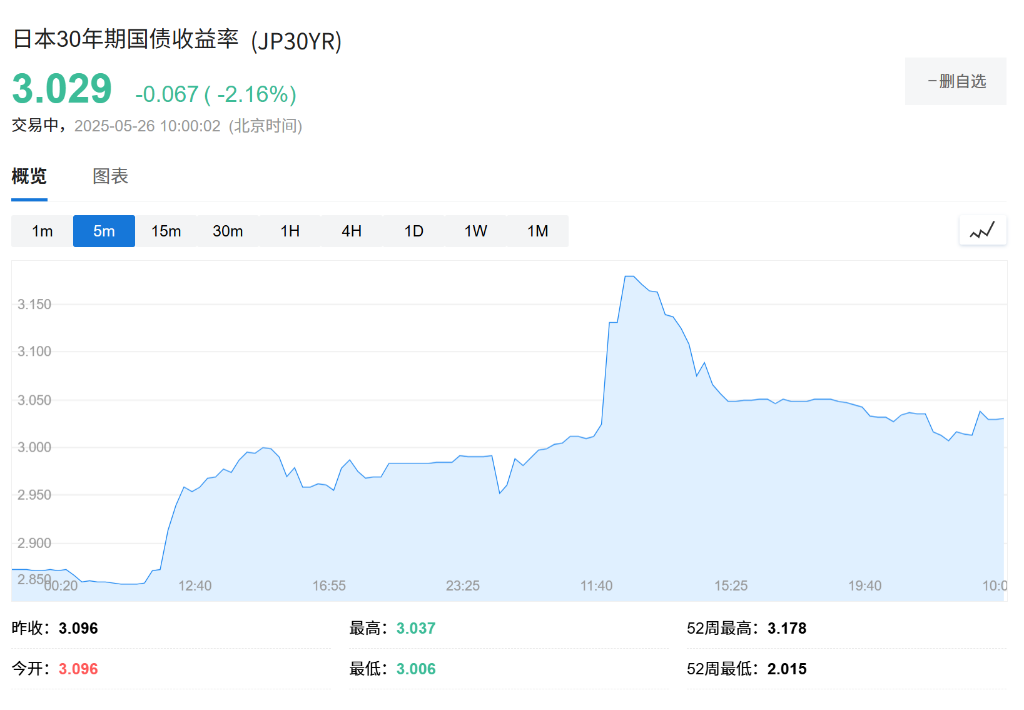
Core Viewpoint - Japan's bond market is facing a structural crisis despite a temporary technical rebound in long-term bond yields, particularly the 30-year and 40-year bonds, which saw a decline of 7 basis points to 3.029% [1][4]. Group 1: Market Dynamics - The recent sell-off has pushed the yields of 30-year and 40-year bonds to their highest levels since issuance, indicating a significant market stress [4][5]. - The upcoming auction of 40-year bonds is critical; weak demand could lead to further yield increases and exacerbate the selling cycle, while strong demand may provide temporary stability [4][5]. Group 2: Supply and Demand Imbalance - There is a pronounced steepening of the yield curve in Japan, exacerbated by the central bank's significant reduction in bond purchases, with traditional buyers like life insurance companies failing to fill the gap [5]. - Japanese life insurance companies reported a more than doubling of domestic bond investment losses in the last fiscal year, highlighting the growing supply-demand imbalance [5]. Group 3: Policy and Market Sentiment - The Bank of Japan's Governor has not indicated any plans to intervene in the bond market, contributing to increased market volatility and uncertainty [5]. - The outcome of the 40-year bond auction is seen as a crucial test of market demand, with potential implications for future market stability [5].
长债风暴撕裂投资平衡!动荡市下60/40投资策略还行得通吗
Zhi Tong Cai Jing· 2025-05-25 23:50
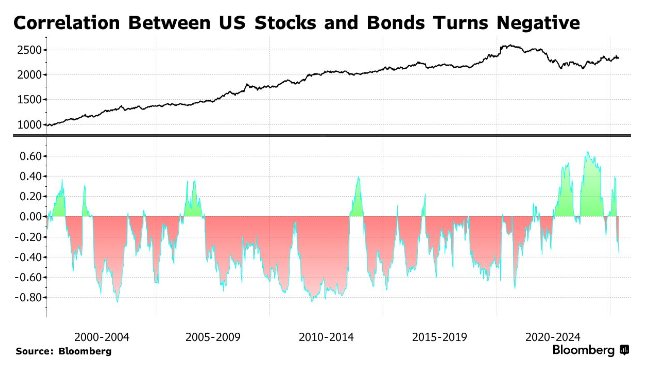
Group 1 - The 60/40 investment strategy, traditionally recommended for balancing risk and stable income, is experiencing a revival due to the restoration of the traditional inverse relationship between stocks and bonds [1][6] - As of mid-May, a 60/40 portfolio indicator in the U.S. has returned approximately 1.6% this year, outperforming the S&P 500 index with lower volatility [1][6] - The recent significant drop in the price of 30-year U.S. Treasury bonds, with yields surpassing 5%, has raised investor caution regarding long-term U.S. debt [1][2] Group 2 - Concerns over rising deficits and the impact of Trump's tax plan have led to a downgrade of the U.S. credit rating by Moody's, contributing to increased long-term bond yields [2] - The performance of long-term bonds is increasingly resembling that of risk assets rather than typical defensive assets, as noted by PGIM's Chief Investment Officer [2][6] - Short-term bonds are currently favored over long-term bonds, as investors seek higher yields to compensate for deficit risks, leading to a steepening yield curve [6][9] Group 3 - The Bloomberg U.S. Treasury Index remains negatively correlated with stocks, with an average duration of approximately 5.7, indicating lower interest rate risk compared to 30-year bonds [9] - The S&P 500 index has seen a recovery, pushing its valuation close to historical highs, while its earnings yield has dropped to 3.95%, about half a percentage point lower than the 10-year Treasury yield [9][12] - Given and other investors prefer mid-term bonds, such as five-year Treasuries, over long-term bonds due to rising debt levels and associated risks [11][12]