滞胀风险

Search documents
“超级央行周”落幕 美联储领衔降息
Sou Hu Cai Jing· 2025-09-19 13:39
Group 1 - The Bank of Japan announced to maintain its current interest rate level and plans to sell financial assets to further reduce its easing measures and normalize monetary policy [1] - The Canadian central bank cut its benchmark interest rate by 25 basis points to 2.5%, aiming to stimulate economic growth and alleviate downward pressure on the economy [1] - The Federal Reserve lowered the federal funds rate target range by 25 basis points to between 4.00% and 4.25%, marking its first rate cut of the year and indicating potential further cuts in the future [2] Group 2 - The Federal Reserve's rate cut is expected to lower corporate financing costs, stimulate investment and consumption, and inject vitality into the U.S. economy [2][3] - The Fed's decision is likely to influence major asset classes, with expectations of a limited decline in U.S. Treasury yields, support for U.S. stocks, and a weaker dollar index [3] - Global funds may seek higher returns due to the U.S. rate decrease, potentially flowing into emerging market equities [3]
中美利差进一步收窄,货币政策坚持“以我为主”
2 1 Shi Ji Jing Ji Bao Dao· 2025-09-18 22:46
Group 1 - The Federal Reserve decided to lower the federal funds rate target range by 25 basis points to 4.00%-4.25%, marking its first rate cut since December 2024, which is seen as a "risk management" move rather than the start of a sustained easing cycle [1] - The decision to cut rates comes amid pressure from the White House and reflects a balance between inflation and employment risks, with Powell indicating a preventive action due to a "strange balance" in the U.S. labor market [1][2] - The U.S. labor market shows signs of slowing, with the Bureau of Labor Statistics revising down the number of jobs added over the past year by 911,000, and August's non-farm payrolls increasing by only 22,000, significantly below the expected 75,000 [1][2] Group 2 - The weakening of the U.S. labor market may be obscured by factors such as reduced labor supply due to immigration policies, leading to a decline in labor force participation, which could accelerate the drop in labor demand [2] - Despite the Fed's rate cut, inflation risks remain, with the Personal Consumption Expenditures (PCE) price index rising by 2.7% over the past 12 months, and core PCE increasing by 2.9%, influenced by rising goods prices and fluctuating service prices [2] - The Fed's contradictory stance of predicting economic growth and rising inflation while cutting rates has led to market confusion, prompting international capital to seek "safe havens," with China being a primary destination [3] Group 3 - The International Financial Institute reported that foreign investors allocated nearly $45 billion to emerging market stocks and bonds in August, the highest in nearly a year, with about $39 billion net inflow to China [3] - The narrowing of the interest rate differential between China and the U.S. post-rate cut may lead to increased capital inflows into China, boosting the renminbi and attracting more foreign investment [3] - China's monetary policy needs to be cautious in response to the narrowing interest rate differential, as further rate cuts could pressure bank margins and potentially lead to increased risk appetite among banks [3]
什么,大利好,黄金却跌了?
Sou Hu Cai Jing· 2025-09-18 08:56
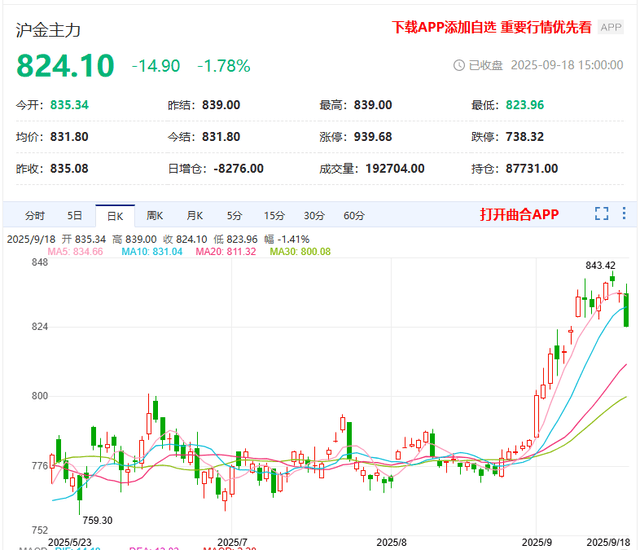
Group 1 - The Federal Reserve's "dot plot" indicates two more rate cuts of 25 basis points each this year, lowering the policy rate range to 4.00%-4.25%, which is more dovish than previous expectations, suggesting a relief from stagflation risks [1] - The latest economic forecast shows a year-end inflation rate median of 3%, above the 2% target but unchanged from the previous quarter; the unemployment rate is expected to remain stable at 4.5%, and economic growth is slightly increased from 1.4% to 1.6% [1] - The Federal Reserve is shifting its view on the temporary impact of Trump's tariffs on inflation, prioritizing the prevention of economic slowdown and rising unemployment, which provides a more favorable environment for non-yielding assets like gold [1] Group 2 - On the day of reporting, the Shanghai gold price fell by 1.78%, closing at 824.1 yuan per gram [3] - According to GF Futures, the market interpreted the Federal Reserve's rate decision as neutral, with the dollar index rebounding after a decline; since September, precious metal prices have rapidly surged and reached new highs, indicating overbought conditions [4] - The outlook suggests that with increasing risks in the U.S. job market, the Federal Reserve's policy path exhibits dual characteristics of "strengthened expectations and compromised independence," which continues to suppress the dollar index and U.S. Treasury yields [4]

国际金融市场早知道:9月18日
Xin Hua Cai Jing· 2025-09-18 00:41
Group 1 - The Federal Reserve announced a 25 basis point cut in the federal funds rate target range to 4.00% to 4.25%, marking the first rate cut of 2025 and following three cuts in 2024 [1] - Fed Chairman Powell highlighted the risks of stagflation, noting a slowdown in job growth and rising inflation, with commodity inflation accelerating while service inflation continues to decline [1] - The Canadian central bank lowered its benchmark interest rate by 25 basis points to 2.5%, citing trade uncertainties from U.S. tariffs impacting economic activity, with GDP declining approximately 1.5% in Q2 and exports down 27% [3] Group 2 - U.S. new home starts fell to an annualized total of 1.307 million units in August, down from 1.429 million in July, significantly below the expected 1.365 million [2] - The European Commission proposed to partially suspend trade-related preferential terms in the EU-Israel Association Agreement [2] - A study from Mannheim University indicated that extreme weather events this summer caused approximately €43 billion in losses to Europe's GDP, with southern Europe being particularly affected [2] Group 3 - Japan's exports to the U.S. fell by 13.8% year-on-year in August, marking the fifth consecutive month of decline due to U.S. tariff policies [4] - The UK’s August CPI remained steady at 3.8%, the highest level in over a year and a half, which may lead to cautiousness from the Bank of England regarding further rate cuts [3] - The World Trade Organization's report predicts that with appropriate policy support, AI applications could boost global trade growth by nearly 40% by 2040 [2]
深夜,中国资产爆发
财联社· 2025-09-18 00:23
Core Viewpoint - The Federal Reserve's decision to cut interest rates by 25 basis points does not indicate the start of a long-term easing cycle, which dampens market bullish sentiment [1][3]. Market Dynamics - The Dow Jones increased by 260.42 points (0.57%) to 46018.32, while the Nasdaq fell by 72.63 points (0.33%) to 22261.33, and the S&P 500 decreased by 6.41 points (0.10%) to 6600.35 [4]. - Among the 11 sectors of the S&P 500, the financial sector rose by 0.96%, and the energy sector increased by 0.28%, while the industrial sector fell by 0.47% and the information technology sector declined by 0.7% [4]. - In the ETF market, the semiconductor ETF dropped by 0.64%, while the energy ETF rose by 0.23% and the financial ETF increased by 0.97% [4]. Stock Performance - Major tech stocks showed mixed results, with Nvidia down 2.62%, Amazon down 1.04%, and Google A down 0.65%, while Microsoft rose by 0.19% and Apple increased by 0.35% [5]. - Lyft's stock surged by 13% following the announcement of a partnership with Waymo for autonomous taxi services in Nashville, while competitor Uber fell by 5% [6]. - Workday's shares rose by 7.25% after reports of Elliott Management acquiring over $2 billion in shares [7]. - StubHub's stock fell over 6% on its first day of trading, marking a reversal in the hot IPO market [8]. - Chinese concept stocks mostly rose, with the Nasdaq Golden Dragon China Index up 2.85%, including Baidu up over 11% and NIO up over 6% [8].

现货黄金:升破3700美元,年内涨幅逾40%
Sou Hu Cai Jing· 2025-09-17 03:12
Core Viewpoint - International gold prices have surpassed $3,700 per ounce, reaching a historical high, driven by investor speculation on potential interest rate cuts by the Federal Reserve [1] Group 1: Price Movement and Historical Context - As of the beginning of this week, gold prices have increased by over 40% year-to-date, marking the largest gain for the same period since 1979 [1] - The trajectory and magnitude of gold price increases over the past nine months resemble the bull market of 1979, which saw a 50% rise in the first nine months and a nearly 30% increase in the fourth quarter [1] - Historical patterns indicate that during periods of high inflation, the Federal Reserve often cuts interest rates, which tends to benefit gold prices [1] Group 2: Market Influences - Global trade uncertainties, geopolitical risks, and a surge in central bank gold purchases, along with inflows into gold ETFs, have contributed to the rising gold prices [1] - Goldman Sachs predicts that if 1% of private holdings in U.S. Treasury bonds were to shift to gold, prices could approach $5,000 per ounce [1] - Following the Jackson Hole global central bank conference in August, gold prices have outperformed U.S. stocks, Bitcoin, the dollar, and oil [1] Group 3: Future Projections - Bank of America forecasts that gold prices could reach $4,000 per ounce by 2026, citing that interest rate cuts may lead to long-term price pressures and increased stagflation risks, creating a favorable environment for gold [1]
美联储决议前瞻:重启降息箭在弦上
Di Yi Cai Jing Zi Xun· 2025-09-16 00:21
Core Viewpoint - The Federal Reserve is expected to restart the interest rate cut process due to alarming signals from the U.S. job market, with significant attention on future easing paths amid internal pressures and the unclear impact of Trump's trade policies [2][3]. Economic Outlook Changes - Since August, both inflation and employment have been under pressure, with the Consumer Price Index (CPI) rising 2.9% year-on-year in August, the highest increase since January, and core CPI at 3.1%, significantly above the Fed's 2% target [3]. - Initial jobless claims reached their highest level since 2021, indicating delays in job placements, while the unemployment rate rose to 4.3% [3]. - The IMF noted signs of pressure on the U.S. economy, including slowing domestic demand and decelerating job growth, with potential inflation risks stemming from tariffs imposed by the Trump administration [3][4]. Policy Outlook - The FOMC is expected to reassess its economic and federal funds rate outlook, with Wall Street anticipating a slight downward adjustment in the 2025 economic growth forecast and a stable inflation prediction [4]. - Wells Fargo predicts a reduction in the median interest rate forecast for 2025 from a 50 basis point cut to a 75 basis point cut, with a further reduction for 2026 [5]. - The updated "dot plot" will help determine whether the FOMC members favor "quarterly cuts" or "continuous cuts," with a terminal policy rate expected to be between 3.00%-3.25% by the end of 2026 [5]. Interest Rate Expectations - The market widely anticipates a 25 basis point rate cut, lowering the federal funds rate to a range of 4.00%-4.25% [6]. - There are indications of potential dissent within the Fed, with some members concerned about rising inflation while others focus on preventing a possible recession [6]. - The futures market shows an 80% probability of a rate cut in October, with expectations for cuts in September, October, and December [6][7]. Future Rate Cut Signals - Analysts suggest that Powell may signal three rate cuts of 25 basis points each in September, October, and December to mitigate risks in the job market [7]. - However, there remains uncertainty regarding future policy directions, which will depend on upcoming inflation and employment data [7].
投资者静候美联储利率决议
Sou Hu Cai Jing· 2025-09-15 14:47
Group 1 - The Dow Jones, S&P 500, and Nasdaq 100 futures saw slight increases, while gold and oil prices experienced minor declines, and Bitcoin surpassed $16,000, indicating a mixed market sentiment ahead of the Federal Reserve's meeting [1] - The Federal Reserve has maintained the federal funds rate target range at 4.25% to 4.50% since the last rate cut in December 2024, which totaled a 100 basis point reduction over three consecutive cuts [1] - Market expectations suggest that the Federal Reserve will announce a 25 basis point rate cut during the upcoming meeting, despite some internal disagreements within the Fed [1] Group 2 - Concerns about stagflation are rising as initial jobless claims have reached their highest level since 2021, indicating a weakening labor market, while inflation remains significantly above the Fed's 2% target [2] - Alicia Levine from Bank of New York suggests that the Fed will prioritize inflation concerns over the weakening labor market, reflecting a potential conflict in policy decisions [2] - David Bianco from DWS Americas highlights that the risks of rising inflation are balanced by the moderate weakness in the labor market, which may justify the Fed's decision to cut rates [2] Group 3 - The S&P 500's forward P/E ratio was reported at 21.8, with an expected year-over-year earnings growth of 7.6% by Q3 2025, indicating positive earnings outlook despite high market valuations [3] - Federal funds futures traders anticipate two to three rate cuts by the end of 2025, with expectations of at least three to four additional cuts in 2026 [3]
瑞银全球股票衍生品策略:四季度波动率风险积聚,小盘股反弹恐难持久
智通财经网· 2025-09-15 09:01
Group 1 - UBS has released a global equity derivatives strategy report, emphasizing the need for early positioning ahead of the "September Curse" and outlining key themes and investment ideas for Q4 [1] - The report highlights that while volatility has not yet manifested in indices, macro risks are gradually increasing, with implied volatility pricing remaining low despite rising market fragility [2] - The analysis indicates that the correlation among sectors has increased, but the continued divergence in the tech sector is a key factor suppressing index volatility [2] Group 2 - UBS suggests that the market's focus on stagflation risk remains insufficient, although recent trends in gold and gold mining stocks may indicate a gradual pricing of this risk [3] - The report recommends selling put options on gold mining stocks to fund the purchase of put options on metal and mining ETFs, or using S&P 500 put options for hedging [3] Group 3 - Small-cap stocks have regained attention, supported by a rebound post-Jackson Hole, but there is no clear evidence of a significant capital shift from high-quality assets to small caps [4] - The report advises focusing on AI-related themes or defensive sectors rather than a tactical approach to low-quality assets [4] Group 4 - During a rate-cutting cycle, the report suggests that allocating to equity volatility is more reasonable than to bond volatility, contingent on certain conditions being met [5] - Investors are encouraged to consider quantitative investment strategies to sell U.S. Treasury volatility to support S&P 500 downside risk exposure [5] Group 5 - The popularity of VIX roll strategies has reached a five-year high, driven by renewed interest in VIX ETPs, but these strategies face dual risks [6][7] - UBS recommends VIX 1x2 put ratio strategies or put calendar spread strategies to achieve yield while mitigating risk [7] Group 6 - UBS has updated its bottom-up analysis of S&P 500 dividends, raising market consensus expectations post-Q2 earnings, particularly from the U.S. banking and tech sectors [8] - The report suggests maintaining bullish option positions for 2026 and exploring new positions for 2027, as well as updating dividend forecasts for the Euro Stoxx 50 index, which appears more attractive than the U.S. market [8]
特朗普预测美联储“大幅降息”,或将抢在开会前安插亲信!美联储在夹击下恐现分裂
Sou Hu Cai Jing· 2025-09-15 04:53
Core Viewpoint - President Trump predicts that the Federal Reserve will announce a "significant rate cut" during its upcoming meeting, marking the first rate cut since December of the previous year [2][4]. Group 1: Rate Cut Expectations - The Federal Reserve is scheduled to meet on September 16-17, with market expectations leaning towards a new round of rate cuts, likely between 25 to 50 basis points [2][6]. - Recent disappointing employment data has heightened concerns about a potential slowdown in the labor market, supporting the case for a rate cut [4][7]. - Initial jobless claims unexpectedly surged to 263,000, the highest in nearly two years, while non-farm payrolls added only 22,000 jobs in August, indicating a significant downward revision of 911,000 jobs over the past year [4][7]. Group 2: Inflation Concerns - Despite the push for rate cuts, persistent inflation remains a concern, with the core Consumer Price Index (CPI) rising 3.1% year-over-year in August, above the Fed's 2% target [7]. - The impact of tariffs imposed by the Trump administration is beginning to affect prices, adding complexity to the Fed's decision-making process as it balances employment concerns with inflation risks [7]. Group 3: Internal Fed Dynamics - There are indications of potential internal divisions within the Federal Reserve, with reports suggesting the possibility of multiple dissenting votes during the upcoming meeting, which could be the first since 2019 [12]. - Trump's attempts to influence the Fed's leadership by appointing allies may further complicate the Fed's independence and decision-making process [11][12].