
生物柴油

Search documents
11月7日主题复盘 | 锂电池全线大涨,生物柴油、有机硅也表现强势
Xuan Gu Bao· 2025-11-07 09:01
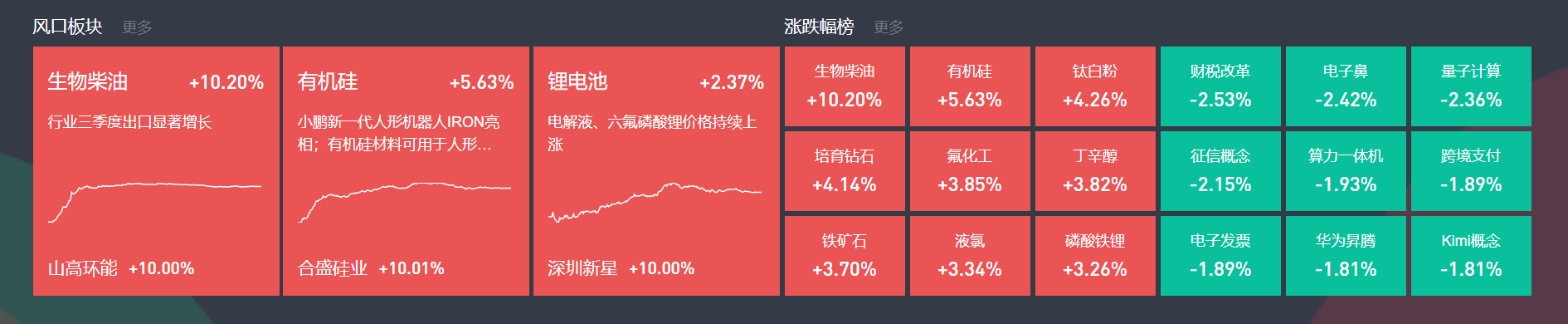
Market Overview - The market experienced fluctuations with all three major indices slightly declining. The organic silicon sector saw a collective surge, with stocks like Dongyue Silicon Material and Hesheng Silicon Industry hitting the daily limit. The chemical sector continued its strong performance, with Qing Shui Yuan and Chengxing Co. achieving consecutive gains. The battery sector also performed well, with stocks such as Fengyuan Co. and Tianji Co. reaching the daily limit. In contrast, robotics concept stocks fell, with Hengshuai Co. and Lixing Co. dropping over 10% [1] Daily Highlights 1. Biodiesel - The biodiesel sector saw significant gains, with stocks like Shanggao Environmental Energy, Haineng Technology, and Zhuoyue New Energy hitting the daily limit. Jiaao Environmental Protection reached a historical high. According to Baichuan Data, the price of SAF in Europe surged from $1780/ton to $2860/ton in the past two weeks, marking a 60% increase [4] 2. Organic Silicon - The organic silicon sector experienced a notable rise, with stocks such as Hesheng Silicon Industry and Dongyue Silicon Material reaching the daily limit. The new generation humanoid robot IRON developed by Xiaopeng Motors was showcased at the 7th Xiaopeng Technology Day on November 5. Xiaopeng's chairman, He Xiaopeng, stated that IRON is the most human-like humanoid robot, featuring a "skeleton-muscle-skin" design [6] 3. Lithium Batteries - The lithium battery sector also saw substantial gains, with stocks like Shenzhen New Star and Furi Co. achieving consecutive gains. On the evening of November 6, Tianci Materials announced two agreements with Zhongchuang Xinhang and Guoxuan High-Tech for supply and procurement contracts, committing to supply a total of 725,000 tons of electrolyte products from 2026 to 2028 [8] Additional Insights - The supply situation for hexafluorophosphate lithium (6F) remains tight, with first and second-tier companies operating at full capacity and no significant expansion plans in sight. Most 6F manufacturers, except Tianci, have reported consecutive losses. Some smaller manufacturers are raising prices to recover cash flow due to the changing supply-demand dynamics in the industry [10]





Soybeans Extending Higher on Monday AM Trade
Yahoo Finance· 2025-11-03 13:33
Market Overview - Soybeans are experiencing gains of 3 to 5 cents in the front months, with futures having posted gains of 7 to 9 cents across most contracts on Friday, resulting in a weekly gain of 55 cents for November [1] - Total open interest increased by 6,882 contracts on Friday, indicating new buying activity [1] - The national average Cash Bean price rose by 6 1/4 cents to $10.33 1/2 [1] Soybean Futures - Soymeal futures increased by $4.50 to $6.10, with December futures rallying $27.50 for the week [1] - Soy Oil futures decreased by 68 to 97 points, with December falling 159 points since last Friday [1] Crop Insurance and Pricing - November soybeans averaged a close of $10.35 throughout October, which is expected to be the harvest price for Crop Insurance, up 32 cents from last year but down 19 cents from the spring price [2] International Trade - China purchased an additional 4 cargoes of soybeans following the recent US/China meeting, with market attention on whether China will be a destination in the upcoming Export Inspections report [3] Biodiesel Production - EIA data indicated that 1.041 billion lbs of soybean oil were used in biodiesel production in August, down 14.48% year-over-year and 6.09% below July, representing 39.15% of total biodiesel feedstock, the highest inclusion rate since September 2023 [4] Brazilian Soybean Crop - AgRural estimates that the Brazilian soybean crop is 47% planted as of Thursday, trailing behind last year's pace of 54% [4]
油料周报-20251102
Dong Ya Qi Huo· 2025-11-02 05:55
1. Report Industry Investment Rating No information is provided regarding the report industry investment rating. 2. Core Viewpoints - For the oilseed market, after the China - US talks, China may increase purchases of US soybeans, which will boost short - term US soybean export sentiment. High inventory pressure persists in the short term, but short - term price rebounds may occur due to cost increases. For rapeseed, domestic supply - demand changes are limited, and attention should be paid to the listing of new Canadian rapeseed and potential import policy changes [7]. - In the oil market, soybean oil maintains a slightly oversupplied pattern with high inventory pressure; palm oil's market trend is oscillating due to conflicts between weakening biodiesel concepts and seasonal production cuts; and rapeseed oil is in a slow de - stocking cycle, with attention on Sino - Canadian relations and import tariffs [39][40][41]. 3. Summary by Relevant Catalogs Oilseed Market - **Soybean Meal**: After the China - US talks, China may increase US soybean purchases, which will drive short - term US soybean export sentiment. Imports from Brazil and Argentina from October to November exceeded expectations, and attention should be paid to the progress of US soybean purchases. After December, South American soybean supply will decline, and US soybean purchases will affect subsequent inventory changes. There is short - term high inventory pressure, but short - term price rebounds may occur due to cost increases [7]. - **Rapeseed Meal**: Domestic supply - demand changes are small. Attention should be paid to the listing of new Canadian rapeseed. With the China - US talks, there are high expectations for the easing of Sino - Canadian relations, and attention should be paid to potential changes in rapeseed import tariffs. Domestic demand has entered a seasonal consumption off - season, especially for aquatic products, and attention should be paid to future import policy changes [7]. Oil Market - **Soybean Oil**: After the China - US talks, the increase in overseas soybean prices may affect domestic costs. The Indonesian B50 plan may fall short of expectations, weakening the biodiesel concept and being unfavorable to the oil market. Recent soybean crushing has slowed down, and soybean oil inventory remains high in the short term, maintaining a slightly oversupplied pattern [39]. - **Palm Oil**: The MPOB report shows that inventory accumulation exceeded expectations this month, with a month - on - month increase, and the report is slightly bearish. The Indonesian B50 biodiesel plan may not be realized, weakening the biodiesel concept. Domestic inventory is still in a high - accumulation stage. Attention should be paid to the de - stocking cycle caused by seasonal production cuts in major producing countries at the end of the year. The market trend is oscillating due to conflicts between weakening biodiesel concepts and seasonal production cuts [40]. - **Rapeseed Oil**: The domestic market is in a slow de - stocking cycle. Sino - Canadian relations are variable, and attention should be paid to potential impacts and changes in import tariffs. Attention should be paid to the possible easing of rapeseed oil imports due to tariff issues, which may lead to lower market expectations [41].
宝城期货豆类油脂早报(2025年10月27日)-20251027
Bao Cheng Qi Huo· 2025-10-27 02:21
Group 1: Report Summary - The report is the Baocheng Futures' morning report on beans and oils on October 27, 2025, covering the price, market trend, and driving logic of varieties such as soybean meal, palm oil, and soybean oil [1][5][7] Group 2: Investment Ratings - Not provided in the report Group 3: Core Views - The domestic soybean meal market maintains a loose supply - demand pattern. The futures price will oscillate until the quantity and time of China's purchase of US soybeans are announced. Palm oil has short - term pressure but also long - term demand support, and its futures price is oscillating weakly [5][7] Group 4: Variety Summaries Soybean Meal - **Time - frame Views**: Short - term (within a week) and medium - term (two weeks to one month) views are oscillating, and the intraday view is weakly oscillating. The reference view is weakly oscillating [5][6] - **Driving Factors**: The supply - demand pattern is affected by Sino - US relations, import arrival rhythm, oil mill operation rhythm, and inventory pressure. The futures price is affected by the possible supply gap in the fourth quarter and China's purchase of US soybeans [5][6] Palm Oil - **Time - frame Views**: Short - term and medium - term views are oscillating, and the intraday view is weakly oscillating. The reference view is weakly oscillating [6][7] - **Driving Factors**: Affected by its biodiesel attribute, Malaysian palm production and exports, Indonesian exports, tariff policies of major producing countries, domestic arrival and inventory, and substitution demand [6][7] Soybean Oil - **Time - frame Views**: Short - term and medium - term views are oscillating, and the intraday view is weakly oscillating. The reference view is weakly oscillating [6] - **Driving Factors**: Influenced by Sino - US relations, US biofuel policies, US soybean oil inventory, domestic soybean cost support, supply rhythm, and oil mill inventory [6]
美国用一半价格"喂饱"我们20年,直到中储粮亮出那把“秘密武器”
Sou Hu Cai Jing· 2025-10-25 07:54
Core Insights - The article discusses the evolution of China's soybean industry from dependency on imports to achieving self-sufficiency, highlighting the strategic importance of food security in the context of international trade dynamics [1][16]. Historical Context - In 2001, China opened its soybean market as part of its WTO accession, leading to a significant influx of cheaper U.S. soybeans, which caused 80% of domestic farmers to abandon soybean cultivation [3]. - By 2004, China became the world's largest soybean importer, accounting for one-third of global trade, while foreign firms controlled 85% of China's crushing capacity [6]. Price Volatility and Market Manipulation - A drought warning in 2003 led to a spike in soybean prices from 2300 RMB/ton to 5500 RMB/ton, followed by a crash to 2200 RMB/ton, resulting in significant losses for Chinese companies [4]. - This price volatility was perceived as a targeted attack by international capital on China's soybean industry [6]. Strategic Responses - In response to the crisis, China initiated a strategic reserve plan in 2004, leading to large-scale purchases of domestic soybeans and market stabilization efforts [7]. - By 2006, China began to counteract speculative pressures by releasing reserves, which helped to stabilize domestic prices and demonstrated China's capacity to withstand food crises [7]. Industry Self-Sufficiency Initiatives - China has diversified its soybean import sources, increasing from 2 countries in 2001 to 12 countries by 2023, focusing on Brazil, Argentina, and emerging markets [8]. - Technological advancements have been made, such as the development of high-protein soybean varieties with protein content exceeding that of U.S. genetically modified soybeans [8]. Future Outlook - By 2024, China's domestic soybean production is expected to stabilize above 20 million tons, with a steadily increasing self-sufficiency rate [9]. - China's approach to trade disputes has matured, emphasizing a dual strategy of domestic support and diversified imports to mitigate risks [13]. Conclusion - The transformation of China's soybean industry reflects a broader narrative of food security as a cornerstone of national security, showcasing resilience and strategic foresight in the face of international challenges [16].

油料周报-20251024
Dong Ya Qi Huo· 2025-10-24 10:32
1. Report Industry Investment Rating No relevant content provided. 2. Core Viewpoints of the Report - For soybeans and related products: The USDA report this month is neutral to bearish overall, with an increase in US soybean production and inventory and a decrease in global production. China's imports from October to November exceeded expectations, and the supply pressure persists. After December, China may turn to buying US soybeans, depending on the China - US negotiation progress. The short - term domestic spot market is in a low - level oscillation, and the demand is in the seasonal off - season with large inventory pressure [5]. - For rapeseed and related products: The domestic supply - demand situation has little change, and attention should be paid to the new rapeseed harvest in Canada. The anti - dumping measures against Canadian rapeseed may lead to a significant decrease in imports, but there is uncertainty. The domestic demand has entered the seasonal consumption off - season, especially the weakening of aquatic product demand. If there is a negotiation with the US, it may ease the China - Canada relationship and relax rapeseed imports [5]. - For oils: - **Soybean oil**: In the short term, the soybean oil inventory has slightly decreased month - on - month due to the slowdown of soybean crushing but remains at a high level. The Indonesian B50 plan may fall short of expectations, weakening the biodiesel concept and being unfavorable to oils. Argentina's tariff - free exports may increase China's direct imports of soybean oil. The market generally shows a slightly oversupplied pattern with high inventory pressure [36]. - **Palm oil**: The MPOB report this month shows that the inventory has accumulated more than expected, and the report is neutral to bearish. The Indonesian B50 biodiesel plan may not be realized, weakening the biodiesel theme. The domestic inventory is still in a relatively high accumulation stage. The market trend is oscillatory due to the conflict between the weakening of biodiesel and the seasonal production decline of palm oil [37]. - **Rapeseed oil**: The domestic market is in a slow de - stocking cycle. The anti - dumping measures against Canadian rapeseed may lead to a decrease in rapeseed oil supply. Attention should be paid to the changes in imports from Russia and the impact of possible trade negotiations at the end of the month on future rapeseed oil purchases. The short - term trend is weak, but there is support in the medium term due to reduced imports [38]. 3. Summary by Relevant Catalogs Soybean and Related Products - **Market fundamentals**: The USDA report adjusted US soybean production, global production, and US soybean inventory. China's imports from Brazil and Argentina in October - November exceeded expectations, and the supply pressure continues. After December, the supply from South America may decrease, and China may turn to US soybeans depending on negotiations [5]. - **Price and spread**: There are various price and spread data such as the closing prices of domestic and foreign soybean futures, soybean meal futures spreads (01 - 05, 05 - 09, 09 - 01), and the price ratio of soybean oil to soybean meal for different contracts (01, 05, 09) [4][27][60]. - **Inventory and consumption**: Data on soybean crushing volume, soybean inventory in crushing plants, soybean meal inventory, and consumption in China are presented, showing the current supply - demand situation [16][18]. Rapeseed and Related Products - **Market fundamentals**: The domestic supply - demand situation is relatively stable, but attention should be paid to the new rapeseed harvest in Canada. The anti - dumping measures against Canadian rapeseed and possible trade negotiations may affect imports [5]. - **Price and spread**: There are data on rapeseed meal futures spreads (01 - 05, 05 - 09, 09 - 01), rapeseed meal spot basis, and the price ratio of rapeseed oil to rapeseed meal for different contracts (01, 05, 09) [26][29][63]. - **Inventory and consumption**: Data on rapeseed expected arrival volume, rapeseed inventory in crushing plants, rapeseed meal inventory, and consumption are provided [21][24]. Oils - **Soybean oil**: The short - term inventory change is affected by soybean crushing, and factors such as the Indonesian B50 plan and Argentina's exports impact the market. There are data on soybean oil production, consumption, inventory, and price spreads [36][40][67]. - **Palm oil**: The MPOB report shows inventory changes, and the Indonesian B50 plan and seasonal production decline affect the market trend. Data on palm oil production, consumption, inventory, and price spreads in Malaysia and Indonesia are presented [37][50][64]. - **Rapeseed oil**: The domestic market is in a de - stocking cycle, and anti - dumping measures and trade negotiations affect supply. There are data on rapeseed oil supply, consumption, inventory, and price spreads [38][42][72].
国富期货早间看点:油世界25/26年全球植物油进口料增310万吨,IGC全球25/26年大豆产量4.28亿吨-20251024
Guo Fu Qi Huo· 2025-10-24 06:39
1. Report Industry Investment Rating No relevant content provided. 2. Core Viewpoints - The global vegetable oil demand in the 2025/26 period is expected to reach a record high, with the import volume of eight major oils increasing by 3.1 million tons to 94.5 million tons. The main driving force for the import increase is the expected 6.1 million - ton rise in global vegetable oil consumption, more than twice that of the previous year. However, vegetable oil prices will still face pressure in 2025/26 [10]. - The implementation of Indonesia's B50 policy may significantly reduce its exportable palm - oil supply, and the global vegetable oil demand in the coming year will rely heavily on sunflower oil [11]. - The weather in the US and Brazil will have an impact on crop growth and harvesting. In the US, future rainfall may help relieve drought but may also delay crop harvesting; in Brazil, the current dry weather is beneficial for farmers' field operations [6][8]. 3. Summary by Directory 01 Overnight Quotes - Futures quotes: The closing prices and daily/overnight percentage changes of commodities such as Malaysian palm oil, Brent crude oil, and US soybeans are presented. For example, the closing price of Malaysian palm oil 01 (BMD) is 4466.00, with a previous - day increase of 0.36% and an overnight decrease of 0.09% [1]. - Currency quotes: The latest prices and percentage changes of the US dollar index and various currencies against the US dollar are provided, including the US dollar index at 98.92 with a 0.05% increase [1]. 02 Spot Quotes - Spot prices and basis information for DCE palm oil 2601, DCE soybean oil 2601, and DCE soybean meal 2601 in different regions are given. For example, the spot price of DCE palm oil 2601 in North China is 9330, with a basis of 90 and a basis change of 0 [3]. - CNF quotes and CNF premium information for imported soybeans from different regions are provided, such as the CNF premium of Brazilian soybeans at 285 cents per bushel and the CNF quote at 483 dollars per ton [3]. 03 Important Fundamental Information - Production Area Weather - US soybean - producing states: The future weather (October 28 - November 1) in most of the US soybean - producing states will have temperatures above normal and precipitation above the average. In addition, frost may occur in some areas in the Midwest in the coming days, and precipitation may delay crop harvesting [4][6]. - Brazil: The current dry weather in Brazil is beneficial for farmers' field operations. A new front will bring showers to the southern and central regions this weekend and early next week, which is generally favorable for soybean planting [7][8]. - International Supply and Demand - Global vegetable oil: The expected increase in global vegetable oil demand in 2025/26 is mainly due to the strong demand from the biodiesel industries in the US, Indonesia, and Brazil. However, traditional exporters may reduce their exports, and Indonesia's biodiesel policy is an unstable factor [10]. - Palm oil in Indonesia: If Indonesia implements the B50 policy, the amount of palm oil used for blending will increase, and the exportable supply will decrease significantly [11]. - Soybean: The IGC predicts that the global soybean output in 2025/26 will decrease by 1 million tons to 428 million tons, the trade volume will increase by 2 million tons to 187 million tons, and the consumption will decrease by 1 million tons to 430 million tons [12]. - Domestic Supply and Demand - Commodity trading volume: On October 23, the trading volume of soybean oil was 11,000 tons, and that of palm oil was 3,600 tons, with a total trading volume of 14,600 tons, a 2.67% decrease from the previous trading day [16]. - Soybean meal trading and oil - mill operation: On October 23, the trading volume of soybean meal in major domestic oil mills was 148,600 tons, an increase of 20,500 tons from the previous day. The operating rate of all - sample oil mills was 68.13%, a 0.38% increase from the previous day [16]. - Agricultural product prices: On October 23, the "Agricultural Product Wholesale Price 200 Index" and the "Vegetable Basket Product Wholesale Price Index" both increased. The prices of various agricultural products such as pork, beef, and eggs also changed to different extents [16]. 04 Macroeconomic News - International News - Fed rate - cut expectations: The probability of the Fed cutting interest rates by 25 basis points in October is 98.3%, and the probability of cumulative 50 - basis - point rate cuts in December is 93.4% [18]. - US economic data: US September existing - home sales totaled 4.06 million units, in line with expectations; the Kansas City Fed manufacturing composite index in October was 6, higher than expected [18]. - EU sanctions: The EU has imposed new sanctions on Russia due to the Russia - Ukraine conflict and has also sanctioned some Chinese and Indian companies. China has expressed strong dissatisfaction and opposition [18]. - Domestic News - Exchange rate: On October 23, the US dollar/Chinese yuan exchange rate was 7.0918, a 36 - point decrease (appreciation of the Chinese yuan) [20]. - Central bank operations: On October 23, the People's Bank of China conducted 212.5 billion yuan of 7 - day reverse repurchase operations, with 236 billion yuan of 7 - day reverse repurchases maturing, resulting in a net withdrawal of 23.5 billion yuan [20]. - Policy news: The Fourth Plenary Session of the 20th Central Committee of the Communist Party of China proposed to build a strong domestic market and accelerate the construction of a new development pattern. China and the US will hold economic and trade consultations in Malaysia from October 24 - 27 [21]. 05 Capital Flows - On October 23, 2025, the net inflow of funds into the futures market was 27.536 billion yuan, including 3.42 billion yuan into commodity futures, 24.868 billion yuan into stock - index futures, and a net outflow of 729 million yuan from bond futures [24]. 06 Arbitrage Tracking No relevant content provided.
棕榈油期货日报-20251023
Guo Jin Qi Huo· 2025-10-23 05:31
Report Summary 1. Report Industry Investment Rating No investment rating information is provided in the report. 2. Core Viewpoints - Recent performance at the origin and demand sides is decent, but there is still a lack of obvious bullish factors. Affected by the decline in crude oil prices and the weakening of the oil market, palm oil prices both at home and abroad continued to decline slightly on the day. The p2601 contract of Dalian palm oil still rose and then fell during the day, with four consecutive days of decline in the daily line. In the short term, the price of the p2601 contract is likely to continue the volatile consolidation trend. In the future, attention should be paid to the biodiesel policy, origin data, and the trends of other oils [12]. 3. Summary by Related Catalogs 3.1 Futures Market - **Contract Market**: On October 21, 2025, the price of the main palm oil p2601 contract opened lower and consolidated during the day, rose in the afternoon session and then fell with a reduction in positions at the end of the session, closing at 9,294 yuan/ton, a decrease of 24 yuan/ton or 0.26% from the previous day's closing price. The trading volume was 553,500 lots, an increase of 92,100 lots from the previous day, and the open interest was 333,700 lots, a decrease of 10,600 lots from the previous day [2]. - **Variety Prices**: The total trading volume of all palm oil futures contracts was 628,800 lots, and the total open interest of the variety was 477,500 lots, a decrease of 11,100 lots from the previous day [4]. - **Related Market**: On the same day, the main 01 contract of the Malaysian BMD futures fell again, closing at 4,508 ringgit/ton, a decrease of 0.13% from the previous day's closing price [5]. 3.2 Spot Market - **Spot Price and Basis Data**: The average spot price of 24 - degree palm oil in China on the day was 9,390 yuan/ton, unchanged from the previous day's average price, and the basis continued to strengthen [5]. - **Registered Warehouse Receipts**: The number of registered warehouse receipts on the day was 600 lots, with no increase or decrease from the previous day [8]. - **Import Profit**: The cost of importing Malaysian palm oil increased slightly on the day, and the import profit loss deepened [10]. 3.3 Influencing Factors - **Export and Production Data**: According to the data of high - frequency institutions ITS and AmSpec Agri, the exports of Malaysian palm oil in the first 20 days of October were 1.0448 million tons and 0.9651 million tons respectively, an increase of 3.4% and 2.5% respectively compared with the same period last month. According to the data of SPPOMA, the yield per unit of Malaysian palm oil in the first 20 days of October increased by 1.45%, and the output increased by 2.71% month - on - month [9]. - **Policy**: Indonesian government officials held a meeting to discuss the preparations for B50 (mixing 50% of palm oil biodiesel with diesel) and E10 (mixing 10% of ethanol with gasoline), and considered restricting the export volume of crude palm oil to increase the production of biodiesel [9][11]. - **Domestic Inventory**: As of October 17, the total domestic palm oil inventory was 549,000 tons, a weekly increase of 26,000 tons; the contract volume was 40,000 tons, a weekly decrease of 17,000 tons. Recently, the arrival volume of purchased palm oil in China has gradually increased, the market trading has remained light, and the inventory has slowly accumulated [11].
丰倍生物(603334):注册制新股纵览 20251021:废弃油脂资源化头部企业
Shenwan Hongyuan Securities· 2025-10-21 10:23
Group 1 - Investment Rating: The report assigns an AHP score of 2.61, placing the company in the 35.5% percentile of the non-Science and Technology Innovation Board AHP model [3][8][9] - Core Business: The company is a leading enterprise in the resource utilization of waste cooking oil, with a full industry chain layout from "waste cooking oil - biofuels - bio-based materials" [3][10] - Market Position: The company has a market share of approximately 6%-7% in the agricultural chemical sector, with bio-based materials accounting for 80% of its revenue [3][10] Group 2 - Industry Growth: The European Union is set to mandate large-scale blending of Sustainable Aviation Fuel (SAF) starting in 2025, creating significant market opportunities for the company [3][15] - Production Capacity: The company achieved a sales volume of 90,300 tons of industrial mixed oil in the first half of 2025, a year-on-year increase of 473.46% [3][18] - Financial Performance: The company reported a revenue of 1.478 billion yuan in the first half of 2025, a 50% increase year-on-year, with a projected revenue of 2.1 to 2.3 billion yuan for the first nine months of 2025 [20][21] Group 3 - Competitive Analysis: The average price-to-earnings ratio (TTM) for comparable companies is 31.09X, while the company's industry has a static P/E ratio of 64.44X [19] - Profitability Trends: The company's gross profit margin has declined from 13.55% in 2022 to 9.50% in the first half of 2025, primarily due to the lower value-added nature of industrial mixed oil products [24] - R&D Investment: The ratio of R&D expenditure to revenue has shown a downward trend, decreasing from 3.00% in 2022 to 2.33% in the first half of 2025 [30][33] Group 4 - Fundraising Plans: The company plans to raise 750 million yuan through the issuance of 35.9 million new shares, with funds allocated for expanding production capacity in various bio-based products [32][34] - Projected Returns: The internal rate of return for the new projects is estimated at 20.25%, with a payback period of approximately 6.83 years [35]
《农产品》日报-20251021
Guang Fa Qi Huo· 2025-10-21 02:40
Group 1: Report Industry Investment Ratings - Not provided in the given content Group 2: Core Views of the Report Palm Oil - In Malaysia, with export growth and production increase lower than market expectations, there is a chance for the price to rise to 4,650 ringgit. Pay close attention to export data and MPOA production data, and focus on whether the price can effectively stand above 4,500 ringgit. In China, the Dalian palm oil futures market maintains a narrow - range consolidation trend. After repeated consolidation, watch if it can break through and stand above 9,500 yuan driven by the rise of Malaysian palm oil [1]. Soybean Oil - Sino - US trade negotiations seem to be back on track after weeks of new tariff threats and export restrictions. The data from the US EPA shows that the renewable fuel blending volume in September exceeded that in August, which is positive for Chicago soybean oil futures. In China, the Dalian soybean oil futures rose following the strength of CBOT soybeans and soybean oil, but the increase was limited due to the drag of Sino - Canadian negotiations and limited downstream demand before the Spring Festival stocking. The possibility of a short - term continued rise is low [1]. Sugar - From the second half of September, the sugarcane crushing volume in the central - southern region of Brazil increased year - on - year, and the cumulative sugar production also increased. Affected by supply expectations, the upward momentum of raw sugar prices is limited. As of October, the market focuses on the production prospects of India and Thailand. The overall production is currently optimistically estimated, and the raw sugar price is expected to fluctuate between 15 - 16 cents per pound. The September sales data is neutral to weak, and the inventory has increased year - on - year. The new sugar pre - sale price is much lower than the current market price, and the spot market is expected to maintain a weak and volatile pattern [3][4]. Cotton - The purchase price of machine - picked cottonseed in Xinjiang is firm. The Zhengzhou cotton futures main contract has cost support at low levels, but there is also increasing hedging pressure above 13,500 - 13,600 yuan. The downstream terminal demand is weak, but textile enterprises' cotton inventory is not high, and they have demand for cotton at current prices. In the short term, the cotton price is expected to fluctuate within a range [5]. Eggs - The存栏量 of laying hens remains high, and the egg supply is sufficient. The downstream demand has improved, which will drive up the egg price. However, the sufficient supply at the origin may suppress the increase in egg prices. It is expected that the egg price will rise slightly this week and then stabilize, but there is still overall pressure [8][10]. Corn - In the short term, the corn price has stabilized and rebounded slightly due to the decrease in supply. However, the pattern of strong supply and weak demand remains unchanged, and the upward space of the price is limited. The demand from deep - processing and feed enterprises is cautious, but their inventory is relatively low, and the subsequent purchase intention will increase. Some regions have started purchasing and storage, but the scale is small [13]. Meal - related Products - The US soybean has improved slightly, but lacks substantial positive factors. Brazil's new - crop soybean sowing is progressing smoothly, and the domestic soybean supply in the fourth quarter is sufficient. The domestic soybean and soybean meal inventory is still at a high level, and the spot price is expected to be weak this year. However, the downward space is limited. If China continues not to purchase US soybeans, the M2601 contract has support around 2,900 yuan, and there may be opportunities for 1 - 5 positive spreads [18]. Pigs - In the short term, the supply and demand are basically balanced, and the pig price has stabilized and rebounded due to the entry of second - fattening in North and Northeast China. In the long term, the supply pressure in the fourth quarter will continue to be released, and the pig price is not optimistic. Policy - driven capacity reduction needs time to take effect, and it is expected that the spot price will still face pressure until the first half of next year. The disk operation should focus on short - selling on rallies, and hold the LH3 - 7 reverse spread [21]. Group 3: Summaries According to Relevant Catalogs Futures Market Data Oils and Fats - **Soybean Oil**: On October 20, the spot price in Jiangsu was 8,610 yuan, up 0.23% from October 17; the futures price of Y2601 was 8,298 yuan, up 0.51%; the basis of Y2601 was 312 yuan, down 6.59% [1]. - **Palm Oil**: The spot price in Guangdong was 9,300 yuan, up 0.54%; the futures price of P2601 was 9,318 yuan, up 0.11%; the basis of P2601 was - 18 yuan, up 68.97%. The import cost in Guangzhou Port in January was 9,708.1 yuan, up 0.18%, and the import profit was - 390 yuan, down 2.06%. The number of warehouse receipts was 600, up 20% [1]. - **Rapeseed Oil**: The spot price in Jiangsu was 10,120 yuan, unchanged; the futures price of OI601 was 9,918 yuan, up 0.58%; the basis of OI601 was 202 yuan, down 22.01% [1]. Sugar - On October 20, the futures price of sugar 2601 was 5,428 yuan/ton, up 0.30%; the futures price of sugar 2605 was 5,386 yuan/ton, up 0.22%; the 1 - 5 spread was 42 yuan/ton, up 11.43%. The main contract's open interest was 426,415, down 3.41% [3]. Cotton - The futures price of cotton 2605 was 13,390 yuan/ton, up 1.05%; the futures price of cotton 2601 was 13,335 yuan/ton, up 0.97%; the 5 - 1 spread was 55 yuan/ton, up 18.18%. The main contract's open interest was 586,467, up 1.11% [5]. Eggs - The price of the egg 11 - contract was 2,770 yuan/500KG, down 1.25%; the price of the egg 01 - contract was 3,166 yuan/500KG, down 0.41%. The basis was 174 yuan/500KG, down 24.47% [8]. Corn - The futures price of corn 2601 was 2,138 yuan/ton, up 0.99%; the basis was 12 yuan/ton, down 7.69%; the 1 - 3 spread was - 30 yuan/ton, down 7.14%. The open interest was 1,701,632, up 1.43%, and the number of warehouse receipts was 49,324, up 34.36% [13]. Meal - related Products - **Soybean Meal**: The spot price in Jiangsu was 2,900 yuan, down 0.68%; the futures price of M2601 was 2,895 yuan, up 0.94%; the basis of M2601 was 5 yuan, down 90.38%. The number of warehouse receipts was 42,761, down 0.3% [18]. - **Rapeseed Meal**: The spot price in Jiangsu was 2,430 yuan, up 0.83%; the futures price of RM2601 was 2,350 yuan, up 1.91%; the basis of RM2601 was 80 yuan, down 23.08%. The number of warehouse receipts was 7,702, unchanged [18]. Pigs - The futures price of the live hog 2511 contract was 11,410 yuan/ton, up 3.26%; the futures price of the live hog 2601 contract was 12,155 yuan/ton, up 4.16%. The 11 - 1 spread was - 745 yuan/ton, down 20.16%. The main contract's open interest was 102,555, down 4.13% [21]. Spot Market Data Sugar - The spot price in Nanning was 5,770 yuan, down 0.35%; in Kunming, it was 5,740 yuan, down 0.35%. The basis in Nanning was 381 yuan, down 7.75%; in Kunming, it was 351 yuan, down 8.36%. The import price of Brazilian sugar (within quota) was 4,254 yuan/ton, down 1.53%; (out - of - quota) was 5,396 yuan/ton, down 1.59% [3]. Cotton - The Xinjiang arrival price of 3128B cotton was 14,517 yuan, up 0.05%; the CC Index of 3128B was 14,679 yuan, unchanged; the FC Index of M: 1% was 12,851 yuan, unchanged. The basis of 3128B - 01 contract was 987 yuan/ton, down 11.88%; the basis of 3128B - 05 contract was 1,052 yuan/ton, down 10.47% [5]. Eggs - The egg - producing area price was 2.94 yuan/500KG, down 3.01%; the price of laying hens was 2.60 yuan/feather, unchanged; the price of culled hens was 4.32 yuan/jin, down 3.14% [8]. Corn - The FOB price in Jinzhou Port was 2,150 yuan/ton, up 0.94%; the bulk grain price in Shekou was 2,310 yuan/ton, unchanged. The north - south trade profit was 79 yuan/ton, down 20.20%; the CIF price was 1,982 yuan/ton, up 0.04%; the import profit was 328 yuan/ton, down 0.21% [13]. Meal - related Products - **Soybean Meal**: The spot price in Jiangsu was 2,900 yuan, down 0.68%. - **Rapeseed Meal**: The spot price in Jiangsu was 2,430 yuan, up 0.83% [18]. Pigs - The spot price in Henan was 11,530 yuan/ton, up 180 yuan; in Shandong, it was 11,550 yuan/ton, up 150 yuan; in Sichuan, it was 11,010 yuan/ton, up 160 yuan; in Liaoning, it was 11,590 yuan/ton, up 140 yuan; in Guangdong, it was 11,530 yuan/ton, up 20 yuan; in Hunan, it was 10,810 yuan/ton, unchanged; in Hebei, it was 11,570 yuan/ton, up 170 yuan [21]. Industry Situation Data Sugar - The cumulative national sugar production was 1,116.21 million tons, up 12.03% year - on - year; the cumulative national sugar sales were 1,048 million tons, up 9.17% year - on - year. The cumulative sugar production in Guangxi was 646.50 million tons, up 4.59% year - on - year; the monthly sugar sales in Guangxi were 26.66 million tons, down 41.20% year - on - year [3]. Cotton - The inventory decreased by 13.1% month - on - month; the industrial inventory decreased by 1.9% month - on - month; the import volume increased by 42.9% month - on - month; the bonded area inventory increased by 1.4% month - on - month [5]. Eggs - The egg - to - feed ratio was 2.31, down 7.97%; the breeding profit was - 28.71 yuan/feather, down 69.88% [8]. Corn - The number of remaining vehicles at Shandong deep - processing enterprises in the morning was 446, down 1.11% [13]. Meal - related Products - The盘面 import profit of Canadian rapeseed meal for January shipment was 792 yuan, up 5.74% [18]. Pigs - The daily slaughter volume of sample points was 164,642, down 1.13%; the weekly white - strip price was 19.01 yuan, unchanged; the weekly piglet price was 26.00 yuan/kg, unchanged; the weekly sow price was 32.47 yuan, down 0.09%; the weekly slaughter weight was 128.25 kg, down 0.18%; the weekly self - breeding profit was - 245 yuan/head, down 60.83%; the weekly purchased - pig breeding profit was - 375 yuan/head, down 24.66%; the monthly fertile sow inventory was 4,038 million heads, down 0.10% [21].