
地缘政治

Search documents
李嘉诚怒了!巴拿马港口被明抢
Xin Lang Cai Jing· 2026-02-04 09:43
Core Viewpoint - The Cheung Kong Group has officially announced its intention to reclaim the legal operating rights of two ports in Panama, following a court ruling that deemed their rights unconstitutional, which the company argues contradicts the original legal framework of the concession agreement [2][4][11]. Group 1: Legal Actions and Responses - The Cheung Kong Group has initiated international arbitration against the Panamanian government, asserting that the local court's ruling is unreasonable and contradicts the original concession agreement approved by Panama [2][12]. - The company has stated that it will reserve all legal means to continue its fight for the ports, indicating a long-term commitment to the dispute [3][13]. Group 2: Background and Context - The conflict began on January 29, when a local court ruled that the Cheung Kong Group's nearly 30-year concession for the ports was unconstitutional, leading to immediate government actions to explore temporary management by Maersk [4][15]. - The U.S. Secretary of State expressed support for the court's ruling, while the Hong Kong government criticized foreign pressure on Panama, emphasizing the need to protect Chinese enterprises' overseas rights [5][16]. Group 3: Economic Significance - The Panama Canal is a crucial global shipping hub, handling 6% of the world's maritime trade and significantly reducing travel distance for ships [6][17]. - In the fiscal year 2024, the Panama Canal is expected to generate $4.986 billion (approximately 36.1 billion RMB), contributing 4% to Panama's GDP [18]. Group 4: Future Implications - The Cheung Kong Group plans to sell 43 global ports, including the two in Panama, to a consortium led by BlackRock for $22.8 billion, although this transaction is currently on hold pending regulatory approvals [19][21]. - Analysts suggest that the recent court ruling may be influenced by geopolitical pressures, particularly from the U.S., raising concerns about the independence of the Panamanian judiciary [9][21].


邓正红能源软实力:地缘局势不确定性与短期供需利多因素共同推动国际油价走高
Sou Hu Cai Jing· 2026-02-04 09:13
Core Insights - The article discusses the impact of geopolitical uncertainties on oil prices, highlighting that short-term factors are currently driving prices upward due to ongoing tensions between the U.S. and Iran, as well as a recent trade agreement between the U.S. and India [1][2][3]. Geopolitical Factors - The U.S. and Iran have shown signals of negotiation, which initially led to a drop in oil prices, but ongoing tensions and uncertainties have caused a rebound in prices [2][3]. - The U.S. has announced a trade agreement with India, reducing tariffs on Indian goods and leading India to stop purchasing Russian oil, which is expected to increase demand for Middle Eastern oil [1][4]. Market Dynamics - Oil prices saw a significant increase on February 3, with WTI crude rising to $63.21 per barrel (up 1.72%) and Brent crude reaching $67.33 per barrel (up 1.55%) [1]. - The OPEC alliance has decided to maintain production cuts until March 2026, contributing to supply constraints and supporting oil prices [5]. Supply and Demand Factors - Factors such as slow recovery in Kazakhstan's oil production, winter storms affecting North American output, and expectations of increased Indian oil purchases are contributing to a tightening supply situation [5]. - The geopolitical landscape is influencing market expectations, with fears of supply disruptions due to tensions in the Strait of Hormuz, a critical oil transport route [3][4]. Long-term Trends - The article suggests that the ongoing geopolitical dynamics will reshape global energy governance, with a shift towards a multipolar energy system and increased competition over rule-setting in the energy market [5].
伊朗局势波澜再起,油价再度反弹
Hua Tai Qi Huo· 2026-02-04 07:52
Group 1: Market News and Important Data - On February 3, the US government is preparing to issue a general license allowing companies to extract oil in Venezuela, a step to attract US - related companies and revive the country's energy industry. Another license allowing companies to buy and sell Venezuelan crude was issued last week [1]. - On February 3, the US Trade Representative said India agreed to cut tariffs on US exports from 13.5% to zero for industrial products, and they also reached a consensus on reducing India's technical non - tariff trade barriers. The US has been monitoring India's reduction of Russian oil purchases [1]. - In recent months, India has cut Russian oil imports. At least three refiners are seeking government clarification, two of which have suspended purchases. India's oil minister expects imports from Russia to continue to decline, and refiners want to increase supplies from Canada and the US [1]. - On February 3, crude oil prices rose slightly in Asian morning trading due to the US - India trade agreement. Trump said the US would cut tariffs on India to 18%, and India would stop buying Russian oil and increase purchases from the US and Venezuela. The US would cancel the 25% extra tariff on India's Russian oil imports, which may trigger more active purchasing by Indian refiners [1]. Group 2: Investment Logic - The situation in Iran has taken a turn with an Iranian drone shot down by the US military. The US - India agreement will lead to a 1 - million - barrel - per - day reduction in Russia oil consumption capacity and an increase in compliant oil purchases, supporting oil prices. However, the pace of India's procurement shift is unknown, and in the short term, the market surplus is concentrated in sanctioned oil, while the supply - demand of compliant oil will tighten [2]. Group 3: Strategy - Oil prices will fluctuate in the short - term, with geopolitical events having a large impact. Control risks, and consider a medium - term short - position allocation [3]
特朗普登机前,喊话中国行动起来!不到12小时,普京派心腹访华
Sou Hu Cai Jing· 2026-02-04 07:05
2月2日,中国企业继续执行暂停采购委内瑞拉原油的内部指令,这一举措有效延缓了美国资源的变现速度。特朗普尽管低姿态邀请合作,但在价格谈判上仍 然坚持高于以往的水平。与1月相比,中国从委内瑞拉的进口量已大幅下降,这一变化主要归因于美国加强了海上拦截,进一步加剧了全球石油市场的波 动。印度方面已经正式签署与委内瑞拉的能源协议,开始转向采购其原油以部分替代伊朗来源,但俄罗斯的进口并未完全停止。这表明,印度的调整幅度相 对有限,仅在美国施压下做出了部分妥协。 在绍伊古访问中国之后,中俄两国决定加强在联合国和上海合作组织框架内的协作,尤其在伊朗问题上,计划于2月中旬进行联合海军演习。与以往不同的 是,这次演习更注重实战部署,能够在海湾地区提供实际的航道保护,降低冲突升级对能源运输的影响。到目前为止,全球油价因这一事件小幅上扬,布伦 特原油期货有所波动,但中国通过增加从中东和非洲的进口,成功缓解了潜在的供应短缺问题。特朗普的表态本质上揭示了美国在石油控制上的急迫心态, 他试图通过邀请中国参与,分担委内瑞拉内部压力的风险,但忽略了中国一贯坚持的互利原则。 如果中国接受美国的邀请,通过美国的渠道购买委内瑞拉的石油,那么一旦美方 ...
永安期货集运早报-20260204
Yong An Qi Huo· 2026-02-04 05:14
Group 1: Contract Information - EC2602 contract had a closing price of 1737.8, a 1.03% increase, a basis of 54.3, a trading volume of 612, an open interest of 1883, and an open interest change of -456 [2][32] - EC2604 contract had a closing price of 1237.9, a 4.50% increase, a basis of 554.2, a trading volume of 29296, an open interest of 34229, and an open interest change of 423 [2][32] - EC2606 contract had a closing price of 1533.7, a 1.36% increase, a basis of 258.4, a trading volume of 3147, an open interest of 13458, and an open interest change of 860 [2][32] - EC2608 contract had a closing price of 1597.9, a -0.62% decrease, a basis of 194.2, a trading volume of 353, an open interest of 1479, and an open interest change of 29 [2][32] - EC2610 contract had a closing price of 1128.6, a -0.12% decrease, a basis of 663.5, a trading volume of 1355, an open interest of 7677, and an open interest change of -207 [2][32] Group 2: Month - Spread Information - The month - spread of EC2502 - 2604 was 499.9 on the previous day, with a daily change of -35.5 and a weekly change of 9.9 [2][32] - The month - spread of EC2504 - 2606 was -295.8 on the previous day, with a daily change of 32.7 and a weekly change of -31.6 [2][32] Group 3: Index Information - The current spot index (European line) was 1792.14 on February 2, 2026, with a -3.61% change from the previous period and a -4.86% change from the period before the previous one [2][32] - The SCFI (European line) was 1418 dollars/TEU on January 30, 2026, with an -11.10% change from the previous period and a -4.83% change from the period before the previous one [2][32] Group 4: Market Analysis and Recommendations - Currently, geopolitical concerns are high. In the near - term, the 04 contract is expected to oscillate between 1100 - 1250 points due to Maersk's stable February quotes, March rush - shipping expectations, April off - season expectations, and long - term contract price suppression. It is recommended to short the 04 contract cautiously, and pay attention to whether there is a significant premium on the market. Future focus should be on PA alliance quotes and geopolitical situations [3][33] - In the long - term, it is recommended to short the 10 contract on rallies, mainly based on the off - season and tax - refund negative factors. The valuations of 06 and 08 are difficult to anchor, and they are expected to oscillate widely within a reasonable range. Cautious operation is recommended under geopolitical uncertainties [3][33] Group 5: European Line Spot Situation - This week, downstream customers are booking cabins for early February (week 6 - 7). Currently, the overall cargo - receiving situation of ships is good, but the cargo - booking pressure has increased. Shipping companies need to book cargo for ships departing during the Spring Festival holiday. The price center in week 7 is 2140 US dollars, equivalent to 1500 points on the market. MSK's cabin opening price for week 8 - 9 is 1950 US dollars (unchanged from the previous period), and other shipping companies' quotes are also mainly unchanged [4][34] Group 6: Related News - On February 3, Maersk and HPL decided to resume a route of the GEMINI alliance's European line through the Suez Canal. Starting from mid - February 2026, a structural change will be implemented for Maersk's ME11 service, transitioning it to the Red Sea and the Suez Canal [5][35] - On February 4, Israeli Prime Minister Netanyahu met with US Middle East envoy Witkoff for over three hours to discuss the Iranian issue. Netanyahu stated that Iran is untrustworthy and cannot abide by any commitments, and the Palestinian National Authority will not participate in the governance of the Gaza Strip. Israel has "uncompromising requirements" for Hamas to disarm, the demilitarization of the Gaza Strip, and the achievement of all war goals. Gaza's reconstruction can only start after these goals are fully achieved [5][35] - On February 3, US media reported that six Iranian gunboats approached the US - flagged oil tanker "Stenalmperative" in the Strait of Hormuz. The oil tanker accelerated and maintained its course under the escort of a US warship and is expected to arrive at Sitra Port in Bahrain on February 5. Iranian media reported that some ships were intercepted for entering Iranian territorial waters without permission [6][36]
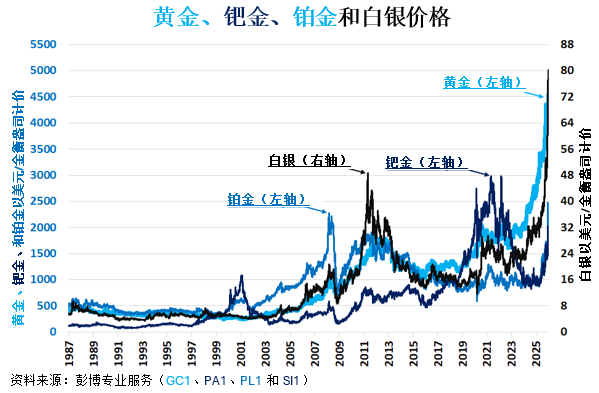
2026年贵金属相对价值前景展望
Qi Huo Ri Bao· 2026-02-04 03:48
Core Insights - Precious metal prices have seen a significant upward trend from the end of 2025 into early 2026, with gold surpassing $4,500 per ounce, silver exceeding $80 per ounce, and platinum reaching its highest level since 2007 [1] - The performance of these metals from the end of 2024 to January 6 shows gold up 65%, palladium up 95%, platinum up 150%, and silver up 170%, indicating a strong recovery for metals that had previously lagged behind gold [4] - The silver-to-gold ratio has dropped to its lowest level since 2013, suggesting a shift in relative value between these two metals [4] Precious Metals Performance - Gold's performance has been relatively weaker compared to other metals, likely due to its prior significant gains from 2000 to the end of 2024, where it rose 73% [4] - Silver's recent surge may reflect its higher beta attribute, leading to more pronounced price movements in response to gold's fluctuations [6] - The decline in silver's traditional uses, such as photography, has been offset by new demand from batteries and solar panels, contributing to its price increase [9] Platinum and Palladium Analysis - Despite recent rebounds, platinum prices remain at historical lows compared to gold and silver, with gold now nearly twice the price of platinum [13] - Palladium has seen two historical price surges due to supply constraints, but its current price is also at a historical low relative to gold and silver [15] - The demand for palladium is declining as electric vehicle market share increases, which may impact its future pricing [13] Market Size and Economic Value - In 2025, global mining output was 818 million ounces of silver, 95 million ounces of gold, 6.4 million ounces of palladium, and 5.5 million ounces of platinum, indicating a significant disparity in market size [17] - The economic value of gold mining output is approximately 6.5 times that of silver and 35 times that of platinum and palladium, suggesting that even a small shift in investment from gold to other metals could significantly impact their prices [20] Macroeconomic Outlook for 2026 - Several macroeconomic factors are driving gold prices higher, including core inflation rates exceeding central bank targets, large budget deficits in major economies, and ongoing geopolitical tensions [23][25][26] - Investors should monitor core inflation rates closely, as sustained high rates without corresponding tightening from central banks could lead to increased demand for precious metals [26] - The global fiscal landscape is expected to remain supportive of precious metals, with many countries maintaining large budget deficits and implementing expansionary fiscal policies [27]
【今晚播出】关税热度表面“降温”,2026全球经济与市场能“稳”吗? | 两说
第一财经· 2026-02-04 03:42
Core Insights - The global economy is entering a new phase influenced by geopolitical factors, policy shifts, and technological advancements [1] - The performance of the global economy in 2025 is under scrutiny due to tariff impacts, while expectations for stability in 2026 are being evaluated amidst a cooling of tariff tensions [1] - Key variables in the global market are emerging from ongoing geopolitical conflicts and rapid advancements in AI technology [1] Summary by Sections - **Global Economic Performance**: The article discusses the overall performance of the global economy in 2025, particularly in light of tariff impacts and the potential for a more stable economic outlook in 2026 as tariff tensions appear to ease [1] - **Geopolitical and Technological Influences**: It highlights the underlying geopolitical conflicts and the rapid progress in AI as critical factors that could influence market dynamics moving forward [1]
【财经分析】地缘扰动不断、短期利多因素犹存 国际油价隔夜强势回升
Xin Hua Cai Jing· 2026-02-04 03:42
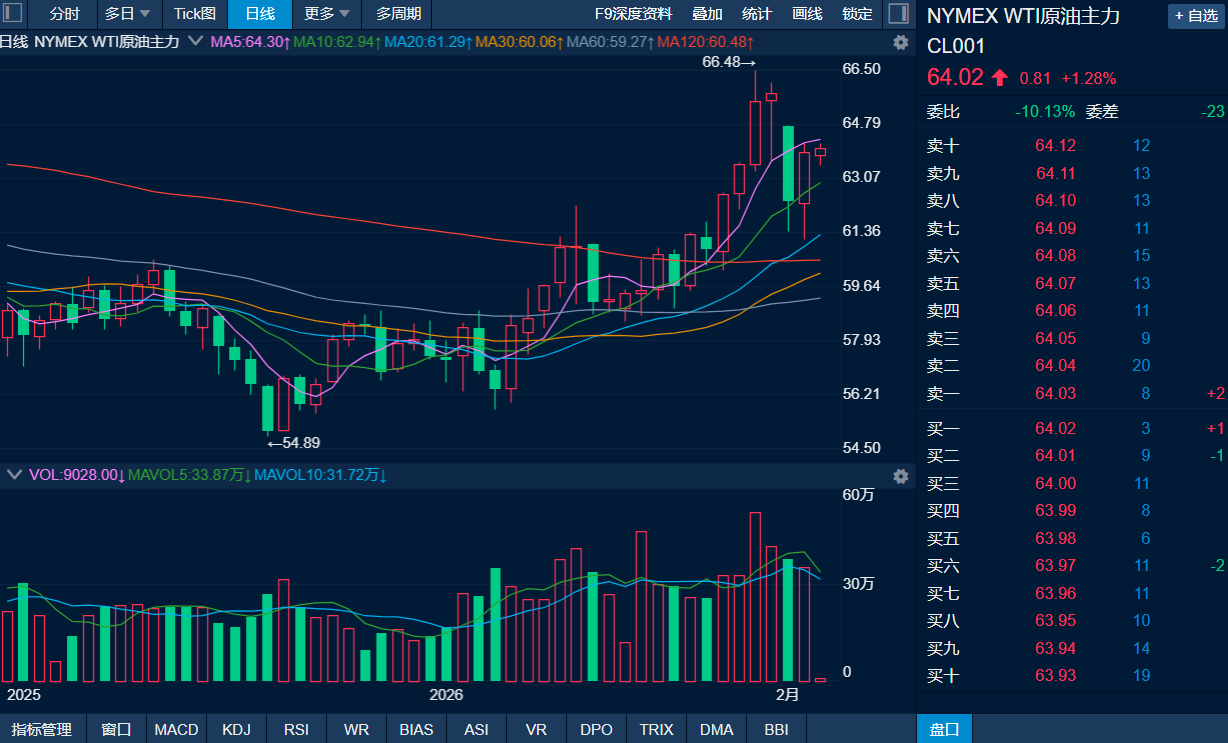
新华财经北京2月4日电(吴郑思)贵金属市场回暖叠加美伊局势不确定性萦绕,国际油价在本周初大幅回落后隔夜强势回升。截至纽约时间周二(2月3日) 14:30,WTI原油结算价报每桶63.21美元,较前一日上涨1.07美元,涨幅1.7%;布伦特原油期价上涨1.03美元,涨幅1.6%,结算价报每桶67.33美元。 与此同时,3日早些时候,英国海事安全企业先锋技术公司及其他一些消息源称,一艘美国油轮当天下午在霍尔木兹海峡无视要求其停船的警告,一度被数 艘武装快艇包围。美军中央司令部发言人3日说,美军当天在阿拉伯海击落伊朗一架无人机,并在当天还护送一艘遭伊方船只逼近的美国油轮。这些消息不 禁令市场开始担忧双方的谈判能否按计划推进,进而成为推动3日国际油价大幅反弹的驱动。 短期利多因素仍在发酵后期过剩担忧不减 值得关注的是,除地缘因素带来的利多以外,1月以来驱动油价反弹的基本面利多因素仍在发挥作用:欧佩克+主要产油国1日决定,将在2026年3月继续暂 停增产;哈萨克斯坦原油生产和出口恢复慢于预期;北美遭遇的冬季暴风损及原油产量并提振取暖油需求;以及美印达成一项贸易协议后可能驱动印度原油 采购转向、令其他地区原油供应紧张的预 ...
大越期货沪铝早报-20260204
Da Yue Qi Huo· 2026-02-04 02:00
沪铝早报- 交易咨询业务资格:证监许可【2012】1091号 大越期货投资咨询部 :祝森林 从业资格证号:F3023048 投资咨询证号:Z0013626 联系方式:0575-85226759 重要提示:本报告非期货交易咨询业务项下服务,其中的观点和信息仅作参考之用,不构成对任何人的投资建议。 我司不会因为关注、收到或阅读本报告内容而视相关人员为客户;市场有风险,投资需谨慎。 每日观点 铝: 1、基本面:碳中和控制产能扩张,国内供应即将到达天花板,下游需求不强劲,房地产延续疲软,宏 观短期情绪多变;中性。 2、基差:现货23290,基差-520,贴水期货,偏空。 3、库存:上期所铝库存较上周涨19718吨至216771吨;中性。 4、盘面:收盘价收于20均线下,20均线向下运行;偏空。 5、主力持仓:主力净持仓多,多减;偏多。 6、预期:碳中和催发铝行业变革,长期利多铝价,宏观情绪多变,铝价震荡向上运行 近期利多利空分析 利多: 利空: 每日汇总 | 类型 | 地方 地方 现货 昨日现货 | 中间价 中间价 | 涨跌 涨跌 | | 类型 | 总量(吨) 总量(吨) | 增减 增减 | | --- | --- ...
五矿期货:乙二醇专题:地缘与基本面博弈,减产压力仍存
Wu Kuang Qi Huo· 2026-02-04 01:59
1. Report Industry Investment Rating - Not provided in the content 2. Core Viewpoints of the Report - Ethylene glycol still has significant inventory accumulation pressure, with high domestic operating rates and expected moderately high import volumes from February to March. It is likely to experience substantial inventory accumulation during the downstream off - season around the Spring Festival [2][4]. - The previous cold wave narrative was unable to support the upward trend of ethylene glycol. The cold wave had no substantial impact on the devices, and the influence of cold waves on China's overall imports has diminished. Currently, the key exogenous variable is the geopolitical situation in the Middle East [12]. - If the geopolitical issues ease, ethylene glycol will need to compress its valuation to reduce the high operating rate under the pressure of weak fundamentals [2][12] 3. Summary by Relevant Catalogs 3.1 Currently, the fundamentals of ethylene glycol remain weak - Ethylene glycol faces significant inventory accumulation pressure, with high domestic operating rates, especially for coal - based plants with good profits. Iran and Kuwait have abundant supplies, Taiwan, China is shipping actively, and Saudi Arabia's production cuts will be reflected later. Import volumes from February to March are expected to be moderately high [4]. - Inventory is likely to increase to historical high levels during the Spring Festival downstream off - season. The inventory decline cycle is expected to start after the maintenance season in March and the restart of the polyester peak season, but the de - stocking intensity will be gentle until the ethylene glycol operating rate is substantially reduced [4] 3.2 The previous cold wave narrative was difficult to support, and the main focus is on the influence of Middle East geopolitics - The cold wave in Texas and Louisiana did not cause extremely low temperatures, only around - 5 degrees Celsius, far from the - 19 degrees Celsius in 2021 that led to the shutdown of chemical plants. So, it had no substantial impact on the devices, and the cold wave narrative ended quickly [12]. - Since the Sino - US tariff issue, the amount of ethylene glycol exported from the US to China has decreased significantly, and its exports have mostly been replaced by those from the Middle East and Taiwan, China. So, the influence of cold waves on China's imports has weakened [12]. - The geopolitical situation in the Middle East is a key exogenous variable. As US exports decline, Saudi Arabia's exports to China have reached a relatively high level. Saudi and Kuwaiti exports are affected by the geopolitical situation in the Middle East. If the geopolitical issues ease, ethylene glycol needs to compress its valuation to reduce the high operating rate [12]