
全国统一大市场建设

Search documents
国家税务总局:深入纠治违规招商引资涉税问题,稳步加强对平台经济等新兴税源监管
Zheng Quan Shi Bao Wang· 2025-09-22 11:43
Core Viewpoint - The National Taxation Administration of China has announced progress on the third round of inspections, emphasizing the need for rectification in tax-related issues concerning investment attraction and enhancing regulation of emerging tax sources [1] Group 1: Taxation and Regulation - The administration aims to address violations in tax-related issues linked to investment attraction [1] - There is a focus on strengthening regulation of the platform economy and other emerging tax sources [1] - The administration is committed to advancing the revision of tax collection laws and standardizing tax incentive policies [1] Group 2: Economic Development Support - The initiatives are designed to support the construction of a unified national market and accelerate the development of new productive forces [1] - The measures are also aimed at promoting high-level opening up to the outside world, thereby better serving the overall economic and social development [1]
中共国家市场监督管理总局党组关于二十届中央第三轮巡视整改进展情况的通报
Zhong Yang Ji Wei Guo Jia Jian Wei Wang Zhan· 2025-09-22 10:37
Group 1 - The Central Eleventh Inspection Team conducted an inspection of the State Administration for Market Regulation (SAMR) from April 15 to July 20, 2024, and provided feedback on October 18, 2024 [1][2] - The SAMR Party Group has prioritized the implementation of inspection rectification as a significant political task to promote high-quality market regulation and strict governance of the Party [2][3] Group 2 - The SAMR Party Group has taken responsibility for rectification by enhancing theoretical learning and establishing a leadership group to oversee the rectification process [3][4] - A detailed rectification plan has been developed, including a problem list, task list, and responsibility list, with clear deadlines and responsible individuals [3][4] Group 3 - The SAMR has focused on high-quality market regulation by implementing measures to address issues such as excessive packaging, food waste, and gas appliance safety [6][7] - The agency has strengthened food safety and product quality oversight, including the issuance of guidelines and the establishment of a quality safety traceability platform [7][8] Group 4 - Efforts to promote a unified national market include enhancing fair competition, improving the business environment, and strengthening anti-monopoly enforcement capabilities [8][9] - The SAMR has implemented measures to improve regulatory efficiency and compliance, including the development of new guidelines and training programs for regulatory staff [9][10] Group 5 - The SAMR is committed to strict governance of the Party, conducting regular assessments of its responsibilities and implementing measures to address issues of formalism and bureaucracy [10][11] - The agency has focused on building a strong leadership team and enhancing the professional development of its staff through training and performance evaluations [11][12] Group 6 - The SAMR plans to continue its rectification efforts by integrating feedback from inspections and ensuring that completed tasks are verified and documented [20] - The agency aims to transform identified issues into actionable results, enhancing its regulatory capabilities to meet the demands of a large-scale market [20]
中共国家发展改革委党组关于二十届中央第三轮巡视整改进展情况的通报
Zhong Yang Ji Wei Guo Jia Jian Wei Wang Zhan· 2025-09-22 10:37
Group 1 - The central inspection team conducted a routine inspection of the National Development and Reform Commission (NDRC) from April 15 to July 20, 2024, and provided feedback on October 19, 2024 [1] - The NDRC leadership emphasized the importance of the inspection and took it as a significant political task to enhance development and reform efforts [2][3] - The NDRC established a leadership group for inspection rectification, led by the main responsible person, to coordinate and address major issues [3] Group 2 - The NDRC developed a high-quality rectification plan immediately after receiving feedback, incorporating suggestions from the Central Commission for Discipline Inspection and the Organization Department [3] - A special democratic life meeting was held to address the feedback, where the leadership engaged in self-criticism and identified areas for improvement [4] - The NDRC implemented a mechanism for regular reporting and evaluation of rectification measures, ensuring accountability and progress tracking [5] Group 3 - The NDRC focused on key issues such as improving market rules, addressing local protectionism, and enhancing project management [6][8] - The NDRC strengthened its role as a coordinator among departments to enhance policy supply and address challenges in high-quality policy implementation [7] - The NDRC initiated measures to improve the business environment and enhance the satisfaction of business entities [9] Group 4 - The NDRC is committed to enhancing the management of investment projects and ensuring effective supervision throughout the project lifecycle [9][20] - The NDRC is actively promoting the development of the private economy and ensuring the implementation of supportive policies [17] - The NDRC is working on the revision of the bidding and tendering law to prevent unreasonable restrictions and enhance fair competition [17] Group 5 - The NDRC is focused on the high-quality construction of the Xiong'an New Area and the Beijing urban sub-center, coordinating policies and addressing challenges [16] - The NDRC is enhancing macroeconomic analysis and monitoring to provide timely policy recommendations [16] - The NDRC is committed to addressing issues related to the supervision of "one person in charge" and ensuring accountability within its ranks [10]
工业硅偏强运行
Tian Fu Qi Huo· 2025-09-22 06:09
Report Summary 1. Industry Investment Rating No information provided. 2. Core View - On Friday, the industrial silicon futures rose sharply in the afternoon, breaking through the high of Tuesday, mainly influenced by capital behavior, overall commodity sentiment, and policy news. The current spot price of industrial silicon is stable, with a slight increase in inventory. Continued attention should be paid to whether there are relevant capacity exit policies. The industrial silicon futures are running strongly [2]. - Maintain the idea of buying on dips. The recommended attention range is 9080 - 9150, and the stop - loss range is 8950 - 8990 [3][4]. 3. Summary by Directory Fundamental Analysis - **Supply**: According to Nonferrous Network data, this week, the weekly output of industrial silicon from sample enterprises in Xinjiang increased by 0.15 million tons to 3.36 million tons, and the operating rate increased by 3.1% to 69.36%. In Yunnan, the weekly output increased slightly by 50 tons to 7565 tons, and in Sichuan, it remained flat at 2135 tons. As the wet season deepens, the electricity price advantage in the southwest region is more obvious, accelerating the resumption of production of silicon plants. The number of newly opened furnaces in Sichuan and Yunnan is increasing. The wet season in the southwest lasts until October, followed by the normal - water season in November and the dry season in December, with expected production cuts in the future. Some large factories in Xinjiang maintain a stable production rhythm. Overall, the supply shows a pattern of stable production in the northwest and shrinking capacity in the southwest [6][7]. - **Demand**: The downstream of industrial silicon is mainly concentrated in the organic silicon, polysilicon, and aluminum alloy fields. Organic silicon's operating rate is generally stable this week, with a relatively stable demand for industrial silicon. In the polysilicon sector, the inventory and operating rate of the downstream polysilicon industry are rising, increasing the demand for industrial silicon. Frequent industry meetings have stimulated positive market expectations. In the aluminum alloy sector, the overall inventory continues to rise significantly, the operating rate of the aluminum - silicon alloy industry shows a slight increasing trend, and downstream orders are good, promoting the increase of the operating rate. In general, the total demand for industrial silicon from the three major downstream industries is stable [8][9]. - **Inventory**: This week, the social inventory of industrial silicon increased slightly by 0.4 million tons to 54.3 million tons, still at a high level in the same period. The downstream industrial silicon inventory was 22.15 million tons, basically unchanged from the previous week. As of September 19, the total number of registered warehouse receipts for industrial silicon was 49,874 lots, basically unchanged from the previous week [10]. Capital Position Analysis - At the close, the position of the 2511 main contract was 311,097 lots, an increase of 26,045 lots. The long - short list shows that the top 20 long - position seats increased by 16,175 lots, and the top 20 short - position seats increased by 13,349 lots. Although the long positions increased more than the short positions, the net short position still reached 31,225 lots [11]. Technical Analysis - On the daily level, the EMA5, 10, and 20 - day moving averages are diverging upward, and the MACD forms a golden cross upward. On Friday afternoon, it broke through the previous high, indicating strong bullish power. The upper pressure is near the previous high, and the lower support is near the neckline and the EMA5 daily line. It is recommended to pay attention to the strength on dips. The band winner indicator shows that the long - short spectrum line on the daily level is red and upward, and the red ladder line appears, with the three - line resonance diverging upward, indicating overall strong operation [13][15].
螺纹钢周报:供应减量需求增加,螺纹小幅反弹-20250922
Guo Xin Qi Huo· 2025-09-22 03:23
Report Industry Investment Rating - Not provided in the content Core Viewpoints of the Report - In August 2025, price data slightly deteriorated, with PPI improving but CPI under pressure, indicating ongoing downward pressure on market prices. Credit and social financing data declined across the board, and government bond net financing remained an important support for the social financing scale. Fundamentally, in terms of supply, the decline in rebar production this week was basically flat, and the space for a continued significant decline in production is limited. In terms of demand, the consumption of building materials improved during the peak season, while the consumption of plates decreased. With the supply of raw materials increasing, the real demand for furnace materials being high under the background of steel mill复产, and downstream increasing inventory appropriately, rebar rebounded slightly [73][74]. Summary According to Relevant Catalogs 1. Rebar Futures Market Review 1.1 Recent Important Information Overview - Economic data: In August 2025, the national CPI decreased by 0.4% year-on-year, and the PPI decreased by 2.9% year-on-year with the decline narrowing. At the end of August, M2 increased by 8.8% year-on-year, M1 increased by 6% year-on-year, and M0 increased by 11.7% year-on-year [8]. - Policy information: The Fed cut the federal funds rate target range by 0.25 percentage points on September 17, 2025. The National Development and Reform Commission published an article emphasizing efforts to promote the construction of a unified national market [8]. 1.2 Rebar Main Contract Trend - Not provided in the content 2. Futures Market Environment: Macro, Comparison, Basis 2.1 Macro - Money Supply - The SHIBOR on September 19, 2025, was 1.5470, up from 1.5280 on August 19, 2025, with a bearish outlook due to the rising interest rate [17]. 2.4 Comparison - Other Commodities in the Industry Chain - As of a certain date, the price of rebar HRB400 20mm in Shanghai was 3,250 yuan/ton, with a weekly increase of 0.62%, a monthly decrease of 2.11%, and a yearly decrease of 2.11%. The prices and their changes of other commodities such as hot - rolled coils, PB powder, metallurgical coke, and main coking coal are also provided [23]. 2.5 Rebar Main Contract Basis - The basis (spot - futures) of rebar on September 19, 2025, was 58 yuan/ton, showing different values on other dates [26]. 3. Rebar Spot Supply and Demand Overview 3.1 Steel Mill Raw Material Inventory - Not provided in the content 3.2 Blast Furnace Profit (Various Steel Products) - Not provided in the content 3.3 Blast Furnace Profit (Futures and Spot) - Not provided in the content 3.4 Blast Furnace Operation - The blast furnace operating rate of 247 steel enterprises in China on September 19, 2025, was 83.98%, compared with 83.83% on September 12, 2025 [38]. 3.5 Electric Furnace Profit - Not provided in the content 3.6 Electric Furnace Operation - Not provided in the content 3.7 Daily Average Hot Metal Output - Not provided in the content 3.8 Weekly Steel Output - On September 19, 2025, the weekly output of steel (including rebar, hot - rolled coils, wire rods, and medium - thick plates) was 770.4 tons, with a year - on - year increase of 0.064897367 and a week - on - week decrease of 0.002899151 [49]. 3.9 Weekly Rebar Output - On September 19, 2025, the weekly output of rebar was 206.45 tons, with a week - on - week decrease of 0.025857594 and a year - on - year increase of 0.062915101 [53]. 3.10 Steel Mill Inventory of Steel - Not provided in the content 3.11 Social Inventory of Steel - Not provided in the content 3.13 Social Inventory of Rebar - Not provided in the content 3.14 Building Materials Transactions - Not provided in the content 3.15 Consumption Indicator - Cement Price - Not provided in the content 3.16 Downstream High - Frequency Data - Land Transaction Area - Not provided in the content 3.17 Downstream High - Frequency Data - Real Estate Transactions - Not provided in the content 4. Future Outlook - Market price data shows downward pressure, and government bond net financing is an important support for social financing. In terms of rebar fundamentals, supply is expected to remain at a low level, and demand for building materials is improving during the peak season. With raw material supply increasing and cost support, rebar rebounded slightly [73][74].
黑色:宏观预期偏好回落做多为主
Chang Jiang Qi Huo· 2025-09-22 03:10
Report Industry Investment Rating - Not provided in the content Core Viewpoints - The overall view is that the macro - expectation is positive, and it is advisable to buy on dips [2][3] Summary by Directory 01 Black Plate Performance Comparison - The black plate showed a strong trend last week, with significant increases in coking coal and coke futures prices. The market focused on coal mine over - production inspections, and the central environmental protection inspection team demanded rectifications in the steel and coking industries in some provinces [3][4] 02 Futures Market Rise - Fall Comparison - The performance of the futures market was differentiated, with the black plate showing obvious strength [6][7] 03 Spot Prices - The second round of coke price cuts was implemented, while other varieties had small price increases [8] 04 Profits and Valuations - The profitability of steel mills slightly decreased, and the valuation of rebar futures increased [9][10] 05 Steel Supply and Demand - The steel demand improved month - on - month, and rebar inventory started to decline. The performance of demand in October should be closely monitored [3][12][13] 06 Iron Ore Supply and Demand - Global iron ore shipments increased, and the iron ore inventory of steel mills significantly rose [20][21] 07 Coking Coal Supply and Demand - Coking coal production continued to increase, and the inventory of coking coal in coking plants and ports increased significantly [3][23][24] 08 Coke Supply and Demand - Coke production remained stable, and the total coke inventory continued to accumulate [26][27] 09 Variety Spreads - The rebar's on - paper profit decreased, and the spread between hot - rolled coil and rebar narrowed [29][30] 10 Key Data/Policy/Information - There were various events including Sino - US economic and trade talks, central environmental protection inspections, Fed's interest rate cuts, and phone calls between leaders of China and the US. Also, there were reports on project shipments, coal mine over - production inspections, and environmental restrictions in Tangshan [35] Trading Strategies - For rebar, it is advisable to buy on dips, with RB2601 focusing on the [3100 - 3250] range [3] - For coking coal and coke, it is advisable to wait and see for the time being, or engage in short - term trading, focusing on the resumption progress of coking coal production [3] - For iron ore, it may run with a slightly strong trend, and it is advisable to wait and see for the time being [3]
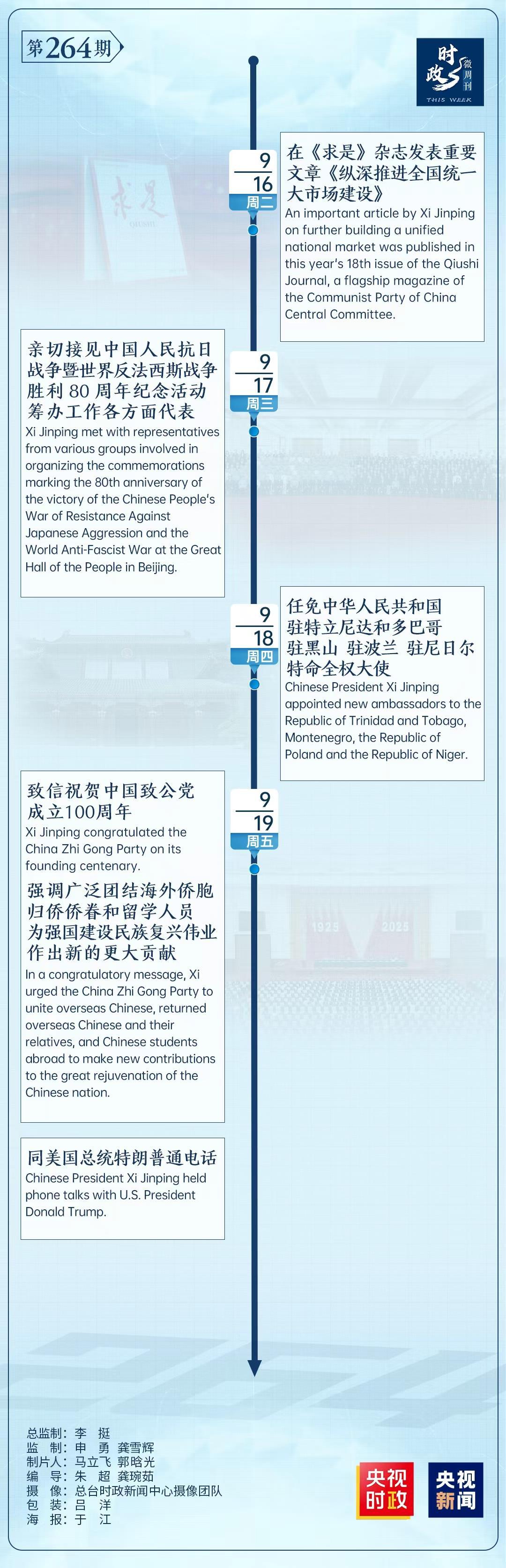
时政微周刊丨总书记的一周(9月15日—9月21日)
Yang Shi Xin Wen· 2025-09-22 00:17
Group 1 - An important article by Xi Jinping on further building a unified national market was published in the Qiushi Journal [1] - Xi Jinping met with representatives involved in organizing the 80th anniversary commemorations of the victory in the Chinese People's War of Resistance Against Japanese Aggression and the World Anti-Fascist War [1] - Xi Jinping appointed new ambassadors to several countries, including Trinidad and Tobago, Montenegro, Poland, and Niger [1][5] Group 2 - Xi Jinping congratulated the China Zhi Gong Party on its centenary [2] - In a congratulatory message, Xi urged the China Zhi Gong Party to unite overseas Chinese and students to contribute to the rejuvenation of the Chinese nation [3] - Xi Jinping held phone talks with U.S. President Donald Trump [4]

为什么要纵深推进全国统一大市场建设?
Sou Hu Cai Jing· 2025-09-21 21:18
Core Viewpoint - The construction of a unified national market is essential for building a new development pattern and promoting high-quality development in China [1][3][4] Group 1: Economic Context - China is undergoing a critical period of transforming its development model, optimizing economic structure, and shifting growth drivers amid profound changes in the global environment [1] - The current economic cycle in China faces several bottlenecks and fragmentation, necessitating the establishment of a unified national market to facilitate the orderly flow and efficient allocation of resources [3] Group 2: Market Development - The unified national market aims to create a competitive environment that fosters innovation and efficient market order, enhancing the internal dynamics and innovative vitality of China's economy [3] - There are existing issues in the market system, such as distorted mechanisms and disrupted competition, which need to be addressed through the establishment of a unified market [3] Group 3: Strategic Importance - The initiative to deepen the construction of a unified national market is a strategic measure to effectively respond to external risks and challenges, enhancing China's competitive edge in the international arena [4] - By leveraging its position as the largest physical consumption market, China can tap into domestic demand potential and mitigate uncertainties in the international market [4]

【策略周报】长假临近,震荡分化延续
华宝财富魔方· 2025-09-21 13:27
Key Points - The article discusses recent significant events in the economic and financial landscape, including a meeting between Chinese and U.S. trade leaders aimed at addressing trade issues and promoting cooperation [2] - It highlights a key article by Xi Jinping emphasizing the need to regulate low-price competition among enterprises, particularly in areas suffering from excessive competition [2] - The article notes the Federal Reserve's decision to lower interest rates by 25 basis points, marking the first rate cut of 2025, with expectations of further cuts later in the year [2] Group 1: Important Events Review - On September 14-15, Chinese and U.S. trade leaders held talks in Madrid, focusing on resolving TikTok-related issues and reducing investment barriers [2] - Xi Jinping's article published on September 16 stresses the importance of addressing disordered competition among businesses [2] - The Federal Reserve announced a 25 basis point rate cut on September 18, with projections for additional cuts in the near future [2]

沪铝期货日报-20250919
Guo Jin Qi Huo· 2025-09-19 06:48
Report Summary 1. Report Industry Investment Rating No investment rating information is provided in the report. 2. Core View The electrolytic aluminum market is expected to maintain a high - level oscillation pattern in the short term. The results of the Fed's interest - rate meeting, changes in domestic aluminum social inventory, and the operating conditions of downstream processing enterprises will determine the subsequent breakthrough direction of aluminum prices [11]. 3. Summary by Related Catalogs 3.1 Futures Market - On September 17, 2025, the al2510 contract of Shanghai Aluminum futures showed a volatile downward trend throughout the day, closing with a negative line, down about 0.38% from the previous settlement to 20910 points. The daily trading volume was 87,910 lots, and the open interest was 137,521 lots [2]. - The total open interest of 12 Shanghai Aluminum futures contracts was 588,644 lots, a decrease of 10,552 lots from the previous trading day. The open interest of the active contract al2510 decreased by 16,514 lots, indicating capital reduction during the decline [3]. 3.2 Spot Market On September 17, 2025, the basis of the main contract al2510 of Shanghai Aluminum strengthened. The spot aluminum price in East China was 20,890 yuan/ton, and the closing price of the futures main contract was 20,910 yuan/ton, with a basis of - 20 yuan/ton [6]. 3.3 Influencing Factors - **Macro - information**: The Fed's interest - rate meeting is imminent. The significant deterioration of the US employment market data has strengthened the market's expectation of the Fed's interest - rate cut. The article "Deeply Promote the Construction of a National Unified Market" by General Secretary Xi Jinping published in Qiushi Journal, aiming to rectify the disorderly low - price competition among enterprises, provides support for the market [7]. - **Fundamental information**: The operating capacity of domestic electrolytic aluminum remains at a high level and is approaching the "ceiling", with limited subsequent increments. With the arrival of the peak season, the operating rate of downstream aluminum processing enterprises has rebounded, and orders in related fields such as photovoltaics and automobiles have increased. However, high - priced aluminum significantly suppresses consumption, and the overall purchasing willingness is not strong. The electrolytic aluminum inventory fluctuates, and a stable de - stocking trend has not been formed [8]. - **Technical analysis**: The daily line of the al2510 contract of Shanghai Aluminum effectively broke below the 5 - day moving average and tested the support of the 10 - day moving average. The MACD red column shrank, the trading volume decreased, the open interest decreased, and market participants showed strong wait - and - see sentiment [9].