
科技成长

Search documents
创金合信基金魏凤春:下半年国内资产配置的变与不变
Xin Lang Ji Jin· 2025-07-09 00:32
Group 1 - The core viewpoint of the article emphasizes a significant decline in global risk premiums, easing U.S. debt pressures, and an increased probability of Federal Reserve interest rate cuts, while still advocating for a cautious approach [1] - The article highlights that technology remains the core of global asset allocation, while the upward trend in gold is weakening due to diverging factors [1] - The passing of the U.S. "Big and Beautiful Act" (BBB Act) and the gradual establishment of "reciprocal tariffs" are seen as reducing short-term political and economic uncertainties, leading to a new investment order [1] Group 2 - The article discusses the current hot topic of anti-involution policies within the context of a unified market, suggesting a potential repeat of the scenario where supply contraction leads to excess profits [2] - It predicts that after the Federal Reserve's interest rate cut in September, overseas capital may flow into China, potentially leading to a significant market rebound similar to last autumn [2] - The article notes a divergence among market participants regarding domestic equity assets, with a shift in focus towards technology growth and a reduction in the importance of low-volatility dividend strategies [2] Group 3 - The analysis indicates that global commodity prices are rising, driven by reduced supply from domestic anti-involution measures and increased demand from international restocking [3] - The article mentions a 4% increase in bank stocks over the past week, suggesting that dividend strategies remain effective despite adjustments in the technology sector [3] Group 4 - The article outlines that in the asset allocation system, fundamental factors play a decisive role while enhanced factors serve as auxiliary [4] - It emphasizes that investors should focus on fundamental changes rather than market momentum, which is often overlooked [4] Group 5 - The article presents quantitative observations indicating that stock investments are more favorable compared to bonds, with an equity risk premium (ERP) of 3.37% and a median excess return of 9.15% [5] - It notes that the stock valuation factor shows a high probability of positive returns, with a current one-year holding return probability of 69% [5] - The article states that the growth rate of net profit attributable to shareholders has increased from 16.20% to 35.1%, indicating an upward trend in the profit cycle [5] Group 6 - The article suggests that bond investment opportunities are weak, with low odds indicated by the valuation factor and a tightening funding environment [6] Group 7 - The article emphasizes that the economic growth target for 2025 is around 5%, with quarterly GDP growth rates projected to decline throughout the year [7] - It highlights that the effects of anti-involution on inflation need further observation, as current PPI and CPI data show limited positive factors for price changes [8] - The article discusses the necessity of broad credit over broad monetary policy, indicating that excessive monetary easing may have diminishing returns on economic stability [8] Group 8 - The article notes a shift in policy focus from short-term stimulus to long-term institutional building, reflecting a significant change in the global policy landscape [9] - It discusses the implications of the BBB Act on global financial markets and capital flows, suggesting that China's ongoing reforms are adapting to these complex changes [9] Group 9 - The article concludes that the dividend strategy remains effective in a low-growth, low-inflation environment, and that the capital structure remains unchanged with state-owned enterprises at the center [10] - It indicates that equity assets may outperform fixed income, but structural market conditions do not support significant overall increases [11] - The article highlights the competition between new technology and old cycles, suggesting that the current environment may not replicate past supply-side reforms [11][12]
知名基金经理二季度调仓路线曝光:加仓军工,医药板块存分歧
2 1 Shi Ji Jing Ji Bao Dao· 2025-07-08 13:24
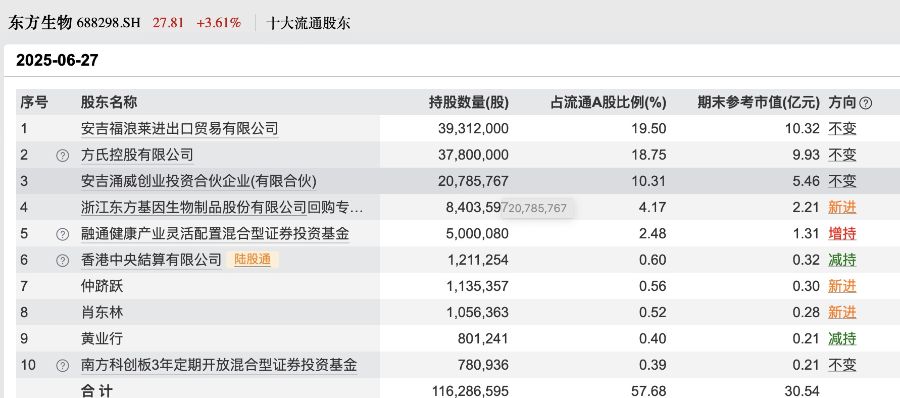
Group 1: Market Sentiment on Pharmaceutical Stocks - There is a significant divergence among fund managers regarding pharmaceutical stocks, particularly in valuation and performance realization, innovation drug development risks and returns, market sentiment and capital flow, policy impacts, and short-term volatility [2][10] - Some fund managers are opting for swing trading in the pharmaceutical sector, with specific examples like Dongfang Biological, which saw a 5.56% increase in Q2 [4][10] - Notable fund managers have either increased or decreased their holdings in specific pharmaceutical companies, such as Wan Minyuan increasing his stake in Dongfang Biological while others like Wu Yuanyi reduced their holdings [5][6][8] Group 2: Military Industry Focus - There has been an increased interest from public funds in the military sector, with notable fund managers like Li Xiaoxing and Chen Yunzhong increasing their positions in companies like Jingpin Special Equipment [11][12] - The military sector has seen a surge in trading activity, with a record weekly trading volume of 4,298.88 billion yuan, indicating heightened market interest [15][16] - The military industry is expected to remain a focal point for market participants, presenting structural opportunities despite potential short-term volatility risks [16] Group 3: Investment Strategies and Future Outlook - Fund managers are focusing on sectors such as dividends, technology growth, and innovative pharmaceuticals for the upcoming quarter, with expectations of a resilient market and structural opportunities [18][19] - The innovative pharmaceutical sector is viewed as having the greatest potential, with opportunities arising from potential corrections in leading innovative pharmaceutical companies [19][20] - The banking sector is also highlighted as a core direction for high dividends, with many A-share banks offering dividend yields above 4.5% [20]

港股通科技ETF(159262)投资价值分析:聚焦科技成长龙头,港股通版“恒生科技”
Huafu Securities· 2025-07-06 13:53
- The Hang Seng Stock Connect China Technology Index (HSSCITI) reflects the overall performance of mainland Chinese technology leaders listed in Hong Kong. It uses free-float market capitalization weighting, with a 10% cap on individual constituent weights, and adjusts semi-annually in June and December[37][38][39] - The index strictly selects 13 technology-related fields from 105 subcategories, excluding "pseudo-tech" companies, such as semiconductor (703010) and gaming software (702040), which represent high-tech hardware and digital content sectors. This enhances the index's technological purity and representativeness[37][38] - A fast-track inclusion mechanism was introduced in 2024, allowing companies newly listed in Hong Kong and ranked in the top 10 by market capitalization to be quickly added to the index. For example, Kuaishou (1024.HK) benefited from this mechanism. Additionally, a "buffer zone" for ranks 24-36 ensures that quality growth stocks are not excluded due to short-term market fluctuations[38][39] - The index's liquidity requirement mandates a turnover rate of 0.1% or higher for investment-type indices, ensuring active trading of constituent stocks and maintaining index vitality[38] - The HSSCITI index is distinct from other international technology indices, such as the Nasdaq 100 Technology Index (NDXTMC) and the STAR 50 Index, in terms of selection criteria, weighting methods, and risk management strategies. For instance, HSSCITI uses a simple 10% cap on individual stock weights, while NDXTMC employs a two-stage mechanism to limit individual weights to 15% and the top five issuers to 60%[39][40][43]
国泰海通|固收:成长为矛,业绩为锚——2025年7月转债策略展望
国泰海通证券研究· 2025-07-02 14:16
Core Viewpoint - The report emphasizes the focus on high-growth sectors driven by policy support and industrial innovation, including technology growth, new consumption, cyclical growth, and financial innovation [1]. Group 1: High-Growth Sectors - The technology growth sector includes strong performance certainty in computing hardware, the semiconductor industry benefiting from domestic substitution, and military industry resonating with domestic and international demand [1]. - New consumption is represented by emotional consumption, which serves as a new engine to boost consumption [1]. - The cyclical growth sector combines cyclical and growth characteristics, with short-term price increase catalysts [1]. - The financial sector is driven by the decline in risk-free interest rates and innovations in stablecoins [1]. Group 2: Market Dynamics - Following the rating disclosures, the downward adjustment of convertible bond ratings has removed constraints on low-priced convertible bonds, leading to an accelerated exit of bank convertible bonds [1]. - High Yield to Maturity (YTM) and dual low convertible bonds are expected to become the new base assets [1]. - The impact of the June rating downgrades is manageable, reflecting market preparedness for the downgrades of weaker quality convertible bonds, with no concerns over credit risk in a relatively strong equity market [1]. Group 3: Market Outlook - The equity market is expected to continue strengthening in July, influenced by three main factors: earnings forecasts from A-share listed companies, potential new actions from Trump after the tariff delay, and important mid-year meetings setting the economic outlook and policies for the second half [2]. - The report suggests that the valuation logic of the Chinese stock market in 2025 is driven by domestic industrial innovation and a systematic reduction in market discount rates, which will attract incremental capital [2]. - The easing of external tensions further strengthens the internal certainty logic, indicating potential upward movement in the stock market before the end of July [2]. Group 4: Convertible Bond Market - High valuations do not restrict the rise of convertible bonds, as the equity market is expected to remain strong, maintaining a tight balance between supply and demand in the convertible bond market [3]. - The median price of convertible bonds reached 124.21 yuan, a new high for 2025, driven by optimistic expectations for underlying stocks [3]. - The report highlights the importance of focusing on sectors with strong performance certainty and significant valuation space, such as AI, military, semiconductors, humanoid robots, stablecoins, innovative drugs, and emotional consumption [3].

最赚钱ETF榜单出炉,4.3万亿市场呈现三大变化
2 1 Shi Ji Jing Ji Bao Dao· 2025-07-02 13:05
Core Viewpoint - The domestic ETF market has reached a new high with a total scale of 4.31 trillion yuan as of June 30, 2023, reflecting a 15.55% increase from the end of last year, driven by over 300 billion yuan in inflows and structural market trends [1][5]. Group 1: Market Trends - The ETF market has seen significant growth since 2025, with over 300 billion yuan in new funds entering the market [1]. - As of June 30, 2023, the total scale of ETFs listed in China reached 4.31 trillion yuan, up from 3.73 trillion yuan at the end of last year, marking a 15.55% growth [1][5]. - Several ETFs have demonstrated strong performance, with multiple Hong Kong stock innovative drug ETFs and others achieving over 50% returns [1][11]. Group 2: Changes in Fund Flows - Three major changes in fund flows have been identified in the ETF market for the first half of the year: 1. The top ten ETFs by net inflow are no longer exclusively broad-based ETFs [2][4]. 2. Bond ETFs have contributed significantly to the market's growth [5][6]. 3. Industry-specific ETFs have gained popularity, particularly dividend-themed ETFs [7][10]. Group 3: Performance of Specific ETFs - The top ten ETFs by net inflow include various products, with the top performers being the HuShen 300 ETF and several bond ETFs, collectively attracting significant capital [3][9]. - Despite some core broad-based ETFs experiencing net outflows since May, they still ranked high in net inflows for the first half of the year, with several exceeding 100 billion yuan [8][9]. - The performance of ETFs tracking innovative drug and technology indices has been particularly strong, with many achieving returns exceeding 50% [11][13]. Group 4: Investor Behavior and Market Sentiment - The divergence between fund flows and returns can be attributed to investor behavior, where institutional investors may redeem funds upon reaching target returns, leading to net outflows despite high returns [15]. - Market sentiment also plays a role, as investors may preemptively invest in broad-based ETFs based on economic recovery expectations, while taking profits from high-performing ETFs [15]. Group 5: Future Outlook - Analysts suggest that the market may continue to experience high volatility, with a focus on sectors such as defense and technology for potential growth opportunities [16][17]. - The ongoing low interest rate environment and policies favoring dividends are expected to support high-yield assets, while the economic recovery may enhance market risk appetite [17].
业内人士认为,A股下半年有望震荡向上 科技和红利资产将受青睐
Shen Zhen Shang Bao· 2025-07-01 22:35
Group 1 - A-shares are expected to show a "first oscillation, then upward" pattern in the second half of the year, with structural opportunities highlighted in technology growth (such as AI and innovative pharmaceuticals) and dividend assets [1][2] - The weak dollar trend, supportive capital market policies, and overall improvement in liquidity are anticipated to drive the upward movement of A-shares [1] - Analysts predict that A-shares will maintain a stable and upward trend, with a focus on technology and emerging consumption sectors as key investment highlights [1][2] Group 2 - Investment themes for the second half of the year are expected to focus on stable assets and growth-oriented technology assets, with high ROE and stable dividend rates in sectors like transportation, consumption, publishing, gaming, and non-ferrous metals [2] - The current market liquidity is favorable for technology and growth style investments, particularly in companies with core technological barriers and overseas channel capabilities [2] - Key opportunities include domestic consumption, technology growth in areas like AI and robotics, industries benefiting from cost improvements, sectors with structural opportunities from overseas expansion, and stable dividend stocks suitable for long-term holdings [2]
A股下半年怎么走?业内认为有望震荡向上 ,科技和红利资产将受青睐
Shen Zhen Shang Bao· 2025-07-01 09:08
Core Viewpoint - A-shares are expected to experience a "first oscillation, then upward" trend in the second half of the year, with structural opportunities highlighted in technology growth and dividend assets [1][2][3] Market Outlook - Analysts predict that the A-share market will see a continuous upward adjustment in the second half, driven by a weak dollar trend, supportive capital market policies, and improved liquidity [2] - The market is expected to present a "stable index, structural bull" scenario, with significant opportunities for value re-evaluation in technology and emerging consumption sectors [2] - The overall liquidity environment is anticipated to improve, supporting a gradual recovery in the market's fundamentals [3] Investment Opportunities - Key sectors expected to perform well include stable assets and growth-oriented technology assets, with a focus on transportation, consumer goods, publishing, gaming, and high ROE sectors [4] - Growth assets are likely to center around military industry, pharmaceuticals, communications, gaming, and AI technologies [4] - Specific investment opportunities include domestic consumption sectors, technology growth in AI and robotics, and industries benefiting from cost improvements [5] Analyst Recommendations - Analysts suggest focusing on five areas: domestic consumption, technology growth, cost-improved industries, structural opportunities from overseas expansion, and stable dividend-paying assets [5] - Emphasis is placed on technology sectors marked by innovation and strategic significance, as well as consumer services and new consumption trends [5]
一线私募,最新解盘!聚焦三大主线
天天基金网· 2025-07-01 05:14
Core Viewpoint - The A-share market is experiencing a rise in both volume and price, driven by top private equity firms increasing their positions, with nearly 90% of large private equity firms maintaining over 50% positions [1][3]. Group 1: Market Positioning - The average position of all private equity firms in the stock market reached 74.62% as of June 20, showing a slight increase of 0.37 percentage points from the previous week, indicating a relatively high level for the year [3]. - Large private equity firms have an even more aggressive average position of 79.43%, significantly above the industry average, with 52.99% of these firms in heavy or full positions (over 80%) [3]. - Overall, 88.62% of large private equity firms maintain positions above 50% [3]. Group 2: Fund Performance - Domestic public equity funds also show high stock positions, with an overall position of 92.72% as of June 20, slightly down from the previous week but still at a relatively high level for the year [5]. Group 3: Market Outlook - The market sentiment is improving due to three main factors: decreasing overseas risks, emerging highlights in various industries, and a predominance of bullish capital [7]. - Key upcoming events include the mid-year earnings forecasts and expectations for policy direction in July, which are expected to significantly influence market performance [7]. - The overall valuation of A-shares is not considered high, with the equity risk premium index remaining at a high level since 2016, indicating strong long-term investment value compared to bonds [8]. Group 4: Investment Strategies - Private equity firms are focusing on three main investment themes: technology growth, defensive dividends, and consumer recovery [10]. - Specific sectors of interest include computing infrastructure, gaming exports, and the export industry, with potential for significant gains [10]. - A balanced investment framework is suggested, targeting high-dividend assets in utilities and transportation, technology growth sectors, and consumer recovery areas benefiting from counter-cyclical policies [10].

“投资者利益优先” !信澳浮动费率基金7月1日正式发行
Zhong Guo Ji Jin Bao· 2025-07-01 00:30
Core Viewpoint - The introduction of the first batch of 26 new floating rate funds marks a significant reform in China's public fund industry, aiming to prioritize investor interests and create a "co-prosperity ecosystem" through performance-linked management fees [1][2]. Group 1: Fund Overview - The new floating rate funds, including the Xinao Advantage Industry Mixed Fund, are designed to align management fees with investor returns, breaking away from the traditional fixed fee model [2][3]. - The Xinao Advantage Industry Mixed Fund will have a management fee structure that varies based on performance, with rates of 1.2%, 0.6%, and 1.5% depending on the fund's performance relative to its benchmark [3][4]. - The fund's investment strategy will focus on technology growth sectors, with a stock allocation of 60% to 95% and a maximum of 50% in Hong Kong stocks [5][6]. Group 2: Manager and Investment Strategy - The fund will be managed by Wu Qingyu, who has a strong background in technology investments and a proven track record in the sector [6][12]. - Wu Qingyu's investment approach will utilize a GARP (Growth at a Reasonable Price) strategy, focusing on sectors such as AI, electronics, and automotive innovation [7][8]. - The fund aims to leverage the company's existing strengths in technology investments to deliver superior returns to investors [8][9]. Group 3: Performance and Market Context - Since its inception on May 29, 2023, the Xinao Advantage Industry Mixed Fund has achieved a performance growth rate of 15.94%, significantly outperforming its benchmark [7]. - The fund's recent performance has positioned it among the top 5% of similar funds, reflecting its resilience and adaptability in a challenging market environment [7][10]. - The current market conditions, characterized by liquidity and a favorable environment for technology stocks, are expected to support the fund's growth trajectory [8].
基金研究周报:抗战胜利80周年纪念活动将举行,军工板块或可布局-20250630
Datong Securities· 2025-06-30 13:53
Market Overview - The equity market saw a collective rebound last week, with the North Certificate 50 index rising the most by 6.84%, followed by the ChiNext index at 5.69% and the Wande All A index at 3.56% [5][6] - The TMT sector experienced a collective rebound, with notable increases in the computer sector (7.70%), defense and military industry (6.90%), and non-bank financials (6.66%) [5][6] Equity Product Allocation Strategy - Event-driven strategies include focusing on the upcoming 80th anniversary of the victory in the War of Resistance against Japan on September 3, with recommended funds such as Huashan Manufacturing Pioneer A (006154) and Boshi Military Industry Theme A (004698) [16] - The recent joint issuance of guidelines by six departments to support consumption can lead to investment opportunities in funds like ICBC Consumer Service A (481013) and Jiashi New Consumption A (001044) [17] - The National Medical Insurance Administration's issuance of guidelines for the 2025 basic medical insurance directory may benefit funds like ICBC Medical Health A (006002) and Penghua Medical Technology A (001230) [18] Asset Allocation Strategy - The overall allocation strategy suggests a balanced core plus a barbell strategy, focusing on dividend and technology sectors [19] - High dividend assets are highlighted as having significant allocation value due to the low interest rate environment and government support for dividend-paying companies [20] - The technology growth direction is emphasized due to national policy support, high industry prosperity, and the need for domestic companies to enhance competitiveness [21] Stable Product Allocation Strategy - The central bank's recent net injection of 12,672 billion yuan indicates a continued loose monetary policy, which is expected to support technology innovation and consumption [24] - The profit data from industrial enterprises shows a decline, suggesting potential for more proactive policies to stimulate domestic demand [25] - Convertible bonds are noted for their dual characteristics of debt and equity, maintaining value but with caution advised regarding volatility risks [26] Key Focus Products - Recommended funds include Nord Short Bond A (005350) and Anxin New Value A (003026), which are positioned to benefit from current market conditions [29]