
存储芯片超级周期

Search documents
存储成本飙升!惠普、戴尔涨价在即,联想(00992)计划跟进
Zhi Tong Cai Jing· 2025-12-01 13:25
Core Viewpoint - The ongoing "super cycle" in storage chips driven by AI is exerting significant cost pressure on global PC and mobile manufacturers, leading to anticipated price increases across the board [1] Group 1: Company Responses - Dell Technologies has issued a price increase warning, indicating that costs will ultimately be passed on to end customers, with a possibility of repricing certain products [1] - HP's CEO has stated the company is prepared to raise product prices if necessary, noting that memory costs currently account for 15% to 18% of typical PC total costs [1] - Lenovo Group plans to follow suit with price increases to counteract rising storage prices, having already locked in production capacity for 2026 to manage costs [1] Group 2: Market Trends - Storage chip prices have surged by 50% cumulatively since the beginning of the price increase phase, with 512GB chips rising nearly 500 yuan since October [1] - Counterpoint Research forecasts that memory prices are expected to rise by an additional 50% by the second quarter of 2026, suggesting that price hikes for mobile and PC products are inevitable [1]



存储成本飙升!惠普、戴尔涨价在即,联想计划跟进
Ge Long Hui· 2025-12-01 09:06
Core Viewpoint - The ongoing "super cycle" in storage chips driven by AI is exerting significant cost pressure on global PC and mobile device manufacturers, leading to anticipated price increases across the board [1] Group 1: Company Responses - Dell Technologies (DELL.US) and HP (HPQ.US) have issued warnings about potential price hikes due to rising storage costs, with Dell's COO Jeff Clarke noting unprecedented speed in cost increases [1] - Lenovo Group (0992.HK) is also planning to raise prices to counteract the profit pressure from soaring storage prices, which have increased by 50% cumulatively since the price surge began [1] - HP's CEO Enrique Lores indicated that memory costs now account for 15% to 18% of typical PC total costs, and the company is exploring options to mitigate this pressure, including sourcing from more suppliers and potentially reducing memory capacity in some products [1] Group 2: Market Trends - The price of 512GB storage chips has risen by nearly 500 yuan since October, reflecting the broader trend of increasing storage costs [1] - Lenovo has proactively locked in production capacity for 2026 to manage rising costs, with its CFO stating that current component inventory is approximately 50% higher than usual and long-term supply agreements have been signed [1] - Market research firm Counterpoint Research predicts that memory prices will increase by another 50% by the second quarter of 2026, suggesting that price hikes for mobile and PC products are inevitable as storage prices continue to rise [1]
60%疯狂提价!港A半导体闻风躁动,反攻信号初现?
Ge Long Hui· 2025-11-18 06:42
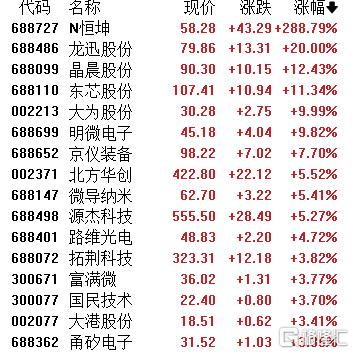
Group 1: Semiconductor Sector Performance - The semiconductor sector in Hong Kong and A-shares experienced a rebound, with notable stocks like Longxin Co. and Daway Co. hitting the daily limit up [1][2] - Key stocks such as SMIC, Cambrian, and Huagong Information also saw significant gains, indicating a strong market sentiment in the semiconductor industry [1][2] Group 2: Price Trends in Memory Chips - The price of DRAM has surged significantly, with a year-on-year increase of 171.8% expected by Q3 2025, driven by a "super cycle" in memory chips [4] - Samsung has raised prices for certain memory chips by up to 60% since September, with specific products like the 32GB DDR5 memory chip seeing a price increase from $149 to $239 [5][6] Group 3: Supply and Demand Dynamics - The demand for high-performance storage, particularly from AI servers, is a key driver behind the price increases, leading to a supply-demand imbalance [6][8] - Analysts predict that the shortage of traditional DRAM products like DDR4 may persist until 2027 due to the overwhelming demand from AI applications [7] Group 4: Industry Expansion and Future Outlook - SMIC reported a capacity utilization rate of 95.8%, indicating strong order demand and a supply shortage in the semiconductor market [8] - Major players like SK Hynix and Samsung are expanding their production capabilities to meet the growing demand, with significant investments planned for new facilities [8] - The long-term growth prospects for the storage industry are viewed positively, with expectations of continued price increases and supply-demand gaps in the coming years [8][9]



股价自高点跳水近三成,小米为何从尖子生跌成“科指垫底”?
Jin Shi Shu Ju· 2025-11-18 03:13
Core Viewpoint - Xiaomi Group has rapidly declined from being a market favorite to one of the worst-performing Chinese tech stocks, facing challenges in the smartphone and electric vehicle markets, making short-term recovery difficult [1] Group 1: Financial Performance and Market Position - Xiaomi is expected to report its slowest revenue growth since 2023, raising concerns among investors [1] - The company's stock has dropped nearly 30% since its peak in September, ranking among the largest declines in the Hang Seng Tech Index [1] - The average target price for Xiaomi's stock has been reduced by over 8% since its August high, making it the third-largest downward adjustment in the Hang Seng Tech Index, following Meituan and Li Auto [2] Group 2: Cost Pressures and Profitability - Rising storage chip prices are anticipated to erode Xiaomi's smartphone profit margins, with mobile DRAM contract prices increasing by 21% in October, the highest level since July 2022 [1] - Analysts indicate that the ongoing "super cycle" in storage chips will pressure profit margins for companies like Xiaomi, as these costs cannot be fully passed on to consumers [2] Group 3: Electric Vehicle Business - Xiaomi is focused on increasing electric vehicle delivery volumes, with a goal of achieving profitability in this sector by the end of the year [2] - Concerns exist regarding the potential impact of the gradual withdrawal of government subsidies on the overall automotive market [2] Group 4: Investor Sentiment and Stock Valuation - Despite the stock's decline, its valuation has become more attractive, with a projected future price-to-earnings ratio of approximately 19 times, half of its early-year peak [2] - Domestic investors have been increasing their positions in Xiaomi, with net purchases for thirteen consecutive days through the trading link mechanism [2] - The short-selling ratio of Xiaomi's stock has risen from a low of 0.4% in July to nearly 0.7%, driven by concerns over safety, factory delays, and insufficient electric vehicle demand despite recent promotions [2]

存储芯片疯狂涨价,PC与服务器厂商受伤!大摩:每涨10%,OEM毛利率就下降45-150个基点
美股IPO· 2025-11-17 09:54
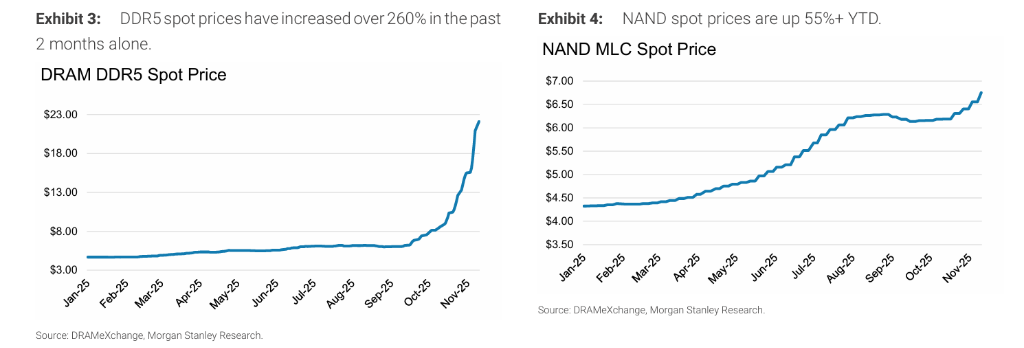
Core Viewpoint - The storage chip market is experiencing an unprecedented "super cycle" driven by AI demand and supply shortages, significantly impacting the profit outlook for PC and server manufacturers [1][3][4]. Group 1: Price Surge and Impact - Morgan Stanley warns that storage chip prices are skyrocketing due to AI demand and supply constraints, with DRAM spot prices soaring over 260% in just two months [1][5]. - The report indicates that the cost of storage chips (NAND and DRAM) constitutes 10%-70% of the BOM for high-end products, leading to a potential decline in hardware OEM gross margins by 45 to 150 basis points for every 10% increase in storage chip prices [3][6]. - The current price surge is unprecedented, with NAND flash prices rising over 50% since the beginning of the year [5][6]. Group 2: Drivers of Price Increase - The price surge is primarily driven by accelerated procurement from large cloud service providers for AI infrastructure, a spike in demand for high-bandwidth memory (HBM) for AI accelerators, and insufficient investment in NAND capacity over the past few years [6][10]. - Morgan Stanley predicts that contract prices for both NAND and DRAM could see double-digit percentage increases each quarter until 2026, far exceeding the previous cycle from 2016-2018 [6][10]. Group 3: Historical Context and Comparison - The previous storage super cycle from 2016 to 2018 serves as a reference point, where OEM margins and stock valuations began to decline 6 to 12 months after prices started to rise [8][10]. - Key differences in the current cycle include a more rapid price increase and a weaker demand environment for non-AI hardware compared to the previous cycle [10][11]. Group 4: Company Ratings and Vulnerabilities - Morgan Stanley has downgraded ratings for several major hardware companies, citing dual pressures on profits and valuations [12][13][14]. - Dell Technologies was downgraded from "Overweight" to "Underweight," with a target price cut from $144 to $110, due to significant impacts from rising storage costs [13]. - HP's rating was lowered from "Market Perform" to "Underweight," with a target price adjustment from $26 to $24, as profit margin pressures overshadow market recovery [14]. - Lenovo's rating was adjusted from "Overweight" to "Market Perform," as over 60% of its PC business targets the enterprise market, which is better positioned to pass on cost increases [17]. Group 5: Market Segmentation and Resilience - Different hardware manufacturers face varying levels of risk, with PC and server manufacturers more exposed due to their reliance on DRAM [18][20]. - Companies like Apple and Pure Storage are viewed as more resilient due to strong supply chain negotiation power and better pricing capabilities [20]. - Memory chip manufacturers such as Micron Technology, SK Hynix, and Samsung Electronics are expected to be direct beneficiaries of this super cycle [20].



存储芯片疯狂涨价,PC与服务器厂商受伤!大摩:每涨10%,OEM毛利率就下降45-150个基点
Hua Er Jie Jian Wen· 2025-11-17 09:01
Core Insights - A significant "super cycle" in storage chips is impacting the profit outlook for PC and server manufacturers, with Morgan Stanley warning of severe profit margin erosion due to skyrocketing storage chip prices [1][2][3] Price Surge and Market Dynamics - The current price surge in storage chips is driven by increased demand from AI infrastructure, a shift towards high bandwidth memory (HBM), and insufficient investment in NAND flash memory [2][7] - DRAM spot prices have surged over 260% in the past two months, while NAND flash prices have increased by over 50% since the beginning of the year [3][7] Historical Context and Comparison - The previous storage super cycle from 2016 to 2018 serves as a reference point, where OEM profit margins and stock valuations faced pressure after a similar price increase [9][11] - Key differences in the current cycle include a more rapid price increase and a weaker demand environment for non-AI hardware compared to the previous cycle [11][13] Impact on Hardware Manufacturers - Morgan Stanley has downgraded ratings for several global hardware giants, predicting dual pressure on profits and valuations [14] - PC and server manufacturers, particularly those heavily reliant on DRAM, are identified as the most vulnerable, with Dell, HP, Asus, and Acer being the most affected [15][17] Company-Specific Ratings Changes - Dell Technologies: Downgraded from "Overweight" to "Underweight," target price reduced from $144 to $110 due to severe impact from rising storage costs [17] - HP Inc.: Downgraded from "Market Perform" to "Underweight," target price lowered from $26 to $24 as profit margin pressures offset market recovery [17] - Asus: Downgraded from "Market Perform" to "Underweight," target price cut from NT$625 to NT$500 due to reliance on price-sensitive consumer markets [17] - Lenovo Group: Downgraded from "Overweight" to "Market Perform," with over 60% of its PC business targeting the enterprise market, which is better positioned to absorb cost increases [17]
存储芯片“超级周期”:A股玩家谁能多分一杯羹?
财联社· 2025-11-16 04:51
Core Viewpoint - The article discusses a significant price surge in storage chips driven by the AI boom, marking the beginning of a "super cycle" in the storage chip industry, with prices for certain memory chips increasing by as much as 60% in recent months [4][5]. Industry Overview - The storage chip industry is entering a "super cycle" phase, fueled by the demand for AI data centers, leading to a structural mismatch between supply and demand [5]. - The current price trends for DRAM and NAND Flash are showing a comprehensive upward trajectory, indicating a shift from previous low-demand periods [5]. - The AI infrastructure expansion is closely linked to a historic "AI computing power race," with major players in the market recognizing the onset of a storage super cycle [11]. Company Performance - Companies like Shannon Semiconductor and Demingli have seen substantial stock price increases, with Shannon Semiconductor's stock rising by 514.1% and Demingli's by 334.53% year-to-date [6][7]. - Shannon Semiconductor's revenue for the first three quarters of 2025 reached 26.4 billion yuan, a year-on-year increase of 59.90%, although its net profit slightly decreased by 1.36% [8]. - Demingli reported a net loss of 27.07 million yuan for the first three quarters, with total operating costs rising significantly from 3.098 billion yuan to 6.653 billion yuan year-on-year [10]. Market Dynamics - The storage chip market is currently characterized by a seller's market due to expectations of rising prices, leading to excessive purchasing by downstream companies [11]. - The inventory levels of companies like Jiangbolong and Demingli are notably high, with Jiangbolong holding 8.517 billion yuan in inventory, which may positively impact future earnings [12]. - Despite the current bullish sentiment, analysts caution that the long-term sustainability of high inventory levels may be at risk due to potential market fluctuations and technological advancements [12].


中芯国际CEO:存储涨价对逻辑代工有两大致命影响
2 1 Shi Ji Jing Ji Bao Dao· 2025-11-15 14:41
Core Viewpoint - SMIC (Semiconductor Manufacturing International Corporation) has reported strong financial results for Q3, driven by the domestic supply chain shift and AI computing power expansion, but has provided cautious guidance for Q4 and next year, indicating potential challenges ahead [1][2][9]. Group 1: Financial Performance - In Q3, SMIC achieved revenue of $2.382 billion, a year-on-year increase of 9.7% and a quarter-on-quarter increase of 7.8% [1]. - The net profit for Q3 was approximately $192 million, reflecting a year-on-year growth of 28.9% [1]. - The monthly capacity for 8-inch standard logic wafers surpassed one million for the first time, with a capacity utilization rate reaching 95.8% [1][7]. Group 2: Domestic Supply Chain Shift - The growth in Q3 was primarily attributed to the shift of customers to the domestic supply chain, with revenue from Chinese customers accounting for 86.2% of total revenue, up from 84.1% in Q2 [4]. - Revenue from Chinese customers increased by 11% quarter-on-quarter, particularly driven by domestic consumer electronics clients replacing overseas suppliers [4]. Group 3: Inventory Replenishment - Customers are replenishing inventory due to previous understocking caused by tariff concerns, particularly in the analog, power, and high-current product categories [5]. - The automotive and industrial sectors are also reversing their previous low inventory levels, leading to increased demand for replenishment [6]. Group 4: Operational Metrics - The overall capacity utilization rate reached 95.8%, a 3.3 percentage point increase from the previous quarter, marking the highest level since Q2 2022 [7]. - The gross margin for Q3 was 22.0%, up 1.6 percentage points quarter-on-quarter, supported by high capacity utilization offsetting depreciation pressures [7][11]. Group 5: Cautious Outlook - Despite strong Q3 performance, SMIC's guidance for Q4 is conservative, expecting revenue to be flat or grow by 2% quarter-on-quarter, with gross margin projected to decline to 18%-20% [9][10]. - The anticipated "super cycle" in memory chips, driven by AI demand, poses risks for SMIC, as it may lead to supply chain mismatches and cost pressures [10][11]. Group 6: Competitive Landscape - The rising prices of memory chips could squeeze profit margins for terminal products, leading to pressure on SMIC's customers to reduce prices for other chips, which may impact SMIC's profitability [10][11]. - The company acknowledges that competition within the industry will remain intense, despite the high demand for its services [12].

中芯国际CEO:存储涨价对逻辑代工有两大致命影响
21世纪经济报道· 2025-11-15 14:34
Core Viewpoint - SMIC (Semiconductor Manufacturing International Corporation) has reported strong Q3 results, driven by the domestic supply chain shift and increasing AI computing power, but has provided cautious guidance for Q4 and next year, indicating concerns about future demand and profitability [1][8]. Group 1: Q3 Performance Highlights - In Q3, SMIC achieved revenue of $2.382 billion, a year-on-year increase of 9.7% and a quarter-on-quarter increase of 7.8%, with a net profit of approximately $192 million, up 28.9% year-on-year [1]. - The monthly capacity for 8-inch standard logic wafers exceeded one million for the first time, with a capacity utilization rate reaching 95.8%, close to full capacity [1][4]. - Revenue from domestic customers accounted for 86.2% of total revenue, up from 84.1% in Q2, with a significant 11% quarter-on-quarter increase in absolute terms [4]. Group 2: Factors Driving Growth - The primary driver of growth is the shift to domestic supply chains, particularly in the consumer electronics sector, which has created opportunities for SMIC [4]. - Customer inventory replenishment has also contributed to the strong performance, as many clients are restocking to compete in the domestic market after previously depleting their inventories [5]. - The automotive and industrial sectors are showing signs of recovery, leading to increased inventory replenishment from suppliers [5]. Group 3: Cautious Outlook for Q4 - Despite strong Q3 results, SMIC's guidance for Q4 is conservative, expecting revenue to remain flat or grow by 2% quarter-on-quarter, with gross margin projected to decline to 18%-20% [9]. - The cautious outlook is attributed to the ongoing "super cycle" in memory chips, which may impact demand for logic chips and create supply chain risks for SMIC's customers [9][10]. - Rising memory chip prices could pressure profit margins for downstream manufacturers, leading to reduced orders for SMIC's key products [10]. Group 4: Internal and External Cost Pressures - SMIC's capital expenditure for Q3 was $2.394 billion, with a total of $5.7 billion for the first three quarters, indicating ongoing investment in capacity expansion [11]. - Increased depreciation costs from new equipment, which will be deployed in Q4 and Q1 of next year, are expected to further pressure gross margins [11]. - The company acknowledges that competition in the industry will remain intense, necessitating a focus on performance, quality, and cost efficiency [11].
国产供应链切换红利劲爆 中芯国际四季度指引谨慎乐观
2 1 Shi Ji Jing Ji Bao Dao· 2025-11-14 23:14
Core Viewpoint - SMIC (Semiconductor Manufacturing International Corporation) has emerged as a market focus amid a new semiconductor cycle driven by domestic supply chain shifts and AI computing power expansion, reporting strong Q3 financial results but providing cautious guidance for Q4 and next year [1][2]. Group 1: Financial Performance - In Q3, SMIC reported revenue of $2.382 billion, a year-on-year increase of 9.7% and a quarter-on-quarter increase of 7.8%, with a net profit of approximately $192 million, up 28.9% year-on-year [1]. - The monthly capacity for 8-inch standard logic wafers exceeded one million for the first time, with a capacity utilization rate reaching 95.8%, close to full capacity [1][4]. - Despite strong performance, the company expects Q4 revenue to be flat to a 2% increase, with gross margin guidance lowered to 18%-20% [1][8]. Group 2: Drivers of Growth - The primary driver of growth in Q3 was the shift to domestic supply chains, with revenue from Chinese customers accounting for 86.2% of total revenue, up from 84.1% in Q2 [2]. - Customer inventory replenishment also contributed to Q3 performance, as many clients previously moved products overseas due to tariff concerns and are now restocking to compete in the domestic market [3]. Group 3: Operational Metrics - SMIC's overall capacity utilization rate reached 95.8%, a 3.3 percentage point increase from the previous quarter, marking the highest level since Q2 2022 [4]. - The increase in capacity utilization helped offset the pressure from new capacity depreciation, contributing to a gross margin of 22.0%, up 1.6 percentage points quarter-on-quarter [4][8]. Group 4: Market Dynamics and Challenges - The ongoing "super cycle" in memory chips, driven by AI demand, poses risks for SMIC, as rising memory prices could lead to supply chain mismatches and cost pressures for its clients [7][8]. - The company faces increased competition and cost pressures, with capital expenditures for Q3 at $2.394 billion, and total capital expenditures for the year expected to be similar to last year's $7.3 billion [8][9]. - SMIC's management emphasizes the need to focus on performance, quality, and customized product platforms to navigate the competitive landscape [9].