
货币政策宽松

Search documents
宝城期货国债期货早报(2026年1月6日)-20260106
Bao Cheng Qi Huo· 2026-01-06 01:32
Report Summary 1. Report Industry Investment Rating - No investment rating provided in the report 2. Core Viewpoint - The report expects Treasury bond futures to oscillate and consolidate in the short - term, with upper pressure and lower support. The short - term probability of interest rate cuts is low, but there are still medium - to - long - term expectations of monetary policy easing [1][5] 3. Directory Summaries 3.1 Variety Viewpoint Reference - Financial Futures Stock Index Sector - For TL2603, the short - term view is "oscillation", the medium - term view is "oscillation", and the intraday view is "weakening". The reference view is "oscillation and consolidation". The core logic is that the short - term probability of interest rate cuts is low, while medium - to - long - term easing expectations remain [1] 3.2 Main Variety Price Market Driving Logic - Financial Futures Stock Index Sector - For TL, T, TF, and TS, the intraday view is "weakening", the medium - term view is "oscillation", and the reference view is "oscillation and consolidation". Yesterday, Treasury bond futures oscillated and slightly retraced. In the long - run, due to insufficient domestic demand, the monetary policy is expected to be loose in the medium - to - long - term, and there is still an expectation of policy interest rate cuts in 2026, providing strong support for Treasury bond futures. However, in the short - term, the macro data shows strong resilience, reducing the urgency of monetary policy easing. Coupled with the supply - side pressure from the intensive issuance of Treasury bonds in the first quarter, the momentum for the rebound of Treasury bond futures is weak [5]
中信证券:亚太新兴经济体经济增长或将温和降温,低通胀下部分经济体的货币政策仍有宽松空间
Zheng Quan Shi Bao Wang· 2026-01-06 00:37
Core Viewpoint - The resilience of emerging economies in the Asia-Pacific region is expected to exceed expectations in 2025, although some driving factors may weaken in 2026, leading to greater pressure on export-oriented economies while domestic demand-driven markets may show more resilience [1] Economic Growth Outlook - Economic growth in Asia-Pacific emerging economies is anticipated to moderate against a backdrop of high base effects, with low inflation providing some room for monetary policy easing in certain economies [1] Country-Specific Insights - Countries such as India, Indonesia, Thailand, the Philippines, and Vietnam are expected to continue their easing cycles, while Malaysia and Singapore are likely to maintain a stable monetary policy [1]

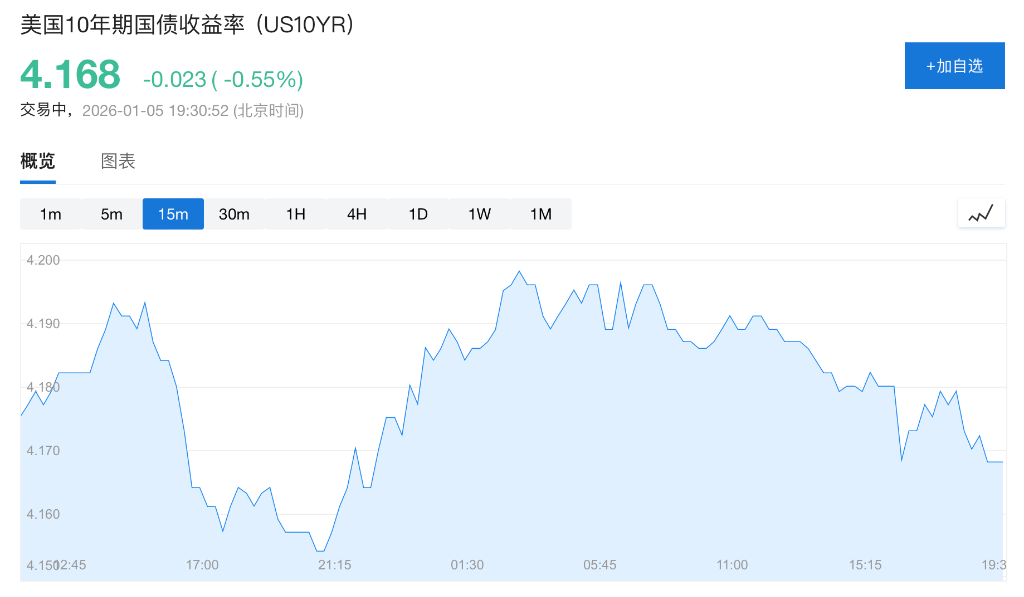
油价回落缓解通胀担忧,美债收益率结束连涨,一周以来首次下跌
Hua Er Jie Jian Wen· 2026-01-05 12:10
Core Viewpoint - US Treasury bonds experienced their first increase in a week, driven by a decline in oil prices that alleviated concerns over persistent inflation, leading to a halt in rising yields [1] Group 1: US Treasury Bonds - On January 5, US Treasury yields slightly decreased, with the 10-year yield falling by 2 basis points to 4.17% and the 2-year yield dropping by 1 basis point to 3.46% [1] - The market's expectation of increased oil supply contributed to the downward pressure on oil prices, which in turn eased inflation concerns [5] Group 2: Oil Market Dynamics - The oil market is facing oversupply pressures, which has led to a decline in prices, further reducing inflation worries and reinforcing expectations for a more accommodative monetary policy from the Federal Reserve [5] - There is a market expectation that Venezuela's oil production may recover, potentially reversing a nearly 20-year trend of declining output [6][9] Group 3: Geopolitical and Economic Context - Despite geopolitical risks typically favoring safe-haven assets like Treasuries, US stock index futures rose, particularly in the tech sector, indicating a preference for risk assets under the expectation of liquidity easing [5] - Market focus remains on economic fundamentals, with investors closely monitoring upcoming US manufacturing data and the influential non-farm payroll report [8]

锡市开年燃爆!新质催发银龙跃,供需弦绷岁首红!
Xin Lang Cai Jing· 2026-01-05 09:28
Core Viewpoint - The domestic tin price has surged significantly at the beginning of 2026, driven by supply concerns from Myanmar and increased demand from emerging technologies, leading to speculation about the start of a "tin bull" market [1] Group 1: Macro Influences - Tin prices have risen due to a "triple push" from macroeconomic and financial factors, including supportive domestic policies, a weakening dollar, and escalating geopolitical tensions [1] - The weakening dollar has reduced the cost of non-ferrous metals priced in USD, attracting global capital back to commodities [1] - Geopolitical conflicts, particularly in Venezuela and the Democratic Republic of Congo, have heightened concerns over resource supply chain stability, increasing the risk premium for strategic metals like tin [1] Group 2: Supply Side Tension - Despite Myanmar's announcement of resuming production, actual supply recovery has been slow due to previous rainy seasons and equipment issues, with December's domestic tin concentrate arrivals decreasing month-on-month [2] - Indonesia's ongoing resource export controls have limited the flow of tin resources to the Chinese market [2] - Global tin inventories are at historically low levels, contributing to price support from supply-side uncertainties [2] Group 3: Emerging Demand Growth - The AI revolution and rapid development of industries such as 5G communication and electric vehicles have significantly increased demand for tin, which is widely used in electronic chips, circuit boards, and batteries [3] - Traditional industries, including home appliances, automotive, and construction, continue to provide stable demand for tin, further supporting its price [3] Group 4: Price Dynamics - Short-term tin prices are expected to oscillate between 330,000 and 340,000 yuan/ton, reflecting a high-stakes battle between strong expectations and weak realities [4] - Supply anxieties from delayed recovery in Myanmar and geopolitical risks in the Democratic Republic of Congo provide solid price support, while traditional consumption is currently in a low season [4] - The current high prices may have already factored in optimistic expectations, with 340,000 yuan/ton identified as a key resistance level [4]

宝城期货国债期货早报(2026 年 1 月 5 日)-20260105
Bao Cheng Qi Huo· 2026-01-05 01:20
投资咨询业务资格:证监许可【2011】1778 号 期货研究报告 宝城期货国债期货早报(2026 年 1 月 5 日) ◼ 品种观点参考—金融期货股指板块 时间周期说明:短期为一周以内、中期为两周至一月 | 品种 | 短期 | 中期 | 日内 | 观点参考 | 核心逻辑概要 | | --- | --- | --- | --- | --- | --- | | TL2603 | 震荡 | 震荡 | 偏弱 | 震荡整理 | 短期降息概率较低,中长期宽松 预期仍存 | 备注: 1.有夜盘的品种以夜盘收盘价为起始价格,无夜盘的品种以昨日收盘价为起始价格,当日日盘收盘 价为终点价格,计算涨跌幅度。 2.跌幅大于 1%为弱势,跌幅 0~1%为偏弱,涨幅 0~1%为偏强,涨幅大于 1%为强势。 3.偏强/偏弱只针对日内观点,短期和中期不做区分。 ◼ 主要品种价格行情驱动逻辑—金融期货股指板块 品种:TL、T、TF、TS 日内观点:偏弱 中期观点:震荡 参考观点:震荡整理 核心逻辑:上周三国债期货均震荡小幅回调。消息面,统计局公布了 12 月制造业 PMI 数据为 50.1%, 比上月上升 0.9 个百分点,升至扩张区间。宏观 ...
【财经分析】2026年债市展望:震荡中寻机,结构分化下的配置之道
Xin Hua Cai Jing· 2026-01-04 08:11
Core Viewpoint - The bond market is expected to exhibit structural differentiation between interest rate bonds and credit bonds in 2026, influenced by a complex interplay of monetary policy and economic recovery factors [1][3][5]. Group 1: Market Trends - In Q4 2025, the interest rate bond market showed a recovery trend after a bearish adjustment in Q3, with the 10-year government bond yield fluctuating between 1.7% and 1.85% [1]. - The credit bond market experienced increased transaction volumes but widening credit spreads, indicating a divergence from interest rate bonds [1][2]. - The issuance scale of credit bonds decreased, with corporate bonds showing zero issuance, reflecting a weak overall supply willingness despite some positive growth in company bonds and medium-term notes [2]. Group 2: Influencing Factors - Positive factors for the bond market include a moderately loose monetary policy, which may support market performance, especially if the U.S. further lowers interest rates [3]. - Negative factors include rising inflation pressures, easing "asset scarcity," and changes in supply structure, which could impact market sentiment and demand [4]. - The overall bond market in 2026 is expected to experience wide fluctuations with a moderate upward trend, particularly in the interest rate bond sector [5]. Group 3: Investment Strategies - Investment strategies should focus on short-term opportunities in interest rate bonds while avoiding duration risks, particularly in the first quarter of 2026 [6]. - Credit bond investments should target structural opportunities, emphasizing coupon strategies, with a focus on high-grade short-duration credit bonds to mitigate risks [6][7]. - The expansion of technology innovation bonds is anticipated to reshape credit bond allocation strategies, with a recommended approach of combining short-term coupons with mid-to-long-term timing [7].
俄议员预计年底关键利率将降至9-10%
Xin Lang Cai Jing· 2026-01-02 23:42
格隆汇1月3日|1月2日,俄罗斯国家杜马金融市场委员会主席阿纳托利·阿克萨科夫在接受俄新社采访 时表示,央行关键利率可能在年底前降至9%至10%的水平。预计最早将于2月进行首次降息,随后央行 或在春季采取更果断的措施。 据阿克萨科夫评估,2月利率可能下调0.5个百分点,而3月降息幅度或达 1-1.5个百分点。 阿克萨科夫指出:"央行过去五次会议上逐步降息的趋势将会延续,且步伐可能更趋果 断,时间点可能接近夏季或秋季。"他还强调,通胀放缓进程为货币政策宽松创造了条件。 阿克萨科夫 补充道:"根据我的预测,到今年年底关键利率将降至9%,也可能是10%。" ...
穆迪首席经济学家预计美联储将于26年初采取激进宽松政策 年中前或降息三次
智通财经网· 2025-12-31 23:56
这一判断明显领先于市场与官方预期。根据芝商所(CME)期货数据并通过CME FedWatch工具反映,市 场当前仅定价2026年可能有两次降息,首次至少要到4月之后,第二次更可能出现在下半年、约9月左 右。 相比之下,美联储内部的态度更为谨慎。央行在12月早些时候更新的利率路径"点阵图"显示,官员们对 全年仅一次降息的预期占据主流。会议纪要也显示,当次是否降息曾是一场"势均力敌"的讨论,尽管官 员们承认未来仍可能继续降息,但节奏将相当克制。 不过,Zandi认为,多重因素的叠加可能迫使美联储更快行动,其中一个重要变数来自政治层面,美国 总统特朗普对美联储人事结构的潜在重塑。当前七名美联储理事中,已有三人由特朗普任命;随着理事 米兰任期在1月到期,特朗普预计将再提名一名立场相近的人选。此外,现任主席鲍威尔的主席任期将 于5月届满(其理事任期延续至2028年初),而总统也正尝试推动撤换理事库克,尽管目前遭到法院阻 止。 美联储下一次议息会议定于1月27日至28日举行。根据CME数据,市场目前仅赋予该次会议约13.8%的 降息概率。 智通财经APP获悉,穆迪分析首席经济学家Mark Zandi表示,就业市场疲软、通 ...
国债期货日报:国债期货窄幅震荡整理-20251230
Bao Cheng Qi Huo· 2025-12-30 11:49
1. Report Industry Investment Rating - No relevant information provided 2. Core View of the Report - Today, treasury bond futures fluctuated within a narrow range. Currently, treasury bond futures are in a stage where both upward and downward driving forces are limited. On one hand, the medium - to long - term monetary policy tends to be loose, and there is still an expectation of a policy interest rate cut, providing strong support for treasury bond futures. On the other hand, the central bank's pace of interest rate cuts will likely maintain strong determination, the short - term rebound momentum driven by interest rate cut expectations is limited, and the supply pressure from the intensive issuance of treasury bonds in the first quarter of next year restricts the upward height of treasury bonds. Overall, treasury bond futures face pressure above and support below, and are expected to fluctuate and consolidate in the short term [4] 3. Summary by Relevant Catalog 3.1 Industry News and Related Charts - On December 30, the People's Bank of China conducted 31.25 billion yuan of 7 - day reverse repurchase operations at a fixed - rate and quantity - tendered method, with a winning bid rate of 1.4%. There were 5.93 billion yuan of reverse repurchases maturing in the open market today, resulting in a net investment of 25.32 billion yuan [6]
宝城期货国债期货早报(2025年12月29日)-20251229
Bao Cheng Qi Huo· 2025-12-29 01:59
Group 1: Report Industry Investment Rating - Not provided in the given content Group 2: Report's Core View - The short - term probability of interest rate cuts is low, while there are still long - term expectations of monetary easing. Treasury bond futures have support but also face pressure, and are expected to remain in a volatile consolidation in the short term. [1][5] Group 3: Summary by Relevant Catalogs 1. Variety View Reference - Financial Futures Stock Index Sector - For TL2603, the short - term view is "volatile", the medium - term view is "volatile", and the intraday view is "weak". The reference view is "volatile consolidation". The core logic is the low short - term probability of interest rate cuts and long - term easing expectations. [1] 2. Main Variety Price Market Driving Logic - Financial Futures Stock Index Sector - For varieties TL, T, TF, TS, the intraday view is "weak", the medium - term view is "volatile", and the reference view is "volatile consolidation". The core logic is that last Friday, treasury bond futures fluctuated slightly up. With the moderately loose monetary policy, a more relaxed monetary environment next year, and increasing expectations of coordinated efforts between monetary and fiscal policies in Q1, treasury bond futures have strong support and the bond yields have decreased. However, the central bank is likely to be cautious about interest rate cuts, limiting the short - term rebound driven by rate - cut expectations. [5]