通胀降温

Search documents
【环球财经】通胀降温 加拿大央行近期料将保持利率稳定
Xin Hua Cai Jing· 2025-11-18 14:36
Core Points - Canada's inflation rate fell to 2.2% in October, down from 2.4% in September, primarily due to declining gasoline prices and easing food inflation [1] - Food price inflation decreased from 4.0% to 3.4%, while gasoline prices plummeted by 9.4% year-on-year, significantly widening from a 4.1% decline in September [1] - The core inflation rate, excluding the impact of carbon tax, improved to 2.7% from the previous 2.9%, although it remains above the overall inflation level [1] Summary by Sections Inflation Data - The October inflation data indicates a continued decline, providing a strong rationale for the Bank of Canada to maintain current interest rates [1] - Economists suggest that the basic trend of inflation should only cause limited concern for the Bank of Canada [1][2] Interest Rate Outlook - Most economists expect interest rates to remain stable for the remainder of the year, given the high threshold for further rate cuts indicated by policymakers [2] - The Bank of Canada previously anticipated inflation would return to its 2% target, and the current data aligns with these expectations [2] Currency Dynamics - The USD/CAD exchange rate remained stable around 1.4025, supported by the current environment favoring the USD against the CAD [2] - The softening of oil prices continues to exert downward pressure on the commodity-linked CAD, providing additional support for the USD [2][3] Economic Context - The USD is in a relatively strong position compared to the CAD, with recent cautious yet hawkish signals from multiple Federal Reserve officials regarding further easing [3] - Concerns about the momentum of the US economy, exacerbated by a record government shutdown delaying data releases, have led to a cautious stance among USD bulls [3]
每周投资策略-20251117
citic securities· 2025-11-17 07:26
Group 1: US Market Focus - The US inflation is gradually cooling down as tariff disruptions diminish, with companies slow to pass on tariff costs, leading to a mild increase in prices of imported sensitive consumer goods [15][21][24] - AI remains a core engine driving earnings upgrades in the US stock market, with significant contributions from companies like Nvidia and Qualcomm [25][28][36] - The expected revenue growth for US tech companies in 2026 is robust, with a structural upward revision in earnings forecasts, particularly in the information technology sector [30][33] Group 2: UK Market Focus - The UK GDP growth is continuously slowing, with a mere 0.1% quarter-on-quarter growth in Q3, necessitating interest rate cuts to support the economy [42][44] - Key stocks to watch include Rolls-Royce Holdings and AstraZeneca, both of which are expected to benefit from improved market conditions and reduced tariff disruptions [49][50] - The UK stock market shows a notable performance disparity, with financial and defense sectors performing well, while consumer and energy sectors lag [48]
TradeMax:美联储内部现政策分歧,市场降息预期明显降温
Sou Hu Cai Jing· 2025-11-14 04:00
Core Viewpoint - Recent statements from Federal Reserve officials have been inconsistent, leading to uncertainty in the market regarding potential interest rate cuts in December [1] Group 1: Economic Resilience and Caution - Minneapolis Fed President Kashkari noted that the current economic performance is stronger than expected, with most businesses showing confidence despite some credit tightening for low-income groups [3] - San Francisco Fed President Daly expressed that it is too early to draw conclusions about the December meeting, indicating that current policy is in a "neutral" state and further data is needed [3] Group 2: Increasing Support for Maintaining Rates - Cleveland Fed President Mester stated that current interest rates have limited restrictive effects and should be maintained to continue cooling inflation, which may persist into early next year [4] - Boston Fed President Collins also advocated for keeping rates at current levels for some time, warning that strong economic growth could slow down inflation's decline [4] - Even traditionally dovish officials, such as Chicago Fed President Goolsbee, have shifted their stance recently [4] Group 3: Market Expectations Shift - Investor expectations for a rate cut in December have dropped to around 47%, a significant decrease from the near 100% expectation prior to the October meeting, indicating a reassessment of the Fed's policy direction [5] Group 4: Anticipated Divergence in December Meeting - Observers expect that regardless of the decision made in December, Fed Chair Powell may face more dissenting votes than usual, with two members already opposing the last meeting's decisions [6] - St. Louis Fed President Bullard emphasized the need for "reverse suppression" of inflation, while Fed Vice Chair Jefferson advocated for caution in the absence of sufficient data [6]

住房租金创十五年最大降幅,美国10月通胀要崩了?
Hua Er Jie Jian Wen· 2025-11-12 06:47
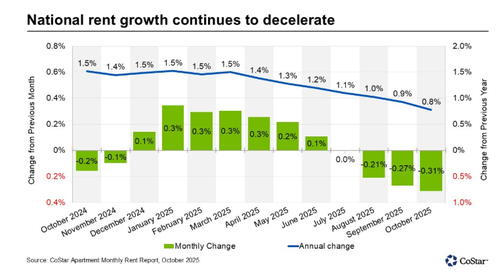
Core Insights - A significant and unexpected cooling of inflation in the U.S. is indicated for October, primarily driven by a notable drop in housing rents, marking the largest monthly decline in fifteen years [1][3] - This trend challenges previous market expectations of persistent price stability and may provide new grounds for the Federal Reserve to adopt a more dovish policy stance [1] - Alternative data sources are being closely monitored due to potential delays in the official Consumer Price Index (CPI) report from the Bureau of Labor Statistics (BLS) [1] Inflation Trends - According to CoStar, October saw a month-over-month rent decrease of 0.31%, the largest drop in over fifteen years [3] - OpenBrand's data shows that inflation rates for durable goods and personal items have significantly slowed due to increased retailer discounts, with a 0.22% rise in October compared to 0.48% in September [2] - The average discount rate in October reached 20.4%, nearing the highest level since July of the previous year [2] Housing Market Dynamics - The rental market is showing signs of weakness, with effective apartment rents in major markets like Denver, Austin, and Phoenix experiencing year-over-year declines of 8.1%, 7.4%, and 5.9%, respectively [6][7] - Invitation Homes reported negative growth in new lease rents for the first time since its IPO in 2017, indicating a broader trend in the single-family rental market [7] - Zillow has revised its rental growth forecasts for single-family homes down to 2.0% for 2026, with multi-family units expected to decline by 0.4% [9] Economic Implications - The ongoing decline in rental prices may signal further downward pressure on the overall real estate market, as rental prices serve as a long-term anchor for housing prices [11] - A significant drop in immigration job applications, which have decreased by 60% over the past four to five months, is linked to reduced rental demand, contributing to the supply-demand imbalance in the rental market [11] Inflation Resilience - Despite signs of cooling in rents and some commodity prices, Goldman Sachs' model suggests that core inflation remains resilient, estimating a 0.24% month-over-month increase in core CPI for October [14] - The model predicts price increases in used cars (+0.5%), new cars (+0.3%), airline tickets (+1%), and hotel prices (+1%), while forecasting a decline in auto insurance prices (-0.3%) [14] - The complexity of the overall inflation outlook necessitates caution among investors as they await potentially delayed official data to assess the true inflation trajectory [14]
铜:宏观驱动影响降温,基本面偏弱拖累价格下行
Sou Hu Cai Jing· 2025-11-07 03:15
Core Viewpoint - The recent fluctuations in copper prices are primarily driven by macroeconomic factors and weak fundamentals, leading to a downward trend in prices [1] Group 1: Macroeconomic Factors - The ISM data for October indicates a continued cooling of inflation in the U.S. [1] - Unexpected rebound in ADP employment figures has created a divergence in economic data, increasing internal disagreements within the Federal Reserve regarding interest rate decisions [1] - The uncertainty surrounding future interest rate paths remains significant [1] Group 2: Fundamental Factors - Previous high prices have led to an accumulation of inventory in the market, resulting in a relatively abundant supply of copper [1] - Slow recovery in consumption is evident, with demand being significantly suppressed by high prices [1] - The limited macroeconomic stimulus on prices suggests that the fundamental recovery for copper remains unsatisfactory, indicating a potential for continued weakness in copper price levels [1]
美元债双周报(25年第43周):通胀降温与贸易缓和打开美债利率下行空间-20251027
Guoxin Securities· 2025-10-27 11:08
Report Investment Rating - The investment rating for the industry is "Underperform" [1][6] Core Viewpoints - Inflation cooling and trade easing open up downward space for US Treasury yields. The September CPI data in the US was lower than expected, with core inflation slowing down, which boosted expectations of interest rate cuts. The market's expectation of a 25 - basis - point interest rate cut in October reached 98.9%, and the probability of another cut in December was 95.3% [1] - The October PMI data in the US exceeded expectations, indicating economic resilience. The Markit manufacturing, services, and composite PMIs all improved compared to September and were better than expected, showing strong economic growth in the early fourth quarter [2] - China and the US reached a framework agreement on issues such as tariffs. The high - level economic and trade consultations effectively eased recent trade tensions and set a constructive tone for the upcoming APEC meeting between the two leaders [3] - Under the positive factors of "inflation cooling + dovish Fed + easing trade tensions", the downward space for US Treasury yields is further opened. It is recommended to maintain medium - to - short - term (2 - 5 years) US Treasuries as the core allocation, and investors with higher risk tolerance can moderately extend the duration to 5 years [4] Summary by Directory US Macroeconomic and Liquidity - The September CPI data showed that overall CPI rose 3% year - on - year, slightly lower than the expected 3.1%, and core CPI also increased by 3% year - on - year, lower than the expected 3.1%. The market's expectation of interest rate cuts in October and December increased significantly [1] - The October PMI data showed that the manufacturing, services, and composite PMIs all improved compared to September and were above the 50 boom - bust line, indicating strong economic growth at the beginning of the fourth quarter [2] Exchange Rate - Not covered in the provided summary content Chinese - funded US Dollar Bonds - The report shows the trends of returns, yields, and spreads of Chinese - funded US dollar bonds since 2023, classified by level and industry [75] Rating Actions - In the past two weeks, the three major international rating agencies carried out 10 rating actions on Chinese - funded US dollar bond issuers, including 5 rating revocations, 1 initial rating, 3 rating downgrades, and 1 rating upgrade [76]
突传降息99%概率消息,释放啥关键信号?下周A股重演924吗?
Sou Hu Cai Jing· 2025-10-26 18:12
Core Insights - The probability of a Federal Reserve interest rate cut has surged to 99%, indicating a strong likelihood of monetary easing, which has led to a significant rally in global markets, particularly in U.S. equities reaching historical highs [1][3]. Economic Indicators - Recent U.S. economic data shows a 0.2% month-over-month increase in the core Consumer Price Index (CPI) for September, marking a decline for three consecutive months, suggesting easing inflation pressures [1]. - The decline in inflation provides the Federal Reserve with the necessary space to consider interest rate cuts, which were previously resisted due to inflation concerns [1][3]. Market Reactions - The U.S. dollar index has shown signs of weakness, and U.S. Treasury yields have decreased, creating additional pressure on the Federal Reserve to lower interest rates [3]. - The employment market, while not experiencing a significant rise in unemployment, still shows a high unemployment rate, indicating a need for economic stimulus through interest rate cuts [3]. A-Share Market Outlook - Historical context suggests that the A-share market may not replicate the previous year's rally following a Federal Reserve rate cut signal, as the current market conditions differ significantly [4][5]. - The Shanghai Composite Index is currently around 3900 points, compared to last year's lower starting point, making a rapid ascent to 5000 points more challenging [5][7]. - The driving forces behind market movements have shifted; last year's rally was fueled by both policy support and U.S. rate cuts, while current market sentiment is less responsive to external stimuli [7]. Investment Implications - A potential interest rate cut by the Federal Reserve is viewed as a medium-term positive for the market, with expectations that global risk appetite may increase, potentially benefiting emerging markets, including A-shares [9]. - The market may experience a gradual upward trend, with a focus on breaking through the psychological barrier of 4000 points, contingent on sustained confidence and capital inflows [9]. - Investment strategies should prioritize low-valued stocks and solid growth companies, avoiding overvalued speculative stocks [10].

【UNforex本周总结】美联储宽松信号主导市场 多资产共振上涨
Sou Hu Cai Jing· 2025-10-25 07:47
Group 1 - The core CPI data for September showed a month-on-month increase of 0.2% and a year-on-year increase of 3%, both below market expectations, indicating a significant reduction in inflation pressure [1] - Following the CPI release, the market raised its bets on a Federal Reserve rate cut, with nearly 100% probability for a 25 basis point cut in October and 98.5% for another cut in December [1] - Despite inflation remaining above the 2% target, recent signals from officials suggest a cooling job market, leading to widespread belief that the Fed has sufficient reasons to initiate a rate cut cycle [1] Group 2 - The decline in inflation has boosted market optimism regarding a "rate cut + soft landing," with major U.S. stock indices rising strongly, and the Nasdaq reaching a historic high with an increase of over 1% [2] - Gold prices strengthened, with spot gold rising to $4,320 per ounce, reflecting both liquidity support from rate cut expectations and strong demand for safe-haven assets amid geopolitical risks [2] - The Japanese stock market surged under the new prime minister's expectations, with the Nikkei 225 index rising over 1,600 points, surpassing the 49,000 mark [2] Group 3 - Upcoming interest rate decisions from the Federal Reserve, European Central Bank, and Bank of Japan are anticipated to be significant market events, with Powell's post-meeting statements being key indicators for future policy direction [3] - The progress of U.S.-China trade negotiations is also under scrutiny; positive outcomes could enhance risk appetite, while friction could lead to renewed interest in safe-haven assets [3] - Overall, the cooling inflation and rate cut expectations create an optimistic market tone, but uncertainties from Japan's political changes, Middle East tensions, and trade talks may induce short-term volatility [3]
帮主郑重:美股破47000创新高!CPI降温后,中长线该这么看
Sou Hu Cai Jing· 2025-10-24 23:35
Core Viewpoint - The recent mild CPI data has provided reassurance to the market, contributing to the historical highs of major stock indices, including the Dow Jones reaching 47,207 points for the first time [1][3]. Market Performance - The Dow Jones increased by 472 points, marking a 2.2% rise for the week, while the Nasdaq and S&P 500 rose by 1.15% and 0.79% respectively, with all three indices showing positive returns [3]. - The CPI report for September showed a month-on-month increase of 0.3% and an annualized rate dropping to 3%, both lower than economists' expectations [3]. Economic Indicators - The core CPI, excluding food and energy, was also lower than expected, which suggests that inflation is not a concern for the Federal Reserve [3]. - Following the CPI report, the probability of a rate cut in December surged from 91% to 98.5%, with the 10-year Treasury yield falling below 4% [3]. Corporate Earnings - Companies like Intel and Procter & Gamble reported better-than-expected sales and earnings, providing solid support for the market's upward movement [3]. - The market largely ignored geopolitical events, such as Trump's termination of trade talks with Canada, as the core logic of the market remained intact [3]. Investment Strategy - Long-term investors are advised to focus on core factors such as declining inflation and Federal Reserve easing, which provide a foundation for market stability [4]. - Emphasis should be placed on companies with reasonable valuations and solid earnings, rather than reacting to daily market fluctuations [4].

命悬一线!狗狗币(DOGE) 逼近生死支撑,跌破or反弹?接下来的走势决定一切!
Sou Hu Cai Jing· 2025-09-24 03:06
Group 1 - The recent drop in Dogecoin has raised questions about a potential breakout that has been building for five months, creating a decisive moment for bullish price predictions [2] - Dogecoin has experienced an 11% decline since the weekend due to market liquidation events, but broader narratives continue to support optimism for Q4 [2] - The approval of a second spot ETF for Dogecoin through 21Shares strengthens its position in the U.S. TradFi market, adding another point of demand [2] Group 2 - The potential collapse of the ascending channel pattern will determine the mid-term trend for Dogecoin, despite the bullish catalysts [4] - The lower boundary of the ascending channel has acted as a support since the market bottomed in April, guiding Dogecoin's rebound over recent months [6] - Analysts view the recent drop as a buying opportunity, emphasizing the importance of a successful rebound to maintain the bull market [6] Group 3 - If Dogecoin loses its current support level, it could drop by 40% to the next significant support at $0.1425 [8] - Momentum indicators show early signs of reversal, with the RSI stabilizing at 40, indicating a reduction in selling pressure [8] - A successful retest of the channel's upper limit, combined with ETF adoption and ongoing macroeconomic easing, could lead to a breakout [8] Group 4 - If the breakout occurs, Dogecoin could potentially return to its historical high of $0.48, representing a 100% gain and opening doors for new price discovery [8] - Achieving a 370% increase towards the $1 milestone may depend on the long-term adoption of Dogecoin through ETFs and corporate financial integration into the U.S. financial market [8]