
M1增速

Search documents
与时舒卷,终返其真
Dong Zheng Qi Huo· 2025-09-15 07:15
1. Report Industry Investment Rating - The rating for Treasury bonds is "Oscillation" [6] 2. Core Viewpoints of the Report - M1 is expected to peak and decline, and the inflation level will remain low. Although the PPI year - on - year reading will rise due to the low base, the overall inflation in Q4 will stay at a low level [1][19] - The main theme of the Q4 market is likely to return to reality. After the stock market gradually evaluates policies and fundamentals, the negative impact on the bond market will be cleared [2] - The impact of monetary policy is mild, and the bond market valuation is reasonable. Even with limited incremental monetary benefits, the bond market can strengthen as it returns to fundamental trading [3] - The Q4 bond market is expected to oscillate and recover. It is recommended to wait for market sentiment to stabilize, then take long positions on dips, continue to hold short - hedging strategies and close them after sentiment stabilizes, and consider curve - flattening strategies [4][82][83] 3. Summary According to the Table of Contents 3.1 2025 Q1 - Q3 Treasury Bond Trend Review - The first stage (early - March mid - late): The central bank guided the tightening of the capital market, and the bond market oscillated weakly [13] - The second stage (end of March - end of June): Monetary policy and the capital market gradually loosened, and the bond market gradually recovered. After the tariff implementation in early April, Treasury bond futures rose rapidly, and the bond market oscillated at a high level from April to May, then strengthened in June [13] - The third stage (July - September): Anti - involution policies led to a rise in market risk appetite, the stock and commodity markets rose rapidly, and Treasury bond futures fell [13] 3.2 M1 Peaks and Declines, Inflation Remains Low 3.2.1 The Current M1 Growth Recovery is Unique and May Lack Sustainability - The current M1 growth recovery is different from previous ones. It is mainly due to the low base, fiscal stimulus creating corporate deposits, improved SME payment cycles, increased corporate settlement willingness, and the revival of household deposit currentization [20][21] - The economic nature of the current M1 growth recovery is limited, and the M1 growth rate is likely to decline in Q4 due to the rising base and potential reduction in fiscal policy intensity [24][25] 3.2.2 The Year - on - Year Inflation Reading Rises, but the Month - on - Month Price Increase Momentum is Weak - The current M1 growth recovery has limited ability to drive inflation. The anti - involution policy has not been fully implemented, and the domestic supply - demand imbalance persists. The Q4 inflation will remain low, and the PPI year - on - year reading will rise due to the low base [19] - It is difficult to reduce supply in Q4 as the anti - involution policy is different from the supply - side structural reform, and the high - tech manufacturing production growth is relatively fast [28][29] - Domestic demand remains weak. The real estate market is difficult to stabilize, Q4 consumption growth is challenging, and although external demand has some resilience, it also faces downward pressure [31][32][36] 3.3 Q4 Market Main Theme Expected to Return to Reality 3.3.1 Capital Drives Stock Market Up, Bond Market Follows Down - The rise of the stock market in Q3 was mainly driven by capital. Factors include high stock - bond return ratios, increased global risk appetite, policy incentives, and increased corporate settlement willingness [39][43][51] - The stock market's bull run in Q3 significantly suppressed the bond market. As the bond market has priced in the existing monetary benefits, the stock market's rise became the key factor suppressing the bond market [53] 3.3.2 When Will the Negative Impact of the Stock Market be Cleared? - Overseas risk appetite may fluctuate in Q4 due to potential inflation risks in the US and geopolitical uncertainties [56] - The stock - bond return ratio approached its 10 - year average in mid - September, and the stock market's upward pace slowed down, indicating a possible return to fundamental trading [59] - Policy incentives are expected to fade away in mid - late October, and the stock market is likely to turn to real - world trading. The bond market and the stock market are expected to gradually return to fundamental trading in Q4 [60][63] 3.4 Monetary Impact is Mild, Bond Market Valuation is Reasonable 3.4.1 No Negative Monetary Factors, Limited Incremental Benefits - Monetary policy and the capital market are likely to remain unchanged. Although there is a need for interest rate cuts, the probability is low, and the market's expectation of continuous interest rate cuts is also low [64][71] - The central bank is not in a hurry to restart open - market bond trading. Even if the policy is implemented, its positive impact on the bond market will be weaker than last year [75] 3.4.2 Bond Market Valuation is Basically Reasonable with Room for Strengthening - The short - end and long - end interest rates in the bond market are gradually approaching reasonable levels. The bond market's sensitivity to negative news will gradually decrease as the valuation becomes more reasonable [76][77] 3.5 Treasury Bond Market Outlook and Strategies - The Q4 bond market is expected to oscillate and recover. It will start with low - level oscillations, then turn upward, and may face fluctuations at the end of the year [82][83] - Strategies include taking long positions on dips after market sentiment stabilizes, continuing to hold short - hedging strategies and closing them after sentiment stabilizes, and considering curve - flattening strategies when the bond market sentiment improves [83]
8月金融数据及公募降费解读
2025-09-15 01:49
Summary of Conference Call Notes Industry Overview - The conference call discusses the financial market in August, highlighting the performance of social financing (社融) and the impact of new regulations on public funds and investment strategies in the asset management industry. Key Points Social Financing and Economic Recovery - In August, the growth rate of social financing decreased to 8.8%, marking the first month-on-month decline of the year, primarily due to a reduction in government bonds by 250 billion yuan [3] - The total amount of government bonds issued was 1.4 trillion yuan, but the year-on-year increase was lower due to a high base last year [3] - Credit performance was weak, with a year-on-year decrease of 310 billion yuan, leading to a credit balance growth rate of 6.8% [3][6] - Both household and corporate loans showed weakness, indicating poor economic recovery [6][7] Deposit Trends - M1 growth rate rose to 6%, indicating a trend of "deposit migration" where funds are moving into non-bank deposits [4][10] - Non-financial institution deposits increased by 16%, higher than the previous month, suggesting a trend of funds entering the market [10][11] - Households accumulated approximately 5 trillion yuan in excess savings, driven by fluctuations in the bond market and declining bank interest rates [12] Fund Fee Reduction Policy - The third phase of the fund fee reduction policy aims to benefit investors by 30 billion yuan, primarily affecting sales service fees and subscription fees [13][15] - New regulations standardize redemption fees and holding periods, with a redemption fee of 1.5% for holdings under 7 days, impacting the short-term pure bond fund sector significantly [14][18] - The policy is expected to alter the competitive landscape of the asset management industry, potentially weakening the retail competitiveness of public funds [2][17] Impact on Short-term and Bond Funds - The extension of the holding period to 6 months will significantly impact short-term pure bond funds, which total approximately 1.1 trillion yuan [18][19] - Institutional investors, particularly wealth management subsidiaries, may withdraw from these funds due to liquidity management needs [19] - The new regulations may also affect the operational strategies of insurance funds that rely on these products for short-term gains [21] Market Reactions and Future Expectations - The market is expected to see an increase in M1 data to around 6.5% to 7% in September, indicating a potential influx of funds into the stock market [12] - The overall financial market performance is improving, with significant increases in trading volumes and account openings [10] Challenges for Asset Management Firms - The new regulations may force public fund institutions to adjust their product offerings, potentially leading to a shift towards other financial products [25] - Smaller institutions may face survival challenges due to reduced sales fees, making it difficult to incentivize distribution channels [25] Conclusion - The financial landscape is undergoing significant changes due to regulatory adjustments and economic conditions, with implications for various stakeholders in the asset management and banking sectors. The focus will be on adapting to these changes while seeking new investment opportunities and managing risks effectively.
央行8月金融数据:社融增26.56万亿,M1增速回升
Sou Hu Cai Jing· 2025-09-14 14:20
Core Insights - The People's Bank of China released financial statistics for August 2025, indicating a cumulative social financing scale increase of 26.56 trillion yuan in the first eight months, which is 4.66 trillion yuan more than the same period last year [1] - As of the end of August, the M2 balance was 331.98 trillion yuan, showing a year-on-year growth of 8.8%, while the M1 balance was 111.23 trillion yuan, with a year-on-year increase of 6% [1] - The growth rate of RMB loans was 7.1% year-on-year, and deposit balances increased by 8.6% year-on-year [1] Financial Metrics - M1 growth accelerated to 6% from 5.6%, while M2 growth remained stable at 8.8%, indicating increased liquidity in corporate funds [1] - The M2-M1 spread narrowed to 2.8%, reflecting a recovery in corporate demand for current deposits and enhanced fund turnover [1] - The growth rate of social financing stock was slightly lower at 8.8%, with government bonds comprising a higher proportion than corporate bonds, indicating weak medium to long-term financing demand from enterprises [1] Economic Outlook - Financial data showed signs of recovery in August, with M1 rising to 6% and M2 maintaining at 8.8%, suggesting enhanced consumption and investment willingness [1] - Despite weak medium to long-term loans for households, improved real estate policies and fiscal measures are expected to support a weak recovery phase in the economy [1] - Government net financing reached 10.27 trillion yuan, increasing by over 4.63 trillion yuan year-on-year, creating supply pressure in the market [1] Risks and Challenges - Financial data may experience short-term fluctuations and face risks from rapid increases in upstream prices [1]
8月金融数据:M1增速回升,社融存量增速处低位
Sou Hu Cai Jing· 2025-09-14 14:20
Core Insights - The central bank released financial statistics for August 2025, indicating significant changes in various indicators [1] Group 1: Financial Metrics - The cumulative increase in social financing scale for the first eight months of 2025 reached 26.56 trillion yuan, an increase of 4.66 trillion yuan compared to the same period last year [1] - As of the end of August, the M2 balance was 331.98 trillion yuan, showing a year-on-year growth of 8.8%, while the M1 balance was 111.23 trillion yuan, with a year-on-year increase of 6% [1] - The year-on-year growth of RMB loans was 7.1%, and the deposit balance increased by 8.6% [1] Group 2: Market Dynamics - The M1 growth rate rebounded, indicating increased corporate funding activity, while the M2 growth rate remained stable at 8.8%, reflecting improved liquidity in the real economy [1] - The M1-M2 spread narrowed to 2.8%, suggesting a recovery in corporate demand for current deposits and enhanced fund activity [1] - Despite a slight decline in credit demand and deposit willingness, the overall financial data showed signs of recovery, indicating a weak monetary expansion coupled with weak credit [1] Group 3: Financing Trends - Government bonds accounted for a higher proportion of the social financing increment compared to corporate bonds, indicating weak recovery in corporate medium- and long-term financing demand [1] - The net financing of government bonds reached 10.27 trillion yuan, an increase of over 4.63 trillion yuan year-on-year, while medium- and long-term loans for residents and enterprises shrank [1] - The overall trend reflects an increase in supply alongside passive allocation characteristics, with future developments dependent on the recovery of real financing demand and the pace of fiscal issuance [1]
8月金融数据点评:社融增速年内首次回落,非银存款表现有所“降温”
Orient Securities· 2025-09-14 11:30
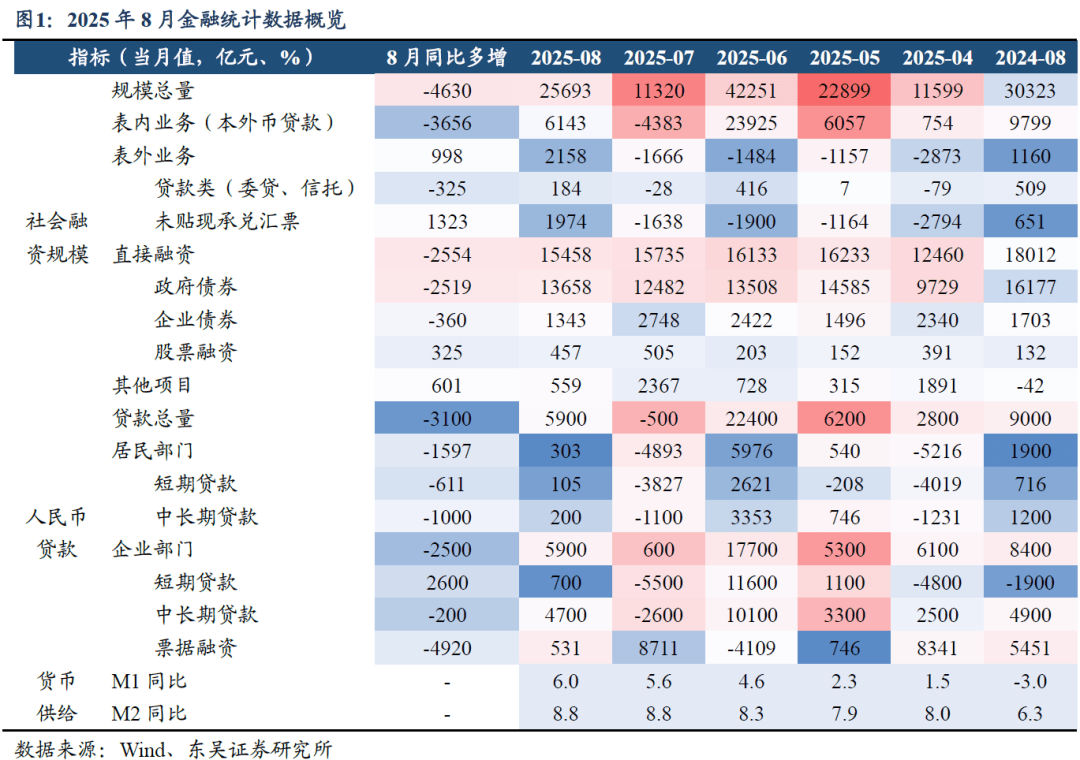
Investment Rating - The report maintains a "Positive" investment rating for the banking industry, indicating an expectation of returns exceeding the market benchmark by more than 5% [9][24]. Core Viewpoints - The growth rate of social financing (社融) has declined for the first time this year, primarily due to weak credit demand and a decrease in government bonds, with August's social financing year-on-year growth at 8.8% and a month-on-month decrease of 0.2 percentage points [9][10]. - The report highlights a significant drop in new loans, with a year-on-year decrease of 3,100 billion yuan in August, reflecting ongoing challenges in the credit market [14][20]. - M1 growth shows a trend of improvement, with a year-on-year increase of 6.0% in August, although non-bank deposits have cooled compared to previous months [20][21]. Summary by Sections Social Financing and Credit - In August 2025, social financing increased by 1.16 trillion yuan, which was higher than market expectations, but still represented a year-on-year decrease of 4,630 billion yuan [9][10]. - The report notes that the decline in social financing is largely driven by a reduction in both corporate loans and government bonds, with corporate direct financing also seeing a slight decrease [11][12]. Loan Dynamics - Total RMB loans grew by 6.8% year-on-year in August, with new loans amounting to 590 billion yuan, slightly above expectations but still reflecting a year-on-year decrease [14][15]. - The report identifies a "seesaw" effect between short-term corporate loans and bill discounting, indicating a strategic shift in bank lending practices [15][16]. Deposit Trends - In August, M1 and M2 growth rates were 6.0% and 8.8% respectively, with a narrowing gap between the two [20][21]. - New RMB deposits totaled 2.06 trillion yuan, with a year-on-year decrease of 1,600 billion yuan, indicating a shift in deposit behavior among residents and enterprises [22][23]. Investment Recommendations - The report suggests focusing on two main investment themes: high-dividend stocks due to insurance rate adjustments and fundamentally strong small to medium-sized banks [24]. - Specific stock recommendations include China Construction Bank, Industrial and Commercial Bank of China, and others, with some rated as "Buy" [24].
芦哲:M2增速或见顶——2025年8月金融数据点评
Sou Hu Cai Jing· 2025-09-14 08:07
Core Viewpoint - In August 2025, the People's Bank of China reported a new social financing scale of 2.57 trillion yuan, a year-on-year decrease of 463 billion yuan, with the total social financing stock growth rate falling to 8.8% [1][2] Social Financing - The new social financing in August 2025 was 2.57 trillion yuan, which is 463 billion yuan less than the same month last year, marking a decline in growth rate [1] - Government bond financing in August was 1.37 trillion yuan, down 251.9 billion yuan year-on-year, indicating a seasonal decrease in government bond issuance [5] - The total amount of new loans from financial institutions was 590 billion yuan, a decrease of 310 billion yuan year-on-year, reflecting weak effective demand [4][6] Loan Issuance - The new RMB loans in August amounted to 590 billion yuan, which is 310 billion yuan less than the previous year, with a year-on-year growth rate of 6.80% [4][6] - Short-term loans for enterprises increased by 700 billion yuan, showing a recovery in short-term financing demand [6] - The issuance of corporate bonds was 1.34 trillion yuan, down 360 billion yuan year-on-year, while stock financing increased by 457 billion yuan, indicating a rise in market activity [4][5] Monetary Supply - As of the end of August 2025, M2 growth rate remained stable at 8.8%, while M1 grew by 6.0%, reflecting a narrowing gap between M2 and M1 [2][7] - The total new RMB deposits in August were 2.06 trillion yuan, a decrease of 1.6 trillion yuan year-on-year, with significant shifts in deposit structures [2][7] - The government bond financing is a key factor in maintaining the synchronization of M2 and social financing growth rates, but a slowdown in government bond issuance may lead to a peak in M2 growth [7][8] Financial Data Outlook - The next four months may see an improvement in direct financing due to an active stock market, with policies aimed at boosting consumer loans and corporate financing potentially leading to a seasonal increase in loan financing [8]

2025年8月金融数据点评:如何解读8月金融数据?
Hua Yuan Zheng Quan· 2025-09-14 03:14
Group 1: Report Industry Investment Rating - The report is bullish on the bond market in the short - term [2] Group 2: Report's Core View - In August 2025, new loans increased significantly less year - on - year, and credit demand remained weak. The mortgage prepayment pressure may rise, and credit demand may be weak in the long - term. In September, banks may boost loan balance data through ultra - short - term loans, and new loans in October may be very low [2] - In recent years, individuals have deleveraged while enterprises have increased leverage, leading to rising corporate debt pressure. Personal consumption is sluggish, and corporate profitability is worrying [2] - In August, the M2 growth rate was flat month - on - month, and the M1 growth rate rebounded month - on - month. It is expected that the M1 growth rate will decline in the fourth quarter [2] - The social financing growth rate may have reached a stage peak. It is expected that new loans will increase less year - on - year in 2025, government bond net financing will expand significantly year - on - year, and the social financing growth rate may rise first and then fall, reaching about 8.1% at the end of the year [2] - The 10 - year government bond may have allocation value for bank self - operations. It is expected that the yield of the 10 - year Treasury bond will be between 1.6% - 1.8% in the second half of the year [2] Group 3: Summary by Related Catalog Credit Data - On September 12, 2025, the central bank disclosed that in August, new loans were 59 billion yuan, and social financing was 2.57 trillion yuan. At the end of August, M2 reached 332.0 trillion yuan, a year - on - year increase of 8.8%; M1 increased by 6.0% year - on - year; the social financing growth rate was 8.8% [1] - In August, new loans increased 31 billion yuan less year - on - year. Personal loans increased 3.03 billion yuan, including 1.05 billion yuan in short - term personal loans and 2 billion yuan in medium - and long - term personal loans, a significant year - on - year decrease. Corporate short - term loans increased 7 billion yuan, corporate medium - and long - term loans increased 47 billion yuan, and bill financing increased 5.31 billion yuan [2] Leverage and Financial Situation - As of the end of August 2025, the ratio of personal loans to deposit balances was only 52.7%, a decrease of 17.6 percentage points compared with the end of May 2022. Since 2021, the difference between personal deposits and loans has increased significantly, while that of corporate has decreased significantly [2] Monetary Supply - The central bank has used the new M1 caliber since January 2025. As of the end of August 2025, the new M1 balance was 111.2 trillion yuan, a decrease of 76.9 billion yuan from the beginning of the year. The M2 growth rate in August was 8.8%, flat month - on - month [2] Social Financing - In August, the social financing increment was 2.57 trillion yuan, a year - on - year decrease of 0.46 trillion yuan. The decrease mainly came from credit and government bond net financing. The social financing growth rate at the end of August was 8.8%, a decrease of 0.2 percentage points from the end of the previous month [2] - It is predicted that in 2025, social financing will be 34.6909 trillion yuan, with new loans of 16.28 trillion yuan, a decrease of 76.95 billion yuan year - on - year; government bond net financing of 13.77 trillion yuan, an increase of 247.46 billion yuan year - on - year [22]
8月物价数据解读:CPI低位承压 PPI低点已过
Yin He Zheng Quan· 2025-09-10 11:19
Group 1: CPI Analysis - In August, the CPI remained flat month-on-month (previous value 0.4%) and decreased year-on-year to -0.4%, compared to a five-year average of 0.3% for the same period[2] - Food prices increased by 0.5% month-on-month (previous value -0.2%) but decreased by 4.3% year-on-year, with the decline expanding by 2.7 percentage points from the previous month[4] - Core CPI remained flat month-on-month and increased by 0.9% year-on-year, marking the fourth consecutive month of growth[4] Group 2: PPI Insights - The PPI turned flat month-on-month (previous value -0.2%), ending an eight-month downward trend, with the year-on-year decline narrowing to -2.9% (previous value -3.6%) for the first time since March[20] - Production demand improvements supported price increases in some energy and raw material sectors, with the PMI production index rising to 50.8% (previous value 50.5%) in August[21] - The prices of coal processing rose by 9.7% month-on-month, while black metal smelting prices increased by 1.9%[21] Group 3: Food Price Trends - Pork prices decreased by 0.5% month-on-month (previous value 0.9%), significantly lower than the five-year average increase of 4.1%[7] - Egg prices rose by 1.5% month-on-month (previous value -0.3%), below the seasonal average increase of 5.9% over the past five years[7] - Fresh vegetable prices increased by 8.5% month-on-month (previous value 1.3%), while fresh fruit prices decreased by 2.8%[7] Group 4: Consumer Behavior and Market Outlook - Consumer confidence remains weak, with limited recovery potential for core CPI, as internal consumption dynamics are sluggish[26] - The agricultural sector is expected to stabilize pork prices, but supply pressures remain significant due to ongoing production adjustments[26] - Risks include potential delays in policy implementation and slower-than-expected recovery in consumer confidence[33]
8月物价数据解读:CPI低位承压,PPI低点已过
Yin He Zheng Quan· 2025-09-10 09:35
Group 1: CPI Analysis - In August, the CPI remained flat month-on-month (previous value 0.4%) and decreased year-on-year to -0.4%, compared to a five-year average of 0.3% for the same period[2] - Food prices increased by 0.5% month-on-month (previous value -0.2%) but decreased by 4.3% year-on-year, with a drop impact on CPI increasing by approximately 0.51 percentage points[4] - Core CPI rose by 0.9% year-on-year, marking a 0.1 percentage point increase from the previous month, with jewelry prices significantly contributing to this rise[12] Group 2: PPI Insights - The PPI turned flat month-on-month (previous value -0.2%) after eight consecutive months of decline, with the year-on-year drop narrowing to -2.9% from -3.6%[20] - Production demand improvements supported price increases in some energy and raw material sectors, with the PMI production index at 50.8%[21] - M1 growth has been rising, which is expected to support PPI improvements, although the real estate market remains weak, impacting overall investment[28] Group 3: Food Price Trends - Pork prices decreased by 0.5% month-on-month (previous value 0.9%), significantly lower than the five-year average increase of 4.1%[7] - Egg prices increased by 1.5% month-on-month (previous value -0.3%), but this is below the seasonal average increase of 5.9%[7] - Fresh vegetable prices rose by 8.5% month-on-month (previous value 1.3%) due to seasonal factors, while fresh fruit prices fell by 2.8%[8] Group 4: Consumer Behavior and Market Outlook - Consumer confidence remains weak, impacting core CPI recovery potential, with challenges from oversupply and weak demand growth[26] - The government's efforts to regulate low-price competition are expected to help PPI rebound, but the transmission effect to CPI remains uncertain[28] - Risks include potential delays in policy implementation and slower-than-expected recovery in consumer confidence[33]
风险偏好难回落,债市仍处逆风期
Dong Zheng Qi Huo· 2025-09-07 08:14
Report Industry Investment Rating - The rating for treasury bonds is "oscillation" [4] Core Viewpoints - Next week, most fundamental data is expected to be weak, but the M1 growth rate may continue to rise, and the market is relatively insensitive to fundamental data. The bond market in Q3 has seasonal patterns, with adjustment pressure increasing in the middle and late months. The decline in constraints on domestic incremental policies after the Fed's rate cut and the potential for an anti - involution market may suppress bond market sentiment. It is recommended to take a bearish approach to the bond market next week, continue to focus on short - hedging strategies, and consider steepening the yield curve strategies [2] Summary by Directory 1. One - Week Review and Views 1.1 This Week's Trend Review - From September 1st to September 7th, treasury bond futures oscillated. On Monday, the bond market strengthened; on Tuesday, both stocks and bonds declined; on Wednesday, the bond market first rose and then the gains narrowed; on Thursday, the bond market rose due to the stock market decline; on Friday, the bond market fell sharply. As of September 5th, the settlement prices of the 2 - year, 5 - year, 10 - year, and 30 - year treasury bond futures main contracts were 102.388, 105.580, 107.920, and 116.300 yuan respectively, with changes of - 0.032, + 0.065, + 0.100, and - 0.260 yuan compared to last weekend [9] 1.2 Next Week's View - The bond market is expected to be weak next week. Fundamental data is concentrated, but the market is insensitive to it. The M1 growth rate may rise, and the risk appetite may increase. The approaching tax period will lead to marginal tightening of the capital side. The Fed's rate - cut expectation and the potential anti - involution market may suppress bond market sentiment. It is recommended to take a bearish approach, focus on short - hedging strategies, and consider steepening the yield curve strategies [2][11][12] 2. Weekly Observation of Interest - Bearing Bonds 2.1 Primary Market - This week, 39 interest - bearing bonds were issued, with a total issuance of 5629.61 billion yuan and a net financing of 3170.39 billion yuan. The net financing of treasury bonds increased, while that of local government bonds decreased, and that of inter - bank certificates of deposit increased [18] 2.2 Secondary Market - As of September 5th, the yields of 2 - year, 5 - year, 10 - year, and 30 - year treasury bonds showed a differentiated trend. The 10Y - 1Y and 30Y - 10Y spreads narrowed, while the 10Y - 5Y spread widened. The implied tax rate increased [22] 3. Treasury Bond Futures 3.1 Price, Trading Volume, and Position - As of September 5th, the settlement prices of the 2 - year, 5 - year, 10 - year, and 30 - year treasury bond futures main contracts changed compared to last weekend. The trading volumes and positions of each contract decreased compared to last weekend [32][35] 3.2 Basis and IRR - This week, the opportunity for cash - and - carry arbitrage was not obvious. The basis of treasury bond futures generally oscillated narrowly, and the IRR of the CTD bonds of each main contract was between 1.4% - 1.8%. The basis and IRR of TL fluctuated greatly, but trading opportunities were difficult to grasp [39] 3.3 Inter - period and Inter - variety Spreads - As of September 5th, the inter - period spreads of the 2 - year, 5 - year, 10 - year, and 30 - year treasury bond futures 2509 - 2512 contracts changed compared to last weekend [43] 4. Weekly Observation of the Capital Side - This week, the central bank's open - market reverse repurchase had a net withdrawal of 12047 billion yuan. The R007, DR007, SHIBOR overnight, and SHIBOR 1 - week rates all decreased. The average daily trading volume of inter - bank pledged repurchase increased, and the overnight proportion was slightly higher than last week [48][51][53] 5. Weekly Overseas Observation - The US dollar index oscillated narrowly, and the yield of the 10Y US treasury bond decreased. As of September 5th, the US dollar index fell 0.11% to 97.7357, and the yield of the 10Y US treasury bond was 4.10%, down 13BP from last weekend. The 8 - month non - farm payrolls data exceeded expectations, strengthening the rate - cut expectation [59] 6. Weekly Observation of High - Frequency Inflation Data - This week, industrial product prices fell, and agricultural product prices showed mixed trends. As of September 5th, the South China industrial product index, metal index, and energy and chemical index decreased, while the prices of pork, 28 key vegetables, and 7 key fruits changed differently compared to last weekend [62] 7. Investment Suggestions - The bond market is expected to be weakly oscillating. It is recommended to take a bearish approach [63]