
滞胀

Search documents
金融压力或是美联储“转鸽”的主要矛盾
2025-05-13 15:19
Summary of Conference Call Records Industry or Company Involved - The discussion primarily revolves around the Federal Reserve's monetary policy decisions and the implications of financial pressure on the U.S. economy. Core Points and Arguments - Current U.S. economy may be in a state of stagflation, with upcoming CPI data and Q2 results likely leaning towards inflation, indicating significant financial pressure that could influence Federal Reserve decisions [1][2] - Financial pressure index is a crucial measure of financing conditions, default risk, and risk appetite, impacting economic conditions through short-term interest rates affecting long-term rates, which is a key focus for the Federal Reserve [1][3] - Financial market volatility can deteriorate consumer spending willingness, and tightening financial conditions may affect manufacturing investment [1][4] - Historical events over the past decade, such as China's economic slowdown and unexpected rate hikes by the Federal Reserve, have led to increased financial pressure, prompting a dovish shift in policy [1][5][6][7][8] - The Federal Reserve is expected to consider rate cuts in July, October, and December, with a higher probability of a cut in July, influenced by stock market pressures or issues with real interest rates [1][11] Other Important but Possibly Overlooked Content - The impact of tariffs on inflation is often temporary, and the Federal Reserve is likely to focus more on economic downturn risks rather than inflationary pressures [1][4] - The financial pressure index reflects the overall economic stability, and its increase has historically signaled a shift towards dovish policies by the Federal Reserve [1][9] - The Federal Reserve's past policy adjustments, including a significant rate hike in 2018 that led to a 20% drop in the stock market, illustrate the delicate balance between monetary policy and market stability [1][10] - Future predictions for 2025 suggest a shift from stagflation risks to economic weakness risks, with potential rate cuts anticipated based on market conditions and economic data [1][11][12]
惊现20年来最大外资买入潮!万亿资金“抛弃”美国狂涌日本
Jin Shi Shu Ju· 2025-05-13 12:33
Group 1 - The core viewpoint of the articles highlights a record influx of foreign investment into Japanese stocks and bonds in April, driven by the aftermath of U.S. President Trump's tariff policies, positioning Japan as a global safe haven for "de-dollarization" trades [1][2] - In April, foreign investors net purchased 8.2 trillion yen (approximately 57 billion USD) in Japanese securities, marking the largest monthly buying spree since 2005 and more than three times the average for April over the past 20 years [1] - The unprecedented buying frenzy included net purchases of 25.5 billion USD in Japanese stocks (the largest amount since April 2023) and net purchases of 31.5 billion USD in Japanese long-term bonds (the largest scale since July 2022) [1] Group 2 - The surge in Japanese asset purchases occurred against a backdrop of global investor concerns regarding U.S. policy shifts, trade wars, and Trump's criticism of Federal Reserve Chairman Powell, suggesting a potential influence of de-dollarization trends [2] - There are indications that foreign central banks may be entering the Japanese bond market as part of diversification strategies, seeking liquid markets, with Japan standing out in this regard [2] - A recent survey by Bank of America indicated that fund managers almost unanimously believe Trump's economic policies could lead the U.S. into stagflation, with shorting the dollar becoming a popular trade among them [2]
美国银行调查显示,对滞胀的担忧略有缓解
news flash· 2025-05-13 12:24
金十数据5月13日讯,美国银行对全球基金经理的调查显示,5月份,人们对全球经济增长停滞、通胀上 升(即"滞胀")的感知风险略有缓解。调查显示,81%的投资者预计未来12个月将出现滞胀。相比之 下,4月份的调查结果为90%,是2022年11月以来的最高水平。最新的调查还显示,9%的人预计经济将 停滞不前,或者增长和通胀将低于趋势水平。约3%的人预计经济增长和通货膨胀都将高于趋势水平, 而3%的人预计经济增长强劲、通货膨胀率低的"金发姑娘"局面将出现。 美国银行调查显示,对滞胀的担忧略有缓解 ...

美银月度机构调研:“做多黄金”仍是最拥挤的交易,美元配置降至2006年以来最低
华尔街见闻· 2025-05-13 11:53
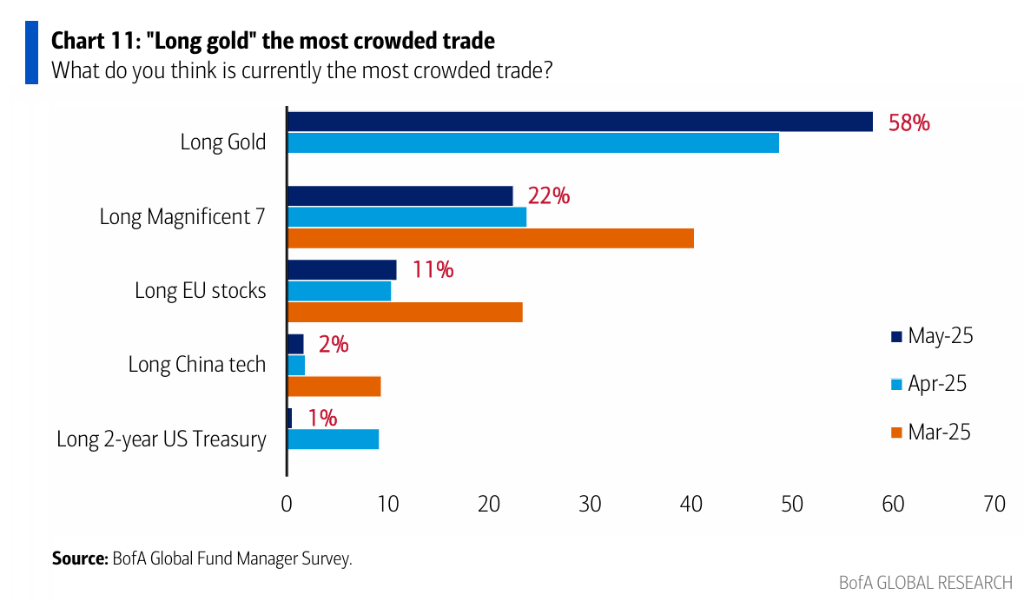
Core Insights - The sentiment towards U.S. assets is cautious, with "long gold" being the most crowded trade for the second consecutive month, as 58% of investors believe it is the current most crowded trade [1][3] - Investors' attitudes towards the U.S. dollar have significantly changed, with 57% considering it overvalued, marking the lowest allocation to the dollar since May 2006 [1][7][12] - Despite a slight improvement in global economic outlook, 81% of investors still expect the economy to enter "stagflation" [2][11] Investor Sentiment - 62% of investors view tariffs as the biggest tail risk for a global recession, while 43% believe tariffs could lead to systemic credit events [2][18] - Cash levels among investors have decreased from 4.8% to 4.5%, slightly below the long-term average of 4.7% since 1999 [14] - 61% of investors now expect a "soft landing" for the global economy, a significant increase from 37% in April [14] Asset Allocation Changes - There is a notable shift in asset allocation, with a net 38% of investors underweighting U.S. stocks, the lowest level since May 2023 [23] - European stocks have seen a 13 percentage point increase in allocation to a net 35% overweight, reversing the decline from April [23] - Technology stocks have experienced a significant 17 percentage point increase in allocation, the largest monthly gain since March 2013 [23] - Energy stocks are now at a net 35% underweight, marking a historical low [23] Economic Outlook - A net 59% of investors expect the economy to weaken, showing the largest monthly improvement since October 2024, despite a 66 percentage point drop from the peak in December 2024 [16] - 46% of investors anticipate two interest rate cuts from the Federal Reserve this year, while 25% expect three cuts [19]

美银月度调研:“做多黄金”仍是最拥挤的交易,美元配置降至2006年以来最低
Hua Er Jie Jian Wen· 2025-05-13 09:52
Group 1 - "Long gold" has become the most crowded trade for the second consecutive month, with 58% of investors considering it the current most crowded trade, significantly higher than the second-ranked "long tech giants" at 22% [2] - Gold is viewed as the most overvalued asset since 2008, with a net 45% of investors believing it is overvalued, an increase from 34% in April [5] - Investor sentiment towards the US dollar has shifted significantly, with a net 17% of investors holding a low allocation stance, marking a 19-year low since May 2006 [8] Group 2 - A net 57% of investors believe the US dollar is overvalued, a decrease of 12 percentage points from the previous month, representing the largest monthly decline since September 2023 [11] - Despite a slight improvement in global investor sentiment, it remains at a pessimistic level, with 61% of investors expecting a "soft landing" for the global economy, up from 37% in April [16] - A net 59% of investors expect the economy to weaken, showing the largest monthly improvement since October 2024, although expectations are still down 66 percentage points from the peak in December 2024 [19] Group 3 - 62% of investors view tariffs as the biggest tail risk for a global recession, with 43% believing tariffs could lead to a systemic credit event, followed by the US shadow banking system at 25% [21] - Investors are significantly adjusting their asset allocations, with a net 38% underweight in US stocks, the lowest level since May 2023, while eurozone stock allocation increased by 13 percentage points to a net 35% overweight [26] - There has been a substantial increase in tech stock allocation by 17 percentage points, marking the largest monthly increase since March 2013, while energy stock allocation has dropped to a net 35% underweight, the lowest on record [26]
美债收益仍处高位,上海金ETF(159830)小幅调整,机构:滞胀风险+利率缓慢下移构成金价中期利多方向
2 1 Shi Ji Jing Ji Bao Dao· 2025-05-13 02:27
Group 1 - The gold sector experienced a slight adjustment, with the Shanghai Gold ETF (159830) down 1.76% and trading volume exceeding 130 million yuan [1] - The Shanghai Gold ETF closely tracks Shanghai Gold (SHAU.SGE) and has lower management and custody fees compared to similar products, with a management fee of 0.25% and a custody fee of 0.05% [1] - Short-term pressure on gold prices is attributed to the decline in interest rate expectations, while medium to long-term outlook remains positive due to high real yields on 10-year U.S. Treasuries and a trend towards stagflation in the U.S. economy [1] Group 2 - Northeast Securities noted that the Federal Reserve decided to maintain the federal funds rate, with Chairman Powell emphasizing a wait-and-see approach, leading to a reduction in short-term rate cut expectations [2] - The market's reaction to the Fed's stance has resulted in upward pressure on U.S. Treasury yields and the dollar, which in turn affects gold prices, although the overall outlook for gold remains favorable [2] - The similarities in gold price movements between this year and last year suggest a need for a cooling-off period after rapid trading adjustments, with a focus on patience and confidence in the medium-term bullish direction for gold prices due to stagflation risks and gradual interest rate declines [2]
《大国博弈》系列第八十五篇:以斗争求合作,中方打到美方筹码底线
EBSCN· 2025-05-13 01:40
2025 年 5 月 12 日 总量研究 以斗争求合作,中方打到美方筹码底线 ——《大国博弈》系列第八十五篇 作者 分析师:高瑞东 执业证书编号:S0930520120002 010-56513108 gaoruidong@ebscn.com 分析师:赵格格 执业证书编号:S0930521010001 0755-23946159 zhaogege@ebscn.com 相关研报 中美会晤前哨观察:特朗普的交易底线—— 《大国博弈》系列第八十四篇(2025-05- 10) 中美关税第二轮,双方在如何出牌?—— 《大国博弈》系列第七十九篇(2025-03- 05) 从减税视角出发,特朗普后续关税力度几 何?——《大国博弈》系列第七十八篇 (2025-02-20) 如何看待美中加墨本轮关税交锋?——《大 国博弈》系列第七十七篇(2025-02-06) 野心与现实:特朗普首日新政评述——《大 国博弈》系列第七十六篇(2025-01-21) 要点 核心观点: 在中国的示范下,越来越多的国家意识到,与美谈判"以斗争求合作则合作存,以 妥协求合作则合作亡","美 X 谈判"进展缓慢,对美国经济、市场和特朗普选盘 逐步造成实质 ...
美国4月CPI,是否印证鲍威尔对滞胀的担忧?点击参与CPI公布后金价竞猜,赢红包大奖
news flash· 2025-05-13 01:25
美国4月CPI,是否印证鲍威尔对滞胀的担忧?点击参与CPI公布后金价竞猜,赢红包大奖 相关链接 CPI公布日,竞猜赢大奖 ...
贸易紧张情绪持续缓和,黄金高位承压回落
Dong Hai Qi Huo· 2025-05-12 14:36
1. Report Industry Investment Rating No relevant information provided. 2. Core Viewpoints of the Report - The precious metals market maintained a volatile pattern this week amidst the divergence of macro - data and policy games. Gold may face short - term pressure due to the re - pricing of the Fed's policy path, the delay of interest - rate cut expectations, and the easing of risk - aversion sentiment. However, the weakening of the US dollar's credit and the global de - dollarization trend provide structural support for the gold price. If it corrects to the next integer level, a long - term position can be established using the ratio spread structure. [5] - The global silver market is expected to have a shortage of 149 million ounces in 2025. The demand for silver will continue to grow with the development of new energy, photovoltaic, and electronics, while the supply is relatively limited, supporting the long - term upward trend of silver prices. [4] 3. Summary by Relevant Catalogs 3.1 Currency Attribute - The US dollar index showed a "first decline then rise" volatile pattern this week. It initially fell below 100 due to tariff uncertainties, then regained momentum after the UK - US trade agreement and the Fed's hawkish signal. The continuous easing of trade tensions pushed the US dollar to stand firm above 100. However, the market is vigilant about the lagged impact of tariff policies. In the short term, attention should be paid to the verification of the "secondary inflation" expectation by relevant data, while in the long - term, debt expansion and the de - dollarization trend still exert downward pressure. [3] 3.2 Financial Attribute - The Fed's May FOMC meeting kept the federal funds rate in the target range of 4.25% - 4.5%. Chairman Powell sent a hawkish signal, emphasizing the risk of "simultaneous increase in inflation and unemployment rate" in the coming months due to rising tariff rates. The probability of an interest - rate cut in June dropped to 19.8%, and in July to 59.1%. [3] - The 1 - year US Treasury yield rose slightly to 4.05%, and the 10 - year US Treasury yield increased by 4 basis points to 4.37%. The 10 - year real yield of US Treasuries rose from 2.06% to 2.08%, a total increase of 2 basis points. The yield spread between the 10 - year and 2 - year US Treasuries narrowed slightly to 0.49%. [21] 3.3 Commodity Attribute - As of the week of May 9, 2025, the gold SPDR holdings were 937.94 (unit not specified), slightly lower than the previous week. The silver SLV holdings were 14,020.96 tons, an increase of 11.19 tons from the previous week. [3] - China's central bank has increased its gold holdings for six consecutive months. In April 2025, China's official gold reserves were 73.77 million ounces, an increase of 70,000 ounces from the end of the previous month. It is expected that the funds from central banks around the world will maintain a net inflow. [43] 3.4 Macro - financial - The US ISM manufacturing PMI in April was 48.7%, higher than the expected 48.0% but lower than the previous value of 49.0%. Key sub - items showed "stagflation" characteristics. New export orders dropped by 6.5 percentage points to 43.1%, the lowest since May 2020, and the output sub - item dropped from 48.3 to 44, indicating that trade barriers are affecting entrepreneurs' confidence. [4] - The US ISM services PMI in April was 51.6, higher than the expected 50.3 and the previous value of 50.8, the highest since January 2023. The price sub - index reached 65.1, the highest since January 2023, reflecting a significant increase in raw material costs due to tariff hikes. [28] 3.5 Supply - demand Situation - The global silver market has been in shortage for five consecutive years, with an expected shortage of 149 million ounces in 2025. The supply is limited due to limited mine production and recycled silver accounting for only 20% of the supply, while the demand for silver will continue to grow with the development of new energy, photovoltaic, and electronics. [4] 3.6 Operation Suggestions - For gold, if it corrects to the lower integer pressure level, a long - term position can be established through the option ratio spread structure. [3] - For silver, considering its recent resistance, when the gold - silver ratio's value center continues to rise and the silver price is at the upper edge of the box range, a collar structure can be used to hedge against the callback risk. If it fully corrects, long positions can be gradually established in batches. [4]
直击华尔街|专访Spartan Capital Securities首席市场经济学家Peter Cardillo: 美国经济或已陷“轻度衰退”,美联储年内料降息一至两次
Sou Hu Cai Jing· 2025-05-12 12:31
Group 1: Federal Reserve and Economic Outlook - The Federal Reserve has maintained interest rates for the third consecutive time, with Chairman Powell emphasizing the uncertainty surrounding trade policies and their economic impact [1][2] - Powell mentioned that the potential for increased tariffs could lead to rising inflation, slower economic growth, and higher unemployment rates [1] - Economic indicators show mixed results, with signs of a mild recession emerging, as both manufacturing and services PMI indices are declining [10][11] Group 2: Technology Sector Performance - Despite macroeconomic volatility, major tech companies have shown structural strengths, with six out of the "Seven Giants" exceeding earnings expectations by an average of 16% [2] - Companies like Google and Microsoft reaffirmed their AI spending plans, while Amazon reported a three-digit year-on-year revenue growth in its AI business [2] Group 3: Trade Agreements and Market Reactions - The recent trade agreement between the UK and the US is seen as a positive development, marking the first new trade deal announced by the US [5][6] - The market is expected to respond favorably to such agreements, although significant challenges remain with other key countries [6] Group 4: Investment Trends and Asset Classes - Investors are advised to focus on various asset classes, including bond yields, dollar trends, and gold prices, as these will influence market dynamics [14] - The dollar index is stabilizing around the 100 mark, with expectations of continued fluctuations in the coming months [16]