
即时零售

Search documents
三场硬仗,阿里进击
36氪· 2025-11-25 15:17
阿里 正在 用史无前例的投入 构建 明天。 阿里迎来了一个多项指标超出预期的财季。 集团整体营收达 2478 亿元,剔除高鑫零售和银泰后,同比增长 15% ,超出市场预期。云业务增长强劲,同比增速高达 34% ,大幅超出市场预期。中 国电商 集团 收入同比增长也达到 16% 。 财报发布后,阿里美股盘前涨超 3% 。受多项 AI 相关市场消息刺激,财报发布的前 2 天,阿里股价一直呈上涨趋势。 市场持续对阿里 AI 进展的高度关注之下,财报会上,阿里 CEO 吴泳铭还首次强调了新的 AI 战略:阿里正在 AI to B 和 AI to C 两大方向齐发力—— 在 AI to B 领域,做世界领先的全栈 AI 服务商,服务千行百业不断增长的 AI 需求;在 AI to C 领域,基于性能领先的 AI 模型和阿里生态优势,打造面 向 C 端用户的 AI 超级原生应用,推动 AI 从千行百业到人人可用。 他进一步解释称: "这 将激发核心业务 产生 更大 的 协同效应, 成为驱动阿里持续增长、迈向新高度的动能引擎。 " 财报会上,吴泳铭还透露,目前看来, AI 服务器上架速度跟不上客户订单的增长,不排除进一步增投的 ...


全文|阿里巴巴业绩会实录:未来三年内不太可能出现人工智能泡沫
Xin Lang Ke Ji· 2025-11-25 15:00
Core Viewpoint - Alibaba reported its Q2 FY2026 earnings with revenue of 247.8 billion yuan, a 5% year-over-year increase, and a net profit of 20.6 billion yuan, down 53% year-over-year, primarily due to a decline in operating profit [1][2]. Financial Performance - Revenue for Q2 FY2026 was 247.8 billion yuan, with a 5% year-over-year growth. Excluding disposed businesses, the year-over-year growth would be 15% [1]. - Net profit was 20.6 billion yuan, reflecting a 53% decline year-over-year. Adjusted net profit was 10.4 billion yuan, down 72% year-over-year [1][2]. Cloud Business Outlook - The management expressed strong confidence in the growth potential of Alibaba Cloud, citing high demand for AI servers that exceeds supply. The backlog of orders continues to grow, indicating a sustained acceleration in future growth [3]. Instant Retail Business Developments - The company has focused on optimizing unit economics in its instant retail business, achieving significant progress. The average order value has increased, and logistics costs have decreased, leading to a reduction in losses per order by half compared to previous months [4][5]. - Instant retail has shown rapid growth, particularly in food and health categories, with a 30% increase in orders from brands like Hema and Cat Supermarket since August [5]. EBITDA and CMR Insights - The EBITDA for the September quarter is expected to be a peak due to prior investments. Future quarters may see reduced investments as operational efficiency improves [6]. - The core e-commerce business's customer management revenue (CMR) is influenced by payment fees and promotional costs, with expected slower growth in the next quarter due to the recent introduction of payment fees [6]. Capital Expenditure Plans - The company has a three-year capital expenditure plan of 380 billion yuan, with 120 billion yuan already invested in the past four quarters. Management may increase investments if demand continues to outpace supply [8][9]. - The return on investment for capital expenditures remains uncertain due to the evolving nature of the AI industry, but long-term demand growth is expected to support investment returns [9][11]. Strategic Focus Areas - Alibaba is prioritizing the enhancement of its AI infrastructure and model capabilities to meet customer demands. The focus includes improving the efficiency of AI resource utilization and expanding high-value application scenarios [10][11]. - The company is also exploring potential growth in other consumer sectors, including offline retail and travel services, while emphasizing the importance of business integration and collaboration [12].
即时零售拖累利润 阿里猛攻美团值得吗
Bei Jing Shang Bao· 2025-11-25 14:48
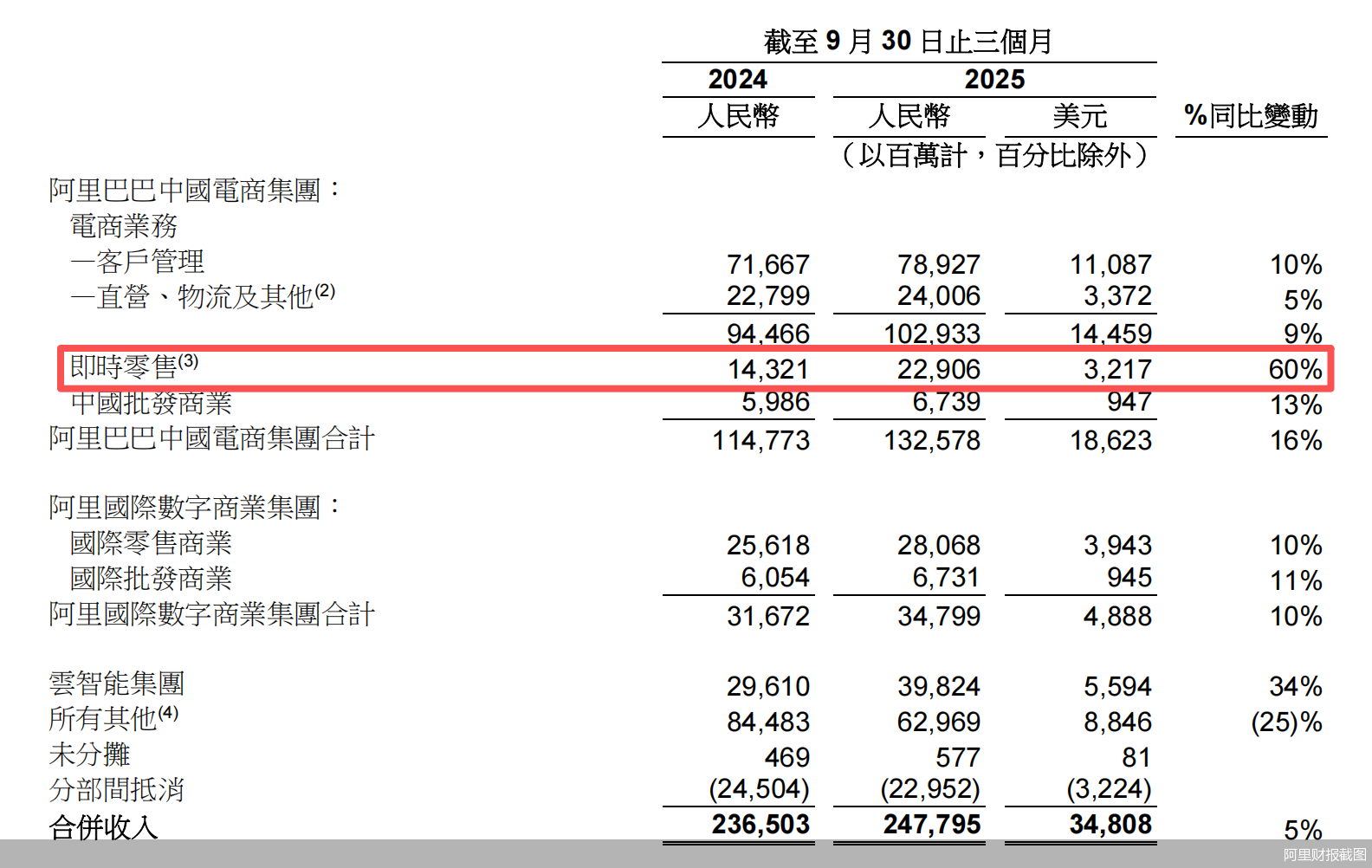
11月25日晚间,阿里发布2026财年第二季度(即自然年2025年三季度)财报,即时零售与云业务成了拉动阿里的两驾"马车"。其中,即时零售业务以六成收 入增速撑起了阿里国内电商大盘的增长。当然,阿里的利润表现也付出了代价,经营利润下滑超过八成。 今年以来,阿里与京东、美团在本地生活战场鏖战半年多。尽管战役投入巨大,但各家似乎都没有收手的意愿。很显然,巨头在意的不是短期的利润得失, 而是电商新叙事的可持续性。 即时零售一跃成为阿里电商攻势最猛的业务。2026财年第二季度,阿里即时零售业务收入达229亿元,同比增长60%,增速首次超过国际电商业务。阿里认 为,这主要是得益于今年4月底上线的淘宝闪购带来的订单增长。 阿里国内电商的客户管理收入、批发业务增速则与上一季度的增速保持了一致。其中,客户管理收入同比增长10%,为789.3亿元。而批发业务收入同比增 长13%。这也意味着,本季度阿里国内电商大盘收入能同比增长16%,还是得益于即时零售的显著拉动作用。 | | | 截至9月 30 日 | | --- | --- | --- | | | 2024 | | | | 人民幣 | 人民幣 | | | | (以直萬 | ...

阿里巴巴蒋凡:淘宝闪购的第二阶段经济效益优化符合预期
Xin Lang Ke Ji· 2025-11-25 14:36
Core Insights - Alibaba Group reported a 60% year-on-year revenue growth in its instant retail business for the second quarter of fiscal year 2026, ending September 30, 2025 [1] - The improvement in unit economics for instant retail is attributed to enhanced logistics efficiency, high customer retention rates, and increased average order value [1] - Approximately 3,500 Tmall brands have integrated their offline stores into instant retail as of October 31 [1] Group 1 - The proportion of high-value single orders has increased, with non-tea drink orders rising to over 75% [1] - The average order value for flash sales has increased by more than double digits compared to August [1] - Alibaba's CEO of China e-commerce, Jiang Fan, emphasized the focus on user experience and high-value customer management in the next phase [1] Group 2 - The first phase of rapid scale expansion for Taobao flash sales has been completed, and the second phase is focused on optimizing economic benefits [1] - This optimization aligns with expectations and lays a foundation for the long-term sustainable development of the delivery business [1] - The confidence in long-term investment in instant retail has been bolstered by these developments [1]
阿里财报:AI+云加速增长34%,即时零售增长60%
Guan Cha Zhe Wang· 2025-11-25 14:30
Core Insights - Alibaba Group reported Q2 FY2026 revenue of 247.795 billion yuan, exceeding market expectations, with a 15% year-on-year growth after excluding divested businesses [1] - The company continues to invest in AI and cloud, with strong growth in core businesses, including a 34% year-on-year increase in Alibaba Cloud revenue, reaching a new high [1] - The CEO emphasized the ongoing investment phase to build AI technology and infrastructure, as well as a large consumer platform combining lifestyle services and e-commerce [1] Group 1: AI and Cloud Developments - Alibaba Cloud launched a full-stack AI upgrade during the Cloud Summit, featuring seven new AI models across various fields, with its flagship model Qwen3-Max ranking among the top globally [2] - According to Omdia, Alibaba Cloud is projected to capture 35.8% of the Chinese AI cloud market by mid-2025, surpassing the combined share of the second to fourth competitors [2] - The company has established AI partnerships with notable organizations such as the NBA, Marriott, China UnionPay, and Bosch [2] Group 2: E-commerce and Consumer Engagement - Alibaba's e-commerce customer management revenue grew by 10% year-on-year, with instant retail revenue increasing by 60%, leading to improved unit economics and user retention [2] - Approximately 3,500 Tmall brands have integrated their offline stores into instant retail, resulting in significant growth during the Double 11 shopping festival [3] - The app Gaode achieved a record high of 360 million daily active users in October, reflecting the effectiveness of its new offline service credit system [3]

【西街观察】外卖大战 冷暖自知
Bei Jing Shang Bao· 2025-11-25 14:29
Core Viewpoint - Alibaba's latest financial report reveals a slight revenue increase of 5% year-on-year, but a significant decline in operating profit by 85%, attributed to the fierce competition in the food delivery market and heavy investments in AI infrastructure [1] Group 1: Financial Performance - Alibaba's revenue increased by 5% year-on-year, but operating profit saw a drastic decline of 85% during the reporting period [1] - The food delivery battle has led to substantial cash outflows for Alibaba, despite a 60% increase in instant retail revenue driven by the launch of "Taobao Flash Purchase" [1] Group 2: Market Competition - The food delivery market has seen Alibaba, JD.com, and Meituan all experiencing steady revenue growth, yet net profits have declined by double digits, indicating a stark contrast in performance [1] - The competition intensified in the third quarter, with Alibaba aggressively targeting Meituan, resulting in a surge of daily orders from 100 million to 250 million [1] Group 3: Strategic Insights - Alibaba's strategy involves not just competing in food delivery but also enhancing its overall e-commerce business, integrating retail operations, and creating a competitive edge in the market [2] - JD.com has shifted its focus from food delivery to in-store services, while Meituan has been preparing to expand its offerings beyond food delivery into a broader range of instant retail categories [2] Group 4: Marketing and Consumer Engagement - The intense competition serves as a marketing strategy and a means to enhance competitive capabilities, focusing on operational efficiency, resource integration, and innovative business models [3] - The battle for consumer attention in the food delivery sector is crucial, with companies prioritizing comprehensive strength over mere profitability [3]

商务部研究院:预计2030年我国即时零售规模达2万亿元
Zheng Quan Shi Bao Wang· 2025-11-25 14:17
Core Insights - The report predicts that China's instant retail market will exceed 1 trillion yuan by 2026 and reach 2 trillion yuan by 2030, with an average annual growth rate of 12.6% during the 14th Five-Year Plan period [1][2] Group 1: Market Growth and Trends - Instant retail is characterized by online ordering and offline fulfillment, relying on local retail supply to meet immediate local demand [1] - The industry is transitioning from price-driven competition to user experience-driven competition, entering a phase that emphasizes both efficiency and quality [1] - "Assurance" has emerged as a higher-level certainty and is now a core standard for user experience in instant retail [1] Group 2: Service Standards and Business Sustainability - Major instant retail platforms are enhancing service experiences, delivery fulfillment, and after-sales guarantees, establishing "fast and assured" as the new service benchmark [1] - A high-standard service system centered around "assurance" is crucial for the long-term sustainable operation of instant retail businesses, covering delivery timeliness, product quality, after-sales service, and customer communication [1] Group 3: Economic Impact and Future Development - Instant retail is reshaping the supply chain value chain and digitally transforming traditional commerce, effectively promoting the transformation of the real economy [2] - For large chain supermarkets, instant retail not only expands channels but also drives comprehensive organizational change and digital reconstruction [2] - Traditional small stores and entrepreneurs are innovating localized supply to transition into neighborhood-based instant retail supply stations, finding their place in the new retail landscape [2] - The future of instant retail is expected to feature multi-scenario coverage, AI-driven fulfillment, a combination of goods and services, networked integration, and a focus on green and low-carbon development [2]
【西街观察】外卖大战,冷暖自知
Bei Jing Shang Bao· 2025-11-25 14:16
尽管最新的财报尚未集齐,从上个季度数据已经能清晰看到得失。 横向对比,在外卖大战的帮助下,阿里、京东、美团的营收均稳步攀升,但净利润却双位数下滑,业绩 冰火,冷暖自知。 三季度是外卖大战炮火猛烈的阶段,阿里猛攻美团为主线,三家巨头几个月烧掉数百亿,将外卖行业的 订单峰值从一天1个亿做大到2.5亿。 大力出奇迹。若放在大平台身上,这是聚焦短期目标的合理战术。用巨资补贴冲高任何单一数字,打外 卖战更是立竿见影。 外卖不是新兴行业,自身讲不出新故事。算不上风口,比不了AI,几乎成为电商零售线上最便宜的赛 道,但如今,几个巨头却愿意为了争夺几杯奶茶,打一场最贵的商战。 外卖大战大半年后,阿里交出了利润跳水的业绩答卷。11月25日,阿里最新财报显示,报告期内阿里收 入同比微增5%。但同时,盈利显著承压,公司期内经营利润同比大幅下滑85%。 外卖大战和AI基建投入让阿里付出大笔现金流,但"淘宝闪购"也带动即时零售收入大增60%,淘宝App 月活显著提升。 淘宝闪购4月30日升级上线,在这场近年来最大的商战中,阿里入局越来越深,京东声量渐弱,而美团 一直都在。 京东作为最早的发起方,外卖身影退后,与几个月前高调的闯入者姿态 ...
阿里CEO吴泳铭:至少三年内,AI泡沫是不太存在的
Di Yi Cai Jing· 2025-11-25 14:06
Core Insights - Alibaba's flash purchase business is expected to significantly reduce its overall investment in the next quarter, indicating a strategic shift towards improving unit economics and profitability [1][2] - The CEO of Alibaba, Wu Yongming, stated that the AI demand remains strong and that the AI bubble is unlikely to exist for at least the next three years, as supply chain expansions are driven by high demand [4][5] Financial Performance - Alibaba's China e-commerce group's adjusted EBITA fell by 76% year-on-year to 10.497 billion yuan, a decrease of 33.83 billion yuan, primarily due to heavy investments in flash purchases and user experience [1] - The flash purchase business incurred losses exceeding 30 billion yuan in the third quarter, but excluding these losses, the e-commerce group's EBITA showed a modest year-on-year growth in the single digits [1] Strategic Focus - The CEO of Alibaba's China e-commerce division, Jiang Fan, highlighted that the unit economics of instant retail have significantly improved, achieving a 50% reduction in per-order losses compared to July and August [2] - Flash purchases are considered a core strategy for the Taotian platform upgrade, with rapid scale expansion and unit economics optimization laying a foundation for sustainable growth in the delivery business [2] AI Demand and Supply Chain - Wu Yongming emphasized that the demand for AI remains robust, with shortages in global storage manufacturers, CPUs, and AI servers, indicating a production expansion cycle driven by AI demand [4][5] - The company plans to accelerate its supply chain and data center pace in response to current and future AI demand, suggesting that previous infrastructure investment plans may need to be increased [5]
商务部研究院:即时零售行业正处于迈向万亿级规模的关键节点
Xin Jing Bao· 2025-11-25 13:50
Core Insights - The instant retail industry in China is at a critical juncture, moving towards a trillion-yuan scale, with a focus on building a healthy ecosystem as a key measure of high-quality development [1] - The competition in the industry is shifting from price-driven to user experience-driven, marking a new development phase that emphasizes efficiency and quality [1] - Establishing a high-standard service system centered around "assurance" is crucial for sustainable long-term operations for merchants [1] Industry Developments - The "Assured Flash Purchase" plan has expanded to 20 services since its full launch in May, with official return services covering nearly 400,000 merchants across 53 cities [2] - The introduction of AI capabilities has led to a nearly 70% reduction in labor costs for merchants handling after-sales issues [2] - The complaint rate from delivery partners regarding "fulfillment difficulties" has been continuously decreasing [2]