
逆周期调节

Search documents
中国央行15日开展5000亿元买断式逆回购操作
Zhong Guo Xin Wen Wang· 2025-08-14 14:04
Core Viewpoint - The People's Bank of China (PBOC) is conducting a 500 billion yuan reverse repurchase operation to maintain ample liquidity in the banking system, signaling a continuation of supportive monetary policy measures [1] Group 1: Monetary Policy Actions - On August 15, the PBOC will implement a fixed-quantity, interest-rate bidding, multi-price reverse repurchase operation amounting to 500 billion yuan with a term of 182 days [1] - The central bank is expected to continue injecting medium-term liquidity through Medium-term Lending Facility (MLF) and reverse repos, especially during a peak period of government bond issuance [1] Group 2: Market Liquidity Outlook - The overall market liquidity in August is not expected to follow the tightening trend observed since late July, with the sustainability of rising market interest rates needing further observation [1] - Given the relatively strong macroeconomic performance in the first half of the year and uncertainties in external conditions and economic growth momentum in the third quarter, the likelihood of a reserve requirement ratio (RRR) cut or resuming government bond trading in the short term is low [1]
7月社融数据超预期增长9%,"一石多鸟"政策效应加快显现
Shang Hai Zheng Quan Bao· 2025-08-13 20:26
Core Viewpoint - The central bank's data indicates that as of the end of July, social financing scale, broad money (M2), and RMB loans grew by 9%, 8.8%, and 6.9% year-on-year, respectively, continuing to outpace economic growth [1][4]. Group 1: Credit Growth Analysis - In July, credit growth slowed due to multiple factors including seasonal effects, local government debt swaps, and financial institutions reducing excessive competition, leading to a decrease in the loan growth rate to 6.9%, down from 8.7% the previous year [2][3]. - July is traditionally a low month for credit, as June often sees higher lending due to banks' performance assessments and businesses' cash flow needs [2][3]. - The impact of local government debt swaps on loan data remains significant, with estimates suggesting that these swaps have influenced loan growth by approximately 2.6 trillion yuan [3]. Group 2: Monetary Policy and Financing Environment - The high growth rates of social financing scale and M2 reflect a moderately loose monetary policy, providing a suitable financial environment for the real economy [4][5]. - As of the end of July, the social financing scale stood at 431.26 trillion yuan, with a year-on-year growth of 9%, indicating a robust increase in financing activities [4]. - Government bond issuance has been a major driver of social financing growth, with a more proactive fiscal policy supporting economic demand [4][5]. Group 3: Loan Structure and Interest Rates - The structure of loans is optimizing to meet the demands of economic transformation, with inclusive small and micro loans and medium to long-term loans for manufacturing showing growth rates of 11.8% and 8.5%, respectively [7]. - Loan interest rates remain low, with new corporate loans averaging around 3.2% and personal housing loans at approximately 3.1%, reflecting a favorable credit supply environment [7]. - The reduction in financing costs has positively impacted effective demand, with some businesses reporting interest rates halved compared to previous levels [7]. Group 4: Future Outlook - Experts anticipate that macroeconomic policies will maintain continuity and stability in the second half of the year, supporting employment, businesses, and market expectations, which will facilitate smoother domestic economic circulation [8].
7月社融、M2增速保持较高水平 资金循环效率提升
Shang Hai Zheng Quan Bao· 2025-08-13 17:48
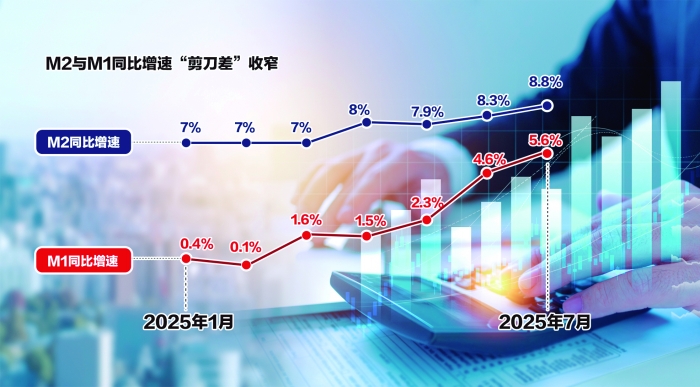
Core Viewpoint - The People's Bank of China reported that as of the end of July, social financing scale, broad money (M2), and RMB loans grew by 9%, 8.8%, and 6.9% year-on-year, respectively, continuing to exceed economic growth rates [1][2]. Group 1: Social Financing and Monetary Policy - The social financing scale reached 431.26 trillion yuan at the end of July, with a year-on-year growth of 9%, which is 0.8 percentage points higher than the same period last year [2]. - The increase in government bonds is a major driver of social financing growth, supported by a more proactive fiscal policy and a moderately loose monetary policy [2]. - The government’s bond issuance is aimed at increasing demand and supporting the economy while reducing the average financing cost for society [2]. Group 2: Money Supply and Efficiency - M2 grew by 8.8% year-on-year, which is 2.5 percentage points higher than the same period last year, indicating improved efficiency in the circulation of funds [3]. - The narrowing "scissors difference" between M2 and narrow money (M1) reflects an increase in the liquidity and efficiency of funds [5]. Group 3: Loan Growth and Structure - As of the end of July, the RMB loan balance was 268.51 trillion yuan, with a year-on-year growth of 6.9%, down from 8.7% the previous year [6]. - The traditional seasonal pattern of credit growth in July, along with the impact of local government debt replacement, has influenced loan data [6][7]. - The structure of credit is further optimized to meet the demands of economic transformation, with significant growth in inclusive small and micro loans and medium to long-term loans for manufacturing [8]. Group 4: Interest Rates and Future Outlook - Loan interest rates remain low, with new corporate loan rates around 3.2% and new personal housing loan rates around 3.1%, reflecting a favorable credit supply environment [8]. - Experts anticipate that macroeconomic policies will maintain continuity and stability in the second half of the year, supporting economic recovery and reasonable growth in effective credit demand [8].

7月M1M2剪刀差持续收窄 宏观政策给力让经济回升有保障
Xin Jing Bao· 2025-08-13 12:32
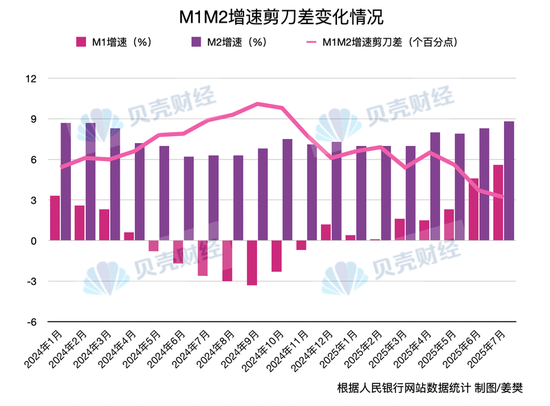
Core Viewpoint - The People's Bank of China (PBOC) reported that as of the end of July, the broad money supply (M2) reached 329.94 trillion yuan, growing by 8.8% year-on-year, while the narrow money supply (M1) was 111.06 trillion yuan, increasing by 5.6% year-on-year. The narrowing gap between M1 and M2 indicates improved liquidity and efficiency in the financial system, supported by effective macroeconomic policies that bolster market confidence and align with the recovery of economic activities [1][2][6]. Group 1: Monetary Supply and Financing - As of July, the M1-M2 gap was 3.2%, down 6.9 percentage points from the peak in September of the previous year, indicating a trend of narrowing [2]. - The social financing scale increased by 1.13 trillion yuan in July, which is 361.3 billion yuan more than the previous year, aligning with economic growth expectations [5][6]. - The total social financing scale for the first seven months reached 23.99 trillion yuan, an increase of 5.12 trillion yuan year-on-year [6]. Group 2: Economic Policy and Growth - The macroeconomic policy has been more proactive this year, with various measures implemented to support sustained economic recovery. The GDP grew by 5.3% year-on-year in the first half of the year, reflecting a positive trend in major economic indicators [7]. - The issuance of government bonds has accelerated, with a total of 13.3 trillion yuan issued in the first half of the year, including 7.89 trillion yuan in national bonds, which is a 36% increase year-on-year [7][8]. - The government’s leverage ratio increased by 9 percentage points to 65.3%, while the leverage ratios of non-financial enterprises and households remained relatively stable, indicating a strategic approach to managing debt levels [8]. Group 3: Future Outlook - The macroeconomic policies are expected to maintain continuity and stability in the second half of the year, focusing on stabilizing employment, businesses, markets, and expectations, which will facilitate smoother domestic economic circulation [9].
新型政策性金融工具前瞻:稳外贸促投资 PSL或重启扩张
Zheng Quan Shi Bao· 2025-08-13 05:51
Core Viewpoint - The Chinese government is implementing a series of proactive macroeconomic policies to stabilize the market and expectations, with new policy financial tools expected to be introduced in the second quarter to support foreign trade and effective investment [1][2]. Group 1: Policy Measures - Since the Politburo meeting on April 25, a package of financial policies has been rapidly released, including interest rate cuts and new structural monetary policy tools [1]. - The People's Bank of China (PBOC) has indicated that new policy tools may be created based on economic conditions and the effectiveness of existing tools [2][6]. - The introduction of new policy financial tools is anticipated to provide targeted support for foreign trade, technological innovation, and consumption [4][5]. Group 2: Financial Tools and Their Impact - In 2022, three policy financial institutions created and deployed approximately 740 billion yuan in policy and development financial tools, leading to a total credit support exceeding 3.5 trillion yuan [2]. - The new policy financial tools may innovate in funding usage, such as supporting basic research and original innovation, as well as facilitating "export to domestic sales" [4]. - The potential introduction of export buyer credit-like tools is expected to alleviate the impact of external demand fluctuations on foreign trade enterprises [4]. Group 3: Support for Investment - Stimulating consumption is prioritized, but effective investment is also a crucial aspect of counter-cyclical adjustments [5]. - The PBOC may restart and expand the Pledged Supplementary Lending (PSL) program to provide long-term low-cost funding for policy banks [6]. - Central fiscal support is deemed essential for the success of new policy financial tools, with expectations for fiscal measures to alleviate project funding costs [6][7].
债券利息要收税,对我们投资有什么影响?|投资小知识
银行螺丝钉· 2025-08-12 12:50
Group 1 - The article discusses the impact of increased taxes on newly issued bonds, particularly in the context of the current high valuation of RMB long-term pure bonds, indicating a potential bearish market ahead [3][5]. - It highlights that the increase in taxes and fees is often a qualitative signal of market cycles, suggesting caution when such news arises, as it may indicate that certain assets are overvalued [3][5]. - The article notes that the new tax policy will not immediately affect existing bonds, but the current valuation of RMB long-term pure bonds is not attractive from an investment perspective [5]. Group 2 - The impact on short-term bond funds is minimal due to their low volatility, making them less susceptible to the changes in tax policy [6]. - The article suggests that the fixed income plus (固收+) products will benefit from the situation, as they primarily allocate to pure bonds while also including some stocks and convertible bonds [7]. - There is a steady demand for stable investments, which is expected to flow into fixed income plus products as a result of reduced yields from deposits and long-term pure bonds [8].

政策“组合拳”快且准 经济“热力图”春意浓
Xin Hua Wang· 2025-08-12 06:31
Core Viewpoint - The economic operation data for January indicates a stable start, with various leading indicators and macro data showing positive signs of recovery, although external challenges remain significant [1][7]. Group 1: Leading Indicators - The Manufacturing Purchasing Managers' Index (PMI) for January is reported at 50.1%, remaining above 50 for three consecutive months, signaling a comprehensive recovery in the economy [2]. - The logistics industry index stands at 51.1%, indicating continued growth, particularly in the railway and postal sectors [2]. - The excavator sales and operating rates reflect robust infrastructure construction, with high operating rates reported for various engineering machinery [2]. - High-frequency data shows industrial production resilience, with a blast furnace operating rate exceeding 70% and a significant increase in coking enterprise operating rates from 54.3% to 76.2% [2]. Group 2: Financial and Economic Data - In January, new RMB loans reached 3.98 trillion yuan, and new social financing totaled 6.17 trillion yuan, both setting monthly historical highs [4]. - The broad money supply (M2) grew by 9.8% year-on-year, indicating a strong monetary environment [4]. - Central enterprises reported a revenue of 3 trillion yuan in January, with a year-on-year growth of 12.4%, and a profit total of 185.3 billion yuan, reflecting robust economic performance [4]. - Actual foreign investment in January was 102.3 billion yuan, marking an 11.6% increase year-on-year, showcasing improved investment conditions [4][5]. Group 3: Policy Recommendations - Experts suggest that fiscal policies should accelerate budget investments and increase spending in employment and livelihood sectors to support small and micro enterprises [8]. - Monetary policy should leverage the current window before potential tightening by the Federal Reserve, with suggestions for reserve requirement ratio cuts and interest rate reductions to boost demand [8]. - A more flexible macro-control toolbox is recommended, including reforms in key sectors and strategies to enhance domestic demand [8]. Group 4: Future Outlook - The combination of steady growth policies and optimistic market expectations is expected to accelerate economic recovery, with the first quarter of 2023 likely to exceed market expectations [3][6]. - The emphasis on maintaining stability while addressing external and internal pressures is crucial for achieving quality growth and overcoming challenges [9].
12家A股银行上半年业绩快报出炉:净利增幅均超10%
Xin Hua Wang· 2025-08-12 06:19
A股上市银行今年上半年经营情况如何? 据记者初步统计,截至今年8月初,已有12家A股上市银行披露业绩快报(未经审计),披露主体目前 均为城商行和农商行。从已披露的数据来看,银行业绩表现亮眼,归母净利润均较去年同期实现两位数 增长,且有多家银行同比增长超30%。 光大银行金融市场部宏观研究员周茂华表示,介于二季度遭遇了散发疫情的冲击,银行如果有两位数的 利润增长,则表明银行的经营和盈利性相当有韧性。 对于银行下半年经营情况,周茂华表示,虽然二季度的散发疫情波及面比较广,但对银行的影响整体可 控,加之上半年出台的政策,其效果也会在下半年逐渐显现,因此对银行下半年的经营"整体保持乐 观"。 营收、净利润齐增长 据记者统计,已披露中期快报的银行营业收入和归母净利润均实现双增长。城商行阵营中的江苏银行、 南京银行、杭州银行营收超百亿元,分别为351.07亿元、235.32亿元、172.95亿元,位居前三位。江苏 银行、南京银行的净利润超百亿元,分别为133.8亿元、101.5亿元,同比增长31.81亿元、16.96亿元。 总体来看,12家银行净利润同比增幅均超10%,其中张家港行、苏州银行、江阴银行等6家银行同比增 速 ...




央行:维持基础货币合理充裕状态
Xin Hua Wang· 2025-08-12 05:55
Core Viewpoint - The People's Bank of China (PBOC) has implemented a 400 billion yuan Medium-term Lending Facility (MLF) operation and a 20 billion yuan reverse repurchase operation, both with a reduction in interest rates, indicating a continued effort to maintain liquidity in the banking system while responding to economic pressures [1][2][3]. Group 1: Monetary Policy Actions - The MLF operation and reverse repo rates were reduced by 10 basis points to 2.75% and 2.0%, respectively, marking the second interest rate cut of the year [1]. - The MLF scale was reduced by 200 billion yuan, which aligns with market expectations and suggests that the central bank aims to avoid signaling an overly tight monetary policy [1][2]. Group 2: Economic Context - Since April, the market liquidity has remained ample due to coordinated monetary and fiscal policies, leading to a decline in major market interest rates [2]. - The manufacturing PMI fell by 1.2 percentage points to 49% in July, indicating a contraction in the manufacturing sector and reflecting weak financing willingness in the real economy [3]. Group 3: Future Monetary Policy Direction - Analysts expect the PBOC to employ more structural tools for targeted support, particularly for small and medium-sized enterprises, the real estate sector, and other key areas [4]. - The reduction in MLF rates is anticipated to influence the Loan Prime Rate (LPR), with a higher probability of a decrease in the LPR, especially for terms longer than five years [3].

股债跷跷板依然是主逻辑,国债震荡偏空
Ning Zheng Qi Huo· 2025-08-11 13:57
Report Industry Investment Rating - The report gives a "shockingly bearish" rating on the bond market, suggesting investors focus on the stock-bond seesaw [5]. Core Viewpoints - The stock-bond seesaw remains the main logic in the bond market, with long-term bond yields breaking below the 60-day moving average, and this logic is expected to continue to dominate the bond market [10]. - Despite a decline in economic sentiment in July, subsequent economic data shows that the economy still has resilience, and countercyclical adjustments such as infrastructure investment are expected to increase in the second half of the year [3]. - The fiscal policy is "very active," with sufficient funds for stabilizing growth and expanding domestic demand. The main tone for the second half of the year is an active fiscal policy and a moderately loose monetary policy, but the likelihood of incremental policies exceeding market expectations is limited [4]. Summary by Chapter Chapter 1: Market Review - The stock-bond seesaw logic has led to a significant decline in long-term bond yields, breaking below the 60-day moving average, and this logic is expected to continue to dominate the bond market [10]. - The Politburo meeting in July provided some assurance for the steady growth of the economy in the second half of the year, with an active fiscal policy and a moderately loose monetary policy [10]. Chapter 2: Key News Overview - A number of major foreign investment projects have made new progress, and the National Development and Reform Commission plans to introduce a new batch of major foreign investment projects and a new version of the "Catalogue of Industries Encouraging Foreign Investment" [15]. - In July, China's total goods trade imports and exports reached 3.91 trillion yuan, a year-on-year increase of 6.7%, with exports growing by 8% and imports by 4.8% [16]. - Seven departments including the central bank jointly issued a guiding opinion on financial support for new industrialization, aiming to build a mature financial system by 2027 [16]. - Multiple departments have deployed key tasks for the second half of the year, with the keywords being effectively releasing domestic demand potential, promoting the integration of "two innovations," and advancing capacity governance in key industries [16][17]. - China's CPI in July was flat year-on-year, with urban CPI remaining unchanged, rural CPI down 0.3%, food prices down 1.6%, non-food prices up 0.3%, consumer goods prices down 0.4%, and service prices up 0.5% [16]. Chapter 3: Analysis of Key Influencing Factors 3.1 Economic Fundamentals - China's official manufacturing PMI in July was 49.3, down 0.4 percentage points month-on-month, and the comprehensive PMI output index was 50.2, down 0.5 percentage points, indicating a decline in economic sentiment and an increase in downward pressure [18]. - China's GDP in the second quarter increased by 5.2% year-on-year and 1.1% quarter-on-quarter, exceeding expectations [18]. - China's CPI in July was flat year-on-year, with different performance in urban and rural areas, as well as in food and non-food prices [18]. 3.2 Policy Front - As of the end of June 2025, the stock of social financing scale was 430.22 trillion yuan, a year-on-year increase of 8.9%. New RMB loans in the first half of the year were 12.92 trillion yuan, and new RMB deposits were 17.94 trillion yuan [20]. - At the end of June, the balance of broad money M2 was 330.29 trillion yuan, a year-on-year increase of 8.3%, and the balance of narrow money M1 was 113.95 trillion yuan, a year-on-year increase of 4.6%. The M2 - M1 gap narrowed by 1.9 percentage points compared to May [20]. 3.3 Capital Front - Although the 7-day reverse repurchase rate has not changed significantly and the policy rate has not been lowered, bond yields and DR007 have declined significantly, indicating that the capital market has loosened to a certain extent [22]. - With the weakening of exchange rate pressure, expectations of further monetary easing may increase, but the probability of significant monetary easing such as reserve requirement ratio cuts and interest rate cuts in the second half of the year is low [22]. 3.4 Supply and Demand Front - In the past week, 16 provinces and municipalities including Shanghai, Hebei, and Beijing issued 161 local government bonds with a total scale of 641.64 billion yuan, including new general bonds, new special bonds, and refinancing bonds [26]. - The National Development and Reform Commission will issue the third batch of consumer goods trade-in funds in July and coordinate relevant aspects to ensure the orderly implementation of the policy throughout the year [26]. - The issuance of special bonds and ultra-long-term special treasury bonds has basically been realized, and the market is waiting for the effects and implementation of relevant policies [26]. 3.5 Sentiment Front - The stock-bond ratio has broken through the short-term shock range and declined, indicating that the market's attention to stocks is greater than that to bonds, and market risk appetite has increased [28]. - Although the stock-bond ratio has slightly declined recently, it is still at a high level compared to the previous period. Attention should be paid to whether it will continue to decline and whether funds will continue to flow from the bond market to the stock market [28]. Chapter 4: Market Outlook and Investment Strategy - The theme of economic work in the second half of the year is to combat involution and maintain stable economic recovery. With the start of infrastructure projects such as the Yajiang Hydropower Station, market expectations for further fiscal and infrastructure investment in the second half of the year have increased [31]. - Although the loose liquidity has supported the bond market, the stock-bond seesaw remains the main logic in the bond market recently. Paying attention to the subsequent trend of the stock market is the key to judging the medium-term trend of the bond market [31].