
智能驾驶

Search documents
沪指刷新逾10年新高!突破2025年11月14日阶段高点,脑机接口概念延续强势、智能驾驶概念表现活跃
Jin Rong Jie· 2026-01-06 01:56
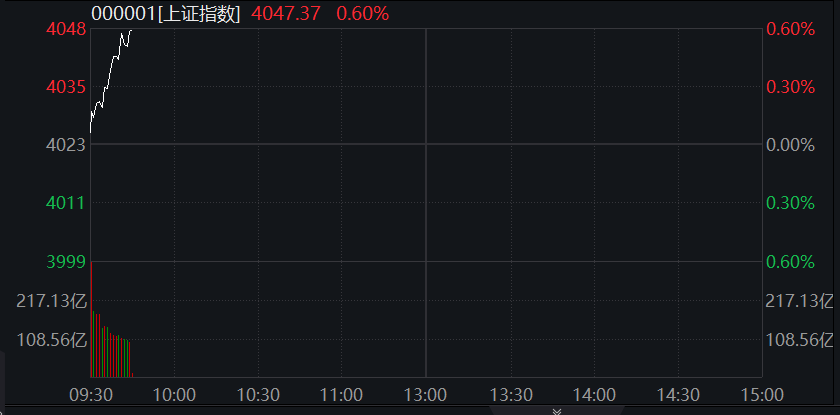
Market Performance - The Shanghai Composite Index surged after the opening, breaking the high point from November 14, 2025, and reaching the highest level since July 2015, closing at 4047.37 points, up 0.6% [1] - The Shenzhen Component Index rose by 0.69% to 13923.61 points, while the ChiNext Index increased by 0.46% to 3309.76 points, and the Sci-Tech 50 Index jumped 1.85% to 1429.42 points [1] - The total trading volume in the Shanghai and Shenzhen markets reached 567.525 billion yuan, with over 3500 stocks rising [1] Sector Highlights - The brain-computer interface sector continued to perform strongly, with several companies hitting the daily limit up, following a breakthrough in implant technology at Fudan University [3] - Semiconductor equipment stocks showed resilience, with companies like Jin Hai Tong hitting the daily limit up and others like Bei Fang Hua Chuang and Zhong Ke Fei Ce rising over 5%, reaching historical highs [3] - The solid-state battery concept saw significant gains, with Jin Long Yu hitting the daily limit up, as a Finnish company announced the launch of the world's first commercially viable all-solid-state battery [4] - The commercial aerospace sector experienced a rebound, with Lei Ke Defense achieving five consecutive limit-ups, following a capital increase announcement from China Aerospace Science and Technology Corporation [4] Institutional Insights - Huatai Securities expressed optimism about the spring market, suggesting a focus on growth sectors like electric equipment and renewable energy, as well as domestic demand improvement themes [5] - CITIC Securities noted that the cross-year market may exhibit characteristics of "growth leading and liquor accumulating," with a focus on sectors like snacks and dairy [5] - Huaxi Securities highlighted 2026 as a year of multiple positive factors, with a solid foundation for a bull market, driven by macro policies and improving corporate earnings [6] - Guojin Securities projected 2026 to be the year of recoverable commercial rockets, emphasizing the importance of cost reduction through recoverable technology in the aerospace sector [7] - Tianfeng Securities recommended focusing on cosmetics, gold jewelry, and duty-free sectors, which are expected to grow amid the recovery of high-end consumption [7]

智能驾驶概念表现活跃 浙江世宝、索菱股份双双涨停
Xin Lang Cai Jing· 2026-01-06 01:43
Core Viewpoint - The smart driving concept is showing active performance in the market, with several companies experiencing significant stock price increases [1] Group 1: Company Performance - Zhejiang Shibao has reached the daily limit increase in stock price [1] - Suoling Co., Ltd. has achieved three consecutive trading days of price increases [1] - Haon Electric has seen a stock price increase of over 9% [1] - Wanji Technology and Luchang Technology have also experienced stock price increases [1]

交通运输部力推公共数据资源开发利用 推动跨行业数据融合
Zhong Guo Jing Ying Bao· 2026-01-06 00:48
Core Viewpoint - The transportation sector is set to enhance the development and utilization of public data resources by 2030, aiming for a mature management and technical system that supports high-quality development in the industry [1][2]. Group 1: Policy Support and Objectives - The Ministry of Transport's "Implementation Opinions" emphasizes breaking down institutional and technical barriers to improve the development and utilization of public data resources in transportation [1]. - By 2030, a comprehensive high-quality data resource system is expected to be established, significantly improving data integration and innovative applications [1][2]. Group 2: Challenges in Data Utilization - Traditional transportation enterprises have lagged in establishing data resource systems, leading to a need for improved data development and utilization levels [1]. - There are significant barriers to data sharing and openness among different types of transportation companies, primarily due to institutional mechanisms and mindset issues, rather than technical difficulties [1][2]. Group 3: Strategies for Data Application and Innovation - The "Implementation Opinions" propose a collaborative approach focusing on sharing, openness, and authorized operations to enhance public data supply capabilities [2]. - It emphasizes the importance of deepening industry collaboration and cross-industry data integration to explore typical scenarios for multi-scenario applications and multi-entity reuse of public data resources [2]. Group 4: Impact on Emerging Industries - The integration of public data with enterprise data is expected to support the development of emerging industries such as artificial intelligence, smart driving, low-altitude economy, new information technologies, and new energy vehicles [2]. - Enhancing public data utilization in the transportation sector is anticipated to promote integrated transportation development, improve logistics efficiency, and reduce overall logistics costs for society [2].
车市进入高销量低增长周期,行业从拼价格转向拼价值
Bei Jing Ri Bao Ke Hu Duan· 2026-01-06 00:34
Group 1 - The core viewpoint of the articles highlights the transformation and challenges in the Chinese automotive market, emphasizing a shift from price competition to value-driven growth, with a focus on innovation and technology integration [1][5][8] - In 2025, China's automotive market is expected to achieve record production and sales, driven by policies such as trade-in incentives and tax exemptions for new energy vehicles, indicating sustained consumer demand [1][6] - The competition landscape is evolving, with companies like BYD surpassing Tesla in electric vehicle sales, marking a shift towards systematic competition based on cost, supply chain, and product matrix [2][3] Group 2 - The industry is witnessing a significant shift towards "boundaryless integration," with companies exploring new technologies and markets beyond traditional automotive manufacturing, such as AI and robotics [3][4] - The year 2025 is anticipated to be a turning point for intelligent driving technology, with advancements making high-level autonomous driving features more accessible to the broader market [3][4] - The automotive sector is facing increasing pressure from regulatory changes and market dynamics, leading to a decline in profit margins and a need for companies to focus on value creation through innovation and quality [5][7] Group 3 - The outlook for 2026 suggests a transition to a phase of high sales but low growth, with expectations of stable annual sales around 30 million vehicles, and a significant increase in exports, particularly in the new energy vehicle segment [6][8] - Capital operations within the automotive industry are becoming more active, with several companies successfully listing on stock exchanges, indicating a trend towards consolidation and value reassessment [7][8] - The competitive environment is expected to intensify, with companies needing to accelerate their transition to new energy and global markets to survive the anticipated market shakeout [8]
城市NOA第三方智驾供应商Momenta市占率超60% 中国智驾全球竞争力跃升
Jing Ji Guan Cha Bao· 2026-01-05 23:57
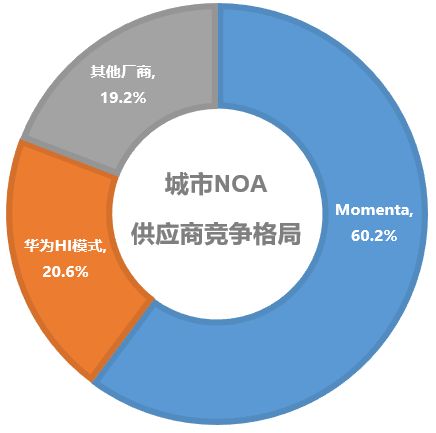
Core Insights - The popularization of intelligent driving in China is entering a critical phase in 2025, transitioning from "production accumulation" to a "scale explosion" cycle [1] - The penetration rate of urban NOA (Navigation on Autopilot) hardware in domestic passenger cars has reached 2.392 million units in the first ten months of 2025, marking a year-on-year increase of 62.8% [1] - Third-party intelligent driving suppliers like Momenta and Huawei are gaining market leadership and global recognition, enhancing the competitiveness of China's intelligent driving supply chain [1] Market Share Analysis - From January to October 2025, Momenta and Huawei's HI model together captured over 80% of the urban NOA third-party intelligent driving supplier market, with Momenta holding a market share of 60.2% and Huawei at 20.6% [3] - Leading suppliers have achieved rapid technological iteration and efficient replication across models and brands due to early production layouts and scalable engineering capabilities [3] Trends in Adoption - The acceleration of urban NOA penetration in 2025 is driven by three factors: technological maturity, increased supply, and awakened demand [5] - Domestic brands like BYD, Geely, and Chery are key drivers of this penetration, implementing a "main model standard configuration" strategy to bring advanced driving features to lower-priced vehicles [5] - Global brands such as Toyota, Nissan, and Mercedes-Benz are collaborating with top Chinese intelligent driving suppliers to enhance their smart transformation, indicating the global recognition of China's intelligent driving solutions [5] Competitive Focus - The competition in urban NOA has shifted from "whether features are available" to "experience is king," with a focus on providing a safe and reassuring high-level driving experience [5] - Momenta is leveraging "reinforcement learning + end-to-end architecture" combined with production data to enhance the driving experience, with its R6 model being the first to achieve mass production based on reinforcement learning [5][6] Strategic Positioning - 2025 is a pivotal year for urban NOA in China, marking the transition from "usable" to "user-friendly" and from niche markets to widespread adoption [6] - Leading suppliers like Momenta and Huawei are not only enhancing domestic market experiences but also actively participating in the global restructuring of the intelligent driving supply chain, providing a "Chinese solution" for the global automotive industry's smart transformation [6]
小鹏汽车-W(09868):港股研究|公司点评|小鹏汽车-W(09868.HK):小鹏汽车2025年12月销量点评:总交付3.75万辆,同环比增长,X9交付强势
Changjiang Securities· 2026-01-05 23:30
Investment Rating - The investment rating for the company is "Buy" and it is maintained [6]. Core Insights - The company delivered a total of 37,508 vehicles in December 2025, representing a year-on-year increase of 2.2% and a month-on-month increase of 2.1% [2][4]. - For the entire year of 2025, the company achieved cumulative deliveries of 429,000 vehicles, marking a significant year-on-year growth of 125.9% [2][4]. - The launch of the new X9 model has been particularly strong, with 5,424 units delivered in December, achieving a month-on-month increase of 68% and a year-on-year increase of 289% [6]. - The company is expected to continue its growth trajectory with new models like the P7+ and G7 set to be released, enhancing its sales cycle [6]. - The overseas market has also shown promising growth, with 45,000 vehicles delivered internationally in 2025, reflecting a year-on-year increase of 96% [6]. - The company anticipates Q4 2025 deliveries to be between 125,000 and 132,000 units, which would represent a year-on-year growth of 36.6% to 44.3% [6]. Summary by Relevant Sections Sales Performance - December 2025 deliveries totaled 37,508 vehicles, with a year-on-year growth of 2.2% and a month-on-month growth of 2.1% [2][4]. - Cumulative deliveries for 2025 reached 429,000 vehicles, up 125.9% year-on-year [2][4]. New Product Launches - The X9 model has seen strong performance, with December deliveries reaching 5,424 units, marking a record for the model [6]. - Upcoming releases of the P7+ and G7 models are expected to further boost sales [6]. International Expansion - The company delivered 45,000 vehicles in international markets in 2025, a 96% increase year-on-year [6]. - The company has established a presence in 60 countries and regions globally, with local production in Malaysia starting in December 2025 [6]. Future Outlook - The company is positioned for significant revenue growth, with projected revenues of approximately 75.1 billion and 112.1 billion for 2025 and 2026, respectively [6]. - The anticipated price-to-sales ratios for 2025 and 2026 are 1.8 and 1.2, respectively, supporting the "Buy" rating [6].
均胜电子董事长王剑峰:制造业要有“定力” 能看清长远浪潮
Zhong Guo Zheng Quan Bao· 2026-01-05 22:17
Core Insights - The article discusses how Junsheng Electronics leverages capital and strategic planning to achieve high-quality development and competitive advantages in the global automotive parts industry amidst the trends of electrification and smart technology [2] Group 1: Company Growth and Strategy - Junsheng Electronics has experienced significant growth over the past two decades, closely linked to a series of key international acquisitions, including the purchase of German company Preh and American KSS [3] - The company follows a "dual-wheel drive" strategy, emphasizing manufacturing as the primary focus while utilizing capital markets as a supplementary tool for technological advancement and market breakthroughs [3][4] - In the first three quarters of 2025, Junsheng reported revenues of 45.844 billion yuan, an increase of 11.45% year-on-year, and a net profit of 1.12 billion yuan, up 18.98% year-on-year, with a gross margin improvement to 18.3% [3][4] Group 2: Integration and Efficiency - The success of Junsheng's acquisitions is attributed to deep integration and synergy post-merger, including the closure of high-cost factories and the relocation of production to more efficient regions [4] - The company aims to steadily increase its net profit margin to over 5% by optimizing global production layouts and enhancing supply chain efficiency [5] Group 3: Future Investments and Technology - Junsheng is focusing on the emerging robotics sector, which, despite its current low revenue contribution, is seen as a significant growth area following the trends in smart connectivity and autonomous driving [6] - The company has already established partnerships with various robotics firms and is working on solutions for industrial robots, aiming to solve application challenges in complex industrial environments [7] Group 4: Regional Strengths and Support - The article highlights the advantages of Ningbo as a manufacturing hub, emphasizing its complete industrial chain and supportive business environment, which has been crucial for Junsheng's growth [8] - The local government's supportive policies and active financial institutions have played a vital role in the company's major acquisitions and transformations [8] Group 5: Long-term Vision and Innovation - Junsheng Electronics is committed to continuous innovation and strategic foresight, recognizing that manufacturing returns may be slower but are essential for long-term success [9][10] - The company emphasizes the importance of regular strategic reassessment every three to four years to strengthen its competitive edge and adapt to industry changes [10]

豪恩汽电:公司在智驾领域的产品主要有超声波雷达系统等
Zheng Quan Ri Bao Wang· 2026-01-05 14:12
Core Viewpoint - The company, Haon Auto Electric (301488), has a diverse range of products in the intelligent driving sector, indicating a strong focus on advanced automotive technologies [1] Product Offerings - The company’s product lineup includes ultrasonic radar systems, millimeter-wave radar systems, in-car monitoring systems, integrated parking systems, front-view active safety systems, domain controllers, intelligent parking systems, intelligent vision systems, visual sensor systems, and electronic rearview mirror systems [1]
广汽华为联手!
Zhong Guo Ji Jin Bao· 2026-01-05 13:27
Core Viewpoint - GAC Group has signed a comprehensive cooperation framework agreement with Huawei Terminal to deepen collaboration on the HarmonyOS ecosystem and AI technology, marking a significant step in their ongoing partnership since 2017 [2][4][7]. Group 1: Partnership Development - The partnership will focus on co-building the HarmonyOS ecosystem, enhancing AI technology, and integrating Huawei's HMS for Car services into GAC's offerings [7][8]. - GAC Group's recent initiatives include the launch of the high-end smart electric vehicle brand "Qijing" in collaboration with Huawei, showcasing their commitment to innovation in the automotive sector [2][4]. Group 2: Technological Integration - GAC Group plans to leverage its industry advantages and market demands to innovate and implement technology in collaboration with Huawei, particularly in AI and smart cockpit development [7][8]. - The integration of Huawei's intelligent driving and HarmonyOS smart cockpit technologies into GAC's models, such as the A800 and M8, highlights the focus on enhancing user experience and product differentiation [8]. Group 3: Strategic Goals - The collaboration aims to accelerate the smart and international development of China's automotive industry, with GAC Group's overseas sales of its self-owned brands increasing by 39% year-on-year in the first eleven months of 2025 [8]. - GAC Group's "Smart Travel 2027" action plan aims to solidify its AI model platform and enhance smart driving and cockpit technologies over the next three years [8].


华源晨会精粹20260105-20260105
Hua Yuan Zheng Quan· 2026-01-05 12:42
Fixed Income - Long-term yields are rising, with credit spreads mostly narrowing slightly, indicating a mixed market response to different credit ratings and sectors [1][5][6] - For 2026, a differentiated allocation strategy is recommended for various credit types, suggesting short-duration municipal bonds as a base and focusing on high-quality entities for longer durations to enhance returns [7] - Predictions for December 2025 indicate new loans of 700 billion yuan and social financing growth of 1.8 trillion yuan, with a weak credit demand expected to continue into 2026 [10][12] North Exchange - The electric vehicle wave is driving upgrades in the automotive supply chain, with a projected 70% growth in total market capitalization for automotive stocks on the North Exchange in 2025 [15][16] - Key trends to watch in 2026 include the localization of core robot components, breakthroughs in battery technology, and advancements in smart driving systems [16][18] - The automotive sector's price-to-earnings ratio increased from 30.6X to 31.9X, reflecting a growing market interest [18] New Consumption - The New Year's Day holiday saw significant consumer activity, with a total of 5.9 billion people expected to travel, marking a 19.5% increase year-on-year [21][22] - Douyin's beauty segment is projected to exceed 230 billion yuan in gross merchandise value for 2025, indicating strong growth in the beauty market [24][25] - Emerging consumer trends highlight a shift towards high-quality domestic brands in beauty and jewelry, with specific recommendations for brands that resonate with younger consumers [25] Transportation - The aviation sector experienced a notable increase in passenger volume during the New Year holiday, with a 13% year-on-year growth in civil aviation passenger numbers [27][29] - Geopolitical events, such as U.S. actions in Venezuela, may positively impact oil transportation markets, with potential increases in shipping demand [31] - The logistics sector is seeing a shift towards quality development, with regulatory changes aimed at reducing competition pressures and improving profitability [36]