资产配置

Search documents
2025财富配置与资产管理大会、银行业高质量发展大会举行
Zhong Guo Zheng Quan Bao· 2025-12-20 01:28
Group 1 - The 2025 Wealth Allocation and Asset Management Conference and the 2025 Banking Industry High-Quality Development Conference were held in Shenzhen, focusing on how wealth management institutions can enhance residents' wealth preservation and appreciation through upgraded service models [1] - The current wealth management market is showing a steady recovery, with a notable demand for equity products, indicating an increased interest in equity asset allocation [1] - The banking wealth management industry is facing unprecedented challenges but also greater opportunities, prompting institutions to prioritize investor interests and enhance product offerings and customer experience [1] Group 2 - ICBC Wealth Management aims to become a fully functional wealth management company, providing a comprehensive range of products and adapting to new challenges in the asset management industry [2] - The growing demand for diversified asset allocation among residents is driving the overall scale of the wealth management market and leading to significant structural changes, with various financial institutions accelerating their entry into the market [2] - The collaboration between public funds and the banking sector is seen as a key support for the high-quality development of banking wealth management [2] Group 3 - Securities companies are increasingly playing a vital role in helping residents preserve and grow their wealth by transitioning to a buyer-oriented advisory model [3] - The integration of banking wealth management and securities asset management is essential for responding to market changes and building a high-quality development ecosystem [3] - The interest of domestic investors in allocating overseas quality assets is rising, with a focus on alternative asset opportunities and multi-asset allocation strategies [3] Group 4 - Despite facing old problems and new challenges, the long-term positive fundamentals of China's economy remain unchanged, necessitating proactive macroeconomic policies to stabilize employment, enterprises, and market expectations [4] - Key strategies for activating economic potential include normalizing local investments, forming new consumer groups, and nurturing new industry demands related to emerging sectors [4] Group 5 - The 2026 investment opportunities are expected to arise from policy synergies and industrial upgrades, with particular attention on sectors such as renewable energy, new materials, chips, embodied intelligence, smart home technology, and health consumption [5]
纵论财富管理机构转型方向,助力居民财富保值增值!2025财富配置与资产管理大会、银行业高质量发展大会举行
Zhong Guo Zheng Quan Bao· 2025-12-19 15:54
Group 1 - The 2025 Wealth Allocation and Asset Management Conference and the 2025 Banking Industry High-Quality Development Conference were held in Shenzhen, focusing on how wealth management institutions can enhance services to help residents preserve and increase wealth [1] - Zhang Bohui from the Chinese University of Hong Kong (Shenzhen) noted a steady recovery in the wealth management market, with a notable performance in equity-linked products, indicating a rising demand for equity asset allocation [1] - Qi Jiankong from CCB Wealth Management highlighted unprecedented challenges and greater opportunities in the banking wealth management sector, emphasizing a shift in operational philosophy to prioritize investor interests [1] Group 2 - Gao Xiangyang from ICBC Wealth Management stated the company aims to become a fully functional wealth management firm, responding to new challenges in the asset management industry by exploring beneficial practices [2] - The growing demand for diversified asset allocation among residents is driving the expansion of the wealth management market and prompting profound structural changes, with various financial institutions accelerating their entry into the market [2] - Tan Xiaogang from Dacheng Fund emphasized that the high-quality development of banking wealth management is a key driver for the overall high-quality development of the banking sector, with ongoing collaboration between public funds and banks being crucial [2] Group 3 - Securities firms are increasingly playing a vital role in helping residents preserve and increase wealth, with initiatives like transitioning to a buy-side advisory model [3] - Li Haichao from Shanghai Securities discussed the company's focus on a unique asset allocation system to drive business transformation and enhance professional capabilities [3] - Wang Qian from Huihua Wealth Management highlighted the need for the asset management industry to focus on alternative asset opportunities and global asset allocation in the low-interest-rate environment [3] Group 4 - Despite existing challenges, the long-term positive fundamentals of China's economy remain unchanged, according to Bi Jiyao, former deputy director of the China Macro Economic Research Institute [4] - Guo Lei, chief economist at GF Securities, identified five potential areas for economic activation, including normalizing local investments and expanding new consumer groups [4] Group 5 - Industry experts shared insights on investment opportunities for 2026, indicating that Chinese assets still hold strong appeal, particularly in sectors like new energy, new materials, chips, and health consumption [5]
富邦金控首席经济学家罗玮:2026年金融市场仍是“股优于债”的格局
Xin Lang Cai Jing· 2025-12-19 15:19
在资产配置方面,罗玮认为,2026年金融市场仍是"股优于债"的格局。由于主要的央行降息周期接近尾 声,明年进一步宽松的空间有限,投资者对持有长期债券的意愿也出现变化。新一代投资者更倾向于将 科技股等增长型资产作为配置选择。罗玮归纳,明年资产配置思路为"在风险可控前提下,股票整体优 于 债券",可在股、债、汇及原物料之间进行动态调整,兼顾成长机会与防御需求。 (编辑:杨井鑫 审核:朱紫云 校对:颜京宁) 中经记者 郝亚娟 夏欣 上海、北京报道 近日,富邦华一银行直播间举办了"富邦财经趋势论坛——2026年全球经济与市场金融展望"。 富邦金控首席经济学家罗玮博士表示,2026年全球经济与金融市场的三大基调主要表现为:全球经济维 持"温和成长";各国央行货币政策调整接近尾声;区域地缘政治及国际贸易关系持续演变。若主要地缘 冲突出现缓和迹象,相关地区经济负担有望减轻,将有助于区域经济复苏,这可能成为明年值得关注的 变量。此外,全球越来越多国家在经历近年贸易环境变化后,正着力构建更具韧性的区域性供应链体 系,这一趋势也将推动国际经贸关系持续转变。 ...
新刊速读 | 利率变局中的中国浮息债定价与配置
Xin Hua Cai Jing· 2025-12-19 14:13
当前全球与中国利率环境的一个突出特征,是从"单向趋势"走向"区间震荡"。主要央行进入降周期,但 通胀与增长的不确定性仍然较高;国内在"稳增长、稳预期"的宏观目标下,多次对政策利率和LPR进行 小幅调整,利率路径呈现出"缓慢下行、阶段停顿、再评估方向"的特征。 在以固息债为主的传统配置框架下,机构投资者对利率的判断一旦出现偏差,久期风险会迅速体现到净 值波动之中。与此同时,监管对资产负债管理、资本充足和流动性管理的要求不断抬高,使得"在收 益、风险和监管约束之间寻找平衡"的难度显著上升。如何在不牺牲过多票息收益的前提下,有效管理 利率风险,成为银行、保险、公募等机构共同面对的实践问题。 在这样的背景下,重新审视浮动利率债券(下称"浮息债")的定价与配置价值,就具有了鲜明的现实针 对性。浮息债兼具利率敏感性管理和资产配置工具双重属性,既与政策利率和市场利率密切相关,又深 度嵌入各类机构资产负债表之中,本文以其为切入点,可以帮助读者从一个具体品种出发,回到更宏观 的利率机制与市场结构问题。 一、将浮息债放回利率与资产配置的大框架 本文并不把浮息债仅仅当作一种"产品"来介绍,而是把它放回中国利率市场化进程、货币政策传 ...

RadexMarkets瑞德克斯:通胀降温推升贵金属
Xin Lang Cai Jing· 2025-12-19 10:36
Group 1 - The core viewpoint of the articles indicates that the precious metals market has rebounded significantly following the release of inflation data, with gold prices reaching a two-month high, reflecting a shift in market sentiment [1][5]. - Inflation data for December showed a year-on-year increase of 2.7%, the lowest level in several months, which was below market expectations of 2.9% to 3.1% [2][6]. - The core inflation rate, excluding food and energy, was reported at 2.6%, indicating a more significant decline than anticipated, reinforcing the view that inflationary pressures are easing [2][6]. Group 2 - The market structure for gold prices is primarily formed through spot and futures mechanisms, with increased trading activity in the futures market during the year-end period [3][7]. - February gold futures rose by $28.20 to around $4,400, maintaining a crucial psychological level, while March silver futures fell to approximately $66.25 but remained within a high range, indicating no substantial change in the medium-term trend [1][5]. - The technical outlook for February gold futures remains strong, with a key resistance level at $4,433 and support around $4,200, while silver shows a bullish structure with resistance at $70.00 and support near $60.00 [3][7]. Group 3 - The combination of falling inflation, declining yields, and a weakening dollar creates a favorable environment for precious metals [4][8]. - The market is expected to maintain a strong upward trend for gold and silver, with short-term fluctuations likely to continue, but overall sentiment remains bullish as long as key support levels are not breached [4][8].


百利好晚盘分析:多重因素驱动 黄金前景光明
Sou Hu Cai Jing· 2025-12-19 09:06
Gold - Gold prices have shown a significant increase this year, with a cumulative rise of over 60%, driven by economic expansion, risk and uncertainty, opportunity cost, and trend momentum [1] - The potential for a mid-term peak in gold prices is suggested due to structural completion, with a notable resistance level at $4,350 [1] - The recognition of gold's diversification and risk-hedging functions by global investors and policymakers has increased, highlighting its necessity in asset allocation [1] Oil - Oil prices have experienced a slight rebound, but the momentum is weakening, indicating a continuation of the previous downtrend [2] - The oversupply of international crude oil is a significant factor that could lead to further price declines, especially with potential easing of sanctions on Russia [2] - A technical analysis suggests a possible head and shoulders pattern forming, with a resistance level at $56.30 [2] US Dollar Index - The US Dollar Index shows signs of a short-term rebound, but this is likely temporary, with a downward trend expected due to interest rate cuts [3] - Recent CPI data indicates a drop to 2.7%, below market expectations, which may facilitate further rate cuts by the Federal Reserve [3] - The potential for more rate cuts in 2026 may exceed market expectations, as indicated by a Federal Reserve official [3] Nikkei 225 - The Nikkei 225 index shows a small bullish candle with a long lower shadow, suggesting that the adjustment phase may be complete [5] - A trend reversal is indicated in the hourly cycle, with prices re-entering a dense trading area, suggesting potential short-term upward movement [5] Copper - Copper prices have shown a medium bearish trend, but the price level has not significantly declined [6] - A potential continuation pattern is forming in the 4-hour cycle, indicating the likelihood of new highs, with a support level at $5.35 [6] Economic Events - The Bank of England has lowered its benchmark interest rate by 25 basis points to 3.75%, marking the fourth rate cut since 2025 [7] - The European Central Bank has maintained its deposit rate at 2.00% and its main refinancing rate at 2.15% [7] - The US CPI for November has decreased from 3.1% to 2.7%, indicating a significant shift in inflation trends [7]
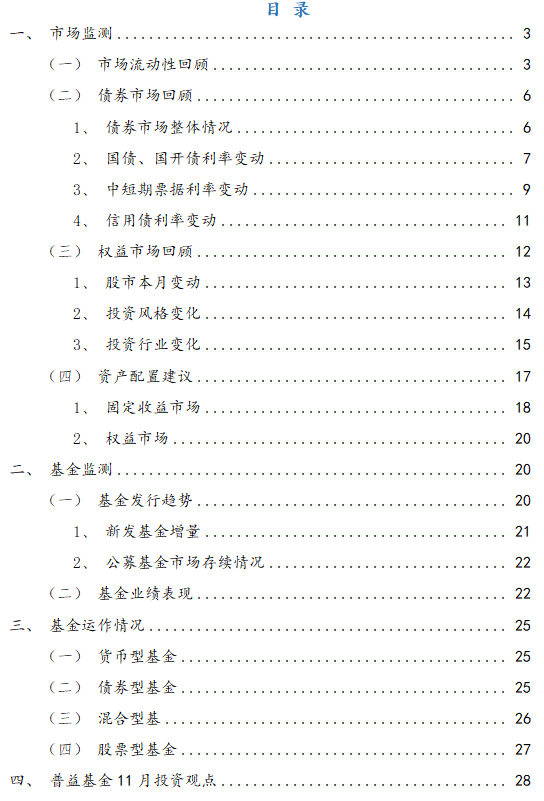
公募基金观察月报(2025年11月)——股债两市同步承压,债券型、股票型基金收益均下行
Sou Hu Cai Jing· 2025-12-19 08:55
Market Liquidity Review - In November, the People's Bank of China (PBOC) announced a moderately accommodative monetary policy to maintain liquidity and support credit growth, with a total of 10 trillion yuan in Medium-term Lending Facility (MLF) operations and 15 trillion yuan in reverse repos conducted during the month [2][3] - The overall liquidity in November was tight but balanced, influenced by short-term factors such as tax payments and increased government bond supply, yet the PBOC's actions helped stabilize liquidity [9] Bond Market Review Overall Situation - The bond market indices showed a mixed performance in November, with government bonds under pressure due to liquidity concerns and weakened expectations for short-term easing, while credit bonds performed relatively better [10] Government and Policy Bonds - The yields on government bonds increased across various maturities, with the 1-year to 10-year yields rising by 2 to 6 basis points, reflecting reduced expectations for interest rate cuts [12][14] Short-term Notes - The yields on short-term notes generally increased, influenced by liquidity pressures and credit risk events in the real estate sector [17] Credit Bonds - The average yield for AAA-rated corporate bonds rose by 5 basis points to 1.95%, while AA+ rated bonds increased by 2 basis points to 2.01%, indicating a slight tightening of credit spreads [21] Equity Market Review - In November, major stock indices experienced a decline, with the Shanghai Composite Index down by 1.67% and the Shenzhen Component Index down by 2.95%, reflecting a market correction after earlier gains [26][27] - The market showed significant sector performance divergence, with defensive sectors performing better compared to growth sectors, which faced profit-taking [28][36] - The valuation of major indices generally declined, with the ChiNext index experiencing a notable drop in valuation [33] Asset Allocation Recommendations Fixed Income Market - The fixed income market is expected to remain stable, with the PBOC's accommodative stance likely to support liquidity, while the economic recovery process needs further consolidation [44][45] Equity Market - The A-share market is anticipated to continue its structural trends, with potential for recovery in defensive sectors and technology growth stocks, depending on policy signals and liquidity improvements [46][70] Fund Issuance Trends - In November, the number of newly issued funds increased to 136, reflecting a recovery in issuance driven by the end of holiday effects and interest in defensive sectors [47][48] - The net asset value of funds decreased by 236 billion yuan month-on-month, with stock funds showing a year-on-year increase despite a decline in recent months [48] Fund Performance - Most fund types experienced declines in November, with commodity funds performing relatively well due to rising gold prices, while equity funds faced significant losses amid market corrections [54][65]
十年国债ETF(511260)近20日净流入超6.2亿元,债市具备多重利好支撑
Sou Hu Cai Jing· 2025-12-19 05:16
Group 1 - The bond market has a clear medium-term positive outlook supported by multiple favorable factors, including demand-side influences from supply-demand mismatches and a prolonged negative Producer Price Index (PPI) [1] - The political bureau meeting has outlined a monetary policy to maintain ample liquidity, which is expected to lower social financing costs [1] - Despite recent volatility in interest rate bonds due to sentiment, there are signs of weakness in the commodity market, leading to a rational return of policy expectations and potential for a rebound from oversold conditions [1] Group 2 - The 10-Year Government Bond ETF (511260) tracks the Shanghai Stock Exchange 10-Year Government Bond Index and has shown consistent high net value since its inception, with a one-year return of 4.17%, a three-year return of 14.04%, and a five-year return of 23.39% [1] - Since its establishment, the 10-Year Government Bond ETF has maintained positive returns for seven consecutive years, positioning it as a potential asset allocation tool across market cycles [1]
铂金市场崛起 看好未来投资机遇——访世界铂金投资协会亚太区总经理邓伟斌
Xin Hua Cai Jing· 2025-12-19 01:21
2025年,铂金打破多年沉寂,价格累计上涨超90%,引起投资者广泛关注。当前我国铂金投资市场面临 哪些挑战和机遇?铂金在未来资产配置中将发挥哪些重要作用?在2025广州投资顾问大会暨财富管理转 型发展会议上,新华财经专访了世界铂金投资协会亚太区总经理邓伟斌。 一是强化回收产业。铂金在很多行业被用作催化剂,而催化剂是可以回收的。强化和支持整个回收产业 的发展,充分调动回收资源,是解决供应难点的有效途径。 二是加强与南非矿业公司联系。通过与南非矿业公司加强联系,能够确保战略金属资源未来的长期供应 保障。南非虽然不缺铂金储量,但欠缺合理的价格激励推动矿业公司持续开采。广州期货交易所挂牌铂 期货,能够充分发挥市场价格发现功能,形成公允合理的定价,推动南非矿业公司更好地开采资源,从 而确保市场供应。 三是基础设施逐步完善。广州期货交易所推动铂期货挂牌上市,以及产业链上回购、回流等基础设施的 完善,提高了投资者购买铂金投资产品的便利性和信心,对市场发展起到了很大的推动作用。 在投资者的资产配置组合中,铂金正逐渐崭露头角。过去几年全世界很多国家的央行都在推动去美元 化、叠加通货膨胀和关键矿产资源争夺的背景,铂金作为一种兼具 ...
李蓓“等风来”
虎嗅APP· 2025-12-18 13:57
Core Viewpoint - The article discusses the response of Li Bei, founder of Hanxia Investment, to a critical piece published by Huxiu, highlighting the strong influence and rapid engagement of her rebuttal in the private equity circle [2][3]. Group 1: Market Risks and Asset Allocation - Li Bei identifies significant risks in current asset allocation, noting that high-net-worth individuals and wealth institutions are heavily concentrated in four main strategies: quantitative enhancement, sci-tech funds, all-weather strategies, and overseas assets, all of which carry notable risk factors [4]. - The risks associated with these strategies include the impact of small-cap factors and non-linear factors on quantitative enhancement, as well as potential downturns in the sci-tech sector due to rising domestic interest rates and the bursting of the AI bubble [4]. - Li Bei's observations on the concentration of wealth management strategies have sparked new discussions in the market, emphasizing the dangers of asset crowding and the potential for significant price volatility if common risk triggers occur [8]. Group 2: Investment Strategy - Hanxia Investment's current portfolio is characterized by a "deep value" approach, focusing on industry leaders with an average PE of 8 times, PB of 0.8 times, and a dividend yield of 5%, with 80% of holdings exhibiting strong cyclical properties [5][6]. - The portfolio also includes strategies to steepen the yield curve by buying medium- to short-term government bonds while shorting long-term bonds, which is expected to mitigate losses during prolonged deflation [7]. - Li Bei categorizes future economic scenarios into two: one where deflation reverses, leading to significant gains for Hanxia Investment, and another where deflation persists, resulting in minor losses or small gains for Hanxia while mainstream strategies continue to rise [7]. Group 3: Market Dynamics and Future Outlook - The article notes that the current market dynamics may not simply follow a "this or that" pattern, as both technology and cyclical sectors could perform well under certain conditions, depending on economic recovery and risk appetite [9]. - The performance of the AI sector, despite recent adjustments, is expected to rebound significantly in the latter half of 2024, indicating that the current asset crowding may not necessarily lead to a market style shift [8][9]. - Li Bei's strategy of waiting for the right economic conditions to capitalize on performance recovery reflects a confident stance, although it requires enduring pressure in a competitive fundraising environment [12].