避险情绪

Search documents
STARTRADER外汇市场观察:12月开局避险情绪有所升温
Sou Hu Cai Jing· 2025-12-01 08:01
Market Overview - Global financial markets exhibited a cautious stance on the first trading day of December, with major asset prices fluctuating around economic data and central bank policy expectations [1] - U.S. stock index futures fell between 0.5% to 1% during European morning trading, reflecting investor hesitance regarding economic outlook [1] Economic Indicators - The U.S. manufacturing PMI for November, released by the Institute for Supply Management, is a key data point influencing U.S. stock market movements, as investors look to gauge the health of the manufacturing sector [1] - China's manufacturing PMI for November dropped to 49.9, indicating contraction, down from 50.6 in October and below the market expectation of 50.5, following a nearly 1.5% increase the previous week [1] Currency Movements - The Australian dollar against the U.S. dollar opened lower on Monday, trading in a negative range below 0.6550, influenced by the disappointing Chinese PMI data [1] - The U.S. dollar index, a core variable for cross-market interactions, fell over 0.7% last week, driven by dovish comments from Federal Reserve officials, with expectations for a 25 basis point rate cut in December continuing to rise [3] - The euro/dollar pair consolidated last week's gains, trading slightly below 1.1600, while the pound/dollar pair saw a slight decline to around 1.3200 after a 1% increase last week [4] Precious Metals - Gold emerged as one of the few strong assets in the current market, reaching a high of over $4250 during Asian trading, although it experienced a pullback during European morning trading, remaining above $4200 [4] - The performance of gold is directly related to the weakening dollar and market expectations for accommodative policies, highlighting its safe-haven and value-preserving attributes [4]


华安期货:11月28日黄金白银高位震荡
Sou Hu Cai Jing· 2025-12-01 07:58
华安期货:11月28日黄金/白银高位震荡 核心逻辑: 重要信息: 美国就业等经济指标偏弱,近期美联储多位官员释放鸽派信号,支持12月降息,增强市场对政策放松预期。地缘因素带来的避 险情绪继续支撑金价。 市场展望: 高位震荡 1、COMEX黄金期货跌0.3%报4189.6美元/盎司,COMEX白银期货涨0.41%报53.825美元/盎司。 2、韩国央行维持基准利率2.5%不变,为连续第四次按兵不动,同时上调今明两年的GDP预期和通胀预期。 3、因感恩节假期,美国股市周四休市一日。 ...

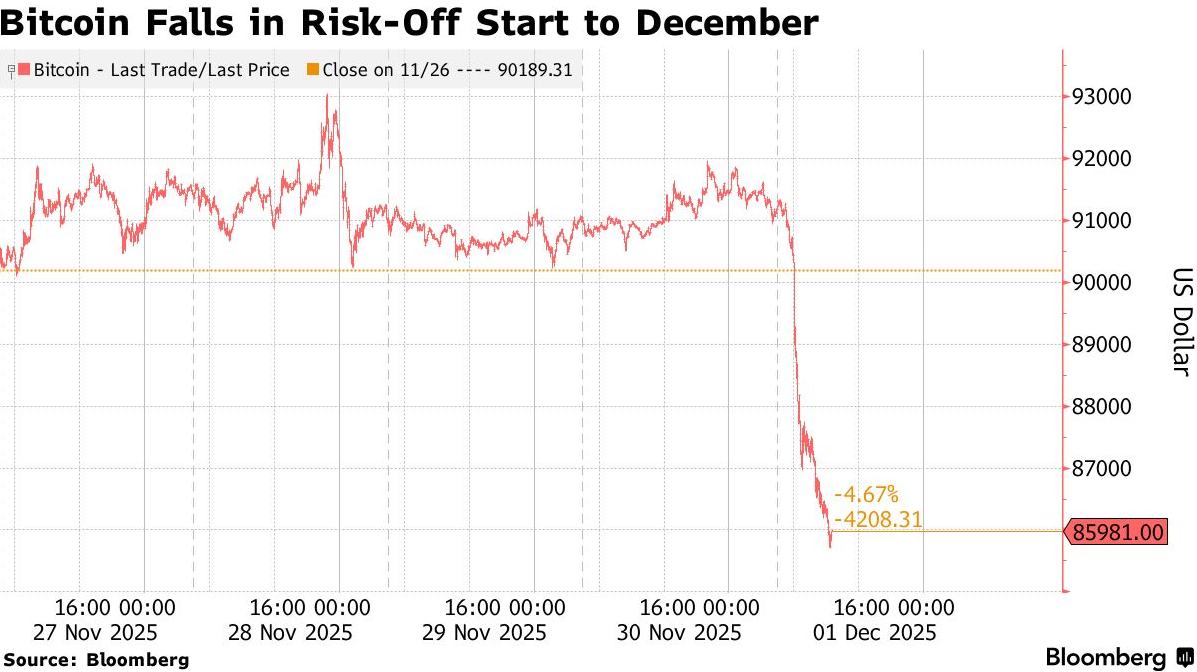
12月开局避险情绪弥漫 比特币跌超6%失守86,000美元
智通财经网· 2025-12-01 06:40
Market Overview - The cryptocurrency market experienced a significant downturn, reigniting a large-scale sell-off trend that had seemed to stabilize [1] - Bitcoin dropped over 6% during Asian trading, falling below $86,000, while Ethereum saw a decline of over 7%, reaching approximately $2,800 [1] - Most altcoins followed a similar trend, with Solana decreasing by 7.8% [1] Market Conditions - The cryptocurrency market has been unstable since early October, with a prolonged downtrend leading to the liquidation of approximately $19 billion in leveraged positions shortly after Bitcoin reached a historical high of $126,251 [4] - By November, Bitcoin's value had significantly decreased, with a drop of 16.7%, although it rebounded to above $90,000 last week due to reduced selling pressure [4] - Traders are preparing for further declines as a new wave of selling emerged [4] Key Indicators - Sean McNulty from FalconX noted a cautious outlook for December, highlighting minimal inflows into Bitcoin ETFs and a lack of buyers at lower prices, with a focus on the critical support level of $80,000 for Bitcoin [4] - Phong Le, CEO of Strategy, indicated that if the market value to Bitcoin holding ratio (mNAV) turns negative, the company may sell its Bitcoin holdings to pay dividends, with the current mNAV at 1.19 and holdings valued at $56 billion [4] Regulatory Environment - S&P Global Ratings downgraded the stability assessment of the largest stablecoin, USDT, to the lowest level, warning that a decline in Bitcoin prices could lead to insufficient collateral for the token [5] - The People's Bank of China issued a warning regarding the risks associated with virtual currencies, including stablecoins, emphasizing the need for government coordination to combat illegal activities, which adds to market uncertainty [5] Market Sentiment - Jeff Ko, Chief Analyst at CoinEx, attributed the pressure on the cryptocurrency market to a series of negative news, including the downgrade of USDT and the warning from the Chinese central bank [6] - Upcoming key economic data will provide insights into the short-term direction of the U.S. economy, influencing expectations regarding the Federal Reserve's interest rate adjustments [6]
俄乌和平推进慢,利好黄金
Sou Hu Cai Jing· 2025-11-28 09:15
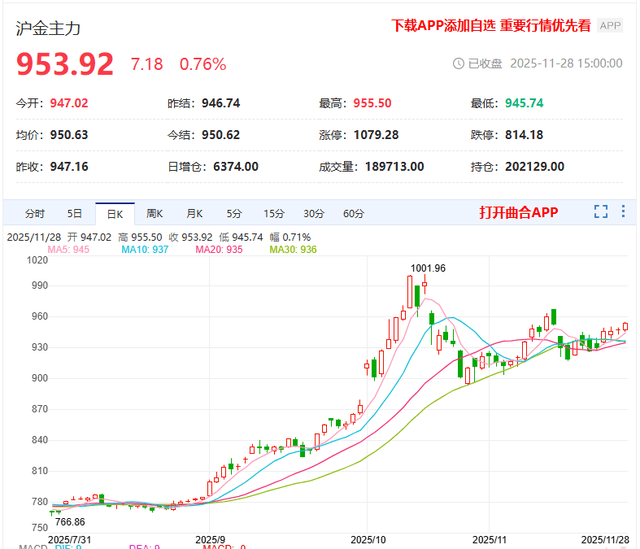
Group 1 - The likelihood of a ceasefire agreement between Russia and Ukraine in the short term is very low due to fundamental disagreements over core interests, particularly territorial and sovereignty issues [1] - Russia demands the withdrawal of Ukrainian forces from four regions and recognition of its control over these areas, while Ukraine firmly refuses to acknowledge any territorial loss [1] - Disagreements over military and alliance issues further complicate the situation, with Ukraine opposing any limitations on its military size and NATO membership, which Russia sees as essential for a ceasefire [1] Group 2 - The overall financial market continues to experience risk-averse sentiment, which is favorable for gold, as evidenced by a 0.76% increase in gold prices [2] - The U.S. economy and job market are facing challenges from government shutdowns and trade tensions, leading to increased uncertainty in monetary policy, which may drive demand for gold [4] - Historical patterns suggest that after reaching new highs, gold prices may face a 2-3 month consolidation period, with potential buying opportunities if prices drop below $3900 [5]
ATFX金属:国际白银再度逼近历史最高点54.47美元
Sou Hu Cai Jing· 2025-11-28 08:16
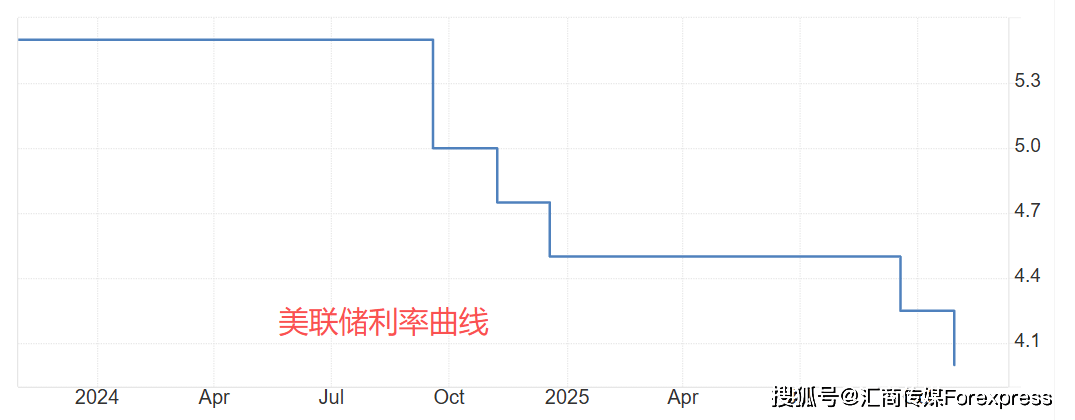
Core Viewpoint - International silver prices are approaching historical highs due to expectations of a Federal Reserve interest rate cut and escalating geopolitical tensions [1][3]. Group 1: Federal Reserve Interest Rate Expectations - The probability of a 25 basis point rate cut by the Federal Reserve in December is as high as 86.9%, with only a 13.1% chance of maintaining current rates [3]. - The FedWatch model, which predicts these probabilities, is highly sensitive to fluctuations in option prices, and the probabilities may change significantly as the December 10 rate decision approaches [3]. Group 2: Geopolitical Tensions - President Trump has indicated potential ground actions against Venezuela, which could escalate tensions in the Caribbean and drive safe-haven demand for silver and gold [3]. - The conflict between Russia and Ukraine may see a turning point, as a peace plan has gained basic acknowledgment from both President Zelensky and President Putin, which could reduce global risk aversion if the conflict ends [3]. Group 3: Technical Analysis of Silver Prices - Technically, silver is currently in a long-term upward trend, but there is uncertainty about whether the current upward wave will end soon [5]. - There is a possibility that silver may reverse after reaching the $55 resistance level, potentially forming a classic triple top pattern, which would make it more difficult to break through historical high price levels [5].
张津镭:感恩节流动性偏薄,黄金区间震荡待破
Sou Hu Cai Jing· 2025-11-28 03:55
同时,俄罗斯总统普京表示和平协议"尚无最终版本",美乌将继续磋商,但涉及领土等核心分歧仍未解 决。地缘层面呈现"进展但未落地"的状态,令避险情绪表现为"降温但未消退",对金价形成边际支撑。 来源:黄金分析师张津镭 张津镭:感恩节流动性偏薄,黄金区间震荡待破 昨日金价整体呈现窄幅震荡,与预期一致,日内波动有限。欧盘时段在约4165附近承压,按计划布局区 间空单;美盘回落至约4150附近手动止盈,小幅落袋约10余美元。此后价格围绕该区间反复,未能走出 趋势性行情,最终收于4157美元/盎司,日线收出小阴线。 周五(11月28日)亚市早盘,金价走强,盘中一度上探至约4193美元/盎司。主要驱动来自对美联储12 月降息25个基点的高概率预期,当前市场定价约为85%—86.9%,较一周前的不足40%显著抬升,压低 美元与实际利率,抬升黄金吸引力。 故日内操作上张津镭建议: 黄金:4193-4150区间操作,止损6美金,止盈30-35美金。若是突破4200关口,可回调出空做多,依次 上看。 从技术上来看,昨日黄金一直居高震荡,呈现三角震荡趋势,本应该在假期因素下继续震荡,然美联储 降息预期打破市场的平静,小时图级别行情也 ...
中加基金权益周报︱股市大跌,但债市反应钝化
Xin Lang Ji Jin· 2025-11-27 08:10
Market Overview and Analysis - The primary market saw the issuance of government bonds, local government bonds, and policy financial bonds amounting to 187 billion, 184.7 billion, and 114.9 billion respectively, with net financing of 101.6 billion, 126.7 billion, and 114.9 billion [1] - Financial bonds (excluding policy financial bonds) totaled an issuance of 206.8 billion with a net financing of 28 billion [1] - Non-financial credit bonds had an issuance of 384.6 billion and a net financing of 129.1 billion, while a new convertible bond was issued with an expected financing scale of 560 million [1] Secondary Market Review - The stock market experienced significant declines, while the bond market showed narrow fluctuations, influenced by factors such as liquidity volatility and rumors regarding mortgage interest subsidies [2] - The liquidity tracking indicated that funding rates fluctuated, with R001 down by 4.2 basis points and R007 up by 0.1 basis points compared to the previous week [2] Policy and Fundamentals - October fiscal revenue showed a clear divergence, with tax revenue increasing significantly while general fiscal expenditure saw a notable decline [3] - High-frequency data indicated weakening in both production and demand sides, with prices of food and production materials decreasing [3] Overseas Market - The non-farm payroll data for September showed mixed results, with Nvidia's earnings exceeding expectations, but the US stock market declined, leading to increased risk aversion overseas [4] - The 10-year US Treasury bond closed at 4.06%, down 8 basis points from the previous week [4] Equity Market - The A-share market weakened significantly, with the Wind All A index dropping by 5.13%, particularly affecting growth sectors [5] - Trading volume decreased, with an average daily trading volume of 1.87 trillion, down by 178.79 billion week-on-week, although there was a surge in trading on Friday due to panic selling and margin calls [5] - As of November 20, 2025, the total financing balance for the entire A-share market was 2.474 trillion, a decrease of 137.75 billion from November 13 [5] Bond Market Strategy Outlook - Given the limited risk of a significant downturn in fundamentals and the central bank's liquidity support, the short-term bond market lacks a clear direction, with the 10-year government bond expected to fluctuate within the 1.75%-1.85% range [6] - As the end of the month approaches, the bond market may operate flexibly around liquidity fluctuations and the central bank's expected bond trading volume in November, suggesting a focus on short to medium-term, high-grade credit bonds to manage risk and stabilize returns [6] - The convertible bond index is expected to experience high-level fluctuations, with a preference for a risk-reward framework to navigate the current market conditions [6]
2025年11月25日人民币兑美元汇率分析:稳定与挑战并存
Sou Hu Cai Jing· 2025-11-26 03:16
Core Viewpoint - The recent volatility of the RMB against the USD is influenced by multiple factors, including U.S. monetary policy, domestic economic recovery, and global risk sentiment. The RMB is expected to maintain a stable range in the near term, with potential fluctuations based on these influences [1][3][7]. Exchange Rate Trends - As of November 25, 2025, the RMB to USD central parity rate is reported at 7.0847, an increase of 28 basis points from the previous trading day, indicating the central bank's intention to stabilize the exchange rate [1]. - The RMB has experienced significant fluctuations over the past year, with a low of 7.25 in 2024 due to a strong USD and tightening U.S. trade policies, followed by a rapid appreciation to around 7.00 due to rising risk aversion [3]. - In 2025, the RMB's exchange rate fluctuated between a "policy floor" and a "market ceiling," with a cumulative appreciation of 0.93% for the year, reflecting a narrowing volatility range compared to previous years [3][4]. Influencing Factors - U.S. monetary policy remains a critical factor, with market predictions suggesting a potential interest rate cut by the Federal Reserve in December, which could exert downward pressure on the USD and influence the RMB [3][4]. - The pace of domestic economic recovery is also crucial, as China's GDP growth met expectations in Q3, but consumption and export recovery remain incomplete, with capital flows facing pressure [4]. - Global risk sentiment, particularly due to escalating geopolitical tensions in the Middle East, has increased demand for USD as a safe haven, putting additional pressure on non-USD currencies, including the RMB [4][6]. Future Outlook - The RMB is expected to maintain a range between 7.05 and 7.15 by the end of 2025, with the strength of the USD and the pace of domestic economic recovery being the primary influencing factors [6]. - If the Federal Reserve cuts interest rates as anticipated and the domestic economy continues to recover steadily, the RMB could potentially return to around 6.98 in 2026 [6]. - Investors should remain vigilant regarding exchange rate fluctuations, as unexpected events, such as changes in the Middle East situation or global economic uncertainties, could lead to short-term volatility [6][7].

瑞士法郎避险情绪 政策分化主导震荡
Jin Tou Wang· 2025-11-26 02:54
Core Viewpoint - The USD/CHF exchange rate is experiencing a slight decline, currently quoted at 0.8064, reflecting a 0.06% drop from the previous trading day, continuing a low-level oscillation trend over the past two weeks [1] Group 1: Market Dynamics - The USD/CHF pair has seen a significant pullback since its peak in October, currently situated in a low-level oscillation range, with ongoing tug-of-war between bulls and bears [1] - Geopolitical tensions in the Middle East are increasing, providing support for the Swiss Franc as a safe-haven currency, while a rebound in the US stock market has somewhat suppressed its safe-haven appeal [1] Group 2: Central Bank Policies - Divergence in central bank policies remains a key driver, with high expectations for a Federal Reserve rate cut in December putting pressure on the USD index and limiting its upward potential [1] - The Swiss National Bank maintains a neutral stance, having paused interest rate hikes but remains cautious of excessive appreciation of the Swiss Franc, with a high threshold for reintroducing negative interest rates, which supports the Franc [1] - Switzerland's trade surplus expanded to 3.2 billion Swiss Francs in October, contributing to the underlying strength of the Swiss Franc [1] Group 3: Technical Analysis - Short-term market expectations are focused on consolidation, with key technical support around the 0.8060 range and the psychological barrier at 0.8000 seen as a potential intervention point for the Swiss National Bank [2] - Resistance is concentrated in the 0.8086-0.8090 range, which needs to be breached to open up upward movement [2] - Future tracking of US non-farm payrolls, inflation data, and geopolitical developments will be crucial as these factors may catalyze a breakout from the current oscillation range, with investors advised to be cautious of short-term volatility risks following data releases [2]
美元指数缺乏持续走强动能
Qi Huo Ri Bao· 2025-11-26 01:42
Core Viewpoint - The strengthening of the US dollar index is primarily supported by external factors, including the weakening of non-US currencies and a temporary alleviation of employment concerns [6]. Group 1: Factors Supporting Dollar Strength - The collective weakening of non-US currencies has provided passive support for the dollar index, with the Japanese yen and British pound both under pressure due to respective economic conditions and policy decisions [1]. - Expectations for interest rate cuts have cooled, reinforcing the resilience of the dollar. Despite a rate cut in October, hawkish signals from the Federal Reserve have led to a significant reduction in the market's expectations for further cuts in December [2]. - The pause in the release of key economic data due to the government shutdown has alleviated short-term employment concerns, with recent ADP employment data showing marginal improvement, thus supporting the dollar index [3]. Group 2: Additional Supporting Factors - Concerns regarding the independence of the Federal Reserve have temporarily eased, following the Supreme Court's decision to hear a case related to potential dismissals within the Fed, which has calmed market fears [5]. - Increased risk aversion has driven demand for the dollar as a safe-haven asset, particularly following a pullback in US tech stocks and tightening liquidity conditions [5]. Group 3: Limitations on Future Dollar Strength - The risks in the employment market have not fundamentally eased, with key employment data yet to be released, and the potential for downward revisions in previously reported job numbers [7]. - There remains room for a return to rate cut expectations, particularly if a dovish candidate is appointed as the next Fed chair, which could negatively impact the dollar index [7]. - The support from non-US currencies is not robust, as the Japanese yen's depreciation may prompt government intervention, which could weaken its support for the dollar index [7]. - Technical resistance is evident near the 100-point mark for the dollar index, requiring additional positive factors for further upward movement [7]. Group 4: Short-term Outlook - In the short term, the dollar index is expected to maintain a high-level oscillation, with upcoming employment data and the appointment of a new Fed chair candidate serving as critical tests for its resilience [8].